
学术出版

Search documents
细胞出版社2024中国年度论文奖重磅公布:十年见证中国科研前进之路!
生物世界· 2025-11-19 04:04
Core Insights - The article highlights the significant growth of Chinese researchers' publications in Cell Press journals over the past decade, showcasing advancements in originality, systematic approaches, and openness in Chinese scientific research [2][48]. - In 2024, the total number of research papers published by Chinese institutions in Cell Press journals reached a record high of 2,446, marking a 17.6% increase from the previous year and nearly quadrupling the output from 2020 [3][14]. Publication Growth - The number of papers published in the life sciences field by Chinese scholars was the highest in 2024, totaling 860 papers, with the medical field showing the most notable growth, increasing by 138 papers [6]. - The journal Cell Reports Medicine saw the number of Chinese papers surpass 100 for the first time, while materials science and interdisciplinary fields also experienced steady growth, reaching 554 and 394 papers, respectively [6]. Journal Performance - In 2024, 18 hybrid journals under Cell Press reported growth in the number of Chinese publications, with Joule and Device in materials science showing the highest increases of 32 and 31 papers, respectively [7]. - The medical journal Med saw a remarkable increase, with a total of 32 papers published, reflecting a 2.5-fold increase from the previous year [7]. Open Access Trends - The proportion of papers published in open access (OA) format by Chinese scientists in Cell Press journals approached three-quarters of all Chinese publications, totaling 1,761 papers, which is a 13% increase from the previous year [10]. - The number of OA papers published in hybrid journals rose from 69 to 119, marking a 72.5% increase, indicating a growing commitment to open access among Chinese researchers [11]. Annual Paper Awards - The 2024 Cell Press Annual Paper Awards recognized 50 outstanding papers across five fields, with an additional 25 papers voted as the most popular by the public [14]. Research Institution Landscape - In 2024, the number of Chinese institutions publishing in Cell Press journals exceeded 300 for the first time, with a notable increase of 40 institutions from the previous year [32]. - Sun Yat-sen University led in publication volume with 113 papers, followed by Shanghai Jiao Tong University and Zhejiang University with 106 and 105 papers, respectively [32]. Regional and International Collaboration - Beijing remained the leading region for publications with 442 papers, followed by Guangdong and Shanghai [38]. - The number of countries and regions collaborating with Chinese scholars reached 76, reflecting a 20.6% increase, with the United States being the most frequent collaborator [43][47].


Cell Press“年度最受欢迎中国论文”投票开启!中国科学家“代表作”由你决定!
生物世界· 2025-10-24 04:04
Core Points - The article highlights the 10th anniversary of the collaboration between Chinese scientists and Cell Press, showcasing over 2400 original research papers published in various fields, indicating a significant growth in China's scientific contributions on the international stage [2] - The voting event for the "2024 Most Popular Chinese Papers" has commenced, encouraging readers to participate and support their favorite research papers [2][3] - The voting process is designed to foster resonance among researchers, allowing them to express appreciation for impactful discoveries or support esteemed scholars [2] Summary by Categories Life Sciences - The article mentions that the voting will cover five major fields, including life sciences, where impactful papers will be recognized [2][8] Material Sciences - The article lists several nominated papers in material sciences, emphasizing innovative research contributions from Chinese institutions [12] Medical Sciences - Notable medical research papers are highlighted, showcasing advancements in cancer treatment and public health studies [14] Cross-Disciplinary Sciences - The article includes nominations from cross-disciplinary research, reflecting the integration of various scientific fields [16] Sustainable Development - Papers related to sustainable development are also nominated, focusing on environmental health and carbon neutrality efforts in China [18]

让论文引用量和影响力翻倍,开放获取(OA)出版还有这么多优势?
生物世界· 2025-10-23 04:13
Core Viewpoint - Springer Nature is committed to making research results immediately accessible, shareable, and reusable to promote scientific discovery, emphasizing the importance of Open Access (OA) in democratizing knowledge and innovation [2]. Group 1: Open Access Overview - Open Access refers to the free, immediate, and online availability of research outputs, allowing anyone to access and utilize these results without any access fees [3]. - The article highlights the difference between subscription-based publishing and Open Access publishing, where in subscription models, costs are covered by subscription fees, while in Open Access, authors or their funders pay Article Processing Charges (APC) [6][7]. Group 2: Benefits of Open Access - Open Access articles have higher visibility and citation rates compared to subscription-based articles, leading to greater usage and downloads [11]. - Open Access facilitates broader audience reach, allowing users who cannot access subscription content to easily access OA research [11]. - It enhances interdisciplinary dialogue and collaboration opportunities among researchers globally [11]. - Open Access publications comply with major international funding policies, promoting adherence to open access regulations [11]. Group 3: Springer Nature's OA Journals - Springer Nature offers approximately 700 pure OA journals, which provide significant benefits to authors, including increased usage and download rates compared to traditional publishing [13]. - The company publishes over 2,200 hybrid journals, allowing authors to choose Gold Open Access for their submissions [14]. Group 4: Publishing Process and Integrity - The publishing process for OA and hybrid journals maintains the same high standards, with similar acceptance rates and rigorous peer review [18]. - Springer Nature emphasizes research integrity throughout the publishing process, collaborating with over 174,000 external academic editors and 1.2 million independent peer reviewers to ensure quality [19]. - In 2024, the company received over 2.3 million submissions, with only 482,000 articles published, reflecting a commitment to publishing high-quality research [19].

Springer Nature上线中文版OA内容中心!探索700+OA期刊,3000+OA图书…
生物世界· 2025-09-26 04:06
Core Viewpoint - Open Science promotes faster and more sustainable scientific development, with Open Access serving as its foundation, providing researchers with increased visibility and collaboration opportunities [2][3]. Group 1: Open Science and Open Access - Open Science is defined as transparent, trustworthy, and accessible science that can be reused and referenced by everyone [2]. - Open Access publishing offers significant benefits, including greater citation advantages, increased usage, and broader impact for research [2]. Group 2: Springer Nature's Open Access Initiatives - Springer Nature offers over 700 pure Open Access journals and more than 2,200 hybrid journals, along with over 3,300 Open Access books, supporting researchers in sharing data and gaining recognition [3]. - The Open Access Content Hub provides resources on Open Science, Open Access journals, books, data, and agreements, allowing users to explore various topics of interest [5][6]. Group 3: Open Access Publishing Options - The Open Access publishing portfolio includes high-impact journals under brands like BMC, Nature Portfolio, Springer, Discover, and Palgrave Macmillan [8]. - Springer Nature has pioneered Open Access book publishing across various fields, including science, technology, medicine, humanities, and social sciences [10]. Group 4: Open Data and Agreements - Springer Nature supports researchers in sharing data and gaining recognition through access to subject repositories, research data courses, and community engagement [13]. - Since 2015, Springer Nature has led the development of transformative agreements, providing Open Access publishing support to researchers from over 3,700 institutions globally [15].
明日开幕!学术盛会即将启幕,共绘全球合作蓝图
Sou Hu Cai Jing· 2025-08-22 15:01
Group 1 - The twelfth IPP International Conference will focus on the theme of modernization in China and the Global South, scheduled for August 23, 2025, in Guangzhou [2][19] - The conference theme arises from significant trends in the international political and economic landscape, including the restructuring of the global economic order due to the tariff plan introduced by the Trump administration in April 2025 [2] - There is a critical need for structural adjustments in China's economic development, alongside the profound impact of emerging technologies like artificial intelligence on production relations [2][3] Group 2 - The international community is seeking new paths to modernization centered on the experiences of the Global South, moving beyond the binary opposition of the "Washington Consensus" and "Beijing Consensus" [3] - The conference aims to explore how the Global South can achieve consensus and unity to reshape the world order, especially in the context of slowing and fragmenting globalization [3] - The accumulated modernization experiences of Global South countries may provide new ideas and solutions for global development through re-conceptualization [3]
脱碳技术由中国主导
日经中文网· 2025-08-22 08:00
Group 1 - The core viewpoint of the articles highlights China's significant advancement in climate change research, surpassing the United States in both the number of published papers and citation quality [2][5][7] - In 2023, Chinese research institutions published approximately 14,000 papers related to climate change, exceeding the United States' 13,000 papers, marking a shift in global research leadership [5][7] - The global publication of climate change-related papers is projected to reach around 77,000 in 2024, with China contributing about 17,000 papers, accounting for 20% of the total [5] Group 2 - China's electric vehicle (EV) global sales share reached 55% as of Q4 2024, leading the market, with steady growth in Europe and Asia [5] - The domestic installed capacity of solar and wind power in China reached 50% in 2023, surpassing traditional coal power, indicating a significant shift towards decarbonization [5] - The Chinese leadership has set the "3060 goal," aiming for carbon emissions to peak by 2030 and achieve carbon neutrality by 2060, reflecting a strong commitment to climate action [7] Group 3 - The role of China in the Intergovernmental Panel on Climate Change (IPCC) is increasing, with Chinese representatives being appointed to key positions, such as co-chairing working groups on climate warming assessments [7] - The United States has shown a declining commitment to climate change research since the Trump administration, proposing significant budget cuts for related agencies [8]

精准选刊不踩坑!Springer Nature旗下OA期刊+全新指标解析,助你提升学术影响力!
生物世界· 2025-08-22 04:15
Core Viewpoint - Springer Nature offers a comprehensive portfolio of open access (OA) journals, providing authors with high-impact publishing options and increased citation opportunities for their research [3]. Group 1: OA Journal Portfolio - Springer Nature has approximately 700 pure OA journals, with 2023 OA articles averaging 6.3 citations each, surpassing industry peers [3]. - Over 500 pure OA journals have an impact factor (IF), with 62% of these journals showing growth in their IF [4]. - 309 pure OA journals are ranked in Q1 across various disciplines, representing 57% of the total [4]. - 450 pure OA journals are in the top 50 of their respective fields, accounting for 83% [4]. - 106 pure OA journals are in the top 10 of their fields, including notable journals like Signal Transduction and Targeted Therapy [4]. Group 2: Historical Context and Development - Springer, founded in 1842, is a renowned publishing brand in science, technology, medicine, humanities, and social sciences, with over 2000 mixed and OA journals [5]. - BMC, a pioneer in OA publishing, has around 300 peer-reviewed OA journals focused on advancing biological, health, and medical sciences [7][8]. Group 3: Specific Journal Highlights - The Discover journal series aims to support rapid publication of research across various scientific fields, targeting a publication timeline of 7-10 weeks [14]. - Nature Partner Journals (npj) collaborate with global scientists and institutions to publish high-quality OA research in diverse scientific areas [19]. - The Communications series under Nature Portfolio emphasizes diverse community engagement and aims to publish research that brings new insights to its fields [23]. - Nature Communications, a highly selective multidisciplinary OA journal, has an impact factor of 15.7 and a total citation count of 911,428 for 2024 [30]. - Scientific Reports, another multidisciplinary OA journal, has an impact factor of 3.9 and a total citation count of 834,622 for 2024 [34]. - Humanities and Social Sciences Communications provides a rigorous platform for research in the humanities and social sciences, with an impact factor of 3.6 for 2024 [35].

理性之上,重新审视科学的认知“盲点” | 红杉Library
红杉汇· 2025-08-22 00:07
Core Concept - The article discusses the concept of "blind spots" in both vision and scientific understanding, emphasizing that humans often overlook evident truths due to cognitive biases, which shape their perception of modern science [3][6][8]. Group 1: Understanding Science - Science has become an indispensable cognitive tool in daily life, necessitating awareness of inherent "blind spots" and the historical context of scientific discourse [6]. - Different attitudes towards science exist, with some viewing it as an endless potential for discovery, while others caution against its rapid development, suggesting a need for reevaluation to prevent irreversible harm to society and the environment [6][7]. - The authors of "What is Science" diagnose a crisis in modern science, attributing it to the adoption of a "blind spot" worldview that obscures the true nature of scientific inquiry [6][8]. Group 2: Limitations of Modern Science - Modern science, while rooted in human subjective experience, is increasingly distancing itself from direct experience, leaning towards mathematical abstraction [7]. - The limitations of modern science are highlighted in addressing complex global challenges such as climate change, habitat destruction, and emerging diseases, revealing the inadequacies of abstract theories in practical applications [7][8]. - The authors argue that the over-reliance on abstract theories has hindered humanity's ability to effectively address real-world issues [7][8]. Group 3: The Nature of Scientific Inquiry - The book emphasizes that science is a product of human experience, and the process of refining this experience has led to a perception of scientific authority [8]. - The authors critique the reductionist view in life sciences, advocating for a holistic understanding of life that acknowledges its dynamic and autonomous nature [11]. - The final sections of the book reflect on the impact of the "blind spot" worldview on environmental issues, linking it to global crises like climate change and pandemics [11][12]. Group 4: Overcoming Blind Spots - The authors propose that recognizing the existence of blind spots is the first step towards overcoming them, advocating for a rejection of errors that neglect human experience [12]. - They do not dismiss the value of science or abstract thinking but criticize the philosophical bias that leads to overlooking human experience [12].

2025中国科技期刊发展论坛举办 发布“学术科协”平台
Huan Qiu Wang Zi Xun· 2025-07-11 06:38
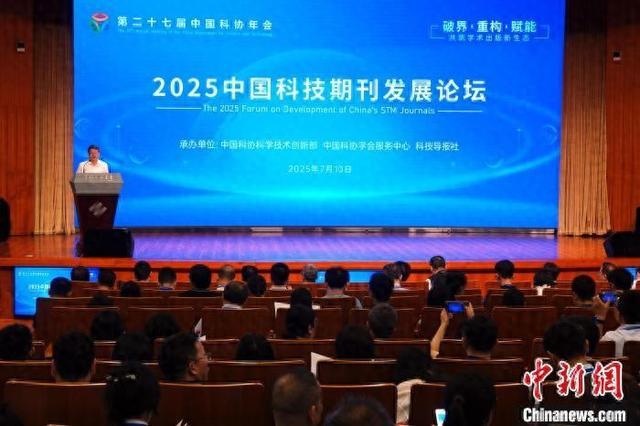
Group 1 - The 2025 China Science and Technology Journal Development Forum was held in Beijing, focusing on the theme "Breaking Boundaries, Restructuring, Empowering - Building a New Ecology of Academic Publishing" [1][8] - The forum included keynote reports and four thematic discussion panels, covering topics such as enhancing journal quality through platform support, constructing an independent evaluation system for journals, and building first-class journals [1][8] - The "Academic Association" platform was launched at the forum, aiming to integrate resources and provide comprehensive services for journal publishing and academic integrity monitoring [5][7] Group 2 - Keynote reports were presented by prominent figures, including the Vice Chairman of the China Association for Science and Technology and editors from various scientific journals, discussing the role of journals in industrial innovation and the impact of AI on academic platforms [3][5] - The forum is part of the "China Science and Technology Journal Excellence Action Plan," which aims to enhance the academic quality and influence of journals, as well as promote independent publishing and data platform development [8]
自然指数2025科研领导者榜单:中国保持第一
Xin Hua She· 2025-06-11 14:55
Core Insights - China continues to lead in scientific research output, expanding its advantage according to the Nature Index 2025 Research Leaders list [1][2] - The data reflects a significant shift in the global research landscape, with China's sustained investment in technology translating into rapid growth in high-quality research output [2] Summary by Categories Research Output - China's share in the Nature Index reached 32,122, a year-on-year increase of approximately 17% [1] - The United States follows with a share of 22,083, while Germany, the UK, Japan, and France also rank among the top contributors [1] Institutional Rankings - Among the top ten global institutions, eight are Chinese, with the Chinese Academy of Sciences ranked first [1] - Other notable Chinese institutions include the University of Science and Technology of China (3rd), Zhejiang University (4th), Peking University (5th), and Tsinghua University (7th) [1] Regional Trends - Asian countries are strengthening their positions, with South Korea rising to 7th place, surpassing Canada [1] - India remains in 9th place, while Western countries have seen a decline in their adjusted shares for the second consecutive year, with decreases of at least 7% for Canada, France, Switzerland, the UK, and the US [1]