旅游科技

Search documents
飞道旅游科技(08069.HK)盈警:预计中期录得亏损净额增加约550%
Ge Long Hui· 2025-11-12 09:33
Group 1 - The core point of the article is that Feidao Tourism Technology (08069.HK) has announced an expected increase in net loss for the six months ending September 30, 2025, by approximately 550% compared to a net loss of about HKD 588,000 for the six months ending September 30, 2024 [1]
飞道旅游科技发盈警 预计中期亏损净额增加约550%
Zhi Tong Cai Jing· 2025-11-12 09:17
Core Viewpoint - Feidao Tourism Technology (08069) anticipates a significant increase in net losses for the six months ending September 30, 2025, projected to rise by approximately 550% compared to a net loss of about 588,000 HKD for the six months ending September 30, 2024, primarily due to unfounded disaster rumors related to a predicted large-scale earthquake in Japan [1] Group 1 - The main reason for the increased losses is the panic among tourists triggered by a manga artist's prediction of a catastrophic event in Japan in July 2025, which has led to widespread fear and calls for travelers to cancel or postpone their trips [1] - The prediction includes potential disasters such as earthquakes and tsunamis, significantly impacting travel bookings, especially from Hong Kong [1] - The situation has resulted in some Hong Kong airlines reducing or canceling flights between Hong Kong and Japan due to the decline in travel demand [1] Group 2 - Japan is a key destination for the company's outbound tourism, and the rumors have severely affected bookings for travel groups during the peak summer months of July and August [1] - Both revenue and gross profit are expected to decline sharply for the six months ending September 30, 2025, due to the impact of these rumors [1] - Despite the unfounded nature of the earthquake prediction and the subsequent confirmation that it is false, management remains confident in the eventual recovery of the Japanese tourism industry and believes that outbound tourism, sightseeing, and hotel businesses will thrive [1]
AI如何将旅游业推向“价值奇点”?比利信息从“西湖+”实践开始
3 6 Ke· 2025-11-06 09:49
Core Insights - The tourism technology innovation over the past decade has primarily focused on pre-trip planning, but the rise of generative AI and multimodal technologies indicates that the real challenge lies in enhancing the fragmented, real-time experiences during the trip [1][4] - The role of AI in the tourism industry is shifting from being a decision-support tool to an intelligent operational entity that can actively recognize scenarios and trigger experiences, thus driving commercial growth [1][11] Company Developments - The travel recommendation AI project "Pao Pao Ai Travel" by Bili Information is currently in the business expansion phase, with plans to launch in Hangzhou's West Lake Scenic Area in 2024, aiming to integrate scenic area operations, user experience, and commercial monetization [2][4] - Bili Information is exploring new locations for expansion, with Chengdu being a primary candidate due to its vibrant digital economy and rich cultural tourism resources [1][2] Technological Innovations - The AI travel intelligent system focuses on real-time recommendations based on the tourist's location, weather changes, and personal preferences, utilizing a combination of maps and camera inputs [4][6] - The system can provide context-aware suggestions, such as sending cold drink coupons during hot weather or activating voice guides when tourists are near popular spots, thus enhancing the travel experience [6][11] Business Model Transformation - The traditional ticketing model is evolving, with tickets being redefined as "experience entry points" that combine cultural experiences and services, thereby increasing visitor engagement and generating new revenue streams for scenic areas [7][9] - The introduction of the RaaS (Result as a Service) model allows for a partnership where the AI system's success is tied to sales performance, transforming the relationship between technology providers and scenic areas into a collaborative growth model [10][11] Industry Implications - The tourism industry is transitioning from static displays to intelligent operations, with AI enabling a real-time feedback loop among content, traffic, and supply, leading to dynamic management of scenic areas [11][13] - The core competitive advantage of AI will increasingly depend on its ability to understand human behavior and generate operational actions in real-time, marking a shift from resource-driven to data-driven strategies [11][13]


启点创新旅游管理系统 四川旅游景区票务系统 西昌售检票系统升级解决方案
Sou Hu Cai Jing· 2025-11-04 14:45
Core Insights - The article discusses the upgrade solution for ticketing systems in Sichuan tourism, focusing on "omni-channel seamless connection, intelligent ticket verification, data-driven operations, all-scenario consumption coverage, safety assurance, and ecological collaboration" to facilitate digital transformation and sustainable development in scenic areas Omni-Channel Ticketing - The solution supports 12 types of purchasing channels, including official websites, mini-programs, OTA platforms, and self-service kiosks, achieving a seamless integration of online, offline, and self-service options. For instance, a provincial science museum saw its window ticket sales drop from 70% to 15%, with online ticket conversion rates reaching 92% [2] - Diverse ticket options such as single park tickets, multi-park tickets, time-reserved tickets, and family packages cater to various customer needs, leading to a 35% revenue increase during non-peak hours for a scenic area that introduced a "early bird ticket + cable car discount" combination [3] Intelligent Ticket Verification - The system integrates multi-modal verification technologies, allowing for quick verification within 0.3 seconds and accommodating over a thousand visitors per hour. For example, a scenic area reduced queue times from 25 minutes to 5 minutes, resulting in a 60% decrease in complaints [5] - AI visual technology significantly reduced the fake ticket rate from 5% to 0.1% and improved resource utilization by 55% in a comprehensive sports venue [6] Data-Driven Operations - Dynamic pricing strategies based on seasonal factors and visitor capacity led to a 30% increase in daily ticket revenue for a water park that introduced "peak limit tickets" [7] - The system predicts visitor flow with 90% accuracy, allowing for dynamic resource allocation and saving over 5 million yuan in annual operating costs for a scenic area [8] All-Scenario Consumption Coverage - The "one code travel" model allows visitors to use electronic vouchers for various services within the scenic area, increasing per capita spending by 42% in Zhangjiajie [10] - A points system enhances customer loyalty, with a water park reporting a 30% increase in member repurchase rates [11] Safety Assurance and Ecological Collaboration - The system employs a zero-trust security architecture to safeguard against risks, ensuring business continuity through a dual-active data center setup [13] - The integration of local businesses into the data platform has led to a 50% revenue increase for surrounding merchants [14] Application Outcomes - Operational efficiency improved by over 60%, with a 15%-20% reduction in labor costs. For example, a scenic area saved over 5 million yuan in annual operating costs through dynamic resource scheduling [15] - Visitor satisfaction increased from 82% to 95%, with repeat visit rates rising by 18% due to reduced waiting times [15] - Revenue growth was notable, with dynamic pricing strategies boosting off-peak ticket sales and cross-industry resource collaboration leading to a 90% increase in secondary consumption [15]

驴迹科技(01745) - 自愿公告 - 潜在业务更新
2025-10-14 10:17
香港交易及結算所有限公司及香港聯合交易所有限公司對本公告的內容概不負 責,對其準確性或完整性亦不發表任何聲明,並明確表示,概不對因本公告全部 或任何部份內容而產生或因倚賴該等內容而引致的任何損失承擔任何責任。 Lvji Technology Holdings Inc. 驢跡科技控股有限公司 (於開曼群島註冊成立的有限公司) (股份代號︰1745) 自願公告 本 公 告 由 驢 跡 科 技 控 股 有 限 公 司(「本公司」,連 同 其 附 屬 公 司 統 稱「本集團」)自 願作出。 為 響 應 文 化 消 費 升 級 趨 勢 並 推 動 本 集 團 業 務 多 元 化 發 展,本 集 團 擬 以「文 旅 知 識 產權+黃金產業」的合作模式開展新業務線,打造具備差異化特色的產品線。據此, 本 公 司 董 事(「董 事」)會(「董事會」)欣 然 宣 佈,在 本 集 團 現 有 主 營 業 務 的 基 礎 上, 本 公 司 正 考 慮 於 香 港 成 立 一 家 全 資 附 屬 公 司(「該附屬公司」),通 過「直 營 旗 艦 店 +全 國 連 鎖 加 盟 店」的 經 營 模 式 從 事 黃 金 製 品 銷 售 業 ...
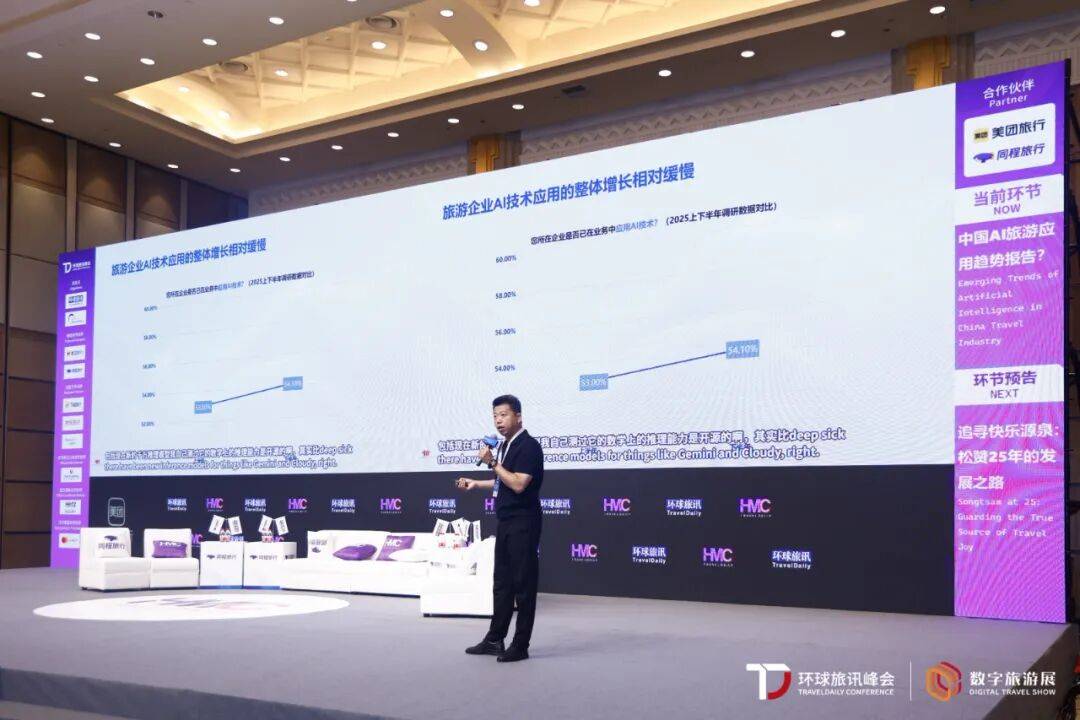
中国AI旅游应用分化加剧:谁在领跑?谁陷停滞?
Sou Hu Cai Jing· 2025-10-06 02:30
Core Insights - The application of AI in China's tourism industry is evolving from conceptual discussions to practical implementations, significantly transforming operational methods for both travelers and tourism companies [2][3] - A report presented at the 2025 Global Travel Summit highlights the challenges and trends of AI adoption within tourism enterprises, emphasizing the role of grassroots employees over CEOs in driving AI integration [4][5] AI Adoption Trends - In the first half of 2024, 53% of surveyed companies reported using AI, with a slight increase to 54.1% in the second half, indicating a slow adoption rate in B2B contexts despite frequent media coverage of new models [5][6] - Large enterprises (1,000+ employees) saw a decline in AI usage from 80.6% to 74.4%, while medium-sized enterprises (200-500 employees) increased their usage from 38.5% to 53.3% [6][7] Sectoral Disparities - The AI application rates among tourism companies show a clear three-tier differentiation: - The first tier includes technology-intensive sectors like airlines, which have a high AI penetration rate - The second tier consists of business travel companies and travel tech firms, known for their quick adoption of new technologies - The third tier includes OTAs, tourism boards, and scenic spots, which are lagging behind [7][8][9] Organizational Challenges - Despite individual employees using AI, many companies have not established end-to-end AI workflows, indicating a gap in organizational integration [11] - Over 50% of companies believe that external policies and market conditions significantly impact AI technology applications, highlighting the uncertainty in the current environment [12] Application Focus - 76.3% of companies are prioritizing AI for internal operational efficiency, although some application rates, such as store management and personalized recommendations, have decreased due to perceived cost-benefit issues [12][13][14] - A significant portion of companies (46.8%) believes AI will mature within one to two years, reflecting an overly optimistic outlook on AI capabilities [16][18] Key Recommendations for AI Integration - Companies need to redefine their understanding of generative AI, moving beyond viewing it as a mere IT project aimed at replacing human roles [19] - Successful AI implementation requires overcoming three capability bridges: organizational questioning ability, data leadership, and human-machine collaboration [19][20] - Establishing dedicated AI project management offices and cultural performance metrics can facilitate better integration of AI into business processes [20][23]
把我的第一次日本旅行,完全交给AI是什么体验?
3 6 Ke· 2025-10-02 01:10
Core Insights - The article explores the potential and limitations of AI travel assistants, highlighting that while they can provide useful travel plans, they still fall short of fully replacing human travel guides [2][30]. Group 1: AI Travel Assistant Experience - The AI travel assistant app, which generates travel itineraries and assists with bookings, shows promise but lacks the personalization and depth of human-created plans [2][4][29]. - The app's ability to create detailed itineraries is noted, including daily plans, dining options, and budget allocations, but users still need to make significant personal adjustments [10][14][16]. - The experience of using AI for travel planning reveals a gap in trust and personalization, as users often prefer the context built through traditional planning methods [19][29]. Group 2: Language and Booking Challenges - The AI assistant's language translation capabilities were found to be less effective in real-time communication, highlighting the need for more seamless interaction tools [20][28]. - The most valuable feature identified was the AI's ability to make phone reservations at restaurants, addressing a common pain point for travelers with language barriers [22][30]. - Despite some functionalities being less efficient than traditional methods, the AI's ability to handle reservations demonstrates its potential to bridge the gap between digital information and real-world actions [25][30]. Group 3: Future of AI in Travel - The article suggests that the future of AI in travel lies not just in generating plans but in facilitating real-world actions for travelers, moving beyond mere information provision [30][31]. - The development of AI travel applications is seen as a significant improvement over previous iterations, making travel without extensive planning a more viable option [31][32]. - The exploration of AI's role in travel is ongoing, with potential for further innovations that enhance the travel experience by addressing practical challenges faced by travelers [31].

飞道旅游科技(08069.HK)与正天订立物业租赁协议
Ge Long Hui· 2025-09-30 10:05
Core Viewpoint - Feidao Tourism Technology (08069.HK) has entered into a property leasing agreement with Zheng Tian for office space in Hong Kong, effective from October 1, 2025, to March 31, 2027 [1] Group 1 - The lease agreement allows either party to terminate the contract with a written notice of at least 30 days at any time during the lease term [1] - The tenant does not have the right to renew the lease agreement [1]
飞道旅游科技与正天订立物业租赁协议
Zhi Tong Cai Jing· 2025-09-30 09:58
Core Viewpoint - The company, Feidao Tourism Technology (08069), has entered into a property lease agreement with Zheng Tian (Zheng Tian Investment Limited) for office space in Hong Kong, ensuring operational stability and aligning with the interests of the company and its shareholders [1] Group 1: Lease Agreement Details - The lease agreement is set to commence on October 1, 2025, and will run until March 31, 2027 [1] - Either party can terminate the lease with a written notice of at least 30 days at any time during the lease term, and the tenant does not have the right to renew the lease [1] - The leased property is located at Room 706-708, 7th Floor, Lippo Sun Plaza, 28 Canton Road, Tsim Sha Tsui, Hong Kong [1] Group 2: Operational Considerations - The property has been occupied by the company since 2016 for its office needs [1] - The board of directors, including independent non-executive directors, believes it is appropriate to continue using the leased property as the company headquarters and office to maintain stable operations [1] - The decision is based on considerations of comparable office rental rates in the vicinity and potential relocation costs if the company were to move out [1]
马蜂窝亮相骁龙峰会 展示智能体AI旅行合作成果
Jing Ji Guan Cha Wang· 2025-09-26 12:38
Core Insights - The 2025 Snapdragon Summit in China showcased the collaboration between Mafengwo and Xiaomi, highlighting advancements in AI applications for the travel sector [2] - The new Snapdragon platform offers breakthroughs in AI computing, energy efficiency, and multimodal interaction, supporting local large model operations and real-time applications [2] - The integration of Mafengwo's travel industry expertise with Xiaomi's technology creates a comprehensive service chain from data perception to personalized services [2] Group 1 - The Snapdragon platform enhances AI capabilities for mobile devices, shifting focus from parameters to scenario-based service improvements [2] - Mafengwo's travel research director demonstrated an AI itinerary planning feature that intelligently organizes travel schedules based on user availability and local data [2] - The collaboration leverages multiple technologies, including travel knowledge graphs and enhanced retrieval systems, to provide a one-stop service from pre-trip planning to in-trip recommendations [2]