
服务型制造

Search documents
发展具有中国特色的服务型制造
Jing Ji Ri Bao· 2025-10-16 22:14
Core Viewpoint - The Ministry of Industry and Information Technology and six other departments have issued the "Implementation Plan for Deepening the Innovation and Development of Service-Oriented Manufacturing (2025-2028)", aiming to enhance the role of service-oriented manufacturing in high-quality development by 2028 [1] Group 1: Service-Oriented Manufacturing - Service-oriented manufacturing is defined as a new industrial form that deeply integrates manufacturing and services, focusing on embedding services throughout the product lifecycle and reshaping the value chain [1][2] - The shift from merely selling products to providing services is emphasized, highlighting the importance of value creation and customer satisfaction in the competitive landscape of manufacturing [1][2] Group 2: Characteristics and Advantages - Service-oriented manufacturing is characterized by a customer demand-driven approach, contrasting with traditional manufacturing that produces first and seeks markets later [2] - The integration of digital and intelligent technologies is crucial for developing a service-oriented manufacturing system in China, addressing issues like supply-demand mismatches and inefficiencies [2][3] Group 3: Shared Manufacturing Model - Shared manufacturing, a model based on the sharing economy, utilizes internet platforms to integrate idle manufacturing resources, providing low-cost access to technology and resources for small and medium-sized enterprises [3] - This model enhances the resilience and flexibility of supply chains, catering to the diverse and personalized demands of consumers in China's vast market [3] Group 4: Regional Focus and Innovation - The development of service-oriented manufacturing should be anchored in local market demands and leverage regional advantages, with different areas focusing on their unique industrial strengths [3] - Encouraging local innovation and specialization can lead to the establishment of service-oriented manufacturing innovation hubs across various regions [3] Group 5: Global Competitiveness - The service-oriented manufacturing model aims to not only be rooted in China's industrial system but also to compete at a global level, reshaping China's manufacturing advantages in the global value chain [4]
深入推动服务型制造创新发展 加快建设现代化产业体系
Jin Rong Shi Bao· 2025-10-14 02:07
Core Viewpoint - The Ministry of Industry and Information Technology, along with six other departments, has issued the "Implementation Plan for Promoting the Innovative Development of Service-Oriented Manufacturing (2025-2028)", aiming to enhance service-oriented manufacturing by 2028 through the establishment of standards, leading brands, and innovation hubs [1][3]. Development Goals - By 2028, the role of service-oriented manufacturing in high-quality development of the manufacturing sector is expected to be significantly enhanced, with 20 standards established, 50 leading brands created, and 100 innovation hubs built [3]. - The plan aims for widespread adoption of typical service-oriented manufacturing models and continuous emergence of new models, optimizing the industrial ecosystem and promoting rapid development of productive services in key areas [3]. Main Tasks - Strengthening key common technology research and model innovation, including the release of a key technology list and upgrading typical models [4]. - Cultivating and expanding key productive services, such as technology services, industrial design, software and information services, and financial services [4]. - Promoting the application of service-oriented manufacturing models across various industries and sectors, enhancing the integration of service elements into manufacturing [4]. - Accelerating the construction of a comprehensive and coordinated standard system for service-oriented manufacturing [4]. - Stimulating the vitality of business entities by nurturing leading enterprises and creating a new development pattern for businesses of all sizes [4]. - Establishing innovation development hubs for service-oriented manufacturing, focusing on high-tech industrial parks and clusters [4]. - Strengthening the foundational support for service-oriented manufacturing through improved information infrastructure and integration of technologies like 5G and industrial internet [4]. Special Actions - Initiating a shared manufacturing cultivation and enhancement action to build shared manufacturing platforms and factories [5]. - Launching a brand enhancement action for service-oriented manufacturing enterprises to cultivate leading brands and improve brand promotion [5]. - Conducting a demonstration action for innovative application scenarios to meet production and consumption demands [5]. Key Technology Research - The Ministry emphasizes the need to strengthen research on key common technologies for service-oriented manufacturing, including the development of a technology list and encouraging enterprises to increase innovation investment [6]. - Focus on integrating common technologies related to demand sensing, collaborative design, and intelligent operation management [6]. - Promoting the application and iterative upgrade of research outcomes in key scenarios and models [6]. Promotion of Typical Models - The Ministry will continue to promote the application of typical service-oriented manufacturing models, encouraging industries to adopt new models and enhance service integration [8]. - Upgrading typical models such as shared manufacturing, personalized customization, and lifecycle management while exploring new service-oriented manufacturing models [8].
【发展之道】 在数智融合中做强服务型制造
Zheng Quan Shi Bao· 2025-10-13 21:03
Core Viewpoint - The implementation plan aims to promote service-oriented manufacturing innovation and development from 2025 to 2028, with specific targets for standard formulation, brand creation, and innovation hubs [1][4]. Group 1: Policy Directions - The plan emphasizes three main policy directions: enhancing R&D for key common technologies, encouraging increased innovation investment by enterprises, and promoting the application of research outcomes in key scenarios [2][3]. - It encourages the establishment of a technology list for service-oriented manufacturing and supports enterprises in addressing common technology challenges [2]. Group 2: Role of Enterprises - Enterprises are identified as the core entities for developing service-oriented manufacturing, with a focus on fostering collaboration along the supply chain and supporting the digital transformation of small and medium-sized enterprises [3]. - The plan encourages large enterprises to deepen cooperation with small and medium-sized enterprises through open platforms and aims to cultivate specialized "little giant" companies and high-tech enterprises [3]. Group 3: Technological Integration - The plan highlights the importance of integrating digital and physical aspects, advocating for the construction of new information infrastructure and the application of AI technologies in service-oriented manufacturing [3]. - It calls for the enhancement of industrial data supply and the establishment of high-quality industry data sets to support innovation [3]. Group 4: Global Manufacturing Trends - The global manufacturing sector is undergoing a transformation from merely providing products to offering "products + services," with service-oriented manufacturing being a key to enhancing value and competitiveness [4]. - The implementation plan serves as a roadmap for Chinese manufacturing to ascend the value chain and improve global competitiveness [4].
七部门:打造服务型制造升级版
Zhong Guo Xin Wen Wang· 2025-10-13 10:40
Core Viewpoint - The Ministry of Industry and Information Technology of China, along with six other departments, has issued an implementation plan aimed at promoting the innovative development of service-oriented manufacturing from 2025 to 2028, with a goal to create an upgraded version of service-oriented manufacturing by 2028 [1] Group 1: Objectives and Goals - By 2028, the plan aims to establish 20 standards, create 50 leading brands, and build 100 innovation development hubs, while widely promoting typical models of service-oriented manufacturing and continuously optimizing the industrial ecosystem [1] - The plan emphasizes the integration of manufacturing and services across various dimensions, enhancing the production service industry in key areas [1] Group 2: Definition and Importance - Service-oriented manufacturing is defined as a new industrial form that integrates services deeply into the entire lifecycle of manufacturing products, reshaping the value chain and extending the industrial chain [1] - Since 2016, service-oriented manufacturing has shown positive results, contributing to the high-quality development of the manufacturing sector, although challenges remain in technology supply, standardization, and application balance across industries [1] Group 3: Key Tasks - The implementation plan outlines seven main tasks, including strengthening key common technology research, fostering key production service industries, and promoting the application of service-oriented manufacturing models [2] - Key production service industries highlighted in the plan include technology services, industrial design, software and information services, production finance services, intellectual property services, and energy-saving and environmental protection services [2]
外媒评价称:人工智能生态系统将是中国未来数年科技投资新引擎
Huan Qiu Wang· 2025-10-13 01:08
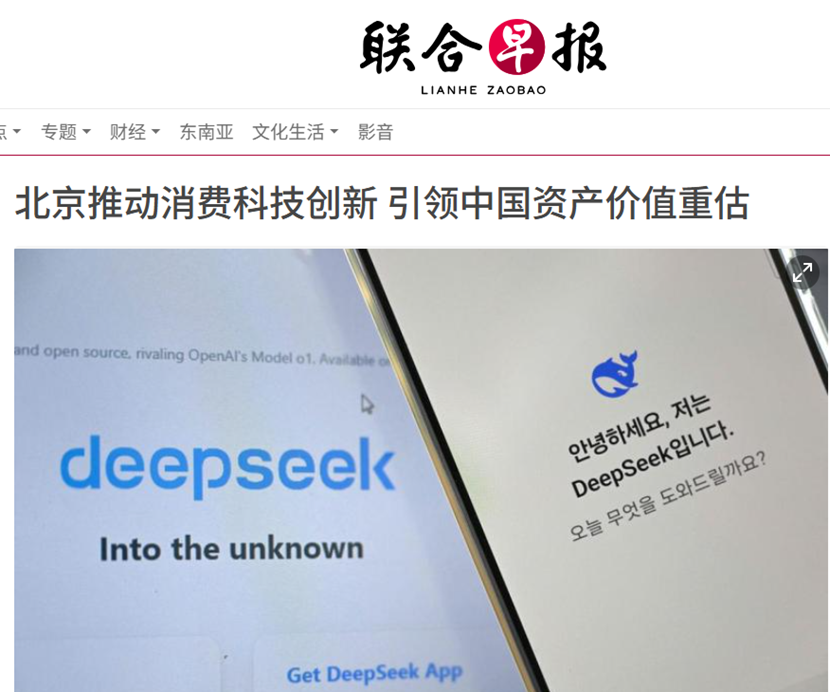
Core Insights - The Ministry of Industry and Information Technology (MIIT) and six other departments have issued an implementation plan to promote service-oriented manufacturing innovation, emphasizing the need for enhanced new-type information infrastructure and the integration of "5G + industrial internet" [1] - The MIIT Minister highlighted the importance of implementing national major science and technology projects and key R&D plans, aiming to attract innovation resources to enterprises [1] - A recent article by HSBC's Chief Investment Officer for Asia suggests that innovations like DeepSeek are reshaping international investors' perceptions of China's tech capabilities and asset values, potentially accelerating the application and commercialization of AI across various industries in China [1] Group 1: Policy and Infrastructure - The implementation plan includes tasks to strengthen new-type information infrastructure and promote the integration of AI technology with service-oriented manufacturing [1] - The focus is on building computing power infrastructure based on demand and enhancing the overall efficiency of the manufacturing innovation system [1] Group 2: Industry Outlook - The AI sector is expected to benefit from favorable industrial policies, with a positive outlook for AI promoters and adopters in industries such as internet, e-commerce, software, smartphones, semiconductors, autonomous driving, and humanoid robots [4] - Increased capital expenditure related to AI applications and commercialization is anticipated to benefit these sectors [4]

培育壮大生产性服务业,服务型制造迎来政策升级
Di Yi Cai Jing· 2025-10-12 12:54
Core Viewpoint - The development of service-oriented manufacturing is crucial for enhancing the quality and efficiency of the manufacturing industry in China, as highlighted by the recent implementation plan issued by the Ministry of Industry and Information Technology (MIIT) [2][3]. Summary by Sections Service-oriented Manufacturing - Service-oriented manufacturing has become a significant direction for the development of the manufacturing industry, promoting deep integration between advanced manufacturing and modern services [2]. - The core of service-oriented manufacturing is the transition from merely selling products to offering "products + services," which is emphasized in the government's work report [2]. Implementation Plan - The MIIT, along with six other departments, has issued an implementation plan for the innovation and development of service-oriented manufacturing from 2025 to 2028, outlining seven main tasks and three special actions [3][4]. - The plan aims to enhance the role of service-oriented manufacturing in high-quality development, with specific goals such as establishing 20 standards, creating 50 leading brands, and building 100 innovation development hubs by 2028 [3][4]. Main Tasks and Special Actions - The seven main tasks include strengthening key common technology research, cultivating key productive service industries, promoting service-oriented manufacturing models, advancing standard system construction, stimulating business vitality, creating innovation development hubs, and solidifying the foundation for service-oriented manufacturing [3][4]. - The three special actions focus on enhancing shared manufacturing platforms, improving brand recognition for service-oriented manufacturing enterprises, and developing innovative application scenarios [4]. Challenges and Support - Despite the rapid development of service-oriented manufacturing, challenges such as weak supply capabilities for key technologies and an incomplete standard system remain [4]. - The plan encourages increased investment in innovation and the development of a list of key common technologies for service-oriented manufacturing, aiming to enhance the overall ecosystem for industrial development [5]. Economic Impact - The contribution of productive services to GDP growth is recognized as vital for high-quality economic development, with a target for productive services to account for 60% of the service industry and 35% of GDP by 2035 [5].
到2028年打造50个服务型制造领军品牌
Xin Hua Ri Bao· 2025-10-11 21:51
Core Viewpoint - The implementation plan aims to enhance the role of service-oriented manufacturing in high-quality development of the manufacturing industry by 2028, with specific targets for standards, leading brands, and innovation hubs [1] Group 1: Key Tasks - Seven main tasks are outlined, including strengthening key common technology breakthroughs and model innovation, cultivating key productive service industries, and promoting the application of service-oriented manufacturing models [1] - The plan emphasizes the establishment of a standard system, stimulating the vitality of business entities, and creating innovation development hubs for service-oriented manufacturing [1] Group 2: Specific Measures - Specific measures include nurturing industrial design entities, enhancing new information infrastructure, accelerating the integration of computing power with industry applications, and promoting the integration of artificial intelligence technology with service-oriented manufacturing [1]
七部门:打造服务型制造升级版
Zhong Guo Xin Wen Wang· 2025-10-11 14:39
Core Viewpoint - The implementation plan aims to promote the development of service-oriented manufacturing in China, targeting the establishment of an upgraded version by 2028, with specific goals for standards, brands, and innovation hubs [1][2]. Group 1: Goals and Objectives - By 2028, the plan aims to complete the formulation of 20 standards, create 50 leading brands, and establish 100 innovation development hubs [1][2]. - The initiative seeks to widely disseminate typical models of service-oriented manufacturing and continuously optimize the industrial ecosystem [1]. Group 2: Definition and Importance - Service-oriented manufacturing is defined as a new industrial form that integrates services deeply into the entire lifecycle of manufacturing products, reshaping the value chain and extending the industrial chain [1]. - Since 2016, service-oriented manufacturing has shown positive results, contributing to the high-quality development of the manufacturing sector [1]. Group 3: Challenges - Key challenges include weak supply capacity of critical technologies, an incomplete standard system, uneven application of typical models across industries, and difficulties in statistical monitoring [1][2]. Group 4: Major Tasks - The plan outlines seven main tasks, including strengthening key common technology research, promoting the application of service-oriented manufacturing models, and building a robust foundation for its development [2]. - Key productive service industries highlighted in the plan include technology services, industrial design, software and information services, productive financial services, intellectual property services, and energy-saving and environmental protection services [2].
七部门:到2028年打造50个服务型制造领军品牌
Xin Hua Wang· 2025-10-11 12:01
Core Viewpoint - The implementation plan for promoting service-oriented manufacturing innovation development from 2025 to 2028 aims to enhance the role of service-oriented manufacturing in high-quality development of the manufacturing industry by setting specific targets and addressing existing challenges [1] Group 1: Objectives and Goals - By 2028, the plan aims to complete the formulation of 20 standards, create 50 leading brands, and establish 100 innovation development highlands in service-oriented manufacturing [1] - Service-oriented manufacturing is defined as a new industry form that deeply integrates services into the entire lifecycle and various stages of manufacturing products [1] Group 2: Current Status and Challenges - The development of service-oriented manufacturing in China has shown positive results, contributing to high-quality development of the manufacturing sector, but challenges remain, including weak supply capacity of key technologies and an incomplete standard system [1] Group 3: Major Tasks - The plan outlines seven main tasks, including strengthening key common technology breakthroughs, cultivating key productive service industries, promoting the application of service-oriented manufacturing models, advancing standard system construction, stimulating the vitality of business entities, creating innovation development highlands, and solidifying the foundation for service-oriented manufacturing development [1] Group 4: Specific Measures - Specific measures include nurturing industrial design entities, enhancing new information infrastructure, accelerating the integration of computing power with industry applications, and promoting the integration of artificial intelligence technology with service-oriented manufacturing [1] Group 5: Support Measures - The plan calls for exploring the establishment of a statistical survey system for service-oriented manufacturing, increasing training for composite innovation talents, and deepening global industrial and supply chain cooperation [1]
七部门:加强关键共性技术攻关和模式创新
Bei Ke Cai Jing· 2025-10-11 10:49
Core Viewpoint - The Ministry of Industry and Information Technology, along with six other departments, has issued a plan to promote the innovation and development of service-oriented manufacturing from 2025 to 2028, focusing on strengthening key common technology breakthroughs and model innovations [1] Group 1: Key Common Technology Breakthroughs - A list of key common technologies for service-oriented manufacturing has been released, encouraging companies to increase innovation investments [1] - The plan emphasizes the integration of demand sensing, collaborative R&D design, coordinated delivery and deployment, and intelligent operation monitoring management in technology breakthroughs [1] - The initiative aims to transform and upgrade the results of technological breakthroughs, focusing on key scenarios and models [1] Group 2: Model Innovations - The plan aims to accelerate the upgrade of typical models such as shared manufacturing, personalized customization, full lifecycle management, total integration and contracting, supply chain management, remote operation, and product-service integration [1] - Exploration of new service-oriented manufacturing models, such as model-driven R&D, is encouraged [1] - The initiative promotes mutual support and promotion between technological innovation and model innovation [1]