
服务型制造

Search documents
黄庆华:如何发展有中国特色的服务型制造
Jing Ji Ri Bao· 2026-02-11 00:55
Core Viewpoint - The development of service-oriented manufacturing is crucial for optimizing resource allocation, expanding new growth spaces, extending industrial chains, and enhancing value chains in China's manufacturing sector [1][2]. Group 1: Definition and Characteristics of Service-Oriented Manufacturing - Service-oriented manufacturing refers to increasing the proportion of service elements in business operations, shifting the focus from merely producing and selling products to providing "products + services" [1]. - It emphasizes deep integration of services throughout the entire value chain, including R&D, production processes, and operational maintenance [1]. - China's service-oriented manufacturing is characterized by its alignment with national industrial upgrading directions and leveraging the synergy of a large-scale market and digital technologies [1][2]. Group 2: Importance and Current Status - Developing service-oriented manufacturing is essential for transforming China's manufacturing sector into a strong manufacturing nation, addressing real challenges in industrial upgrading [2]. - China has the foundational capabilities to advance service-oriented manufacturing, enabling the transition from single product supply to comprehensive lifecycle solutions [2]. - The technology of service-oriented manufacturing is becoming a key support for maintaining China's leading position in manufacturing, particularly in high-end equipment, new energy, and intelligent manufacturing sectors [2]. Group 3: Benefits and Growth Strategies - Service-oriented manufacturing facilitates intrinsic growth by extending value creation throughout the product lifecycle, enhancing customer loyalty, and shifting competition from price to quality and solutions [3]. - It promotes collaborative development within the industrial ecosystem, allowing small and medium enterprises to share advanced manufacturing outcomes and integrate deeply into the industrial network [3]. - The development of service-oriented manufacturing should follow a logical progression that emphasizes demand-driven direction, technological efficiency, systemic support, and reduced friction [3]. Group 4: Recommendations for High-Quality Development - Establish a comprehensive digital service system covering all stages of R&D, production, and operations to enhance flexible manufacturing and agile responses to market demands [4]. - Focus on cultivating key service-oriented manufacturing industries to strengthen service capabilities and promote deep integration of manufacturing and services [5]. - Build a unified national market to facilitate industrial integration, eliminate barriers, and promote the cross-regional and cross-scenario replication of service-oriented manufacturing models [5]. - Empower enterprises to take the lead in exploring service-oriented transformation paths based on their unique conditions and market familiarity [5].
如何发展有中国特色的服务型制造
Jing Ji Ri Bao· 2026-02-10 22:16
Core Viewpoint - The development of service-oriented manufacturing is essential for optimizing resource allocation, expanding new growth spaces, extending industrial chains, and enhancing value chains in China's manufacturing sector [1][2]. Group 1: Definition and Characteristics of Service-Oriented Manufacturing - Service-oriented manufacturing refers to increasing the proportion of service elements in business operations, shifting the primary business model from product sales to providing "product + service" [1]. - It emphasizes the deep integration of manufacturing and services across the entire value chain, distinguishing it from traditional product-centric manufacturing [1]. - China's service-oriented manufacturing is characterized by its alignment with national industrial upgrading, leveraging strategic guidance, a vast market, and digital technology [1][2]. Group 2: Importance and Advantages - Developing service-oriented manufacturing is a key pathway to transforming China's large-scale market and complete industrial system into sustainable competitiveness [2]. - The technology of service-oriented manufacturing is becoming a crucial support for maintaining China's leading position in manufacturing, particularly in high-end equipment, new energy, and intelligent manufacturing [2]. Group 3: Growth and Development Strategies - Service-oriented manufacturing can achieve intrinsic growth by extending value creation throughout the product lifecycle, enhancing product value and customer loyalty [3]. - It promotes collaborative development within the industrial ecosystem, enabling small and medium-sized enterprises to share advanced manufacturing outcomes and integrate deeply into the industrial network [3]. - Key strategies for high-quality development include constructing a comprehensive digital service system, nurturing key service-oriented manufacturing industries, building a unified national market, and empowering enterprises to explore service-oriented transformation paths [4][5].
从制造产品到制造价值以服务型制造推动制造业转型升级
Xin Lang Cai Jing· 2026-01-14 20:45
Core Viewpoint - The "14th Five-Year Plan" emphasizes the construction of a modern industrial system and the strengthening of the real economy, with a focus on intelligent, green, and integrated development [1] Group 1: Service-Oriented Manufacturing - Service-oriented manufacturing is a new manufacturing model that integrates manufacturing and services, representing a key direction for the transformation and upgrading of the manufacturing industry [2] - This model shifts the business focus from merely producing and selling products to providing a combination of "products + services," extending value creation across the entire lifecycle of products [2][3] - Service-oriented manufacturing is characterized by customization, lifecycle management, and information value-added services, requiring a deep integration of services into all stages of the manufacturing process [2][3] Group 2: Benefits of Service-Oriented Manufacturing - The development of service-oriented manufacturing promotes the upgrading of industrial foundations and modernization of industrial chains, contributing to domestic demand expansion and consumption promotion [4] - It enhances the technological level and innovation capability of the manufacturing sector by increasing investments in productive services such as R&D and data [4] - Service-oriented manufacturing fosters a dynamic balance between supply and demand, shifting consumer focus from mere functionality to enhanced experiences [5] Group 3: Current Trends and Challenges - The service-oriented manufacturing model is becoming a critical lever for the manufacturing industry to move up the value chain, with countries like the US and Japan already seeing mature developments in this area [7] - Despite rapid growth, China's service-oriented manufacturing still faces challenges such as a lack of awareness, insufficient technological supply, and an underdeveloped standard system [8] Group 4: Policy Recommendations - The "14th Five-Year Plan" suggests a systematic approach to developing service-oriented manufacturing, focusing on regional strengths and encouraging innovation and application [9] - It emphasizes the need for support in building service-oriented manufacturing enterprises, including fostering collaboration between leading companies and smaller firms [10] - Policies should include financial incentives and support for technology development to facilitate the transition to service-oriented manufacturing [11]
广州着力打造中心城区工业转型新标杆和服务型制造发展新高地
Zhong Guo Fa Zhan Wang· 2026-01-13 03:13
Group 1 - The "Service-Oriented Manufacturing Journey" event was held in Haizhu District, Guangzhou, aimed at promoting service-oriented manufacturing and supported by the Ministry of Industry and Information Technology [1] - Haizhu District has proposed to create an "Innovation Belt for Service-Oriented Manufacturing" and has established a "4+6" service-oriented manufacturing industry system to drive industrial transformation [1] - A strategic cooperation agreement was signed between the Guangzhou Municipal Bureau of Industry and Information Technology, Haizhu District Government, and the China Service-Oriented Manufacturing Alliance to enhance collaboration in various fields [1] Group 2 - The "Service-Oriented Manufacturing Capability Open Platform" aims to address issues of resource dispersion and supply-demand mismatch by gathering service capabilities from SMEs and industrial clusters, currently integrating over 100 service providers [2] - The "Service-Oriented Manufacturing Development Level Intelligent Diagnosis Platform" utilizes big data and AI to assess the service-oriented manufacturing maturity of enterprises, having analyzed over 60,000 annual reports and generated over 10,000 diagnostic reports [2] - The Greater Bay Area Research Institute introduced a "5G + AI Dual-Engine Empowerment Service Plan" to support the digital transformation of industrial clusters [2] Group 3 - Guangzhou Bank's Haizhu Center Branch launched a specialized financial service product to support service-oriented manufacturing enterprises, providing a tailored service system and innovative credit loan models [3] - The product evaluates enterprises based on technology strength, R&D intensity, talent level, service capability, and brand influence, offering higher credit loan limits to qualified service-oriented manufacturing firms [3] - Eight support measures were proposed to empower the innovation belt for service-oriented manufacturing, including financial support and talent aggregation [3] Group 4 - Experts and representatives from leading service-oriented manufacturing companies shared insights and experiences during the event, promoting practical cooperation [4] - A special survey on service-oriented manufacturing was conducted, with participants visiting companies to understand their development needs and technological solutions [4] - The event included a promotional session for attracting investment in the service-oriented manufacturing innovation development belt, with discussions on technology promotion and financing integration [4]
第七届服务型制造大会在海南澄迈召开 共话服务型制造中国方案与全球合作
Sou Hu Cai Jing· 2025-12-31 05:36
Core Insights - The seventh Service-Oriented Manufacturing Conference was held in Hainan, focusing on nurturing new productive forces and promoting China's service-oriented manufacturing model for global cooperation [1] - The conference aimed to showcase achievements in service-oriented manufacturing and mobilize efforts for the 14th Five-Year Plan, emphasizing the transition from scale expansion to value creation in manufacturing [1] Group 1: Conference Structure and Objectives - The conference featured a "1+1+N" core agenda, including a plenary session, closed-door discussions, and a series of exchange activities to enhance cooperation and consensus among participants [5] - Key discussions focused on strategies for innovation in service-oriented manufacturing, aiming to convert consensus into actionable results and collaborative projects [5] Group 2: Key Outcomes and Initiatives - The conference announced the establishment of a standardization working group for service-oriented manufacturing, which will focus on developing a comprehensive standard system [6] - The "China Service-Oriented Manufacturing Development Report (2023-2024)" was released, providing an overview of the sector's development and future scenarios [6] Group 3: Brand Development and Talent Cultivation - A joint initiative was launched to enhance service-oriented manufacturing brands, targeting the cultivation of 100 leading enterprises and 50 flagship brands by 2028 [7] - Collaboration among various organizations was emphasized to strengthen the supply of innovative talent in service-oriented manufacturing, including the introduction of a micro-major in this field [8] Group 4: International Cooperation and Market Expansion - The conference included activities aimed at facilitating international cooperation and supporting Chinese enterprises in expanding overseas, particularly in the context of Hainan's Free Trade Port [9] - A comprehensive support package was provided to address key concerns for companies looking to expand internationally, including policy support and compliance guidance [9]

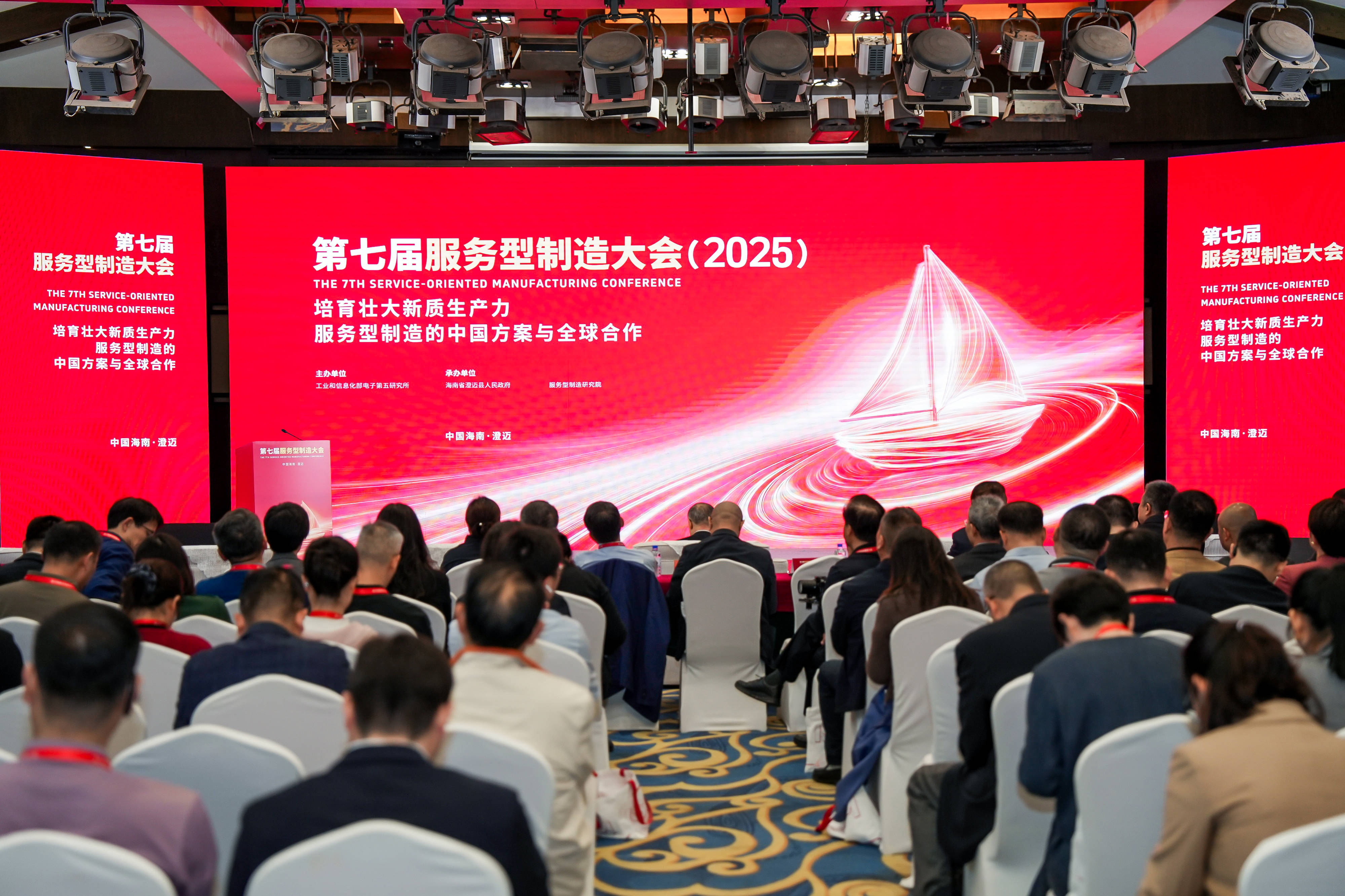
第七届服务型制造大会在海南举行
Zhong Guo Xin Wen Wang· 2025-12-31 01:28
Group 1 - The seventh Service-Oriented Manufacturing Conference was held in Hainan, focusing on the theme of cultivating new productive forces through service-oriented manufacturing and global cooperation [1] - Service-oriented manufacturing is a new industrial form that deeply integrates manufacturing and services, serving as a significant engine for cultivating new productive forces [1] - The conference featured high-level dialogues and discussions on topics such as industrial integration, global industrial patterns, technological breakthroughs, and standard system construction, aiming to generate targeted policy recommendations and actionable cooperation projects [1] Group 2 - The "China Service-Oriented Manufacturing Development Report (2023-2024)" was released, providing a comprehensive overview of the industry's development and future trends over the past two years [1] - Service-oriented manufacturing enterprises have covered 35 categories of the national economy, significantly contributing to economic growth, strengthening industrial chains, promoting technological innovation, driving industrial upgrades, and building industrial ecosystems [1] - A joint initiative was launched to cultivate 100 leading service-oriented manufacturing enterprises and 50 leading brands by 2028 [1] Group 3 - Talent cultivation is emphasized as the cornerstone of sustainable industrial development, with various institutions collaborating to nurture composite talents in service-oriented manufacturing [2] - The establishment of a micro-specialty in service-oriented manufacturing at Harbin Institute of Technology aims to enhance students' capabilities in product service system design and business model innovation [2] - Hainan's Free Trade Port is seen as a new driving force for the development of service-oriented manufacturing, providing strong support for manufacturing enterprises to expand internationally [2] Group 4 - The tax incentives and trade facilitation measures following the operation of Hainan's Free Trade Port are expected to significantly enhance its attractiveness to foreign enterprises [3] - The China-Finland Chamber of Commerce aims to create a more efficient platform for government-enterprise dialogue, facilitating European companies' understanding of Hainan and exploring cooperation opportunities in sectors like healthcare, tourism, and high-end manufacturing [3]
2026重点工作:芯片被提及
半导体芯闻· 2025-12-29 10:26
Core Viewpoint - The primary task for 2026 is to "consolidate the stable and positive trend of the industrial economy," reflecting a shift in policy focus from short-term growth to long-term quality improvement [3][4][5]. Group 1: Industrial Economy - The meeting emphasizes the need to support industrial provinces and stabilize effective investment in manufacturing [4]. - The industrial economy is expected to show resilience and vitality, with telecommunications and software business revenues projected to grow by approximately 9% and 12% respectively [3]. - The shift from "promoting stable growth" to "consolidating a stable and positive trend" indicates a deeper understanding of the current industrial economic situation [4]. Group 2: Supply and Demand - The focus on increasing the supply of green products, trendy products, and products for the elderly aligns with market demand trends [4]. - The emphasis on domestic demand as a primary driver of economic growth reflects a strategic shift towards building a strong domestic market [5]. Group 3: Technological Integration - The meeting highlights the importance of "AI + manufacturing" initiatives, aiming to cultivate key industry intelligent entities and original intelligent enterprises [7][10]. - The transition from "digital empowerment" to "intelligent empowerment" signifies a deeper integration of intelligent technologies into traditional industries [8]. Group 4: Emerging Industries - The conference outlines plans to develop emerging pillar industries such as integrated circuits, new displays, new materials, aerospace, low-altitude economy, and biomedicine [10][11]. - These industries are seen as crucial for addressing "bottleneck" issues and fostering new productive forces, with a focus on high value-added and high-tech characteristics [12]. Group 5: Quality Enterprises - The meeting stresses the need to cultivate high-quality enterprises, including "little giant" companies and manufacturing champions, while addressing issues of overdue payments to businesses [15][17]. - The goal is to enhance the service capabilities of the information and communication industry, with significant growth in 5G infrastructure [15]. Group 6: Governance and Competition - The meeting calls for improved governance efficiency in the industrial and information sectors, aiming to curb "involution" competition and promote high-quality standards [17]. - Strengthening policy coordination across industries, finance, and taxation is essential for fostering productive cooperation [17].
培优塑强推动服务型制造跃升
Xin Lang Cai Jing· 2025-12-26 23:07
Core Viewpoint - The recent implementation plan by seven departments, including the Ministry of Industry and Information Technology, aims to develop an upgraded version of service-oriented manufacturing by 2028, marking a new phase in China's service-oriented manufacturing development [1]. Group 1: Current State and Challenges - China's service-oriented manufacturing has transitioned from concept to practical implementation, with continuous innovation in models and an extension of service components [1]. - Current challenges include insufficient depth in service transformation for some enterprises, which remain at the basic service level, and the underutilization of collaborative efficiency across the industrial chain [1]. Group 2: Strategic Directions for Improvement - To enhance service-oriented manufacturing, the focus should be on deepening integration, shifting from single product offerings to "product + service" solutions, and moving from transactional to relational manufacturing [1]. - Emphasis on digital and intelligent integration is crucial, accelerating the fusion of technologies like industrial internet and artificial intelligence with the entire manufacturing process [2]. - Promoting value integration through service elements embedded in the lifecycle of products is essential for transitioning from "selling products" to "selling value" [1][2]. Group 3: Innovation and Systematic Approaches - The essence of service-oriented manufacturing lies in innovation, which is vital for reshaping industrial competitiveness [2]. - The "14th Five-Year Plan" suggests promoting technological upgrades and digital transformation in manufacturing, focusing on smart, green, and service-oriented manufacturing [2]. - A systematic approach is necessary for quality upgrades in service-oriented manufacturing, requiring multi-party collaboration and comprehensive strategies [2]. Group 4: Local Adaptation and Implementation - Strengthening service-oriented manufacturing is a systematic project that relates to high-quality development in manufacturing [3]. - Localities should explore transformation paths based on their industrial foundations, aiming for a leap from quantitative to qualitative changes in service-oriented manufacturing [3].
省服务型制造发展促进会成立
Liao Ning Ri Bao· 2025-12-13 01:34
Core Viewpoint - The establishment of the Liaoning Service-oriented Manufacturing Development Promotion Association aims to integrate resources and promote innovation in service-oriented manufacturing, addressing transformation bottlenecks in the industry [1] Group 1: Purpose and Goals - The association is designed to serve as a bridge, facilitating communication between government and enterprises, and reflecting industry demands [1] - It will conduct policy interpretation and dissemination to ensure effective implementation of supportive policies for service-oriented manufacturing [1] - The association aims to strengthen the construction of new think tanks to address industry transformation challenges and provide tailored consulting services for enterprises [1] Group 2: Importance of Service-oriented Manufacturing - Service-oriented manufacturing is crucial for the deep integration of advanced manufacturing and modern services, enhancing the value creation capacity of the manufacturing sector [1] - Recent policies from the national and provincial levels have established a supportive framework for the development of service-oriented manufacturing [1] - The promotion of service-oriented manufacturing is seen as a key measure to accelerate the construction of a modern industrial system [1]
中经评论:发展具有中国特色的服务型制造
Jing Ji Ri Bao· 2025-10-17 00:08
Core Viewpoint - The Ministry of Industry and Information Technology and six other departments have issued a plan to enhance the role of service-oriented manufacturing in high-quality development by 2028, aiming to create an upgraded version of service-oriented manufacturing that integrates advanced manufacturing with modern services [1] Group 1: Characteristics of Service-Oriented Manufacturing - Service-oriented manufacturing is characterized by deep integration of manufacturing and services throughout the product lifecycle, focusing on creating new value through services rather than just selling products [1][2] - This model shifts the focus from merely producing goods to enhancing user experience and value, thereby addressing the challenges of homogeneous competition in the manufacturing sector [2] Group 2: Technological Support and Development - A distinctive feature of China's service-oriented manufacturing system is its reliance on digital and intelligent technologies, which address issues such as supply-demand mismatches and inefficiencies in traditional manufacturing [2][3] - China has established a competitive advantage in digital technologies like 5G and industrial internet, which serve as a robust foundation for the development of service-oriented manufacturing [2] Group 3: Shared Manufacturing Model - Shared manufacturing, a model based on the sharing economy, utilizes internet platforms to integrate idle manufacturing resources, providing low-cost access to technology and resources for small and medium-sized enterprises [3] - This model enhances the resilience and flexibility of supply chains, catering to the diverse and personalized demands of consumers in China's vast market [3] Group 4: Localized Development Strategies - The development of service-oriented manufacturing should be anchored in local market demands and leverage regional advantages, with different areas focusing on their unique industrial strengths [3] - For instance, the Yangtze River Delta can focus on high-end equipment lifecycle services, while the Pearl River Delta can expand customized R&D based on its electronic information industry advantages [3] Group 5: Global Competitiveness - Service-oriented manufacturing in China aims to achieve world-class standards by leveraging the country's comprehensive industrial system and large domestic market, positioning itself competitively in the global value chain [4]