
汽车后市场

Search documents
服务消费发展将迎重要战略机遇期
Ren Min Ri Bao· 2026-02-07 03:08
Core Viewpoint - The State Council has introduced a work plan to accelerate the cultivation of new growth points in service consumption, emphasizing the importance of service consumption in driving high-quality economic development [2][3]. Group 1: Policy Framework - The work plan aims to optimize and expand service supply, with a focus on developing specific support policies for sectors such as home services, automotive aftermarket, and performing arts [2]. - The Ministry of Commerce will establish a "1+N" policy system to support the cultivation of new growth points in service consumption, implementing tailored policies for over ten specific areas [2]. Group 2: Quality Improvement and Consumer Benefits - An action plan will be developed to enhance service quality and benefit consumers, featuring over 60 specific measures targeting both supply and demand sides [3]. - The plan includes initiatives to improve service levels in cultural entertainment, tourism, and sports events [3]. Group 3: Infrastructure and New Consumption Models - The Ministry of Transport plans to foster new growth points in transportation service consumption, including the development of a high-quality car rental service network and the expansion of yacht and cruise consumption [4][5]. - There will be a focus on enhancing charging facilities at highway service areas, with a target of building over 10,000 charging stations by 2026, including at least 25% high-power chargers [4]. Group 4: Sports and Entertainment Consumption - The sports sector is expected to see significant consumer engagement, with ski resorts projected to attract 118 million visitors and generate a total consumption of 69.15 billion yuan during the 2025-2026 winter season [6]. - The network audiovisual sector is projected to reach a market size of nearly one trillion yuan by 2025, driven by the popularity of micro-short dramas [6][7]. Group 5: International Consumption and Tourism - The Ministry of Commerce is working to enhance the international consumption environment, with a target of 82.04 million inbound travelers by 2025, reflecting a 26.4% year-on-year increase [7]. - The growth of duty-free shopping is highlighted, with a 95.9% increase in sales of duty-free goods, and nearly 13,000 duty-free stores expected by the end of 2025 [7].
服务消费发展将迎重要战略机遇期(权威发布)
Ren Min Ri Bao· 2026-02-07 00:35
Core Viewpoint - The State Council has introduced a work plan to accelerate the cultivation of new growth points in service consumption, emphasizing the importance of service consumption in driving high-quality economic development [2][3]. Group 1: Policy Framework - The work plan aims to optimize and expand service supply, with a focus on developing specific support policies for sectors such as home services, automotive aftermarket, and performing arts [2]. - The Ministry of Commerce will establish a "1+N" policy system to support the cultivation of new growth points in service consumption, implementing tailored policies for various industries [2][3]. Group 2: Quality Improvement and Consumer Benefits - An action plan will be developed to enhance service quality and benefit consumers, featuring over 60 specific measures targeting both supply and demand sides [3]. - The plan includes initiatives to improve service levels in cultural entertainment, tourism, and sports events, promoting a better consumer experience [3]. Group 3: Infrastructure and New Consumption Models - The Ministry of Transport plans to foster new growth points in transportation service consumption, including the development of a high-quality car rental service network and the expansion of yacht and cruise consumption [4][5]. - There will be a focus on enhancing charging facilities at highway service areas, with a target of installing over 10,000 charging stations by 2026, including at least 25% high-power chargers [4]. Group 4: Sports and Entertainment Consumption - The sports sector is expected to see significant consumer engagement, with projections indicating 1.18 billion visitors to ski resorts during the 2025-2026 season, generating a total consumption of 69.15 billion yuan [6]. - The network audiovisual sector is projected to reach a market size of nearly 1 trillion yuan by 2025, driven by the popularity of micro-short dramas [6][7]. Group 5: International Consumption and Tax Refunds - The Ministry of Commerce is working to enhance the international consumption environment, with a target of 82.04 million inbound travelers by 2025, representing a 26.4% increase [7]. - The number of duty-free shops is expected to reach nearly 13,000 by the end of 2025, with a significant increase in sales of duty-free goods [7].
加快培育服务消费新增长点多部委将推出利好政策
Shang Hai Zheng Quan Bao· 2026-02-06 18:36
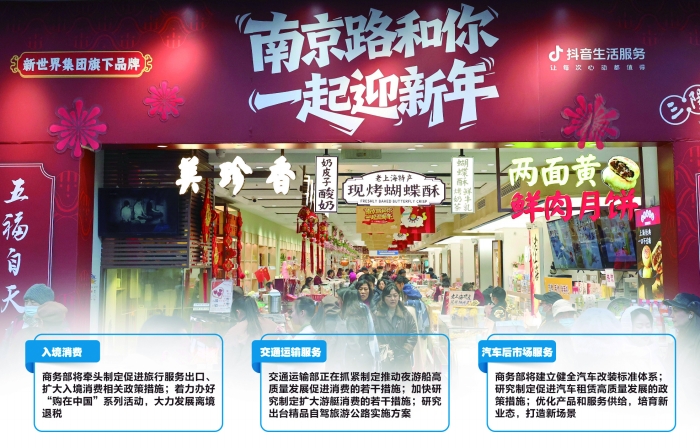
新华社图 郭晨凯 制图 加快培育服务消费新增长点 多部委将推出利好政策 ◎记者 白丽斐 国新办2月6日举行国务院政策例行吹风会,商务部、交通运输部、广电总局、体育总局相关负责人出席 介绍《加快培育服务消费新增长点工作方案》(下称《工作方案》)相关情况,"剧透"将制定推出的多 项利好政策。 商务部副部长鄢东表示,商务部将会同相关部门搭建培育服务消费新增长点的"1+N"政策体系,以《工 作方案》这个"1"为统领,按照"一业一策"的思路,制定出台家政、汽车后市场、演艺、铁旅融合、入 境消费等10多项具体领域支持政策,推动清理制约服务消费的不合理限制性措施,优化细化制度供给, 为培育服务消费新增长点营造稳定透明可预期的政策环境。 将制定促进旅行服务出口、扩大入境消费相关政策措施 入境消费在提振消费方面发挥着重要的作用。数据显示,2025年,全国各口岸出入境外国人8203.5万人 次,同比增长26.4%。截至2025年底,全国离境退税商店近1.3万家;2025年离境退税商品销售额同比增 长95.9%。 鄢东介绍,下一步,商务部将牵头抓好《工作方案》落实落地,加强政策设计,优化平台建设,持续打 造"购在中国"品牌,不断吸 ...

21评论|着力让居民更有钱更有闲,促进服务消费增长
2 1 Shi Ji Jing Ji Bao Dao· 2026-02-06 16:41
Core Viewpoint - The Chinese government is implementing a "1+N" policy system to cultivate new growth points in service consumption, focusing on over ten specific areas such as housekeeping, automotive aftermarket, and inbound consumption, as outlined in the recently released "Work Plan for Accelerating the Cultivation of New Growth Points in Service Consumption" [1][2] Group 1: Policy Framework - The "Work Plan" aims to stimulate service consumption as a core strategy for expanding domestic demand, addressing current pain points while fostering long-term growth potential [1][3] - It proposes 12 measures across three areas: invigorating key sectors, nurturing potential sectors, and enhancing support mechanisms [1][3] Group 2: Focus Areas - The plan targets six mature sectors: transportation, housekeeping, online audio-visual, travel, automotive aftermarket, and inbound consumption, aiming to optimize supply and unlock existing consumption scale [2] - It also identifies three potential sectors: performance services, sports events, and experiential services, promoting institutional innovation to unlock new growth spaces [2] Group 3: Support Systems - The "Work Plan" establishes a support system focusing on standards, credit, and financial assistance to solidify the foundation for service consumption development [3] - It emphasizes the need for a standard system covering traditional and emerging sectors, a credit system to enhance service commitments, and financial support measures including loans and bond issuance [3] Group 4: Long-term Implications - The implementation of the "Work Plan" is expected to optimize economic structure, directly driving consumption growth and production investment, creating a virtuous cycle of supply and demand [3] - It aims to meet the rising demand for high-quality living standards, enhancing employment and income while fostering globally competitive service enterprises [3] Group 5: Challenges Ahead - The plan faces challenges such as institutional barriers in the supply side and the need to enhance consumer capacity and time availability on the demand side [4][5] - Addressing these challenges requires ongoing reforms and improvements in the macroeconomic environment, as well as a focus on high-end service industry talent and infrastructure development [4][5]
聚焦加快培育服务消费新增长点 四部门划重点
Zheng Quan Ri Bao· 2026-02-06 16:28
在抓好平台载体建设方面,扎实推进消费新业态新模式新场景试点、汽车流通消费改革试点、国际化消费环境建设试点、 高质量户外运动目的地等先行先试平台建设,打造一批带动面广、显示度高的消费新场景,促进服务消费新增长点培育。同 时,继续办好"服务消费季""中华美食荟"等促消费活动。 交通运输部综合规划司负责人刘东表示,下一步,拟培育的交通运输服务消费新增长点主要有以下几个方面:一是发展自 驾游服务;二是推动小微型客车租赁高质量发展;三是发展壮大夜游船经济;四是培育发展游艇消费;五是着力扩大邮轮消 费。 谈及下一步在培育服务消费新增长点方面,还有哪些考虑和举措,鄢东表示,将从持续完善政策措施体系、促进服务消费 提质惠民、抓好平台载体建设三个方面来落实。 在持续完善政策措施体系方面,商务部将会同相关部门搭建培育服务消费新增长点的"1+N"政策体系,以《工作方案》这 个"1"为统领,按照"一业一策"的思路,制定出台家政、汽车后市场、演艺、铁旅融合、入境消费等10多项具体领域支持政 策。 在促进服务消费提质惠民方面,商务部将加快制定印发服务消费提质惠民行动方案,包括60多项具体举措,会同相关部门 推动提升文化娱乐、旅游休闲、体 ...
服务消费升级扩容路径:汽车后市场、入境游等将迎新政
2 1 Shi Ji Jing Ji Bao Dao· 2026-02-06 12:48
对于下一步工作,商务部副部长鄢东透露,将会同相关部门搭建培育服务消费新增长点的"1+N"政策体系。以日前印发的《加快培育服务消费 新增长点工作方案》为统领,按照"一业一策"思路,制定出台家政、汽车后市场、演艺、入境消费等10多项具体领域支持政策。 此外,商务部将加快制定印发服务消费提质惠民行动方案,包括60多项具体举措,从供给和需求两端协同发力,会同相关部门推动提升文化娱 乐、旅游休闲、体育赛事等领域服务供给水平。 推动汽车后市场服务消费扩容提质 21世纪经济报道记者张旭 北京报道 服务消费是扩大内需的重要抓手。 近日,国务院办公厅发布《加快培育服务消费新增长点工作方案》(以下简称《工作方案》),从激发重点领域发展活力、培育潜力领域发展 动能、加强支持保障等方面提出12条政策举措。2月6日,国新办召开国务院政策例行吹风会,多部门解读《工作方案》。 近年来,随着居民生活水平提升,中国居民消费结构从商品消费为主向商品消费和服务消费并重转变。2025年人均服务性消费支出占居民人均 消费支出的比重达46.1%,接近居民消费的"半壁江山"。 目前我国汽车产销量已连续17年蝉联世界第一,国内汽车保有量也达到3.66亿辆。 ...
着力让居民更有钱更有闲,促进服务消费增长
2 1 Shi Ji Jing Ji Bao Dao· 2026-02-06 11:50
Core Viewpoint - The enhancement of consumer capacity relies on the increase of per capita disposable income, necessitating a positive cycle of "employment - income - consumption - investment" [1] Group 1: Policy Framework - The Ministry of Commerce announced a "1+N" policy system to cultivate new growth points in service consumption, guided by the recently issued "Work Plan for Accelerating the Cultivation of New Growth Points in Service Consumption" [1][2] - The "Work Plan" outlines 12 measures focusing on stimulating key areas, nurturing potential sectors, and strengthening support, aiming to optimize supply and cultivate new growth drivers for future domestic demand [1][3] Group 2: Focus Areas - The plan targets six mature sectors: transportation, housekeeping, online audio-visual, travel, automotive aftermarket, and inbound consumption, aiming to optimize supply and unlock existing consumption scale [2] - It also identifies potential sectors such as performance, sports events, and experiential services, promoting institutional innovation to unlock new growth spaces [2] Group 3: Support Systems - The "Work Plan" establishes a support system from three aspects: standards, credit, and financial support, to solidify the foundation for service consumption development [3] - Financial support includes increasing single household loan limits to 10 million yuan and providing interest subsidies, alongside facilitating corporate bond issuance and REITs to alleviate financing challenges [3] Group 4: Long-term Implications - The implementation of the "Work Plan" is expected to optimize economic structure, directly stimulate consumption growth, and promote production investment, creating a virtuous cycle of supply and demand [3] - It aims to better meet the needs of residents for a better quality of life, enhancing employment and income while fostering globally competitive service enterprises [3] Group 5: Challenges Ahead - The plan faces challenges such as breaking down systemic barriers in the service industry and addressing consumer capacity and time constraints, which are essential for enhancing service consumption [4][5] - There is a need to ensure the availability of high-end service industry talent and infrastructure to support the quality, personalization, and internationalization of service consumption [5]
加快培育服务消费新增长点,这场发布会划了重点
Jing Ji Guan Cha Wang· 2026-02-06 11:21
Core Viewpoint - The Chinese government is accelerating the cultivation of new growth points in service consumption through a comprehensive work plan focusing on nine key areas, aiming to enhance service consumption quality and benefit the public [1]. Group 1: Service Consumption Growth Points - The work plan identifies nine key areas for service consumption growth, including transportation, housekeeping, online audio-visual services, tourism, automotive aftermarket, inbound consumption, performances, sports events, and emotional experiences [1]. - The Ministry of Commerce has initiated a "Three New" pilot program in 50 cities, receiving initial financial support of 8.6 billion yuan, to foster new consumption growth points [2]. - The pilot cities, with a combined population of over 480 million and accounting for more than half of the national retail sales, provide a significant market capacity for exploring new growth paths [2]. Group 2: Automotive Aftermarket - The automotive aftermarket, including services like modification and rental, is highlighted as a key area for releasing consumption potential, with China's vehicle ownership reaching 366 million [4]. - The Ministry of Commerce plans to enhance the automotive aftermarket by exploring new development models, improving regulatory frameworks, and promoting collaboration with tourism and other industries [5][6]. - Specific measures include establishing standards for vehicle modification and optimizing the automotive rental service network to better meet diverse consumer needs [6]. Group 3: Sports Events and Economic Development - The sports sector is being leveraged to stimulate consumption and economic growth, with the State Sports General Administration focusing on resolving challenges in event approvals and safety management [7]. - Pilot programs in cities like Shenyang and Hangzhou have been initiated to promote sports consumption, with 1,947 monitored events in 2025 generating 43.128 billion yuan in consumption [8]. - Upcoming major sports events and integrated promotional activities aim to deepen the connection between sports and tourism, expanding the consumption market [8].
商务部:持续推动汽车后市场服务消费扩容提质
Jin Rong Jie· 2026-02-06 08:00
商务部服务贸易和商贸服务业司司长孔德军在国务院政策例行吹风会上表示,下一步,商务部等部门将 贯彻落实《工作方案》要求,重点从三个方面发力,持续推动汽车后市场服务消费扩容提质。首先是试 点先行,探索发展模式。为顺应汽车流通消费新形势、新趋势,商务部会同相关部门深入推进汽车流通 消费改革试点,支持试点地区结合本地实际围绕管理制度、标准技术、数据平台等方面,深化改革、积 极创新、先行先试,探索汽车后市场高质量发展的新路径。其次是精准施策,完善制度保障。关于改 装,建立健全汽车改装标准体系,推动构建汽车改装管理制度,促进汽车改装市场积极有序发展;关于 租赁,研究制定促进汽车租赁高质量发展的政策措施,进一步优化汽车租赁服务网络,促进汽车租赁与 旅游等产业协同发展。同时,围绕房车露营、赛车赛事、传统经典车认定等,分领域推动顶层设计完 善,优化产品和服务供给,培育新业态,打造新场景,更好满足群众多样化汽车消费需求。最后是破除 壁垒,激活消费动能。推动清理汽车后市场消费领域限制性措施,畅通消费链条,释放汽车后市场的消 费潜力。 ...
政策加码汽车后市场服务
Xin Lang Cai Jing· 2026-02-05 13:06
(来源:中国政府采购报) 本报讯 日前,国务院办公厅印发《加快培育服务消费新增长点工作方案》(以下简称《工作方 案》),其中提到,激活汽车后市场服务等重点领域发展活力。 《工作方案》明确,要推动汽车流通消费领域全链条创新发展,选择部分城市开展试点,支持在汽车后 市场重点领域先行先试,加快清理限制性措施,探索开展汽车改装分级分类管理,健全传统经典车认定 体系,加强房车露营基地建设,研究完善相关管理制度、技术标准。加强国际合作,发展汽车文化,支 持汽车博物馆建设运营,鼓励举办相关赛事及活动,打造汽车与旅游、文化、体育等跨界融合创新项 目。推动小微型客车租赁高质量发展,完善小微型客车租赁服务网络,培育壮大经营主体,提高租赁服 务水平。进一步促进自驾游发展,改善自驾游交通运输条件,为自驾游营造安全、舒适、便捷的出行环 境。 转自:中国政府采购报 【一周新闻速览】 政策加码汽车后市场服务 本报拥有此文版权,若需转载或复制,请注明来源于中国政府采购报,标注作者,并保持文章的完整 性。否则,将追究法律责任。 (付娟) ...