汽车改装服务

Search documents
我国持续推动汽车后市场服务消费扩容提质
Xin Lang Cai Jing· 2026-02-10 04:37
Core Viewpoint - The Chinese Ministry of Transport is focusing on enhancing service consumption in the transportation sector, particularly through the promotion of self-driving tourism and the development of high-quality travel routes to stimulate economic growth and consumer spending [1][2]. Group 1: Self-Driving Tourism Development - Self-driving tourism has emerged as a new consumption hotspot, with many highways becoming popular tourist destinations, fulfilling public demand and boosting consumption [1]. - The Ministry plans to create a series of long-distance, cross-regional, high-quality self-driving tourism routes, improving road service capabilities and enhancing travel experiences [2]. Group 2: New Consumption Models - The Ministry is collaborating with other departments to develop innovative tourism products, such as "service area + tourism" and "bridge + tourism," which effectively stimulate related sectors like car rentals and camping services [2]. - There is a focus on supporting new consumption formats along travel routes, including self-driving camps, rental facilities, boutique accommodations, and themed dining [2]. Group 3: Growth of Rental and Night Tourism - The small and micro car rental market is expected to grow at an annual rate of approximately 15% during the 14th Five-Year Plan period, with efforts to enhance service networks and improve rental conditions [3]. - The Ministry is also working on measures to promote the night cruise economy and expand yacht consumption, with a target of 9,850 registered yachts by the end of 2025 [3]. Group 4: Expansion of Automotive Aftermarket Services - The automotive market in China has seen continuous growth, with a vehicle ownership of 366 million, leading to increased demand for aftermarket services like car modifications and rentals [4]. - The Ministry of Commerce is implementing measures to extend the automotive consumption chain, including pilot programs for automotive circulation and promoting automotive cultural events [5]. Group 5: Event Economy Development - The development of the event economy is a key focus, with efforts to enhance sports event services and innovate economic models to sustain growth in this sector [6].
新能源后市场:以融合创新和生态重构驱动价值跃升
Zhong Guo Qi Che Bao Wang· 2026-02-09 03:59
Core Insights - The automotive market in China is transitioning from a growth phase to a saturation phase, with a projected vehicle ownership of 366 million by 2025, including 43.97 million new energy vehicles [1] - The rise of the automotive aftermarket is supported by this transition, as evidenced by discussions at the 2026 New Energy Aftermarket New Ecology Conference in Chongqing [1] Group 1: Market Dynamics - The shift in focus from manufacturing to the aftermarket services is evident as the automotive market matures, particularly in Chongqing, which is positioning itself as a hub for smart connected new energy vehicles [3] - Chongqing's government is actively developing a modern manufacturing system and integrating the automotive supply chain, including components, vehicles, and aftermarket services [3][4] - The city is enhancing its vehicle maintenance and service capabilities, encouraging the establishment of service networks and improving digital service offerings [4] Group 2: Industry Opportunities - The expected increase in new energy vehicle ownership to over 120 million by the end of the 14th Five-Year Plan presents significant market opportunities, with the service industry projected to grow from 1.9 trillion yuan in 2024 to 5 trillion yuan by 2030 [6] - The automotive aftermarket is evolving to emphasize diverse revenue models, including maintenance and ancillary services, driven by consumer demand for cost-effective and convenient solutions [7][9] Group 3: Technological Integration - AI technology is anticipated to play a crucial role in transforming the automotive aftermarket, enabling smarter service delivery and operational efficiencies [8] - The integration of AI will facilitate the development of algorithm-driven services, enhancing user experience and operational capabilities in the aftermarket [8] Group 4: Regulatory and Policy Framework - The automotive modification industry is gaining traction, supported by evolving policies that shift from restrictive to supportive frameworks, thus fostering high-quality development [9][11] - The industry is expected to undergo significant restructuring in terms of policies, technology, and ecosystem collaboration to adapt to new market demands and technological advancements [11]


权威发布|服务消费发展将迎重要战略机遇期
Ren Min Ri Bao· 2026-02-08 02:57
Core Viewpoint - The Chinese government is implementing a comprehensive plan to accelerate the growth of service consumption, which is expected to play a crucial role in enhancing economic quality and driving consumer spending [2][3]. Group 1: Policy Framework - The State Council has issued a "Work Plan" aimed at optimizing and expanding service supply, fostering new growth points in service consumption, and enhancing the quality of service consumption [2]. - The Ministry of Commerce will establish a "1+N" policy system to support various sectors, including home services, automotive aftermarket, and performing arts, with over ten specific support policies to be introduced [2][3]. Group 2: Service Consumption Growth - From 2020 to 2025, per capita service consumption expenditure is projected to grow at an annual rate of 8.5%, with the share of service consumption in total household expenditure increasing to 46.1%, up by 3.5 percentage points [2]. - The focus of consumer demand is shifting from mere availability to quality, with increasing demand for personalized, diverse, and high-quality service consumption products [2]. Group 3: Infrastructure and Support Initiatives - The Ministry of Transport plans to cultivate new growth points in transportation service consumption, including the development of a high-quality car rental service network and the expansion of yacht and cruise consumption [4][6]. - Plans are in place to construct over 10,000 charging stations on highways by 2026, with at least 25% being high-power charging stations to enhance service capacity [4]. Group 4: Sports and Entertainment Consumption - The sports sector is expected to see significant growth, with ski resorts projected to attract 118 million visitors and generate a total consumption of 69.15 billion yuan during the 2025-2026 winter season [7]. - The network audiovisual sector is anticipated to reach a market size of nearly one trillion yuan by 2025, driven by the popularity of micro-short dramas and a user base of 1.09 billion [7][8]. Group 5: International Consumption - The Ministry of Commerce is focusing on enhancing the international consumption environment, with a target of 82.04 million inbound travelers by 2025, representing a 26.4% increase [8]. - The sales of tax refund goods for outbound travelers are expected to grow by 95.9%, with nearly 13,000 tax refund stores established by the end of 2025 [8].
四部门预告一揽子新政!
Jin Rong Shi Bao· 2026-02-07 07:17
Core Viewpoint - The recently released "Work Plan for Accelerating the Cultivation of New Growth Points in Service Consumption" aims to enhance service consumption across various sectors, focusing on innovative measures and pilot programs to stimulate economic growth and consumer spending [1]. Group 1: Transportation Service Consumption Growth Points - The plan includes the development of self-driving travel services, with a goal to build over 10,000 charging stations on national highways, ensuring at least 25% are high-power chargers [5]. - It aims to improve the quality of small and micro car rental services by facilitating free or low-cost returns in different locations and enhancing vehicle supply during peak times [5]. - The initiative seeks to expand the night cruise economy and is formulating measures to promote high-quality development in this area [6]. - There is a focus on increasing yacht consumption, with a significant rise in yacht registrations, and measures are being developed to enhance supply and promote mass consumption [5]. - The plan also includes expanding cruise consumption by supporting local development of cruise services and enhancing the overall cruise tourism experience [6]. Group 2: New Consumption Models and Pilot Programs - The "Three New" pilot program, initiated by the Ministry of Commerce and the Ministry of Finance, has selected 50 cities to explore new consumption models, with an initial funding of 8.6 billion yuan allocated [2][3]. - These pilot cities, with a combined population of over 480 million, account for more than half of the national retail sales, providing a substantial market for testing new growth paths [3]. - The program emphasizes cross-departmental coordination to create a conducive environment for emerging service consumption models, including travel, automotive aftermarkets, and online audiovisual sectors [3]. Group 3: Enhancing Inbound Consumption - The Ministry of Commerce plans to strengthen policies to attract and expand inbound consumption, including promoting travel service exports and enhancing the "Buy in China" brand [8]. - Specific initiatives include organizing international consumption events and improving the international consumption environment in major cities like Shanghai and Beijing [8]. - The strategy also focuses on developing tax refund services to attract foreign tourists, enhancing the shopping experience for inbound consumers [9]. Group 4: Promoting Micro-Short Dramas and Audiovisual Consumption - The State Administration of Radio and Television is pushing for the development of micro-short dramas to stimulate service consumption and economic growth, with a focus on policy support and market competition [11]. - The initiative aims to integrate micro-short dramas with various industries, enhancing service consumption through innovative content and technology [11]. - The audiovisual sector is experiencing significant growth, with nearly half of users engaging in consumption due to viewing programs, indicating a strong potential for further development [12]. Group 5: Automotive Aftermarket Development - The automotive market in China is expanding, with over 366 million vehicles, leading to increased demand for aftermarket services such as modifications and rentals [13]. - The Ministry of Commerce is exploring new models for the automotive aftermarket, focusing on regulatory reforms and enhancing service quality [14]. - Efforts will be made to establish standards for vehicle modifications and improve the rental service network to better meet diverse consumer needs [14]. Group 6: Home Service Industry and Credit Platforms - The home service sector is recognized as a growing necessity, with plans to enhance support for service providers and improve service quality through training and innovation [15]. - A comprehensive credit information platform for home services is being developed to ensure consumer trust and enhance service delivery [15].
加快培育服务消费新增长点多部委将推出利好政策
Shang Hai Zheng Quan Bao· 2026-02-06 18:36
Core Insights - The Chinese government is accelerating the cultivation of new growth points in service consumption through a comprehensive policy framework, aiming to enhance the service sector's contribution to economic growth [2][3] Group 1: Policy Framework - The Ministry of Commerce will establish a "1+N" policy system to support service consumption, focusing on specific sectors such as home services, automotive aftermarket, and inbound consumption [2] - The "Work Plan" will guide the development of over ten specific support policies across various service sectors, aiming to eliminate unreasonable restrictions and optimize the regulatory environment [2][3] Group 2: Growth Projections - From 2020 to 2025, China's per capita service consumption expenditure is projected to grow at an annual rate of 8.5%, with the share of service consumption in total per capita consumption expected to rise by 3.5 percentage points, reaching 46.1% by 2025 [3] Group 3: Specific Initiatives - The Ministry of Commerce plans to implement over 60 specific measures to enhance service quality and meet consumer demands in areas such as cultural entertainment, tourism, and sports events [4] - Policies will be developed to promote travel service exports and expand inbound consumption, with a target of 82.035 million inbound travelers by 2025, reflecting a 26.4% year-on-year increase [5] Group 4: Transportation Services - The Ministry of Transport aims to cultivate new growth points in transportation services, including self-driving tours, night cruise economies, and yacht consumption [6] - Measures are being developed to enhance the quality of night cruise services and expand yacht consumption, promoting a shift towards mass-market and large-scale development [6] Group 5: Automotive Aftermarket - The automotive aftermarket in China, with a vehicle ownership of 366 million, presents significant growth potential, focusing on areas such as vehicle modification, rental services, and motorsport events [7] - The Ministry of Commerce will implement strategies to expand and improve automotive aftermarket services, including establishing standards for vehicle modifications and enhancing rental service networks [7]
服务消费升级扩容路径:汽车后市场、入境游等将迎新政
2 1 Shi Ji Jing Ji Bao Dao· 2026-02-06 12:48
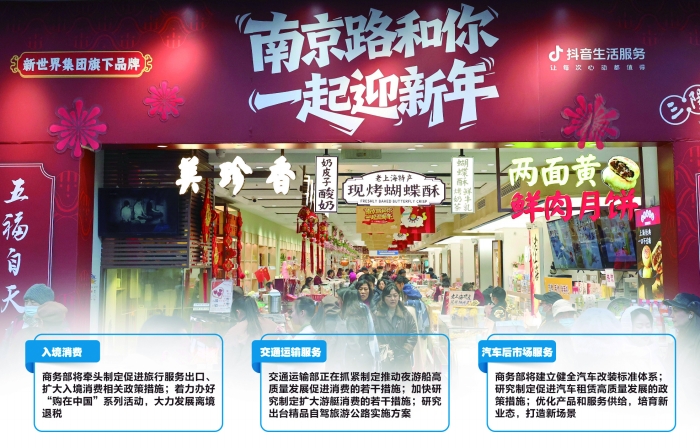
Core Viewpoint - The Chinese government is focusing on expanding service consumption as a key strategy to boost domestic demand, with a new work plan outlining 12 policy measures to stimulate growth in various service sectors [1][9]. Group 1: Service Consumption Growth Strategy - The State Council has released a work plan aimed at fostering new growth points in service consumption, emphasizing the importance of service consumption in enhancing residents' quality of life and driving economic development [1][9]. - By 2025, per capita spending on services is projected to account for 46.1% of total per capita consumption, indicating a significant shift towards service-oriented consumption [1]. - The Ministry of Commerce plans to establish a "1+N" policy framework to support various sectors, including home services, automotive aftermarket, and cultural entertainment, with over ten specific support policies to be developed [1][9]. Group 2: Automotive Aftermarket Focus - The automotive aftermarket is highlighted as a key area for service consumption expansion, driven by the increasing number of vehicles in China, which has reached 366 million [2]. - The demand for automotive services, including modifications and rentals, is expected to grow, enhancing consumer experience and satisfaction [2]. - The Ministry of Commerce aims to extend the automotive consumption chain and promote related industries through initiatives such as pilot reforms in automotive circulation and consumer events [3][9]. Group 3: Micro-Short Drama Development - The micro-short drama sector has seen explosive growth, with 33,000 new dramas expected to be released by 2025 and a market size exceeding 100 billion yuan, doubling from the previous year [6][7]. - The government is promoting micro-short dramas as a new form of cultural service consumption, encouraging innovation and competition within the industry [7][8]. - Policies will be implemented to support the development of micro-short dramas, including a management framework to ensure content safety while fostering market competition [8][9]. Group 4: Employment and Economic Impact - The new growth points in service consumption are expected to create significant employment opportunities and enhance income levels, contributing to a virtuous cycle of employment, income, and consumption [10][11]. - The Ministry of Commerce will focus on integrating digital services, cultural tourism, and green economy initiatives to stimulate service consumption [11][12]. - The government plans to address supply chain bottlenecks and encourage private sector participation to invigorate service consumption [12].
探索汽车改装分级分类管理 撬动服务消费新空间
Zheng Quan Ri Bao Wang· 2026-01-30 11:59
Core Viewpoint - The State Council's "Work Plan for Accelerating the Cultivation of New Growth Points in Service Consumption" proposes to explore graded and classified management of automotive modifications, highlighting the potential for significant market growth in this sector [1]. Group 1: Market Potential - Service consumption is becoming a crucial direction for expanding domestic demand and optimizing consumption structure, with automotive modifications representing a high-value service opportunity [1]. - According to a report by Jia Shi Information, a 1% increase in modification penetration could generate tens of billions in new market space for every additional 10 million vehicles in stock [1]. Group 2: Industry Challenges - Despite China's strong manufacturing and export capabilities in automotive parts, domestic consumption of automotive modifications remains cautious due to strict regulatory limitations [2]. - The low penetration rate of modified vehicles is attributed to regulatory constraints, leading to a situation where domestic production is more focused on overseas markets [2]. Group 3: Consumer Demand and Regulatory Environment - There is a persistent consumer demand for vehicle personalization and functional modifications, but uncertainties regarding regulations have hindered market release [2]. - The current vehicle inspection system and ambiguous compliance standards have created high operational risks for authorized dealers, discouraging them from engaging in high-value modification services [2]. Group 4: Future Directions - Industry experts suggest that addressing the bottlenecks in the modification business is crucial, especially as the demand for traditional fuel vehicle repairs declines with the rise of electric vehicles [3]. - Three pathways are proposed to expand the market: establishing technical and service standards under government guidance, encouraging major manufacturers to offer standardized modification services, and supporting pilot programs in select cities to promote a regulated automotive aftermarket ecosystem [3].
重大利好来了!国务院同意→
Jin Rong Shi Bao· 2025-11-26 11:20
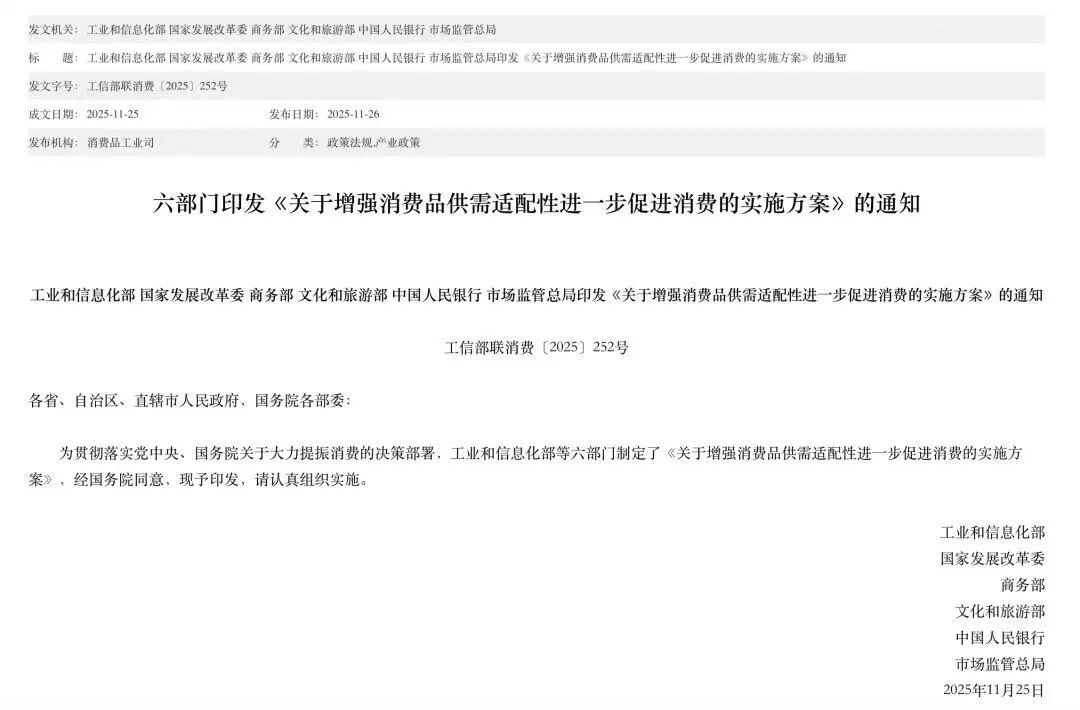
Core Viewpoint - The implementation plan aims to enhance the adaptability of consumer goods supply and demand, leading to consumption upgrades that drive industrial upgrades, thereby achieving a dynamic balance between supply and demand at a higher level [1][4]. Policy Framework - The plan is jointly issued by multiple government bodies, including the Ministry of Industry and Information Technology, the National Development and Reform Commission, and others, marking it as a significant policy document following the Fourth Plenary Session of the 20th Party Congress [1][2]. Goals and Targets - By 2027, the supply structure of consumer goods is expected to be significantly optimized, forming three trillion-level consumption sectors and ten hundred-billion-level consumption hotspots [4]. - By 2030, a high-quality development pattern characterized by positive interaction between supply and consumption is anticipated, with a steady increase in the contribution of consumption to economic growth [4]. Industry Focus Areas - The plan emphasizes the development of new fields and tracks, focusing on key industries such as smart connected vehicles, smart home products, consumer electronics, modern textiles, food, and green building materials [5]. - It encourages the integration of artificial intelligence across the entire consumer goods industry, promoting the development of AI-enabled products like household service robots and smart appliances [5]. Sports and Health Products - The plan aims to enhance the supply of leisure and sports products, targeting new demands from the sports economy, outdoor economy, and ice and snow economy [6]. - It supports the innovation and development of health products, including special dietary foods and high-end medical devices, while promoting the consumption of organic and geographical indication agricultural products [6]. Diverse Consumer Interests - The plan seeks to expand the supply of interest-based consumer products, including pet-related items, anime, and trendy products, while also promoting low-altitude tourism and private flying [7]. - It encourages the development of local intellectual property and innovative design in cultural products, as well as the transformation of traditional retail spaces to include trendy stores [7]. Customization and Experience - The plan emphasizes the need for precise matching of consumer needs, particularly in the baby and children's product sector, and encourages the development of high-end fashion brands and personalized services [8]. - It promotes the creation of immersive consumer experiences through the use of digital technologies, including virtual reality and the metaverse [10]. Financial Support and Services - The plan highlights the importance of financial support for the consumer goods industry, including policies for equipment upgrades and trade-in programs, as well as enhancing the adaptability and convenience of consumer financial services [11].
为用户提供多种维保服务,国外的汽车后市场服务为何有吸引力?
Zhong Guo Qi Che Bao Wang· 2025-11-25 04:26
Core Insights - The article emphasizes the growing importance of the automotive after-market services, particularly in the context of winter maintenance in Northern regions, and highlights valuable lessons from international practices [3] Group 1: After-Market Service Models - The U.S. automotive repair industry has developed a standardized and professionalized service model through chain repair shops, ensuring consistent quality across locations [4] - Chain enterprises in the U.S. benefit from economies of scale, allowing them to reduce costs and negotiate better prices for quality parts, enhancing service affordability for consumers [4] - In Europe, the Stellantis Group's EUROREPAR has established a vast service network with over 6,000 stores, balancing quality and cost through a multi-brand and proprietary parts supply model [5] Group 2: Technological Advancements - European automotive maintenance companies are leveraging smart diagnostic systems to enhance service efficiency by quickly identifying vehicle issues through real-time data analysis [5] - The rise of electric vehicles in Europe has prompted the establishment of specialized battery testing and recycling processes, ensuring environmental responsibility throughout the vehicle lifecycle [5] Group 3: Industry Self-Regulation - Canada has implemented a self-regulatory framework through initiatives like the Motorist Assurance Program (MAPC), which sets clear industry standards and provides dispute resolution for consumers [6][7] - The MAPC program fosters a competitive environment by encouraging repair shops to improve service quality and maintain consumer trust through certification [7] Group 4: Customization and Modification Trends - The article discusses the evolution of automotive modification culture in Europe, highlighting the blend of performance enhancement and cultural expression [8] - German modification shops are noted for their precision engineering, achieving performance improvements of 10%-40% while maintaining fuel efficiency and emissions compliance [8][9] - The Italian modification scene is characterized by an artistic approach, merging aesthetic design with mechanical performance, particularly in supercar modifications [9] Group 5: Lessons for Domestic Markets - Industry experts suggest that domestic automotive after-market services should establish comprehensive service standards, focusing on repair processes, parts quality, and pricing [10] - There is a call for enhanced customer relationship management through data analytics to provide personalized services while maintaining standardization [10] - The article advocates for increased investment in technology related to connected vehicles and remote diagnostics to keep pace with trends in electric and smart vehicles [10][11] - Emphasis is placed on the importance of talent development and regulatory frameworks to ensure service quality and industry sustainability [11]

十一黄金周尽兴越野 京东汽车携手百大品牌为第20届英雄会震撼加码
Zhong Jin Zai Xian· 2025-09-30 08:30
Core Viewpoint - The 20th Off-road Hero Conference, a premier off-road event in China, will take place in the Badain Jaran Desert from October 1 to October 5, showcasing a deep strategic partnership between JD Auto and Off-road E-Zu [1][3] Group 1: Event Highlights - The event will feature five main highlights: the best camping sites, thrilling competitions, exciting live performances, beautiful routes, and valuable supplies [3] - JD Auto will serve as the sole official registration channel, offering exclusive benefits such as VIP camps and supply packages for participants [1][3] - The event will include a variety of activities such as a super T3 competition, a million-dollar prize contest, and a DREAMLAND electronic music festival [3] Group 2: JD Auto's Role - JD Auto aims to create a comprehensive off-road service ecosystem, integrating professional events, automotive exhibitions, and music festivals [3][7] - The company has established a "JD Auto Modification Brand Alliance" with over 50 brands to enhance the off-road consumer experience [7] - JD Auto will provide a one-stop automotive service platform covering purchase, modification, maintenance, usage, and replacement [7] Group 3: Innovative Offerings - The JD Auto maintenance area will showcase advanced automotive technologies, including self-repair tires and a complete tire size range [4][5] - A rescue team will be on-site to offer free assistance for tire changes and other services during the event [4] - JD Auto will also introduce a drone driving school, allowing attendees to obtain a professional drone license [5][7] Group 4: Online Engagement - An online off-road venue will be created for users to watch live broadcasts of the event, participate in prize draws, and enjoy discounts on off-road products [8] - Users can access various promotions, including significant discounts and chances to win prizes, enhancing the overall experience [8]