
海洋交通运输业

Search documents
中国海洋经济十万亿时代 广东2万亿领跑
2 1 Shi Ji Jing Ji Bao Dao· 2025-08-20 14:14
Core Insights - The National Development and Reform Commission of China is working on the "14th Five-Year" marine economy development plan, aiming to break through key core technologies, marking a new chapter in building a marine power [1] - In 2024, China's marine production value is expected to exceed 10 trillion yuan, with a growth rate surpassing GDP by 0.9 percentage points, and the country will account for about one-third of global maritime transport volume [1] - Guangdong province is leading the marine economy with a production value exceeding 2 trillion yuan, followed by Shandong, Fujian, Zhejiang, Shanghai, and Jiangsu, which are also significant contributors to the marine economy [7] Marine Economy Overview - In 2024, the marine production value of China is projected to reach 10.54 trillion yuan, with Guangdong contributing 2 trillion yuan, making it the only province to surpass this threshold [7] - The top three marine economic provinces account for half of the national total, showcasing their significant role in the marine economy [7] Guangdong's Marine Economic Development - Guangdong has established a Marine Strong Province Committee, aiming for innovation in mechanisms and systems to enhance marine economic growth [1] - The marine production value in Guangdong has shown a steady increase, with a notable contribution from various sectors such as marine tourism, transportation, and engineering [9][11] - The province has over 80,000 marine-related enterprises, with a growing number of high-tech companies contributing to the development of new marine industries [11] Sector Performance - In 2024, the marine tourism industry in Guangdong is expected to grow by 10%, while marine power generation is projected to grow by 26.7% [9] - The marine engineering equipment manufacturing sector is also experiencing growth, with a 6.8% increase in value added [9] Technological Advancements - Guangdong is advancing in deep-sea exploration technologies, with the launch of the "Dream" deep-sea drilling vessel and the construction of the world's first deep-sea ecological system research facility [13][15] - The province is positioning itself as a key center for marine scientific innovation, focusing on deep-sea mining, natural gas hydrate extraction, and marine hydrogen production [15]


广州首提海岸退缩线 解码“一带三区”的空间革命
Nan Fang Du Shi Bao· 2025-08-20 11:39
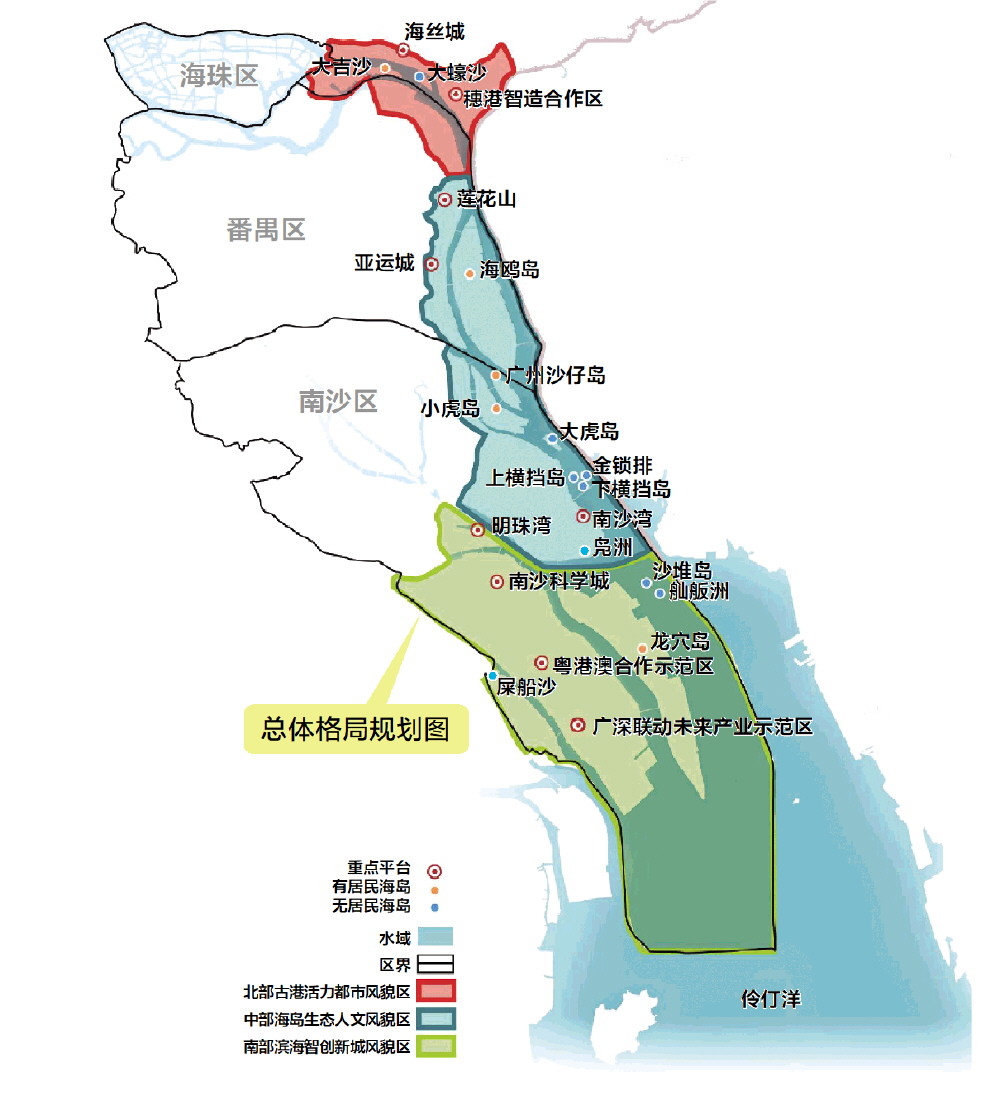
Core Perspective - Guangzhou is implementing a coastal and marine spatial planning strategy aimed at establishing itself as a "marine innovation development capital" and a modern city with marine characteristics by 2035, with a focus on ecological protection and economic development [2][15]. Spatial Layout - The planning introduces a spatial structure termed "One Belt, Three Zones, and String of Pearls," which includes a marine economic innovation development belt and three differentiated urban zones based on their unique attributes [4][6]. - The total planning area covers 798 square kilometers, with 385 square kilometers of marine area and 413 square kilometers of land area [4]. Industry Space Reconstruction - The coastal area has developed three major industry clusters: marine transportation, high-end shipbuilding, and coastal tourism, contributing to a marine production value of 497.9 billion yuan, accounting for 25% of the province's total [6][15]. - The planning emphasizes upgrading existing industries and fostering emerging sectors such as modern marine fisheries and marine new energy [6][8]. Ecological Protection Innovation - The planning introduces a "coastline retreat line" system to balance development and ecological protection, categorizing coastline areas into strict protection, limited development, and optimized utilization [9][10]. - Approximately 36.29% of the marine area is designated as ecological protection zones, with a focus on sustainable management of marine resources [9][15]. Regional Collaborative Strategy - The planning aims to enhance collaboration within the Guangdong-Hong Kong-Macao Greater Bay Area, focusing on building a world-class port cluster and improving transportation infrastructure [12][14]. - Specific areas within the Nansha region are designated for technology innovation, international tourism, and marine scientific research, highlighting its strategic importance [8][12]. Urban Evaluation - The planning reflects a strong ambition for economic development while prioritizing ecological sustainability, with innovative measures such as differentiated management of 14 islands and a strategic reserve for future industrial development [15][16]. - The successful implementation of this planning will require addressing challenges such as resource integration among industrial clusters and disaster risk management along the optimized utilization coastline [16].
万亿元级“蓝色引擎”全速启动,央企入局海洋经济
Hua Xia Shi Bao· 2025-08-15 12:29
Group 1 - The ocean economy is experiencing unprecedented development opportunities, becoming a strategic high ground for China [1] - The central government emphasizes the need for high-quality development of the ocean economy and plans to establish national ocean economy development demonstration zones [1][2] - The ocean economy's total value is projected to exceed 10 trillion yuan, reaching 10.5 trillion yuan in 2024, with a year-on-year growth of 5.9% [2] Group 2 - The first quarter of 2024 saw the ocean production value reach 2.5 trillion yuan, reflecting a year-on-year increase of 5.7% [2] - Various regions are formulating ocean economy development plans, including Shandong, Liaoning, and Hainan [3] - The focus is on enhancing ocean resource development capabilities and transitioning to a quality and efficiency-oriented ocean economy [4] Group 3 - State-owned enterprises (SOEs) are encouraged to participate in ocean economy development due to their financial strength and technological capabilities [7] - China National Offshore Oil Corporation (CNOOC) has made significant discoveries in oil and gas reserves, highlighting the importance of SOEs in resource exploration [7][8] - The shipbuilding industry is a key component of the ocean economy, with China's market share in marine vessels and offshore engineering equipment leading globally [8] Group 4 - The government is promoting policies to support the development of marine energy and encourage investment from SOEs and private sectors [9] - The potential for deep-sea technology and marine economy development is significant, with opportunities in deep-sea equipment, marine biotechnology, and offshore wind power [9]
“向海图强”大有可为
Zheng Quan Ri Bao· 2025-08-13 16:21
Group 1 - The core viewpoint highlights the resilience and growth potential of China's marine economy, with a reported marine GDP of 5.1 trillion yuan in the first half of 2025, reflecting a year-on-year growth of 5.8%, outpacing the national GDP growth rate [1] - The marine economy's growth is supported by an increase in marine resource supply capabilities, with 167,000 hectares of newly approved marine and island areas activating over 500 billion yuan in investments [1] - Traditional marine industries continue to play a stabilizing role, with the marine shipbuilding industry maintaining a leading international market share and marine tourism showing strong performance [1] Group 2 - Policy support is guiding the direction of marine economic development, with the 2025 Government Work Report emphasizing the application of new technologies and the promotion of deep-sea technology as a strategic emerging industry [2] - Local governments, such as Shanghai, Guangdong, and Fujian, have introduced policies to support marine economic development, indicating a coordinated effort to enhance the sector [2] Group 3 - The digital transformation of the marine economy is unlocking new potential, with digital technologies enhancing efficiency and quality across traditional marine industries [3] - Innovations such as digital twin platforms in shipbuilding and smart logistics models are significantly improving operational efficiency and reducing costs [3] Group 4 - Active investment and financing are crucial for the expansion of the marine economy, which is characterized by high capital intensity and long project cycles [4] - In 2024, marine-related IPO financing is projected to reach 11.4 billion yuan, accounting for 17% of total IPO financing, indicating a robust investment climate [4] - Local initiatives, such as the establishment of industry funds in cities like Fuzhou and Xiamen, are further supporting marine economic development [4]
上半年海洋经济生产总值超5万亿元,多地布局海洋新经济
Hua Xia Shi Bao· 2025-08-08 13:27
Core Viewpoint - The ocean economy is emerging as a new growth point for coastal provinces and cities in China, with significant government support and policy initiatives aimed at promoting its development [2][3]. Economic Performance - In the first half of the year, China's marine GDP reached 5.1 trillion yuan, marking a year-on-year growth of 5.8% [2]. - The marine GDP is projected to exceed 10 trillion yuan in 2024, reaching 10.5438 trillion yuan, with a growth rate of 5.9%, outpacing the national GDP growth by 0.9 percentage points [3]. - Marine aquaculture production increased by 5.6% year-on-year, contributing to a 4.8% rise in marine food production [3]. Sector Highlights - The marine tourism sector saw an increase in value added to 771.8 billion yuan, growing by 8% year-on-year, with cruise tourism experiencing a surge in passenger numbers [4]. - The marine transportation sector reported a 5.2% increase in cargo volume and a 6.9% increase in cargo turnover [5]. - The marine engineering equipment manufacturing industry maintained a leading international market share, with new orders, completed orders, and hand-held orders accounting for 64.0%, 47.2%, and 57.6% of the global market, respectively [5]. Emerging Industries - There is a rapid rise in emerging marine industries, although traditional industries still dominate, with marine fisheries, coastal tourism, and marine transportation accounting for nearly 90% of the marine economy [6]. - The development of marine renewable energy, marine biomedicine, and high-tech marine equipment is expected to create significant growth opportunities [6]. Regional Developments - Various regions are actively laying out plans for marine economic development, with Hainan aiming to build a modern marine industry system by 2027 [7]. - Shanghai's marine GDP reached 1.1387 trillion yuan in 2024, growing by 11.2%, and the city is focused on developing a world-class shipbuilding and marine engineering equipment industry [8]. - Fujian province, a leader in marine production, is accelerating its investment in the marine biomedicine sector, with a new high-tech industrial park under construction [8]. Overall Outlook - The regional driving effect of the marine economy is becoming increasingly significant, with provinces like Shandong, Guangdong, and Hainan actively promoting marine economic development [9].
我国海洋经济总量稳步增长、结构持续优化、动能加快转换
Zhong Guo Chan Ye Jing Ji Xin Xi Wang· 2025-08-06 22:55
Group 1: Marine Economy Overview - The marine economy in China showed resilience and growth in the first half of the year, with a total marine production value of 5.1 trillion yuan, representing a year-on-year increase of 5.8% [1] - The traditional marine industry is developing steadily, with shipbuilding completion volume increasing by 4.7% year-on-year [2] - The marine tourism sector has seen significant growth, with an added value of 771.8 billion yuan, up 8.0% year-on-year [2] Group 2: Marine Equipment and Emerging Industries - The marine equipment construction market continues to lead globally, with new orders, delivered orders, and hand-held orders accounting for 64.6%, 43.3%, and 62.6% of the international market share, respectively [3] - The marine pharmaceutical and biological products sector is becoming more competitive, with advancements in marine drug research capabilities [3] - The seawater desalination sector is experiencing rapid technological innovation, with significant projects being completed [4] Group 3: Investment and Resource Development - In the first half of the year, 167,000 hectares of new marine and island projects were approved, involving investments exceeding 500 billion yuan, ensuring the demand for major projects [4] - The marine oil and gas resource development projects are progressing steadily, with significant milestones achieved in oil field development [4] - The marine food and water resource security capabilities are being strengthened, with a 4.8% increase in domestic marine product output [4] Group 4: Business Outlook and Innovation - Nearly 90% of marine-related enterprises expect stable or increased average employment numbers in the second half of the year [5] - A higher proportion of enterprises reported year-on-year growth in revenue, profit, and R&D expenditure compared to the first quarter [5] - Companies are enhancing their innovation capabilities through various measures, including talent development and digital transformation [5] Group 5: Maritime Trade and Infrastructure - The maritime import and export total increased by 1.1% year-on-year, indicating resilience in maritime trade [7] - The construction of smart and green ports is accelerating, with 23 automated container terminals and 29 automated bulk terminals completed [7] - New direct shipping routes have been established, expanding the maritime trade network [7]
数读3.2万亿北部海洋经济圈 蓝色引擎激活发展新动能
Zheng Quan Shi Bao· 2025-08-06 18:33
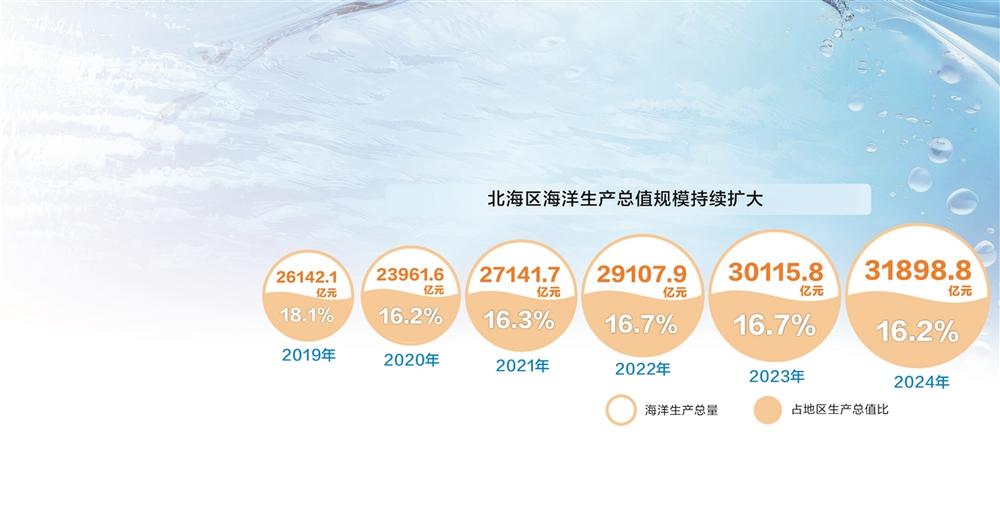
Core Insights - The northern marine economy is experiencing high-quality development, with significant contributions from the provinces of Shandong, Liaoning, Hebei, and the municipality of Tianjin [4][5]. Group 1: Marine Economic Performance - In 2024, the marine GDP of the northern marine economic zone reached 31,898.8 billion yuan, with a nominal growth rate of 5.9%, accounting for 16.2% of the regional GDP and 30.3% of the national marine GDP [5]. - Shandong Province's marine GDP surpassed 18,011.8 billion yuan, growing by 6.1% year-on-year, contributing 23.9% to the province's economic growth [6]. - Hebei Province's port cargo throughput exceeded 1.4 billion tons for the first time in 2024, with Tangshan Port handling 862 million tons, marking a 2.37% increase from the previous year [9]. Group 2: Sector Contributions - The marine tourism industry is the dominant sector in the northern marine economy, contributing 30.8% to the marine industry value added in the northern region [5]. - In Shandong, the marine fishery, marine product processing, marine mining, marine salt, and marine chemical industries all ranked first nationally in value added [6]. - In Tianjin, the marine oil and gas industry achieved a value added of 1,280.3 billion yuan, accounting for 41.7% of the city's marine industry value added [13]. Group 3: Growth Drivers and Innovations - The marine shipbuilding industry in the northern region saw the highest growth rate at 28.5% year-on-year [5]. - Shandong has developed a robust marine biopharmaceutical industry, holding over 50% of the national market share and ranking first in value added for three consecutive years [8]. - Liaoning Province is focusing on clean marine energy, with wind and solar power installations exceeding 50% of total energy capacity [11][12]. Group 4: Future Outlook - Hebei plans to accelerate port project construction with an investment of 8.5 billion yuan in 2025, aiming to enhance its port capacity significantly [10]. - Tianjin's cruise economy is rapidly growing, with a 67% increase in cruise ship entries and a 93% rise in passenger numbers from May 2024 to May 2025 [14].
上半年我国海洋生产总值5.1万亿元
Yang Shi Wang· 2025-08-04 12:27
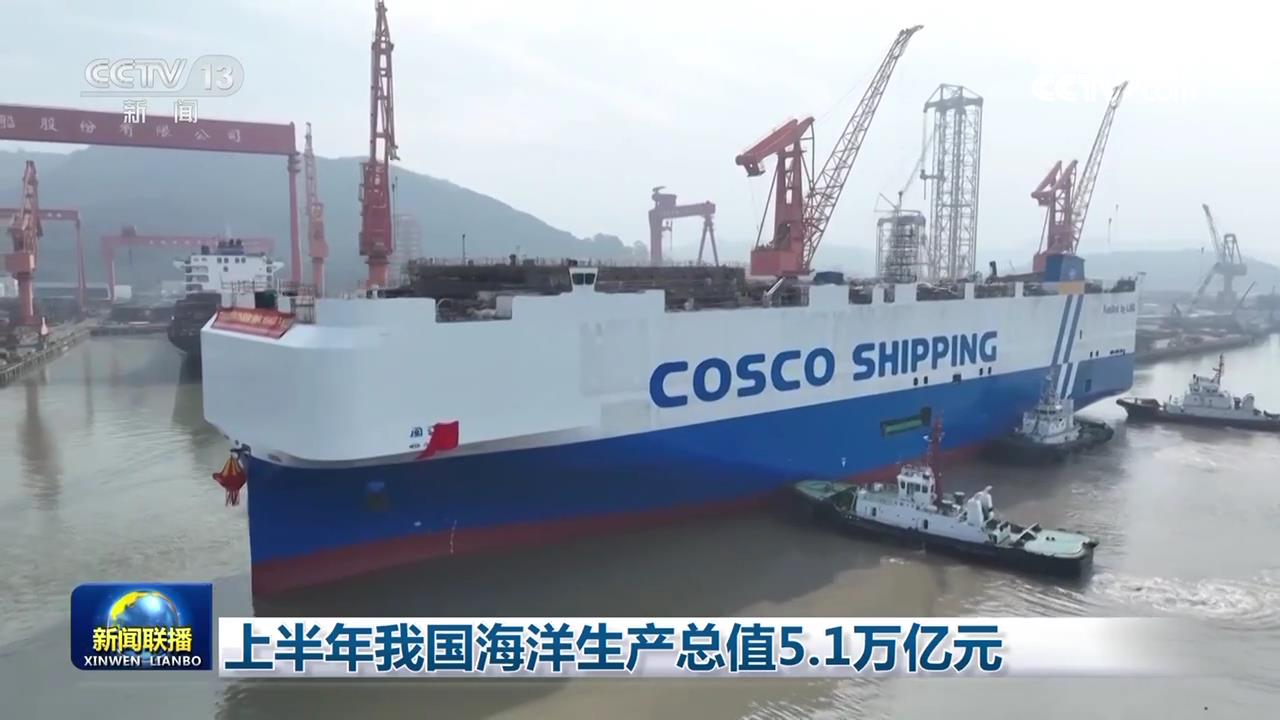
Group 1 - The core viewpoint is that China's marine economy is showing steady growth, with a marine production value of 5.1 trillion yuan, representing a year-on-year increase of 5.8% [1] Group 2 - The development of emerging marine industries is positive, with marine engineering equipment deliveries and hand-held order amounts increasing by 39.3% and 9.7% respectively [3] Group 3 - Traditional marine industries continue to play a stabilizing role, with the marine shipbuilding industry's international market share remaining strong. The marine tourism industry's added value reached 771.8 billion yuan, growing by 8% year-on-year. The resilience of the marine transportation industry is evident, with marine freight volume and cargo turnover increasing by 5.2% and 6.9% respectively [4] Group 4 - The supply capacity of marine resource factors is steadily improving, with a newly approved area for marine and island use of 167,000 hectares, a year-on-year increase of 25.2%. The capacity for marine clean energy is also on the rise, with new offshore wind power grid-connected capacity and power generation increasing by 199.4% and 2.2% respectively. The construction of the "blue granary" is progressing steadily, with domestic marine aquaculture production increasing by 4.8% year-on-year [6]
上半年我国海洋生产总值同比增长近六成
Zhong Guo Zi Ran Zi Yuan Bao· 2025-08-04 01:41
Core Viewpoint - The marine economy in China has shown resilience and positive growth in the first half of the year, with a marine production value reaching 5.1 trillion yuan, reflecting a year-on-year increase of 5.8% [1] Marine Resource Supply Capacity - The newly approved marine and island area reached 167,000 hectares, marking a year-on-year increase of 25.2%, with project investments exceeding 500 billion yuan [1] - Marine crude oil and natural gas production increased by 2.3% and 16.9% respectively [1] - The capacity and generation of offshore wind power saw significant growth, with new grid-connected capacity increasing by 199.4% and generation by 2.2% [1] - The domestic marine aquaculture production increased by 4.8% [1] Traditional Marine Industries - The marine shipbuilding industry maintained a leading position in the international market, with new orders, completed orders, and hand-held orders accounting for 64.0%, 47.2%, and 57.6% of the global total respectively [1] - The added value of the marine tourism industry grew by 8.0%, with cruise ports receiving 40.1% more passengers year-on-year [1] - The marine transportation sector demonstrated resilience, with marine freight volume and cargo turnover increasing by 5.2% and 6.9% respectively [1] Emerging Marine Industries - The delivery and hand-held order value of marine engineering equipment increased by 39.3% and 9.7% respectively [1] - Qingdao has released a "Starfish Model" for marine drug research and development [1] - The megawatt-level generator "Fengjin" has been continuously operating for over three years [1]
上半年海洋经济稳中向好
Ren Min Ri Bao· 2025-08-03 19:06
Core Insights - The marine economy in China showed resilience in the first half of the year, with a gross marine product of 5.1 trillion yuan, reflecting a year-on-year growth of 5.8% despite external pressures [1] Group 1: Traditional Marine Industries - The marine shipbuilding industry maintained a leading position in the international market, with new orders, completed orders, and hand-held orders accounting for 64.0%, 47.2%, and 57.6% of the global market, respectively [1] - The marine tourism sector experienced an 8.0% increase in added value, with cruise ports receiving 40.1% more passengers compared to the previous year [1] - The marine transportation sector demonstrated resilience, with marine cargo volume and cargo turnover increasing by 5.2% and 6.9%, respectively [1] Group 2: Emerging Marine Industries - The offshore engineering equipment construction market in China continued to lead globally, with new order value, delivered order value, and hand-held order value representing 64.6%, 43.3%, and 62.6% of the international market, respectively [2] - The supply capacity of marine resources steadily improved, with a 25.2% year-on-year increase in newly approved marine and island areas, involving investments exceeding 500 billion yuan [2] - Marine oil and natural gas production increased by 2.3% and 16.9%, respectively, while offshore wind power saw a remarkable growth in new grid-connected capacity and generation, increasing by 199.4% and 2.2% [2] Group 3: Business Outlook and Trade - A significant proportion of marine enterprises reported positive expectations for production and operations, with 87.6% of companies optimistic or neutral about the economic environment in the second half of the year [3] - Marine foreign trade remained stable, with a 1.1% year-on-year increase in maritime import and export volume, showing resilience amid challenging international conditions [3] - High-end, intelligent, and green marine products continued to show competitive advantages, contributing to export growth, with ship and wind turbine exports increasing by 20.0% and 13.7%, respectively [3]