电动汽车充电

Search documents
国家能源局:截至1月底我国电动汽车充电基础设施总数达2069.8万个
Xin Hua Cai Jing· 2026-02-27 07:02
Core Insights - The National Energy Administration of China reported that as of January 2026, the total number of electric vehicle charging facilities reached 20.698 million, representing a year-on-year growth of 49.6% [1] Summary by Category Overall Charging Infrastructure - The total number of electric vehicle charging infrastructure (guns) in China reached 20.698 million, with a year-on-year increase of 49.6% [1] Public Charging Facilities - Public charging facilities accounted for 4.801 million guns, showing a year-on-year growth of 31.2% [1] - The total rated power of public charging facilities reached 226 million kilowatts, with an average power of approximately 47.01 kilowatts [1] Private Charging Facilities - Private charging facilities comprised 15.897 million guns, reflecting a year-on-year increase of 56.1% [1] - The installed electricity capacity for private charging facilities reached 138 million kilovolt-amperes [1]
截至2026年1月底 我国电动汽车充电基础设施总数达2069.8万个
Yang Shi Xin Wen· 2026-02-27 06:45
Core Insights - As of January 2026, China's electric vehicle charging infrastructure has reached a total of 20.698 million charging points, representing a year-on-year growth of 49.6% [1] Summary by Category Total Charging Infrastructure - The total number of electric vehicle charging points in China is 20.698 million, with a year-on-year increase of 49.6% [1] Public Charging Facilities - Public charging facilities account for 4.801 million points, showing a year-on-year growth of 31.2% [1] Private Charging Facilities - Private charging facilities comprise 15.897 million points, with a significant year-on-year increase of 56.1% [1]
1月我国电动汽车充电基础设施(枪)总数达到2069.8万个,同比增长49.6%
Jin Rong Jie· 2026-02-27 06:23
Core Insights - The National Energy Administration released data on electric vehicle charging facilities in China as of January 2026, indicating significant growth in infrastructure [1] Summary by Categories Overall Infrastructure Growth - The total number of electric vehicle charging facilities reached 20.698 million, representing a year-on-year increase of 49.6% [1] Public Charging Facilities - Public charging facilities accounted for 4.801 million units, with a year-on-year growth of 31.2% [1] - The total rated power of public charging facilities reached 226 million kilowatts, with an average power of approximately 47.01 kilowatts [1] Private Charging Facilities - Private charging facilities totaled 15.897 million units, showing a year-on-year increase of 56.1% [1] - The installed power capacity for private charging facilities reached 138 million kilovolt-amperes [1]
国家能源局:1月底我国电动汽车充电基础设施(枪)总数达2069.8万个 同比增长49.6%
智通财经网· 2026-02-27 06:18
Core Insights - The National Energy Administration released data on electric vehicle charging infrastructure in China as of January 2026, indicating significant growth in the sector [1] Summary by Category Overall Growth - The total number of electric vehicle charging facilities (guns) in China reached 20.698 million, representing a year-on-year increase of 49.6% [1] Public Charging Facilities - Public charging facilities accounted for 4.801 million guns, with a year-on-year growth of 31.2% [1] - The total rated power of public charging facilities reached 226 million kilowatts, with an average power of approximately 47.01 kilowatts [1] Private Charging Facilities - Private charging facilities comprised 15.897 million guns, showing a year-on-year increase of 56.1% [1] - The installed electricity capacity for private charging facilities reached 13.8 million kilovolt-amperes [1]
1月底我国电动汽车充电基础设施(枪)总数达2069.8万个 同比增长49.6%
Jin Rong Jie· 2026-02-27 06:17
Group 1 - The total number of electric vehicle charging infrastructure (units) in China reached 20.698 million by the end of January 2026, representing a year-on-year growth of 49.6% [1] - Public charging facilities (units) accounted for 4.801 million, with a year-on-year increase of 31.2%, and the total rated power of public charging facilities reached 226 million kilowatts, averaging approximately 47.01 kilowatts [1] - Private charging facilities (units) totaled 15.897 million, showing a year-on-year growth of 56.1%, with the installed electricity capacity for private charging facilities reaching 13.8 million kilovolt-amperes [1]
特锐德递表港交所 为全球最大的高压预制舱变电站制造商
Zhi Tong Cai Jing· 2026-02-26 23:15
Company Overview - The company, Teruid, is a leading provider of prefabricated substations, transformers, switchgear, and electric vehicle (EV) charging equipment, involved in the research, manufacturing, sales, and operation of EV charging networks [2] - Teruid is recognized as the largest global supplier of prefabricated substations and the largest supplier of high-voltage prefabricated substations, with cumulative sales of 1,242 high-voltage prefabricated substations during the reporting period [2] - The company plays a significant role in the construction of China's new power system, possessing full-chain technology for the research, manufacturing, and operation of high-voltage prefabricated substations and EV charging [2] Electric Vehicle Charging - Teruid's smart EV charging equipment integrates efficient energy replenishment and bidirectional energy interaction, providing safe and convenient charging services through proprietary safety technology and big data platforms [3] - The company has established a global sales network, with its power equipment sold in over 60 countries and regions, and is constructing an overseas headquarters for intelligent manufacturing of high-voltage prefabricated substations in Qingdao [3] Financial Data - For the fiscal years ending October 31, 2023, 2024, and 2025, the company reported revenues of approximately RMB 12.69 billion, RMB 15.37 billion, and RMB 11.33 billion, respectively [6] - The net profit for the same periods was RMB 527 million, RMB 939 million, and RMB 835 million, respectively [6] - The gross profit margins for 2023, 2024, and 2025 were 26.2%, 25.9%, and 26.8%, respectively [7] Market Growth - The global market for prefabricated substations is projected to grow from RMB 31 billion in 2020 to RMB 81.5 billion by 2024, with a compound annual growth rate (CAGR) of 27.3% [8] - The high-voltage prefabricated substation market is expected to reach RMB 5.6 billion in 2024 and RMB 52.6 billion by 2030, with a CAGR of 45.2% from 2024 to 2030 [8] - The EV charging network market in mainland China is anticipated to grow from RMB 40.4 billion in 2024 to approximately RMB 203.4 billion by 2030, with a CAGR of 30.9% [9]


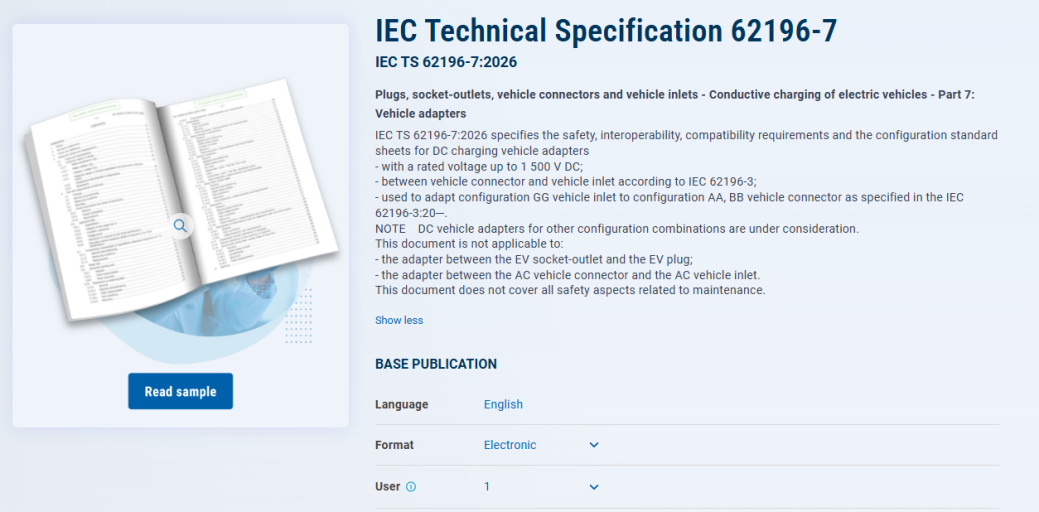
南瑞牵头编制的国际标准《电动汽车传导式充电车辆适配器》正式发布
Zhong Guo Neng Yuan Wang· 2026-02-26 09:56
Core Viewpoint - The release of the international standard IEC TS62196-7:2026 for electric vehicle conductive charging vehicle adapters marks a significant step in addressing compatibility issues and establishing a global charging technology ecosystem led by China [1][5]. Group 1: Standard Overview - The standard focuses on core technical specifications for direct current charging vehicle adapters, detailing safety, interoperability requirements, and supporting testing methods [5]. - IEC TS62196-7 specifies technical indicators with a rated voltage of up to 1500V DC, primarily applicable to adapters connecting vehicles compliant with the IEC62196-3 standard [5]. - The standard provides strict definitions for adapters between vehicles equipped with the GG (ChaoJi interface) socket and typical vehicle plugs used in Japan and China, enhancing the usability of existing DC charging networks [5][6]. Group 2: Technical and Strategic Implications - The release of IEC TS62196-7 offers a technical solution to the physical interface compatibility challenge and is a key component in building a compatible system with existing global charging standards [6]. - Ongoing discussions by IEC TC69MT5 and PT17 working groups on complementary System D requirements and multi-system compatibility will further enhance the standard's effectiveness [6]. - The successful publication of this standard highlights the technical expertise and international influence of the State Grid Electric Power Research Institute (NARI Group), which aims to contribute to global charging interface compatibility with high-quality technical solutions [6].

这个春节,好吃、好住、好行、好游、好购、好玩!
Xin Lang Cai Jing· 2026-02-22 00:25
Group 1 - The core theme of the article highlights the vibrant consumption trends during the Spring Festival, showcasing the resilience and vitality of China's consumer market through the "乐购新春" initiative, which encompasses six key areas: food, accommodation, transportation, tourism, shopping, and entertainment [28][29] Group 2 - In the "Food" category, various traditional delicacies and festive activities are emphasized, creating a sense of happiness and togetherness during the New Year celebrations [28] - The "Accommodation" aspect focuses on diverse lodging experiences, enhancing the comfort and warmth of the New Year [28] - The "Transportation" segment illustrates the growing trend of leisure travel, supported by convenient travel options that facilitate festive journeys [28] - The "Tourism" section highlights lively events such as lantern festivals and temple fairs, contributing to a joyful atmosphere [28] - In the "Shopping" category, bustling markets for New Year goods reflect a strong consumer demand, merging traditional flavors with quality consumption [28] - The "Entertainment" aspect showcases the integration of folk performances and modern technology, enriching cultural tourism during the New Year [28]

优步将推出激励措施,推动电动汽车充电桩建设
Xin Lang Cai Jing· 2026-02-18 16:21
Core Viewpoint - Uber announced an incentive policy to encourage the construction of electric vehicle charging stations in the communities where its drivers live and work, aiming to boost the electric vehicle market impacted by recent U.S. policy changes [3][4]. Group 1: Incentive Policy and Impact - Uber will ensure that charging stations installed in driver communities meet minimum usage hours, helping operators recover their investments more quickly [3][4]. - Despite a significant drop in electric vehicle sales due to policy changes, the growth rate of charging station installations reached a historical high last year, partly due to the increasing number of electric vehicle drivers among Uber's 13,000 drivers in New York City [3][4]. - Uber plans to promote the construction of 1,000 charging stations to alleviate the issue of charging accessibility for drivers who cannot charge at home [4][16]. Group 2: Collaboration and Infrastructure Development - Uber is collaborating with European charging company Ionity, which will utilize Uber's data to determine optimal locations for new charging stations [5][16]. - The company announced a $100 million investment to build charging hubs for autonomous electric vehicles, which may pose a threat to Uber's business model [6][16]. - Uber's partnership with EVgo indicates that ride-hailing drivers account for about 25% of the charging volume, up from 10% in 2021, highlighting the growing trend of electrification in ride-hailing services [8][18]. Group 3: Driver Support and Market Trends - Uber provides a $4,000 subsidy for drivers purchasing electric vehicles, contingent on completing at least 100 rides [19]. - A survey by Uber indicates that charging issues are a major barrier to purchasing electric vehicles, despite the lower costs of used electric vehicles compared to gasoline counterparts [18][19]. - The company aims to address the charging needs of renters and urban residents who rely on public charging stations, which are often overcrowded [4][16].

美政府定下目标:100%“美国产”
中国能源报· 2026-02-11 13:11
Core Viewpoint - The U.S. Department of Transportation plans to increase the domestic manufacturing component of federally funded electric vehicle charging stations from 55% to 100%, requiring that all charging station equipment be produced in the U.S. This could create significant barriers to the use of related funds [1]. Group 1 - The Biden administration previously agreed to waive some "Buy American" requirements for a $500 million government funding project to expedite the deployment of charging stations [1]. - The proposed revisions will take effect immediately once finalized, with the Department of Transportation expressing confidence in manufacturers' ability to produce electric vehicle charging equipment domestically [1]. - The initiative aims to protect the American public from potential cybersecurity threats posed by foreign-made electric vehicle charging components [1]. Group 2 - Transportation Secretary Sean Duffy stated that increasing the domestic component requirement will strengthen domestic manufacturing, create new jobs in the U.S., enhance the competitiveness of American businesses, and address potential national security concerns [1]. - Environmental organization Mountain Club criticized the proposal, claiming it is a deliberate attempt to undermine the project, which could hinder the deployment of electric vehicle charging infrastructure and deprive communities of access to clean and affordable transportation options [2]. - A recent ruling by U.S. District Judge Tana Lin deemed the Trump administration's suspension of funding for electric vehicle charging infrastructure expansion illegal, marking a victory for 20 Democratic-led states involved in the lawsuit [2].