移动应用

Search documents
占星App不务正业后,更加赚钱了
创业邦· 2025-12-24 00:03
Core Insights - The article discusses the evolution of astrology applications, highlighting two prominent examples: "CHANI" and "Stardust," which represent different approaches to integrating astrology into daily life [5][20]. Group 1: CHANI - "CHANI" has transformed from a traditional astrology app into a lifestyle platform by incorporating self-care features such as meditation and affirmations, moving beyond mere entertainment [5][7]. - In the last 30 days, "CHANI" generated $832,500 in revenue, reflecting a year-on-year growth of 15.17%, positioning it among the top-earning astrology apps in the U.S. [5]. - The app's structure allows for scalable and subscription-based emotional support, previously offered by human astrologers, thus broadening its market appeal [11][13]. - "CHANI" emphasizes the personal touch in its content, with all materials created by Chani Nicholas and professional astrologers, avoiding AI-generated content to maintain a human connection [13]. Group 2: Stardust - "Stardust" takes a different approach by focusing on a high-frequency need—menstrual tracking—while integrating astrology elements, thus creating a unique user experience [15][20]. - The app connects menstrual cycles with lunar cycles, providing users with personalized insights and lifestyle recommendations, enhancing the ritualistic aspect of tracking [17]. - "Stardust" includes a partner feature that allows users to share menstrual information with their partners, fostering better understanding and communication in relationships, which has proven popular among users [18]. Group 3: Market Trends - Both "CHANI" and "Stardust" illustrate a shift in astrology app usage from merely checking horoscopes to incorporating astrology into everyday life, reflecting a broader trend towards lifestyle integration [20].


海南:22款App违法违规收集使用个人信息被责令限期整改
Zhong Guo Xin Wen Wang· 2025-12-23 03:30
Core Viewpoint - The Hainan Provincial Internet Information Office has identified 22 mobile applications that illegally collect and use personal information, mandating these apps to rectify their practices by a specified deadline [1][2]. Group 1: Findings from the Inspection - A concentrated inspection conducted in the fourth quarter of 2025 revealed that 22 apps, including "Toca Life: World," "Hobo Simulator 2," and "Rust Wars Box," exhibited various illegal behaviors such as unauthorized collection, excessive data gathering, and lack of clear purpose statements for data collection [1]. - The identified apps are required to implement corrective measures to address these violations [1]. Group 2: Regulatory Measures and Future Actions - The Hainan Provincial Internet Information Office emphasizes that mobile app operators must adhere to legal regulations and principles of legality, necessity, and integrity while protecting user personal information [2]. - In 2026, the Hainan provincial authorities will continue to conduct regular inspections and governance of personal information protection in mobile applications, especially in light of increased cross-border data flow and user rights protection needs following the full closure of the Hainan Free Trade Port [2].
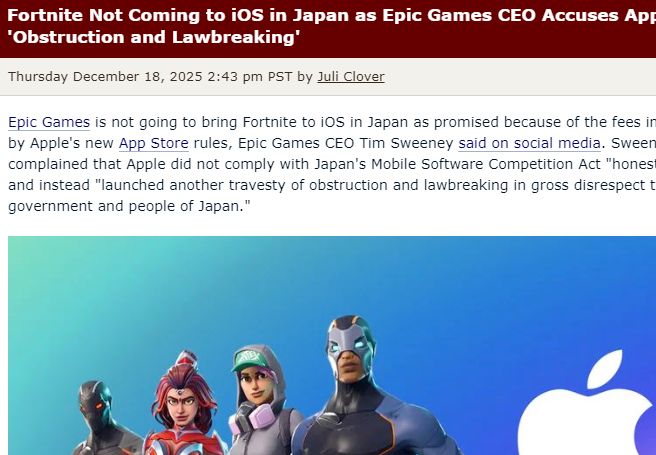
《堡垒之夜》放弃日本iOS,Epic硬刚苹果指控违法
Huan Qiu Wang Zi Xun· 2025-12-19 03:08
Group 1 - Epic Games CEO Tim Sweeney announced that the company will not be able to launch Fortnite on the iOS platform in Japan by the end of 2025 due to high fees imposed by Apple's new App Store rules [1][4] - The new rules require Epic to pay a 5% revenue share if distributing games through alternative app stores, or a 5% fee on in-app purchases or a 15% fee for digital purchases via web links if using the Apple App Store [4] - Sweeney criticized Apple for abusing its market position, hindering normal transactions between developers and users, and failing to create genuine competition, which ultimately harms consumer interests [4] Group 2 - The situation arose following the passage of Japan's Mobile Software Competition Law in 2024, which initially led Sweeney to optimistically announce Fortnite's entry into the Japanese iOS market [4] - Apple responded by stating that it had fully cooperated with Japanese regulatory authorities during the formulation of the new rules, asserting compliance with local regulations [4]

过度收集信息,应用程序岂能变身“隐私刺客”?
Ren Min Ri Bao· 2025-12-14 04:12
Core Viewpoint - The National Cybersecurity Notification Center reported that 69 mobile applications are involved in illegal collection and use of personal information, reflecting a severe situation in personal information protection with over 200 applications reported this year alone [1] Group 1: Current Situation - The frequent reports of violations indicate a persistent issue of excessive collection, improper use, and illegal trading of personal information [1] - The phenomenon of "privacy assassins" disrupts daily life through spam calls and targeted advertisements, often violating laws and regulations [1] Group 2: Legal Framework and User Consent - The Personal Information Protection Law mandates that personal information processing must adhere to principles of legality, legitimacy, necessity, and integrity, requiring individual consent [1] - In practice, the concept of "informed consent" is often easily breached, with vague app information authorization agreements leading to user confusion [1] Group 3: Recommendations for Improvement - Merely naming and reporting violators is insufficient; significant penalties and app removals are necessary to deter violations [2] - Users should shift from passive acceptance to active protection by cautiously authorizing apps to access personal information and regularly checking usage [2] Group 4: Long-term Strategies - Continuous regulatory oversight is essential, including the introduction of third-party organizations to supervise app privacy policies and dismantle illegal operations [2] - Companies must proactively identify security risks and integrate personal information protection into their product development processes [2] - Building user trust is crucial, as companies that disregard user privacy will ultimately be rejected by the market [2]
苹果(AAPL.US)与Epic拉锯战上诉失败 禁止27%佣金但准许知识产权费
Zhi Tong Cai Jing· 2025-12-12 02:09
Core Viewpoint - Apple Inc. has faced a setback in its legal battle against a ruling that found it in contempt of court, but it has gained an opportunity to defend its practice of charging developers fees for transactions outside the App Store [1][2]. Group 1: Legal Proceedings - A federal appeals court upheld a previous ruling that Apple had willfully disobeyed a judge's order regarding its monopolistic practices under California law [1][2]. - The court indicated that the lower court had overstepped by prohibiting all commissions, suggesting that Apple is entitled to some compensation for the use of its intellectual property by developers [1][2]. Group 2: Financial Implications - Apple generates billions annually from digital sales commissions in its App Store, with estimates suggesting it earned $10 billion from its U.S. App Store in 2024 [2]. - The company has facilitated over $400 billion in developer sales in 2024, although it does not separately report App Store revenue [2]. Group 3: Ongoing Disputes - The legal dispute, initiated by Epic Games over competition in the App Store, has been ongoing for over five years, with Apple previously allowing developers to direct users to cheaper payment options but imposing a new 27% commission on such transactions [2][3].
国家网络与信息安全信息通报中心通报69款违法违规收集使用个人信息的移动应用
Yang Shi Wang· 2025-12-05 05:51
Core Viewpoint - The National Cybersecurity and Information Security Information Notification Center reported that 69 mobile applications were found to illegally collect and use personal information, violating laws such as the Cybersecurity Law and the Personal Information Protection Law [1][2][3]. Group 1: Non-compliance with Privacy Policies - 15 mobile applications failed to clearly inform users about the collection and use of personal information at the first run, including the lack of accessible privacy policies [1]. - 39 mobile applications did not list the purposes, methods, and scope of personal information collection in their privacy policies [2]. - 15 mobile applications did not inform users about the recipients of their personal information when shared with other processors, nor did they obtain separate consent [3]. Group 2: User Consent and Rights - 3 mobile applications began collecting personal information without obtaining user consent [4]. - 8 mobile applications did not provide effective means for users to correct, delete personal information, or cancel their accounts, or set unreasonable conditions for these actions [5]. - 3 mobile applications failed to process complaints and reports within the promised timeframe and did not establish a convenient mechanism for users to exercise their rights [6]. Group 3: Withdrawal of Consent - 35 mobile applications did not provide users with a way to withdraw consent for the collection of personal information [7]. Group 4: Automated Decision-Making and Sensitive Information - 5 mobile applications used automated decision-making for information push and marketing without providing options to refuse or not targeting personal characteristics [8]. - 1 mobile application did not inform users about the necessity and impact of processing sensitive personal information [8]. Group 5: Security Measures - 21 mobile applications did not implement appropriate security measures such as encryption or de-identification [8]. Group 6: Absence of Privacy Policies - 2 mobile applications were found to have no privacy policy at all [8].
关注!这40款移动应用违法违规收集使用个人信息
Bei Jing Ri Bao Ke Hu Duan· 2025-11-17 08:14
Core Viewpoint - The Ministry of Public Security's Computer Information System Security Product Quality Supervision and Inspection Center has detected 40 mobile applications that illegally collect and use personal information, violating laws such as the Cybersecurity Law and the Personal Information Protection Law [1][2][3][4][5][6][7][8][9][10][11][12][13][14] Group 1: Violations of Personal Information Collection - 16 applications failed to list the purposes, methods, and scope of personal information collection [1] - 1 application did not inform users of the purpose when requesting permission to collect personal information [2] - 2 applications began collecting personal information before obtaining user consent [3] - 16 applications collected personal information beyond the scope authorized by users [4] - 1 application described the need for personal information collection beyond the necessary range in its privacy policy [5] Group 2: Inadequate User Rights and Options - 2 applications had permissions for collecting personal information that exceeded the necessary range for their functions [6] - 10 applications collected personal information beyond the necessary range for their functions [7] - 5 applications did not provide users with a channel or function for complaints regarding personal information [8] - 3 applications did not offer users a way to correct or supplement their personal information [9] - 3 applications did not provide users with a specific way to delete their personal information [9] - 1 application did not offer a way to cancel user accounts [10] - 1 application set unreasonable conditions or additional requirements in the account cancellation process [11] - 1 application did not provide an option to exit or close personalized display modes [12] Group 3: Misleading Advertising - 2 applications were found to have misleading or deceptive advertising practices [13]
唱吧APP,被通报
Nan Fang Du Shi Bao· 2025-11-11 15:28
Core Insights - The Ministry of Industry and Information Technology (MIIT) has initiated a governance campaign against illegal collection and use of personal information by apps and SDKs [1] - A total of 39 apps and SDKs were found to infringe on user rights, including well-known software such as "Changba" [1] - The main issue with "Changba" was the illegal collection of personal information, with the software being sourced from the XPeng in-car application store [1] Summary of Issues - The reported violations include mandatory use of targeted push notifications, lack of clear disclosure on personal information collection, forced automatic renewals, excessive collection of personal information, and default consent to privacy policies [1] - MIIT has mandated that the identified apps and SDKs must rectify their issues in accordance with relevant regulations [1] - Non-compliance with the rectification requirements will lead to legal and regulatory actions by MIIT [1]
70款移动应用被通报!有没有你常用的→
Xin Hua Wang· 2025-11-02 02:56
Core Points - The article highlights the detection of 70 mobile applications that violate personal information protection laws, as mandated by the Cybersecurity Law and the Personal Information Protection Law [2][3][4] Group 1: Violations in User Notification - 23 mobile applications failed to clearly inform users about the collection and use of personal information at the first run, including the lack of accessible privacy policies [2] - 24 mobile applications did not specify the purposes, methods, and scope of personal information collection in their privacy policies [3] Group 2: Consent and Information Sharing - 14 mobile applications shared personal information with third parties without user consent or proper anonymization [5] - 5 mobile applications began collecting personal information without obtaining user consent first [6] Group 3: User Rights and Complaint Handling - 4 mobile applications did not provide effective mechanisms for users to correct, delete personal information, or cancel their accounts [6] - 2 mobile applications failed to process complaints and reports within the promised timeframe [6] Group 4: Withdrawal of Consent - 23 mobile applications did not offer users a way to withdraw consent for personal information collection [6] Group 5: Automated Decision-Making and Sensitive Information - 3 mobile applications used automated decision-making for marketing without providing options to refuse [7] - 1 mobile application did not inform users about the necessity and impact of processing sensitive personal information [7] Group 6: Minor Protection and Security Measures - 13 mobile applications did not have specific rules for processing information of minors or obtain parental consent [8] - 34 mobile applications lacked adequate security measures such as encryption or de-identification [8] Group 7: Absence of Privacy Policies - 9 mobile applications were found to have no privacy policy at all [9] Group 8: Follow-up on Previous Violations - 28 out of 69 previously reported applications still exhibited violations upon re-examination, leading to their removal from distribution platforms [9]

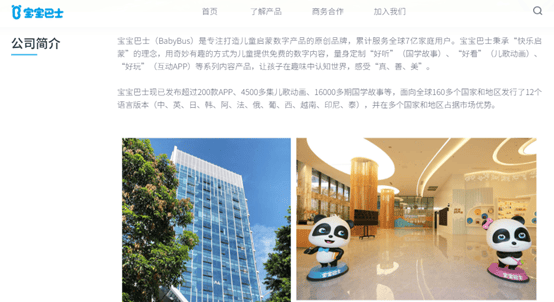
ESG解读|宝宝巴士广告审核形同虚设,甩锅第三方审核,长效预防机制空转
Sou Hu Cai Jing· 2025-10-30 10:43
Core Viewpoint - BabyBus is facing a significant backlash due to inappropriate advertisements appearing on its app, which have raised concerns about the safety and content management practices of the company [3][5][10]. Group 1: Incident Overview - Multiple parents reported that the BabyBus app displayed ads that automatically redirected to inappropriate content, including adult-themed live streams and explicit stories [3][5]. - The incident is not isolated; similar complaints were made over a year ago regarding misleading ad designs that led to unwanted app downloads [5][10]. - BabyBus acknowledged the issue and issued an apology, committing to remove all ads, hold responsible parties accountable, and enhance their technology to filter inappropriate content [6][10]. Group 2: Advertising and Content Management Issues - The company's revenue model heavily relies on advertising, which has exposed vulnerabilities in their ad review and management processes [7][10]. - The design of the ad close buttons was criticized for being too small and poorly placed, making it easy for children to accidentally engage with inappropriate content [8][10]. - Despite claims of having mechanisms to prevent accidental clicks, these features were found to be ineffective, allowing children to access harmful material [8][9]. Group 3: Data Security and Compliance Concerns - The incident has raised alarms about potential data security risks, as the app may collect sensitive information through third-party ads, leading to privacy violations [9][10]. - BabyBus's failure to effectively manage third-party ad content reflects a broader issue of compliance and governance within the company [10][11]. - The delayed response to the incident, with over 24 hours passing before an official apology was issued, indicates a lack of proactive measures in addressing user concerns [11][14]. Group 4: Trust and Reputation Challenges - The company's reliance on a "traffic-first" approach has led to significant trust issues among users, as the response to the incident has been seen as inadequate [10][14]. - Current measures to rectify the situation focus primarily on technical fixes rather than addressing the underlying profit-driven logic that prioritizes ad revenue over user safety [14].