
新一代信息技术

Search documents
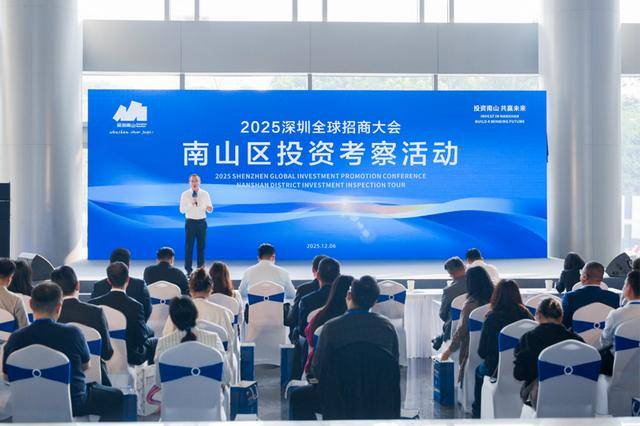
全球企业探营南山,解锁“创新沃土”投资价值
Sou Hu Cai Jing· 2025-12-06 12:27
Core Insights - The Shenzhen Global Investment Conference held on December 5, 2025, attracted over 50 Fortune 500 companies and other enterprises, showcasing Nanshan's development environment and entrepreneurial ecosystem [3][5] - Nanshan is positioning itself as a hub for innovation and investment, emphasizing its supportive business environment and strategic focus on emerging industries [5][12] Group 1: Event Overview - The event served as a platform for global enterprises to explore investment opportunities in Nanshan, highlighting the area's commitment to innovation and collaboration [3][5] - Participants visited key sites such as Nanshan Smart City and Honghualing Base, which exemplify the region's industrial development [5][10] Group 2: Infrastructure and Development - Nanshan Smart City is designed to foster innovation in information technology, artificial intelligence, and biomedicine, featuring a unique spatial ecosystem [8] - Honghualing Base, covering 118,000 square meters with a total construction area of 992,000 square meters, provides high-quality development spaces for enterprises [10] Group 3: Policy and Support - Nanshan has established a comprehensive policy support system that integrates funding, talent, space, and services to assist enterprises throughout their lifecycle [12] - Recent initiatives include the "Six Coupons" and "Six Ones" policies, which target various stages of business development and talent acquisition [12] Group 4: Future Prospects - Nanshan is focusing on strategic emerging industries such as artificial intelligence, biomedicine, and robotics, aiming to enhance its competitive edge and attract global talent [12] - The district has successfully introduced 378 key projects with a total investment exceeding 150 billion yuan, indicating a steady increase in investment scale compared to the previous year [12]

【锋行链盟】A股创业板借壳上市流程及核心要点
Sou Hu Cai Jing· 2025-12-06 04:48
Group 1 - The core viewpoint of the article is that the China A-share market has allowed backdoor listings on the ChiNext board for certain high-tech and strategic emerging industries, breaking the previous prohibition against such practices [1][3] Group 2 - The policy background for backdoor listings includes the revised "Major Asset Restructuring Management Measures" and the China Securities Regulatory Commission's decision to allow certain high-tech assets to be injected into ChiNext listed companies [3] - The core thresholds for backdoor listings on ChiNext require the shell company to be a legally existing ChiNext listed company, with injected assets belonging to high-tech industries and meeting specific financial criteria [3][4] Group 3 - The operational process for backdoor listings involves several stages, including preliminary preparations, control acquisition, major asset restructuring, and post-restructuring integration and information disclosure [3][5] - Key considerations for successful backdoor listings include compliance with national strategic policies, asset quality, clean shell resources, genuine transactions, regulatory communication, and integration capabilities [4][5] Group 4 - The requirements for injected assets are equivalent to IPO standards, necessitating significant profitability and operational compliance [5] - The regulatory environment is stringent, with few successful cases since the policy change, indicating a high level of scrutiny from regulators [5][6] Group 5 - Notable cases include Aisikai, which attempted a backdoor listing but was ultimately terminated due to compliance issues, and Puli Sheng, which successfully completed a backdoor listing in 2022 [5]


深交所专精特新“小巨人”集群崛起 以创新动能夯实高质量发展根基
Zheng Quan Shi Bao Wang· 2025-12-05 02:24
Core Insights - Since 2025, the Shenzhen Stock Exchange has added 20 "Little Giant" enterprises, accounting for 51.28% of the newly listed companies during the same period, highlighting the growth of innovative companies in niche sectors that contribute to industrial upgrades [1][4] - As of October 31, 2025, there are 533 specialized and innovative "Little Giant" companies listed on the Shenzhen Stock Exchange, representing 18.54% of all A-share companies, with a total market capitalization of 3.81 trillion yuan, which is 8.95% of the total market capitalization of the Shenzhen Stock Exchange [1][6] Financial Performance - In the first three quarters of 2025, the 533 "Little Giant" companies achieved a total operating income of 568.32 billion yuan, a year-on-year increase of 9.91%, surpassing the overall growth rate of 5.5% for the Shenzhen Stock Exchange [2] - The net profit for these companies reached 44.52 billion yuan, with a year-on-year growth of 8.18%, indicating strong operational resilience [2] - 83.49% of the "Little Giant" companies reported both revenue and profit growth, with 46 companies achieving over 30% growth in both metrics [2] Market Performance - As of October 31, 2025, the price-to-earnings ratio for "Little Giant" companies on the Shenzhen Stock Exchange was 161.16 times, with an average market capitalization of 7.16 billion yuan, and 89 companies exceeding 10 billion yuan in market value [3] - The average daily turnover rate for these companies was 8.30%, higher than the overall Shenzhen market and the entire A-share market [3] - From January to October 2025, 487 "Little Giant" companies saw their stock prices increase, representing 91.37% of the total [3] Financing Support - To assist "Little Giant" companies in overcoming financing challenges, the Shenzhen Stock Exchange has provided multi-faceted support, including listing cultivation and refinancing [4] - Since 2025, 15 "Little Giant" companies completed targeted placements, raising a total of 12.23 billion yuan, with notable contributions from companies like Fulede and Hualing Cable [4] Index Development - The Shenzhen Stock Exchange launched the Shenzhen Specialized and Innovative Index and the ChiNext Specialized and Innovative Index on July 7, 2025, to reflect the performance of specialized and innovative companies [5][6] - As of October 31, 2025, the total market capitalization of these indices was 1.83 trillion yuan and 1.60 trillion yuan, with average daily trading volumes of 52.6 billion yuan and 50.5 billion yuan, respectively [5][6] - Since their launch, these indices have seen significant growth, with cumulative increases of 99.88% and 112.15%, outperforming the CSI 300 Index [5][6]
《2025中国民营企业国际化发展报告》发布 民企出海表现持续向好
Ren Min Wang· 2025-12-03 07:31
Core Insights - The report indicates that China's private enterprises are expanding their overseas operations, with a total overseas revenue of 52,149.66 billion yuan, reflecting an increase of 11.93% year-on-year [1] - The overall operating efficiency remains stable, with most industries reporting profitability; the net profit of internationalized private enterprises reached 21,087.99 billion yuan, up by 2.78% [1] - There is significant growth in export trade and direct foreign investment, particularly in traditional industries, new energy vehicles, lithium battery sectors, and new-generation information technology, which are maintaining high investment growth rates [1] - Research and development investments are continuously increasing, leading to a notable enhancement in innovation capabilities; by the end of last year, internationalized private enterprises held 67,669 valid international invention patents, an increase of 11.32% [1]
深市指数焕新 筑牢价值投资“压舱石”
Jin Rong Shi Bao· 2025-12-03 02:24
相较之下,创业板指作为新质生产力的强引擎,聚焦于研发驱动的高成长性新兴产业,创新发展势 头更为强劲。三季报数据显示,新一期样本公司2025年前三季度营业收入、净利润同比分别增长16%、 24%,其中,高端装备制造、新能源产业净利润同比分别增长60%、54%。 据悉,本次调整将于12月15日正式实施,深证成指将更换17只样本股,调入主板公司7家、创业板 公司10家;创业板指将更换8只样本股;深证100将更换7只样本股,调入主板公司4家、创业板公司3 家;创业板50将更换5只样本股。 "强引擎"推动新质生产力发展 目前,深市上市公司已整体呈现出业绩稳中向好、战略性新兴产业增长强劲、科技创新驱动特征显 著的态势,是新质生产力发展的重要策源地。据统计,调整后的创业板指战略性新兴产业权重占比将达 93%。根据今年三季报数据,新一期样本公司前三季度研发费用同比增速为13%,研发费用占营业收入 比重为5%,其中30家公司研发强度超10%。 与此同时,本次调整后,深证100新质蓝筹属性将更为突出,战略性新兴产业权重提升至81%,先 进制造、数字经济、绿色低碳等重点领域权重提升至79%;创业板50战略性新兴产业权重则达到98% ...
《2025中国民营企业国际化发展报告》发布
Ren Min Wang· 2025-12-03 02:00
Group 1 - The report indicates that the scale of overseas operations of Chinese private enterprises has further expanded, with an increase in internationalization level, as the total overseas income of internationalized private enterprises reached 52,149.66 billion yuan, growing by 11.93% [1] - The overall operating efficiency remains stable, with most enterprises in various industries being profitable. Last year, internationalized private enterprises achieved a net profit of 21,087.99 billion yuan, an increase of 2.78% [1] - There has been a significant growth in export trade, and the scale of foreign direct investment is large, with traditional industries, the new energy vehicle industry, the lithium battery industry, and the new generation information technology industry maintaining a high growth rate in foreign investment [1] Group 2 - Research and development investment continues to increase, with a significant enhancement in innovation capabilities. By the end of last year, internationalized private enterprises held 67,669 valid international invention patents, an increase of 11.32% [1]
民企出海表现持续向好
Ren Min Ri Bao· 2025-12-02 20:33
Group 1 - The report indicates that the scale of overseas operations of private enterprises in China has further expanded, with an increase in internationalization level, as the total overseas income of internationalized private enterprises reached 52,149.66 billion yuan, growing by 11.93% [1] - The overall operating efficiency remains stable, with most industries reporting profitability; last year, internationalized private enterprises achieved a net profit of 21,087.99 billion yuan, an increase of 2.78% [1] - There is a significant growth in export trade, and the scale of foreign direct investment is large, with traditional industries, the new energy vehicle industry, the lithium battery industry, and the new generation information technology industry maintaining a high growth rate in foreign investment [1] Group 2 - Research and development investment continues to increase, with a notable enhancement in innovation capabilities; by the end of last year, internationalized private enterprises held 67,669 valid international invention patents, an increase of 11.32% [1]
“湘”约全球校友!湖南吸引投资打出产业实力、开放平台、成本优势“三张牌”
Sou Hu Cai Jing· 2025-12-02 14:25
Core Insights - The "Alumni Return to Hunan" conference was held in Changsha, focusing on promoting investment in key industrial chains in Hunan Province [2] Group 1: Industrial Strength - Hunan Province has cultivated 13 key industrial chains, with the new generation information technology chain being recognized as a national advanced manufacturing cluster, uniquely achieving domestic design for all types of core chips [4] - The green agricultural products and food processing industry chain leads the central region in revenue, while the engineering machinery industry chain ranks first nationwide [4] - The cultural and creative tourism industry chain received over 700 million visitors annually [4] - In the aerospace and Beidou industry chain, small and medium-sized aircraft engines hold a 90% market share, and over 80% of core Beidou technology resources are located in Hunan [4] - Hunan is home to the world's largest rail transit equipment manufacturing base and Asia's largest and most diverse refinery catalyst production base [4] - The province is recognized as the only pilot province for green construction [4] - Hunan leads globally in medium-low speed maglev technology, with over 90% of the system developed independently [5] - The province ranks fifth in the production of new energy vehicles and holds the top market share for positive materials [5] - The intelligent weighing industry chain is the only one co-built by the National Market Supervision Administration and Hunan Province [5] Group 2: Open Platforms - Hunan has established one national-level new area, 19 national-level parks, 8 customs special supervision zones, 7 cross-border e-commerce comprehensive pilot zones, and 3 first-class ports [5] - The province hosts two national-level platforms for China-Africa trade, maintaining the highest trade scale in central and western China for five consecutive years [5] - The free trade pilot zone has achieved 109 institutional innovation results [5] - Hunan has built five international trade corridors, with the number of China-Europe freight trains ranking among the top four nationwide for three consecutive years, allowing goods to reach Europe in 15 days [5] - The Hunan-Guangdong-Nonferrous Sea-Rail Intermodal Transport model reduces shipping time by 10 to 15 days [5] Group 3: Cost Advantages - Hunan features a "low cost + high matching" characteristic, with a unique advantage of "one low, six good, one excellent," making it the lowest in comprehensive operating costs in the central region [5] - The average price of commercial housing in Changsha is 11,000 yuan per square meter, with a housing price-to-income ratio of only 7.4, the lowest among 21 mega cities [5] - Through integrated measures such as source-network-load-storage, electricity costs have been reduced by over 10% [5] - Logistics costs have seen a "ten-year continuous decline," remaining below the national average for four consecutive years [5] Group 4: Investment and Talent Attraction - The "Alumni Return to Hunan" initiative is expected to attract actual investment of 134.172 billion yuan and recruit 2,109 talented individuals from November 2024 to November 2025 [6]

福建星网锐捷通讯股份有限公司关于对外投资设立产业基金暨关联交易的公告
Shang Hai Zheng Quan Bao· 2025-12-01 19:39
Group 1 - The company plans to invest 80 million RMB to establish the Fujian Fojin Xinke Venture Capital Partnership (tentative name) with several partners, focusing on sectors such as semiconductors, artificial intelligence, and new materials, with a total fund size of 300 million RMB [1][43][24] - The investment aims to leverage high-tech resources and strengthen ties with government entities, enhancing collaboration in various fields including industry, capital, and technology [25][24] - The fund will not be consolidated into the company's financial statements, and the investment will not significantly impact the company's normal operations or financial status [26][24] Group 2 - The investment has been approved by the company's board of directors and independent directors, ensuring compliance with relevant laws and regulations [2][44][29] - The ordinary partner of the fund is a subsidiary of the company's controlling shareholder, establishing a clear relationship and oversight mechanism [2][3] - The fund's management fees will be 2% of the total amount invested during the investment period and 1% during the exit period, ensuring a structured fee arrangement [17][24]

合力泰:与关联方共同出资5000万元设立产业基金
Xin Lang Cai Jing· 2025-12-01 12:32
Core Viewpoint - The company plans to invest 50 million RMB to establish a venture capital partnership focused on high-quality projects in semiconductor, artificial intelligence, new generation information technology, new display, and new materials industries, with a total fund size of 300 million RMB [1] Group 1 - The company will use its own funds of 50 million RMB to co-invest with several partners [1] - The partners include Fujian Electronic Information Industry Equity Investment Management Co., Ltd., Fujian StarNet RuiJie Communication Co., Ltd., Fujian JinTou JinPeng Venture Capital Fund Partnership (Limited Partnership), and Fuzhou Venture Capital Co., Ltd. [1] - The fund aims to invest in projects that align with new productive forces and have potential merger and acquisition value [1]
