服装零售

Search documents
Costco、山姆们的「会员制奥莱」,拿捏了中产
36氪· 2025-11-19 13:31
Core Insights - Membership-based warehouse retailers like Costco are gaining a competitive advantage in the apparel retail sector, with projected sales growth from $7 billion in 2019 to $9.7 billion by 2024, potentially surpassing brands like Lululemon and Puma [5][6] - The shift towards larger stores and online sales by traditional apparel brands has led to a reduction in physical retail locations, creating opportunities for large chain retailers [6][7] - The appeal of high-quality, low-priced branded products is attracting more consumers, especially in uncertain economic conditions [16][20] Sales Growth and Market Dynamics - Costco's apparel business has seen approximately 40% growth over the past five years, with double-digit growth reported in men's clothing sales [5][6] - BJ's and Sam's Club have also experienced growth in their apparel segments, with increases of about 28% and 21% respectively [5] - The overall sales growth of outlet malls in China reached 8.9% year-on-year, with foot traffic increasing by 12.5% [16][17] Consumer Behavior and Preferences - Consumers are increasingly turning to warehouse clubs for clothing purchases, finding better value compared to traditional retail stores [9][18] - Membership models enhance consumer loyalty and spending, as seen with Jiangnan Buyi, where over 80% of retail sales came from members [19][20] - The one-stop shopping experience offered by warehouse clubs reduces decision-making costs for consumers, making them more attractive [18] Product Strategy and Challenges - Costco and Sam's Club are introducing private label products that mimic popular brands, but this strategy carries risks of legal challenges related to trademark infringement [6][21][25] - The success of these membership stores hinges on maintaining product quality; any lapses could damage their reputation [22][26] - Legal issues have arisen for both Costco and Sam's Club regarding the authenticity of luxury brand products sold at discounted prices [22][25] Industry Outlook - The global fashion industry is expected to face challenges, with revenue growth projected to remain in the low single digits due to economic uncertainties [25][26] - The apparel retail sector is undergoing a phase of adjustment, with membership warehouse stores capitalizing on the trend towards value-oriented shopping [26]



成都市新都区蔡来来服装店(个体工商户)成立 注册资本1万人民币
Sou Hu Cai Jing· 2025-11-19 09:56
Core Viewpoint - A new individual business, Cai Lailai Clothing Store, has been established in Chengdu's Xindu District, focusing on various clothing and accessory sales [1] Company Summary - The legal representative of the newly established clothing store is Cai Hualan [1] - The registered capital of the business is 10,000 RMB [1] - The business operations include retail and wholesale of clothing and accessories, as well as internet sales, excluding items that require special permits [1] Industry Summary - The business scope encompasses a wide range of activities, including the sale of clothing, clothing accessories, shoes, hats, leather products, and bags [1] - The store is permitted to operate independently based on its business license, without needing further approvals for most activities [1]
我的职场成长日记丨大促活动订单激增 发票额度“告急”怎么破?
蓝色柳林财税室· 2025-11-19 07:16
Core Viewpoint - The article discusses the importance of proper tax handling during promotional activities, emphasizing compliance with tax regulations when issuing invoices for discounts and sales promotions [6][17]. Group 1: Promotional Activities and Tax Handling - The company successfully increased order volume through promotional activities, specifically "buy three get 20% off" and "spend 300 get 50 off" [6][19]. - It is crucial for the company to ensure that the tax department supports the invoicing process to meet customer demands [6][18]. - Tax regulations require that discounts must be clearly indicated on the same invoice as the sales amount to be eligible for tax deductions [21][23]. Group 2: Invoice Issuance and Compliance - If discounts are issued on a separate invoice, the company cannot deduct the discount amount from the taxable sales amount, which must be calculated based on the original price [23][26]. - Simply noting the discount in the remarks section of the invoice is insufficient for tax purposes; the discount must be explicitly stated in the amount section of the invoice [26][24]. - The article highlights the process for adjusting invoice limits with tax authorities if the current month's limit is reached, ensuring compliance with tax obligations [7][9].

广岛、冲绳、长崎接连表态:反对!日本一航司跟进免费退改赴日机票政策,有乘客已提交申请;日本国债遭投资者抛售
Mei Ri Jing Ji Xin Wen· 2025-11-19 03:31
Group 1 - Japanese Prime Minister Kishi Sanae's provocative remarks regarding Taiwan have raised concerns about deteriorating Japan-China relations, potentially impacting Japan's economy, which is already under downward pressure, leading to fears of negative growth in Q4 [1][6][22] - The yield on Japan's 10-year government bonds rose to 1.76%, the highest since June 2008, due to market fears that Kishi's expansionary fiscal policies could worsen the fiscal situation, resulting in a sell-off of Japanese government bonds [3][5] - The Tokyo stock market experienced a significant decline, with the Nikkei 225 index dropping 3.22%, the largest drop since early April, as investors reacted to concerns over the impact of deteriorating Japan-China relations on companies with exposure to the Chinese market [5][6][20] Group 2 - Analysts indicate that the sell-off in the Tokyo stock market has spread to all stocks related to business in China, including tourism and retail companies, as investors fear the implications of Kishi's remarks on their performance [5][6][20] - Concerns about Japan's economic outlook have intensified, with experts warning that if the government does not retract Kishi's statements, the damage to the real economy could be severe [5][6][22] - The potential modification of Japan's "Three Non-Nuclear Principles" by Kishi has sparked strong opposition domestically, with various political figures and local governors expressing their disapproval [15][19][24]

包浩斯国际发盈警 预期中期净亏损约600万至700万港元
Zhi Tong Cai Jing· 2025-11-18 08:47
包浩斯国际(00483)公布,预期该集团于截至2025年9月30日止六个月将取得亏损净额约600万港元至约 700万港元(2024年:约250万港元)。业绩未如理想主要由于零售业不景气涵盖多重结构性及周期性因 素,包括全球及本地经济不确定因素持续导致本地消费意欲低迷,以及境内旅游模式结构性转变已转变 为体验式消费,而非再集中于以购物为主的活动,导致零售收益下跌约9.6%(2025年:约7460万港 元;2024年:约8250万港元)。 ...
港股异动 | 德永佳集团(00321)逆市涨超7% 双11单日销售创新高 上半年电商业务GMV增长46%
智通财经网· 2025-11-18 07:57
Core Viewpoint - De Yong Jia Group (00321) has seen a significant stock price increase, rising over 7% in a bearish market, attributed to strong sales performance during the Double 11 shopping event and robust e-commerce growth [1] Group 1: Financial Performance - The company reported a record single-day sales exceeding 10 million RMB during this year's Double 11 event [1] - For the first half of the year, the e-commerce business's Gross Merchandise Volume (GMV) grew by 46% year-on-year, reaching 350 million HKD [1] - As of September 30, the company maintained a healthy cash flow, with net cash amounting to 1 billion HKD, an increase of 300 million HKD since March 31 [1] Group 2: Dividend Policy - The interim results indicated a dividend payout ratio of approximately 50% for the first half of the year [1] - The company aims to maintain a full-year dividend payout ratio between 60% and 80% [1] Group 3: Future Strategy - De Yong Jia Group plans to increase light-asset investments in its e-commerce segment moving forward [1]

德永佳集团逆市涨超7% 双11单日销售创新高 上半年电商业务GMV增长46%
Zhi Tong Cai Jing· 2025-11-18 07:57
Group 1 - The core viewpoint of the article highlights that 德永佳集团 (00321) has seen a significant stock price increase, rising over 7% in a bearish market, with a current price of 1.01 HKD and a trading volume of 11.36 million HKD [1] - The company reported record single-day sales exceeding 10 million RMB during this year's Double 11 shopping festival, indicating strong performance in e-commerce [1] - For the first half of the year, the e-commerce business's GMV grew by 46% year-on-year to 350 million HKD, and the company plans to increase light-asset investments in e-commerce moving forward [1] Group 2 - As of September 30, the company reported a dividend payout ratio of approximately 50% for the first half of the year, with an aim to maintain a payout ratio of 60% to 80% for the full year [1] - The company maintains a healthy cash flow, with net cash reaching 1 billion HKD as of the end of the first half, an increase of 300 million HKD compared to March 31, primarily due to increased operating cash [1]
李维斯(LEVI.US)联手微软(MSFT)加码AI,全面提速DTC战略转型
Zhi Tong Cai Jing· 2025-11-18 07:11
Core Insights - Levi's aims to transform into a direct-to-consumer (DTC) retailer through collaboration with Microsoft, enhancing global consumer experiences and employee productivity [1][2] - The company plans to utilize modern technologies such as Microsoft 365 Copilot, Copilot Studio, Azure AI Foundry, and intelligent agent orchestration to accelerate its transformation [1] - A new Azure-native orchestration agent embedded in Microsoft Teams will simplify operations and empower employees in retail and warehouse environments [1] Digital Transformation Efforts - As part of its broader digital transformation, Levi's is migrating application workloads from on-premises data centers to the cloud using Microsoft Azure [2] - The company employed Azure Migrate and GitHub Copilot to plan and execute the migration of its private data center environment to the cloud [2] - Levi's is also leveraging Azure AI Foundry and Semantic Kernel to build intelligent automation capabilities [2]


刚刚,日本股汇“双杀”!
Shang Hai Zheng Quan Bao· 2025-11-18 04:26
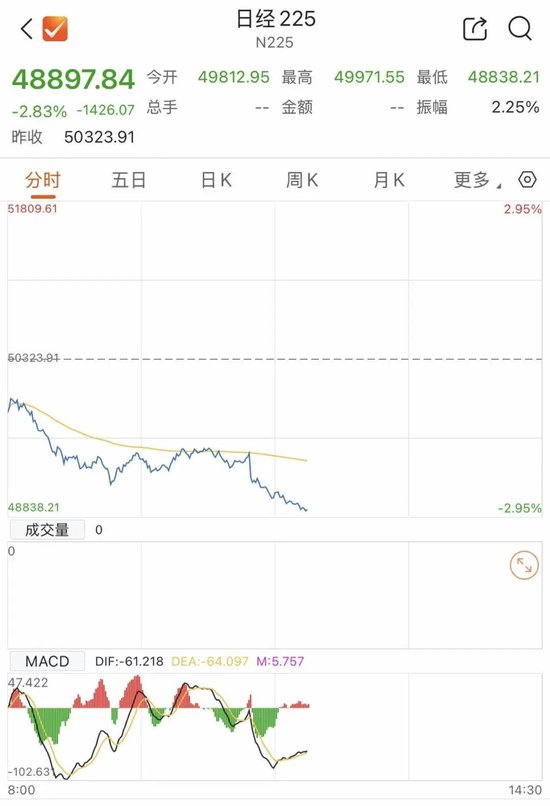
Group 1 - The Japanese stock market experienced a significant decline, with the Nikkei 225 index falling below 49,000 points, down over 1,400 points, representing a drop of 2.83% [1] - The Japanese yen continued its weakening trend, with the euro to yen exchange rate surpassing 180 for the first time since 1999, driven by concerns over Japan's deteriorating fiscal situation [3] - Political tensions arising from provocative statements by Japanese Prime Minister Suga Yoshihide regarding Taiwan have negatively impacted consumer sentiment, leading to declines in major companies such as SoftBank Group, Tokyo Electron, and Nintendo [5] Group 2 - Analysts express concerns that deteriorating Japan-China relations could further impact Japan's economy, which is already facing downward pressure, potentially leading to negative growth in the fourth quarter [7] - The South Korean stock market also saw a significant drop, with the KOSPI index declining over 3% [7]


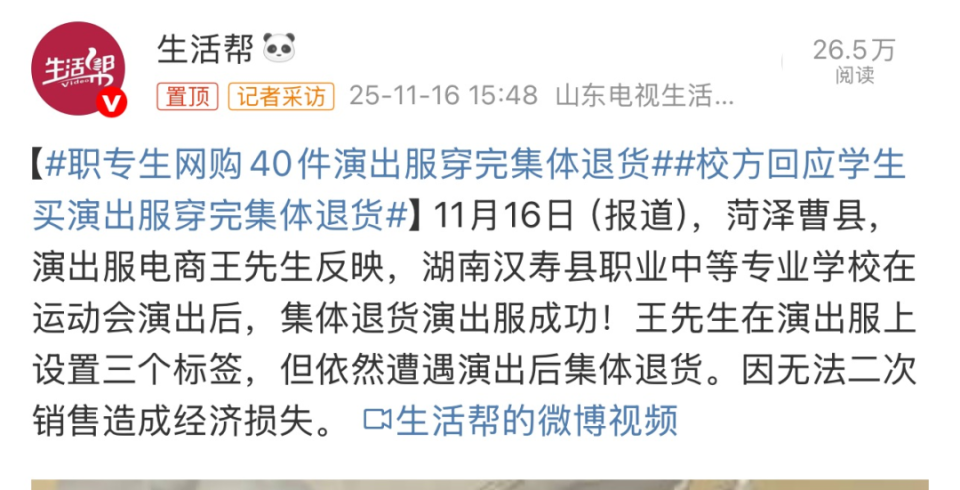
学生网购40件演出服 7天后成功退货,校方回应来了!商家:都脏得没法再次销售;有商家防“蹭穿”绝招亮了
Mei Ri Jing Ji Xin Wen· 2025-11-17 09:13
Core Viewpoint - The article highlights the issue of high return rates in the clothing e-commerce sector, particularly due to students returning worn clothing after events, leading to financial losses for merchants [1][8]. Group 1: Merchant Experiences - A merchant in Heze reported a loss after students returned 40 performance costumes, which were worn and could not be resold [1]. - Another merchant from Shenyang experienced a loss of approximately 80,000 yuan due to over 60 students returning clothes after a sports event, claiming quality issues [8]. - Merchants are increasingly frustrated with the high return rates, which are often not due to product quality but rather misuse of the "no reason return" policy [8]. Group 2: School Involvement - The vice principal of the school involved stated that the returns were personal actions by students, and the school had not issued any return instructions [6]. - The school paid a deposit to the merchant and planned to handle refunds after students returned the items [6]. Group 3: E-commerce Platform Response - The e-commerce platform's customer service suggested that merchants file complaints regarding returns that exceed seven days and show signs of use, indicating a process for reviewing such cases [4]. - The platform aims to protect merchants' rights by potentially reversing incorrect refund decisions [4]. Group 4: Industry Trends - Some merchants are implementing measures to prevent misuse of return policies, such as attaching large tags or locks to clothing to deter customers from returning worn items [8][12]. - The trend of high return rates in the clothing sector is causing significant distress among merchants, prompting them to seek innovative solutions to mitigate losses [8].