
装备制造

Search documents
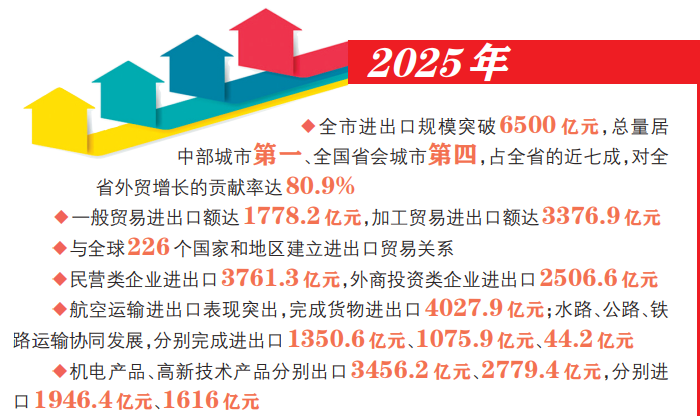
2025年郑州进出口完成6501.8亿元
Zheng Zhou Ri Bao· 2026-01-29 00:45
Core Insights - The city's foreign trade reached a record high of 650.18 billion yuan, accounting for 69.5% of the province's total, with a year-on-year growth of 16.8%, outperforming the national growth rate by 13 percentage points [1] Group 1: Trade Performance - The city achieved a total import and export volume of 650.18 billion yuan in 2025, ranking first among central cities and fourth among provincial capitals nationwide, contributing 80.9% to the province's foreign trade growth [1] - General trade and processing trade both showed strong growth, with general trade imports and exports reaching 177.82 billion yuan (27.3% of total), up 24.7% year-on-year, and processing trade at 337.69 billion yuan (51.9% of total), up 37.3% year-on-year [1] Group 2: Market Diversification - The city expanded its trade relationships to 226 countries and regions, with significant growth in trade with India, Vietnam, Japan, the Netherlands, Australia, Germany, Singapore, and the UAE, effectively reducing risks from reliance on single markets [2] - The number of foreign trade entities increased to 6,982, a year-on-year growth of 19.5%, with private enterprises accounting for 57.8% of total foreign trade, growing 3.3% year-on-year [2] Group 3: Transportation and Export Structure - The city leveraged its "hub + channel" advantages, with air transport leading growth, accounting for 62% of total imports and exports at 402.79 billion yuan, up 10.5% year-on-year [3] - High-value products dominated exports, with electromechanical products and high-tech products exporting 345.62 billion yuan and 277.94 billion yuan respectively, making up 80.8% and 65% of total exports, with year-on-year growth of 22.3% and 18.3% [3] Group 4: Import Focus and E-commerce Integration - The import structure aligned closely with industrial needs, with electromechanical products and high-tech products making up 87.4% and 72.6% of total imports, growing 11.6% and 9.1% year-on-year [4] - The city developed a "cross-border e-commerce + industrial belt" model, fostering export clusters in machinery, new materials, and furniture, with significant contributions from local companies [4] Group 5: Policy Initiatives - The city implemented various measures to boost foreign trade, including the issuance of the "2025 Zhengzhou Foreign Investment and Trade Stabilization Implementation Plan" and hosting events to connect businesses with policies [5] - Future plans include focusing on electronics and automotive industries, enhancing cooperation with ASEAN and EU markets, and improving financial services for small and medium-sized foreign trade enterprises [6]

增速达百分之五点八,高于全省零点三个百分点 成都都市圈GDP站上三万亿元台阶
Si Chuan Ri Bao· 2026-01-29 00:25
Economic Overview - The GDP of the Chengdu metropolitan area reached 31,310.2 billion yuan in 2025, accounting for 46.3% of the province's total [1] - The GDP growth rate for the Chengdu metropolitan area was 5.8%, surpassing the provincial average by 0.3 percentage points [1] - Chengdu led the metropolitan area with a GDP of 24,763.6 billion yuan, while Meishan's GDP reached 2,008.72 billion yuan, entering the "200 billion club" [1] Industrial Growth - The industrial added value above designated size in the Chengdu metropolitan area grew by 7.4% year-on-year, exceeding the provincial growth rate by 0.9 percentage points [2] - Notable growth in specific sectors included a 181.0% increase in Chengdu's new energy vehicles and a 33.9% rise in lithium-ion battery production [2] - Deyang's main industries saw a 5.4% increase, with electronic and communication equipment manufacturing growing by 44.9% [2] Investment and Consumption - Fixed asset investment in the Chengdu metropolitan area increased by 1.8% year-on-year, outperforming the provincial growth rate by 4.2 percentage points [2] - The total retail sales of consumer goods reached 13,790.5 billion yuan, with a year-on-year growth of 5.4%, accounting for 47.3% of the province's total [2] Strategic Initiatives - The "2026 Chengdu Metropolitan Area Outbound and Overseas Plan" aims to promote brand matrix expansion and diversify market outreach, focusing on key industries such as electronic information and equipment manufacturing [3] - The plan targets the expansion of over 800 product categories into overseas markets and aims to add more than 700 foreign trade enterprises and exceed 4,000 cross-border e-commerce companies [3]
实践与思考丨始终坚持问题导向 增强促改促治实效
Zhong Yang Ji Wei Guo Jia Jian Wei Wang Zhan· 2026-01-28 23:32
Core Viewpoint - The article emphasizes the importance of enhancing anti-corruption measures through a systematic approach, focusing on case-based reforms and governance improvements within the organization [2][3]. Group 1: Anti-Corruption Mechanisms - The Central Commission for Discipline Inspection (CCDI) highlights the need for a unified leadership structure to strengthen anti-corruption efforts and improve accountability [2]. - The organization is committed to a high-pressure stance against corruption, particularly in key areas such as engineering, investment, and financial management [3][4]. - A collaborative approach is being adopted, involving joint efforts with local disciplinary bodies to enhance case handling and information sharing [3]. Group 2: Case Analysis and Education - The organization is focusing on in-depth analysis of cases to identify root causes and enhance warning education, thereby strengthening the ideological defenses against corruption [5][6]. - A mechanism for case analysis is established to systematically review violations of regulations, with a focus on typical cases and their implications [6][7]. - Educational resources are being utilized to transform case studies into practical learning materials for employees, enhancing the effectiveness of warning education [7]. Group 3: Governance and Reform - The organization aims to integrate case-based reforms with its development strategy, focusing on problem rectification and the establishment of long-term mechanisms [8][9]. - There is an emphasis on addressing systemic issues revealed by cases, promoting a comprehensive approach to governance and reform [9][10]. - The organization is committed to fostering a culture of integrity, incorporating it into the overall cultural framework to create a positive political environment [10].
成都都市圈GDP站上3万亿台阶
Sou Hu Cai Jing· 2026-01-28 23:08
Core Insights - Chengdu Metropolitan Area's GDP reached 3 trillion yuan in 2025, accounting for 46.3% of the province's total, marking it as a key driver for high-quality economic development in Sichuan [1] - The GDP of the Chengdu Metropolitan Area grew by 5.8% year-on-year, surpassing the provincial growth rate by 0.3 percentage points [1] - Industrial collaboration is identified as the main engine for economic growth, with the value of nine key collaborative industrial chains exceeding 1.2 trillion yuan [1] Economic Performance - The industrial added value of the Chengdu Metropolitan Area increased by 7.4% year-on-year, outpacing the provincial growth rate by 0.9 percentage points [2] - Notable growth in specific sectors includes a 181.0% increase in Chengdu's new energy vehicles and a 44.9% increase in electronic and communication equipment manufacturing in Deyang [2] - Fixed asset investment in the Chengdu Metropolitan Area rose by 1.8% year-on-year, exceeding the provincial growth rate by 4.2 percentage points [2] Consumer Market - The total retail sales of consumer goods in the Chengdu Metropolitan Area reached 1.379 trillion yuan in 2025, with a year-on-year growth of 5.4%, accounting for 47.3% of the province's total [2] Future Plans - The "2026 Chengdu Metropolitan Area Outbound and Overseas Plan" aims to promote over 800 product categories in international markets, targeting the expansion of foreign trade enterprises and cross-border e-commerce [3]
工业经济趋稳向优,凸显经济新动能发展提速
2 1 Shi Ji Jing Ji Bao Dao· 2026-01-28 22:33
Group 1 - The core viewpoint of the articles indicates that China's industrial economy is showing signs of stabilization and transformation, with a return to positive profit growth for the first time in three years, achieving a total profit of 73,982 billion yuan in 2025, a 0.6% increase from the previous year [1] - In December 2025, profits for large-scale industrial enterprises increased by 5.3%, reversing a 13.1% decline in November, indicating a significant recovery [1] - The data reflects a structural shift in China's industrial economy, with new growth drivers emerging, particularly in the equipment manufacturing and high-tech manufacturing sectors, which are becoming the main contributors to profit growth [1][2] Group 2 - The equipment manufacturing sector saw a profit increase of 7.7%, contributing 2.8 percentage points to the overall profit growth of large-scale industrial enterprises, with its profit share rising to 39.8% [1] - High-tech manufacturing profits grew by 13.3%, surpassing the overall industrial profit growth rate of 12.7%, highlighting its role in driving high-quality industrial development [1] - Key industries such as semiconductors experienced explosive profit growth, with integrated circuit manufacturing profits increasing by 172.6%, indicating the success of China's innovation-driven development strategy [2] Group 3 - Traditional industries, particularly mining, faced significant profit declines, with the mining sector's profits dropping by 26.2%, primarily due to falling international oil prices and the transition to green energy [2] - The shift in industrial competitiveness is moving from cost efficiency to technological innovation and system resilience, as evidenced by high profit growth in sectors like railways, shipbuilding, and semiconductors [3] - The growth logic of industrial enterprises is transitioning from speed and scale to quality and efficiency, with profit growth becoming more closely linked to added value rather than revenue growth [3] Group 4 - Domestic consumption and investment are still recovering, while external demand faces increased risks due to geopolitical and economic uncertainties, leading to challenges of insufficient effective demand and overcapacity in industrial enterprises [4] - Continuous efforts are needed to promote the transformation and upgrading of traditional industries, encouraging mergers, restructuring, or bankruptcy to eliminate inefficient capacity and help improve the financial health of industrial enterprises [4]
税收数据显示经济高质量发展扎实推进
Xin Lang Cai Jing· 2026-01-28 19:57
Core Viewpoint - The latest tax data from the National Taxation Administration indicates that during the "14th Five-Year Plan" period, China is making solid progress in high-quality development, with significant advancements expected by 2025 [1] Group 1: High-End Manufacturing - The sales revenue of the national equipment manufacturing industry has an average annual growth rate of 9.1%, consistently outpacing the average growth rate of the manufacturing sector, reflecting steady progress in the high-end manufacturing sector [1] Group 2: Innovation Industries - The sales revenue of the national high-tech industry has an average annual growth rate of 13.9%, maintaining a rapid growth pace, indicating an acceleration in the development of innovation industries [1] Group 3: Digital Economy - The sales revenue of the core industries of the digital economy has an average annual growth rate of 10.5%, while the annual growth rate of enterprise procurement of digital technologies is 11.2%, reflecting the ongoing acceleration of digital industrialization and industrial digitalization processes [1] Group 4: Green Transition - The sales revenue of the new energy vehicle manufacturing industry has an average annual growth rate of 49.5%, while the sales revenue of clean energy generation, represented by wind, solar, water, and nuclear power, has an average annual growth rate of 13.9%, indicating a deepening of the green transition [1] Group 5: Unified Market - The proportion of inter-provincial trade sales to total sales has increased from 38.6% in 2021 to 41% in 2025, reflecting the accelerated promotion of a unified national market [1]
云南两会观察:生态大省工业发展向“新”向“绿”
Zhong Guo Xin Wen Wang· 2026-01-28 17:20
Group 1 - The core viewpoint highlights the significant industrial growth in Yunnan province, with industrial added value surpassing 760 billion yuan and an average annual growth rate of 5.9% since the 14th Five-Year Plan [1] - Yunnan is focusing on green transformation and exploring the integration of ecological value with economic benefits, aiming to enhance traditional industries and develop strategic emerging industries [1] - The industrial added value in Yunnan is projected to increase from 563 billion yuan in 2020 to 762.9 billion yuan by 2025, with an average annual growth rate of 4.8% [1] Group 2 - The new industrial momentum in Yunnan is significantly strengthening, with the total output value of strategic emerging industries increasing by 3 percentage points compared to 2020 [2] - The annual growth rates for high-tech manufacturing and equipment manufacturing added value are 25.8% and 28.3%, respectively [2] - By 2025, the added value of the electronics industry, high-tech manufacturing, and equipment manufacturing is expected to grow by 22.7%, 17.6%, and 17.7% respectively, indicating robust growth [2] Group 3 - Yunnan's clean energy advantages are being rapidly transformed into industrial strengths, with the province's green electricity installed capacity and proportion ranking among the top in the country [3] - The carbon dioxide emissions per kilowatt-hour of electricity generated in Yunnan are the lowest in the country at only 0.13 kilograms [3] - By 2025, hydropower and solar power generation are expected to increase by 5.6% and 33.7%, respectively, with clean electricity accounting for 87.6% of the total [3] - The "new three" industries, represented by green aluminum, silicon photovoltaic, and new energy batteries, are rapidly emerging, with expected increases in added value of 75.9%, 12.1%, and 3.2% respectively by 2025 [3] - The green aluminum industry chain is projected to exceed 100 billion yuan in 2023 and reach 180 billion yuan by 2025 [3] - During the 15th Five-Year Plan, Yunnan aims to establish itself as a major clean energy base, strategic non-ferrous metal industry base, and a world-class tourism destination while enhancing its green aluminum, silicon photovoltaic, and phosphate chemical industries [3]
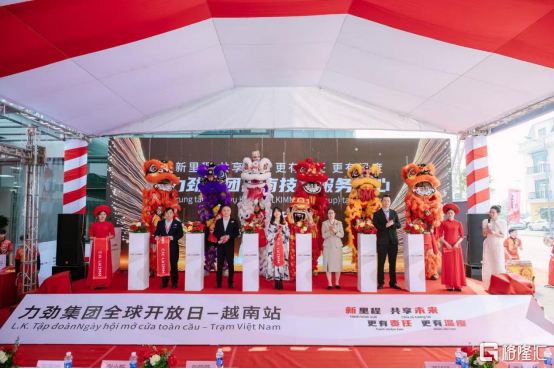
力劲集团2026全球开放日越南站:以深度本地化服务赢得客户信赖,共筑东盟制造新生态
Ge Long Hui· 2026-01-28 14:38
Group 1 - The core viewpoint of the articles highlights Vietnam's emergence as a focal point for global equipment manufacturing companies due to strong growth in the manufacturing sector, ongoing policy benefits, and substantial equipment market demand [1][8] - The company, Lijin Group, is intensifying its presence in the Vietnamese market by focusing on long-term, stable, and sustainable service capabilities rather than merely exporting equipment [1][5] - Lijin Group successfully held the "2026 Global Open Day Vietnam Station" event in Haiphong, showcasing its technological strengths and solutions in die-casting, injection molding, and CNC processing, while clarifying its long-term localization strategy in Vietnam and ASEAN [1][3] Group 2 - During the event, Lijin Group signed procurement agreements for dozens of all-electric injection molding machines with San Yi Electronics, aimed at enhancing production efficiency and product precision for clients [3] - The Vice President of Lijin Group emphasized that Vietnam's manufacturing sector is a crucial growth point for ASEAN's economy and serves as a foundation for the company's overseas market stability [5] - The open day event reinforced Lijin Group's commitment to deepening local partnerships and building a regional manufacturing ecosystem, driven by a dual strategy of globalization and localization [8]
天津两会观察:津城产业图新,重在“链”“群”并举
Zhong Guo Xin Wen Wang· 2026-01-28 12:15
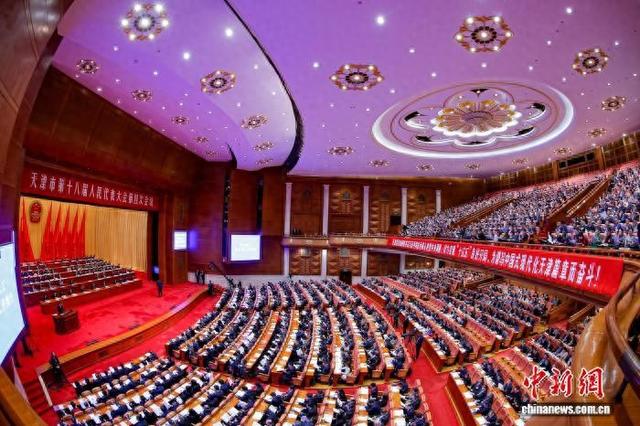
Group 1 - The core focus of Tianjin's industrial upgrade is to build a modern industrial ecosystem with both vertical depth and horizontal density, emphasizing intelligent, green, and integrated development [1][2] - The report outlines a strategic approach to enhance the resilience of industrial chains and the vitality of industrial clusters, moving from "physical splicing" to "chemical integration" [2] - Key industries highlighted include green petrochemicals, automotive, equipment manufacturing, aerospace, and information technology, with a focus on upstream and downstream connectivity and cluster cultivation [2][5] Group 2 - Traditional industries will be upgraded through specific initiatives, such as developing a chain from basic chemicals to new materials in green petrochemicals and enhancing capabilities in aerospace through collaboration with major companies [5] - Strategic emerging industries like information technology and biomedicine are emphasized, with support for local leading enterprises and the creation of AI+ information technology application scenarios [5] - The dual support of "solid foundation" and "nurturing new" is proposed to enhance both existing and new industrial capacities, focusing on smart transformation and the integration of traditional industries into key chains [6]
豪森智能(688529.SH):2025年预亏8.2亿元至9.1亿元
Ge Long Hui A P P· 2026-01-28 09:56
Core Viewpoint - The company, Haosen Intelligent (688529.SH), is expected to report a significant net loss for the year 2025, with projected losses ranging from 820 million to 910 million yuan compared to the previous year [1] Financial Performance - The net profit attributable to the parent company is forecasted to be between -910 million yuan and -820 million yuan for 2025 [1] - The net profit after deducting non-recurring gains and losses is estimated to be between -909 million yuan and -819 million yuan [1] Operational Challenges - The company faces extended project acceptance cycles due to long international transportation logistics and prolonged on-site implementation periods for overseas projects [1] - Domestic downstream automotive manufacturers and parts suppliers are experiencing low capacity utilization rates, contributing to a slight decline in revenue for 2025 [1] Market Conditions - Increased competition in the downstream vehicle sales market has led to reduced capital expenditures by client automotive companies, resulting in lower demand for equipment investments [1] - The expansion of production capacity in the equipment manufacturing industry has intensified market competition, limiting profit margins on orders and increasing the cost proportion of project implementation [1]
