体育

Search documents
杭州临安:农旅体融合绘就乡村振兴新图景
Xin Lang Cai Jing· 2026-01-20 12:46
Group 1 - The core idea of the news is the integration of agriculture, tourism, and sports in rural revitalization, particularly in Yidu Village, Hangzhou, which is transforming traditional rural areas into vibrant, multi-functional spaces [1][2][3] - Infrastructure upgrades are crucial for the development, with projects including road widening, guardrail installation, and lighting improvements to enhance rural transportation networks [1] - The establishment of unique accommodations and recreational facilities, such as themed restaurants and adventure sports, is attracting tourists and creating immersive experiences in the countryside [1] Group 2 - Agricultural development is focused on green and organic practices, with companies cultivating traditional products and high-quality crops, enhancing the market reach of local agricultural goods [2] - The sports and dining sectors are thriving, with initiatives like drone training programs and unique dining experiences that combine leisure and nature, appealing to a wide audience [2] - Sports events are pivotal in energizing the village, with various competitions attracting participants and spectators, leading to increased local economic activity and promoting a healthy lifestyle [3]
刚刚,利好来了!六部门,重磅发布!
券商中国· 2026-01-20 12:12
Core Viewpoint - The announcement from six departments aims to support the development of community family services such as elderly care, childcare, and domestic services by providing tax exemptions and financial incentives to relevant institutions [2][4][10]. Group 1: Tax and Fee Policies - Institutions providing community elderly care, childcare, and domestic services will enjoy tax exemptions on income from these services, specifically exempting them from value-added tax [4]. - Income from community elderly care, childcare, and domestic services will be calculated at 90% for taxable income purposes [5]. - Properties and land used for these services will be exempt from deed tax, property tax, and urban land use tax [6][7]. - Specific conditions for domestic service companies to qualify for tax exemptions include signing tripartite agreements with service workers and clients, paying wages, and managing service workers [8]. Group 2: Financial Policies to Boost Consumption - The Ministry of Finance has introduced five financial policies to stimulate domestic demand, focusing on enhancing consumption and expanding private investment [10]. - The implementation period for loan interest subsidies for service industry operators and personal consumption loans has been extended to December 31, 2026, maintaining a subsidy rate of 1% [10]. - Optimizations to personal consumption loan subsidies include expanding the support scope to include credit card installment payments, increasing subsidy limits, and broadening the range of eligible financial institutions [11][12].


国常会再度部署促消费,服务消费与增收是关键
Sou Hu Cai Jing· 2026-01-20 10:06
Core Viewpoint - The Chinese government is intensifying its consumer promotion policies, transitioning from short-term economic indicators to a long-term mechanism that integrates consumer growth with improving people's livelihoods [4][6]. Group 1: Consumer Promotion Policies - The State Council has held two consecutive meetings focusing on consumer promotion, indicating a shift towards establishing a long-term mechanism for consumer growth [2][3]. - The government aims to enhance the effectiveness of consumer promotion policies by integrating various measures to boost residents' consumption power and drive economic growth [3][4]. Group 2: Service Consumption Growth - There is a push to cultivate new growth points in service consumption, with an emphasis on supporting new business models and enhancing the quality of service supply [4][6]. - The integration of new technologies like artificial intelligence and big data is expected to create innovative service consumption models, expanding service consumption beyond traditional sectors [4][5]. Group 3: Debt and Payment Issues - The government is prioritizing the clearance of overdue payments to businesses and ensuring the payment of wages to migrant workers, which is crucial for maintaining social stability and supporting economic activity [8][9]. - A special bond issuance is planned to support the clearance of overdue payments, which will help convert hidden debts into visible government liabilities, thus improving debt management [10].

12类835件民生实事落地兑现 心安城市塑成亮丽品牌
Qi Lu Wan Bao· 2026-01-20 09:00
Group 1 - The government work report highlights that during the "14th Five-Year Plan" period, 835 livelihood projects across 12 categories have been implemented in Binzhou City, with public spending on livelihoods maintaining around 80% [1] Group 2 - Social security has been expanded and improved, achieving 206,000 new urban jobs, with basic pension and medical insurance coverage rates stable at over 96% [3] - Urban and rural minimum living standards have been increased by 56% and 69% respectively, with the "three guarantees" level remaining among the top in the province [3] Group 3 - Educational initiatives have shown comprehensive progress, with a 100% coverage rate for the strong school expansion action and continuous improvement in the college entrance examination admission rates [3] - Binzhou College has been renamed Shandong Aviation College, and other educational institutions have undergone significant upgrades, including the establishment of new colleges [3] Group 4 - The city has created 45 provincial-level medical key specialties, with full coverage of central pharmacies and prescription review centers, and the "original residence care" model has been promoted nationwide [3] - The "Book Fragrant Binzhou" initiative has gained popularity, with 37 outstanding plays receiving provincial-level awards [3] Group 5 - The city has maintained stability in social order, with the implementation of the "Five Safety Projects," resulting in a continuous decline in production safety accidents and fatalities [3] - Cases of telecom fraud and criminal theft have decreased by 36% and 33% respectively, with a resolution rate of over 96% for petition matters [3]
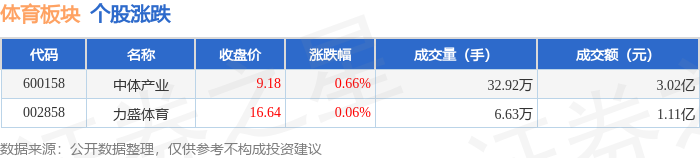
体育板块1月20日涨0.53%,中体产业领涨,主力资金净流入1663.17万元
Zheng Xing Xing Ye Ri Bao· 2026-01-20 08:56
Group 1 - The sports sector increased by 0.53% compared to the previous trading day, with Zhongti Industry leading the gains [1] - On the same day, the Shanghai Composite Index closed at 4113.65, down 0.01%, while the Shenzhen Component Index closed at 14155.63, down 0.97% [1] - Zhongti Industry's closing price was 9.18, with a gain of 0.66%, and Lisheng Sports closed at 16.64, with a slight increase of 0.06% [1] Group 2 - The net inflow of main funds in the sports sector was 16.63 million yuan, while retail funds experienced a net outflow of 12.35 million yuan [1] - Zhongti Industry had a net inflow of 18.47 million yuan from main funds, accounting for 6.13%, while Lisheng Sports saw a net outflow of 1.84 million yuan from main funds, with a negative ratio of -1.66% [1] - Retail investors showed a net outflow of 1.04 million yuan for Zhongti Industry and 0.20 million yuan for Lisheng Sports [1]

服务业贷款贴息上限提至一千万元
第一财经· 2026-01-20 07:20
Core Viewpoint - The Chinese government is enhancing its loan interest subsidy policy for service industry operators to further stimulate domestic demand, extending the policy until December 31, 2026, and expanding the scope of supported sectors [2][3]. Group 1: Policy Extension and Scope - The Ministry of Finance and other departments have announced the extension of the loan interest subsidy policy for service industry operators, which was set to expire at the end of last year, for an additional year [2]. - The policy now includes three new categories: digital, green, and retail sectors, in addition to the previously supported eight sectors such as catering, health, elderly care, childcare, housekeeping, cultural entertainment, tourism, and sports [2]. Group 2: Increased Financial Support - The maximum loan amount eligible for interest subsidies has been increased from 1 million yuan to 10 million yuan per borrower, with a subsidy period not exceeding one year [3]. - The annual interest subsidy rate remains at 1%, consistent with previous regulations [3]. - The number of banks eligible to process these loans has been expanded to include city commercial banks with a financial regulatory rating of 3A or above, provincial rural commercial banks, rural commercial banks in provincial capital cities, and foreign banks [3]. Group 3: Economic Impact - The Ministry of Finance aims to leverage this policy to provide more low-cost financial resources to service industry operators, thereby improving the flow of capital in the real economy and better meeting the growing demand for high-quality service consumption among the public [3].
财政部等四部门:延长服务业经营主体贷款贴息政策实施期限至2026年底
Sou Hu Cai Jing· 2026-01-20 06:44
Core Viewpoint - The Ministry of Finance and other departments have announced an extension of the loan interest subsidy policy for service industry operators until December 31, 2026, with specific provisions for loans issued between March 16, 2025, and December 31, 2025 [1] Group 1: Policy Extension - The loan interest subsidy policy for service industry operators will be extended until December 31, 2026 [1] - Loans issued during the period from March 16, 2025, to December 31, 2025, will follow the existing subsidy policy guidelines [1] Group 2: Subsidy Limits - The maximum loan amount eligible for interest subsidies is set at 10 million yuan per borrower for new loans issued in 2026 [1] - The interest subsidy period will not exceed one year, with an annual subsidy rate of 1% [1] - The funding for the subsidies will be shared between the central government (90%) and provincial governments (10%) [1] Group 3: Expanded Support Areas - The policy will expand its support to include three additional consumption sectors: digital, green, and retail, alongside the existing eight sectors such as catering, health, elderly care, childcare, housekeeping, cultural entertainment, tourism, and sports [1]
服务业贷款贴息上限提至一千万元
Di Yi Cai Jing· 2026-01-20 06:07
Group 1 - The core viewpoint of the news is the extension and expansion of the fiscal interest subsidy policy for service industry operators in China, aimed at boosting domestic demand [1][2] Group 2 - The fiscal interest subsidy policy for service industry operators has been extended for one year until December 31, 2026, with a possibility of further extension based on circumstances [1] - The policy now includes three additional consumption sectors: digital, green, and retail, expanding the previous eight sectors [1] Group 3 - The maximum loan amount eligible for interest subsidies has been increased from 1 million yuan to 10 million yuan per borrower for new loans issued in 2026, with a subsidy period not exceeding one year [2] - The annual interest subsidy rate remains at 1%, consistent with previous regulations [2] Group 4 - The number of banks eligible to process these loans has been expanded to include city commercial banks, provincial rural commercial banks, rural commercial banks in provincial capital cities, and foreign banks, in addition to the previously designated 21 national banks [2] - The Ministry of Finance aims to leverage this policy to provide low-cost financial resources to service industry operators, thereby enhancing the supply of high-quality service consumption to meet growing public demand [2]
财政部等四部门:优化实施服务业经营主体贷款贴息政策
Xin Hua Cai Jing· 2026-01-20 05:35
Core Viewpoint - The Ministry of Finance and other departments have announced a policy to optimize the implementation of loan interest subsidy for service industry operators, aiming to boost consumption and expand domestic demand by leveraging fiscal funds to guide financial institutions in supporting quality service supply and innovative consumption scenarios [1][2]. Group 1: Policy Implementation - The implementation period for the loan interest subsidy policy has been extended to December 31, 2026, with loans issued between March 16, 2025, and December 31, 2025, following the existing subsidy scheme [1]. - The maximum loan amount eligible for interest subsidy has been increased to 10 million yuan per borrower, with a subsidy period not exceeding one year and an annual interest subsidy rate of 1% [1]. Group 2: Supported Sectors - The policy now includes support for three additional consumption sectors: digital, green, and retail, alongside the existing eight sectors such as catering, health, and tourism [2]. - The digital sector corresponds to "Internet and related services" and "digital content services," while the green sector includes categories like "energy-efficient buildings" and "green transportation" [2]. Group 3: Banking Institutions - A total of 21 national banks and various city commercial banks, rural commercial banks, and foreign banks are included as eligible institutions for processing these loans [3]. Group 4: Operational Mechanisms - The provincial finance departments will optimize existing processes and establish a joint review mechanism with industry management departments and financial institutions to enhance efficiency and reduce redundancy [3]. - The subsidy funds will be allocated using a "pre-allocation + settlement" method, with specific deadlines for applications and settlements outlined for both banks and provincial finance departments [4]. Group 5: Supervision and Management - The Ministry of Finance will conduct joint inspections to ensure compliance, with strict penalties for banks and operators involved in fraudulent activities [6]. - Financial institutions are required to monitor the use of loan funds to prevent misuse for investment or speculative activities [6]. Group 6: Reporting and Flexibility - Banks must report on policy execution, including loan issuance and subsidy usage, within specified timeframes to ensure transparency [11]. - The policy encourages flexible borrowing and repayment models for service operators, while loans that are overdue or classified as non-performing will not receive subsidies [7].
重大利好!财政部等部门发布多项政策“大礼包”
天天基金网· 2026-01-20 05:21
Core Viewpoint - The article discusses multiple policy announcements from the Ministry of Finance and other departments aimed at extending financial support for various sectors, particularly focusing on service industries, personal consumption, and small to medium enterprises (SMEs) through loan interest subsidies and guarantees [2][4][7]. Group 1: Service Industry Loan Subsidies - The implementation period for the service industry loan interest subsidy policy has been extended to December 31, 2026 [4][6]. - The maximum loan amount eligible for interest subsidies has been increased to 10 million yuan for new loans issued in 2026, with a subsidy period not exceeding one year and an annual subsidy rate of 1% [4][3]. - The policy now includes additional support for digital, green, and retail consumption sectors, expanding the previous focus areas [5]. Group 2: Personal Consumption Loan Subsidies - The personal consumption loan interest subsidy policy has also been extended to December 31, 2026, with the adjusted implementation period from September 1, 2025, to December 31, 2026 [7][6]. - The subsidy standards have been improved by removing the previous limits on single transaction subsidies and cumulative consumption subsidy caps for individual borrowers [7][6]. Group 3: Special Guarantee Plan for Private Investment - A special guarantee plan for private investment has been introduced with a total quota of 500 billion yuan, to be implemented over two years [9][8]. - This plan aims to support eligible loans for SMEs, covering various operational needs such as equipment purchases, technological upgrades, and business expansions [9]. Group 4: Equipment Update Loan Subsidies - The equipment update loan interest subsidy policy has been optimized, allowing for a subsidy of 1.5% on fixed asset loans for equipment updates, applicable for up to two years [11][10]. - The policy will also include support for new technology innovation loans issued by banks starting in 2026 [11]. Group 5: SME Loan Subsidies - A loan interest subsidy policy for SMEs has been announced, providing a 1.5% annual subsidy on fixed asset loans issued from January 1, 2026, for a maximum period of two years [13][14]. - The maximum loan amount eligible for subsidies is set at 50 million yuan, with the policy initially valid for one year [14].