
家政

Search documents
财政贴息来了!贷款利率直接降1个点,个人消费、服务业都能享
Sou Hu Cai Jing· 2025-08-15 07:01
Group 1 - The government has introduced two significant policies: the "Personal Consumption Loan Interest Subsidy Program" and the "Service Industry Operating Entity Loan Subsidy Program," aimed at reducing loan interest rates for consumers and service providers [1] - From September 1, 2025, to August 31, 2026, consumers can enjoy a 1% annual interest subsidy on loans for various purposes such as purchasing cars, home renovations, education, tourism, and health [3] - There is a cap on the interest subsidy: for loans exceeding 50,000 yuan, only the portion up to 50,000 yuan will be subsidized [4] Group 2 - Individual users can receive a maximum interest subsidy of 3,000 yuan, applicable to loans up to 300,000 yuan [5] - For example, a loan of 100,000 yuan at a 4% interest rate would incur 4,000 yuan in interest, but with the subsidy, the rate drops to 3%, saving 1,000 yuan in interest [6] - Service industry businesses, such as restaurants and tourism, can also benefit from a 1% annual interest subsidy starting March 16, 2025, if the loan is used to improve consumer infrastructure or service capabilities [7] Group 3 - The policy specifies participating banks, including six major state-owned banks, twelve joint-stock banks, and five consumer finance institutions for personal consumption loans, and 21 national banks for service industry loans [9] - The subsidy is funded by the government, with 90% of the interest covered by the central government and 10% by local governments, ensuring that banks do not incur losses or impose additional fees [10] - The effectiveness of the policy will be evaluated after its expiration to determine if support will continue [10]


服务消费释放新动能头部企业发力新增量
Zheng Quan Shi Bao· 2025-08-14 18:21
Core Insights - Service consumption is becoming an important direction for consumer upgrades as people's quality of life improves, shifting focus from "having" to "quality" [1] - The restaurant industry is innovating through product, scene, and model innovations to cultivate new service consumption growth [2][3] - The tourism industry is responding to diverse consumer demands by innovating services, enhancing growth potential [4][5] - Companies are leveraging AI and product innovations to improve service efficiency and meet new consumer needs [6] - The expansion of service consumption is recognized as a means to tap into domestic demand potential, supported by national policies [7] Restaurant Industry Innovations - Haidilao has increased nighttime dining services, leading to a noticeable rise in customer flow, particularly among young people [2] - McDonald's China plans to optimize its restaurant network and invest 4 billion yuan in digital development from 2024 to 2028 [3] - Haidilao has opened over 50 night-themed restaurants in major cities, catering to diverse consumer needs [3] - The partnership between the brands under the Xiaobu Group and international IPs has positively impacted restaurant performance [3] Tourism Industry Developments - Hainan Airlines emphasizes service upgrades to create new revenue sources and enhance consumer experiences [4] - Huazhu Group is exploring diverse travel needs, including services tailored for the elderly and marathon participants [4] - China National Travel International is focusing on integrating new consumption forms in tourism, leading to a 45% increase in night tourism revenue [5] Service Consumption Growth Strategies - 58.com is enhancing service efficiency through AI and product innovations, significantly improving operational metrics [6] - The Chinese government is actively promoting service consumption through various policies aimed at high-quality development in key sectors [7] - In the first half of the year, final consumption expenditure contributed 52.0% to economic growth, indicating a strong service consumption trend [7]
财政贴息不止为撬动消费
Hu Xiu· 2025-08-14 10:27
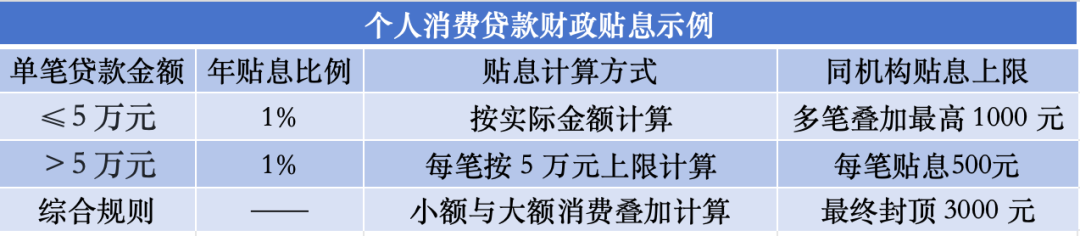
Group 1 - The core viewpoint of the article is the introduction of significant policies aimed at promoting consumption and expanding domestic demand through financial support [2][10]. - The Ministry of Finance, in collaboration with other departments, has launched the "Personal Consumption Loan Interest Subsidy Policy" and the "Service Industry Operating Entity Loan Interest Subsidy Policy" [2][10]. - These policies are designed to provide financial incentives for personal consumption loans and loans to service industry entities, thereby stimulating economic activity [12]. Group 2 - The personal consumption loan interest subsidy policy will be effective from September 1, 2025, to August 31, 2026, covering loans used for consumption as identified by lending institutions [4][5]. - The subsidy rate is set at 1%, which is approximately one-third of the current personal consumption loan interest rates offered by commercial banks [8]. - Specific consumption areas eligible for subsidies include household appliances, automotive purchases, education, cultural tourism, and healthcare, among others [8][13]. Group 3 - For loans under 50,000 yuan, the subsidy is calculated based on the actual amount, with a maximum subsidy of 1,000 yuan for multiple loans from the same institution [9]. - For loans over 50,000 yuan, the subsidy is capped at 500 yuan per 50,000 yuan, with a total maximum subsidy of 3,000 yuan when combined with smaller loans [9]. - The service industry loan subsidy policy targets eight key sectors, including dining, health, and tourism, with a similar subsidy rate of 1% and a maximum loan amount of 1 million yuan per entity [9][12]. Group 4 - The policies are part of a broader strategy to enhance consumer spending and investment efficiency, as highlighted in recent government reports [11]. - The implementation of these policies is expected to alleviate purchasing power issues for consumers and reduce financing costs for businesses, thereby supporting sustained economic growth [7][12]. - The government plans to evaluate the effectiveness of these policies after their expiration and may consider extending or expanding them based on the results [10].
人民财评:政策精准发力,服务业升级迎来新动能
Ren Min Wang· 2025-08-14 08:32
Core Viewpoint - The implementation of the loan interest subsidy policy aims to support the service industry, which is crucial for high-quality economic development, by providing financial assistance to enhance consumption and expand domestic demand [1][2]. Group 1: Policy Implementation - The Ministry of Finance and nine other departments have jointly issued the "Implementation Plan for Loan Interest Subsidy Policy for Service Industry Operators" to support consumption and domestic demand strategies [1]. - The service industry has become a core engine for economic growth, with its value-added accounting for over 50% of GDP and 88.2% of newly established business entities in the third sector in the first half of the year [1][2]. Group 2: Financial Support Mechanism - The policy aims to lower financing costs for service industry operators, who often face challenges due to reliance on light asset operations and lack of effective collateral [2]. - The subsidy rate is set at 1 percentage point for a maximum loan amount of 1 million yuan per entity, with a maximum subsidy of 10,000 yuan per entity for one year [2][3]. Group 3: Expected Outcomes - The loan interest subsidy policy is expected to provide financial convenience and incentives for high-quality service enterprises, enabling them to innovate, upgrade, and expand, thereby enhancing service quality [3]. - The policy will undergo evaluations post-implementation to assess its effectiveness and may lead to extensions or adjustments based on the outcomes [3]. Group 4: Collaborative Measures - To maximize the effectiveness of the subsidy policy, it is essential to establish a risk-sharing mechanism, enhance policy communication, and create an evaluation system to ensure efficient use of funds [3].
21社论丨加大支持服务业发展力度,全方位扩大国内需求
21世纪经济报道· 2025-08-14 02:29
Core Viewpoint - The article discusses the implementation of a loan interest subsidy policy aimed at service industry operators, which is expected to stimulate consumption and support economic growth in China [1][2]. Group 1: Policy Overview - The loan interest subsidy policy targets service industry operators in eight key consumption sectors, including catering, health, elderly care, childcare, housekeeping, cultural entertainment, tourism, and sports [1]. - The subsidy rate is set at 1% for a duration of one year, with a maximum loan amount of 1 million yuan per entity and a maximum subsidy of 10,000 yuan per entity [1]. Group 2: Short-term Effects - The policy alleviates financial pressure on service industry operators, particularly small and micro enterprises, by reducing financing costs [2]. - It is expected to boost consumer confidence and market vitality, especially in the cultural tourism and sports sectors, by allowing operators to enhance service quality and improve the consumer environment [2]. - The policy plays a significant role in stabilizing and growing the employment market, as the service industry is a major employer [2]. Group 3: Long-term Effects - The policy promotes structural optimization and upgrading of the service industry by encouraging innovation in service consumption formats and expanding quality service supply [3]. - It enhances the innovation capability and competitiveness of the service industry, particularly in the health sector, by fostering developments in AI and precision health management services [3]. - The policy supports the cultivation of new growth points and business models in the service industry, such as the integration of tourism with accommodation and wellness services [3]. Group 4: Economic Impact - The policy facilitates a virtuous cycle in the macro economy by promoting a positive interaction between service consumption and investment [4]. - It contributes to industrial structure optimization and economic transformation, particularly in public services like health and elderly care, which also aids in regional coordination and urban-rural integration [5]. Group 5: Implementation Considerations - Effective implementation of the policy requires attention to precision and effectiveness, addressing the diverse needs of different service sectors, and ensuring long-term funding support [5]. - Local governments are encouraged to develop specific implementation guidelines to ensure the policy is effectively executed [5].

最高1万元!这些贷款贴息,怎么申领?
Jin Rong Shi Bao· 2025-08-14 02:27
Core Points - The Ministry of Finance and nine other departments have jointly issued the "Implementation Plan for Loan Interest Subsidy Policy for Service Industry Operating Entities" [1] - The policy is applicable for loan contracts signed between March 16, 2025, and December 31, 2025, with funds disbursed to operating entities [1] Group 1: Eligibility and Conditions - To qualify for the loan interest subsidy, the loan funds must be used for operational activities [2] - The eligible sectors include eight categories: catering, accommodation, health, elderly care, childcare, housekeeping, cultural entertainment, tourism, and sports [2] - The subsidy can last for up to one year, with the actual duration based on the loan term if it is less than one year [2] Group 2: Application Process - Borrowing entities do not need to apply for the subsidy; they only need to follow the standard loan process with banks [3] - Once the bank receives the subsidy funds from the government, it will return the corresponding subsidy amount to the operating entity for interest already paid [3] Group 3: Subsidy Details - The subsidy rate is set at 1%, with a maximum loan amount of 1 million yuan per entity, allowing for a maximum subsidy of 10,000 yuan [4] - The example provided illustrates that a restaurant obtaining a 900,000 yuan loan can receive a total subsidy of 9,000 yuan, with specific disbursement timelines [4] Group 4: Participating Banks - A total of 21 national banks are designated as the lending institutions for this subsidy program [5] - The list includes major banks such as the Agricultural Bank of China, Industrial and Commercial Bank of China, and China Construction Bank among others [5]
《服务业经营主体贷款贴息政策实施方案》热点问题解答
Jin Rong Shi Bao· 2025-08-14 01:35
什么时间能享受到政策? 在2025年3月16日《提振消费专项行动方案》公开时至2025年12月31日期间签订贷款合同且相关贷 款资金发放至经营主体的,按照贷款本金对经营主体进行贴息。 需要符合哪些条件才能申请? 服务业经营主体贷款贴息的条件,核心是要将贷款资金用于经营活动。 对于餐饮住宿、健康、养老、托育、家政、文化娱乐、旅游、体育八类消费领域服务业经营主体而 言,从今年3月16日到年底的时间里,只要与银行签订了贷款合同,而且已经收到贷款资金的这些经营 主体,都可以享受最长1年的贴息,贷款期限不足1年的,按照实际期限来进行贴息。 经办银行收到财政贴息资金以后,对经营主体已经支付的利息,一次性向经营主体返还对应的贴息 资金。 对于经营主体未来需支付的利息,贷款经办银行在后续按期收取时,直接扣除对应的贴息资金。 最高能享受多少贴息? 贴息比例为1个百分点,可以贴息1年,上述八类主要消费领域的服务业经营主体单户享受贴息的贷 款规模最高是100万元,单户享受贴息最高1万元。 同一笔贷款不得重复享受中央财政其他贴息政策;已享受地方财政相关贴息政策的,此次贴息不得 超出扣除已有贴息后的实际利率水平。 贷款经办银行有哪些? ...
加大服务消费领域信贷投放力度 多部门详解贷款贴息政策
Zhong Guo Zheng Quan Bao· 2025-08-14 00:38
Core Viewpoint - The introduction of personal consumption loan interest subsidy policies and service industry loan interest subsidy policies aims to stimulate consumer demand and support service sector financing, reflecting a shift in fiscal and financial policy focus towards improving people's livelihoods and promoting consumption [1][4]. Group 1: Personal Consumption Loan Subsidy Policy - The subsidy is available for individuals with genuine consumption behavior, applicable to both small daily expenses and larger purchases such as vehicles, home renovations, and electronics [2]. - Each individual can receive a maximum subsidy of 500 yuan per loan, and multiple consumptions can be combined for additional subsidies [2]. - The application process is streamlined, with the burden on borrowers minimized as the loan processing institutions handle the necessary calculations and applications for subsidy funds [3]. Group 2: Service Industry Loan Subsidy Policy - The subsidy is targeted at service industry entities, particularly in sectors like dining, health, and tourism, provided that the loan funds are used for operational activities [2]. - From March 16 to the end of the year, eligible businesses can receive subsidies for up to one year, with the duration adjusted based on the actual loan term [2]. - Financial institutions are encouraged to increase credit support for key service sectors, enhancing the development of related industries and expanding high-quality consumption supply [4]. Group 3: Implementation and Oversight - The management of subsidy funds will adhere to principles of safety and designated use, with central and local financial departments responsible for auditing and disbursing funds [5]. - A comprehensive oversight mechanism will be established to ensure compliance and effective use of funds, with regular checks on loan processing institutions [5][6]. - Financial regulatory bodies will guide banks in managing loans and preventing misuse of subsidy funds, ensuring that the benefits reach eligible businesses [6].
消费贷款领域又一“国补”落地 以“真金白银”助力居民更好消费
Zhong Guo Qing Nian Bao· 2025-08-13 23:57
Core Points - The Chinese government has introduced a new subsidy policy for personal consumption loans and loans to service industry operators, marking the first time such a policy has been implemented at the central level [1][2] - The subsidy rate for both policies is set at 1 percentage point, with a one-year implementation period [1][2] - The policies aim to support genuine consumer borrowing needs and improve service supply capabilities in key consumption sectors [2][3] Summary by Category Personal Consumption Loans - The subsidy applies to personal consumption loans used for specific categories, including daily expenses under 50,000 yuan and larger purchases like home appliances and vehicles [1][2] - Borrowers can receive a maximum subsidy of 1,000 yuan for loans under 50,000 yuan and up to 3,000 yuan for loans above that amount when combining multiple loans [2] - The core requirement for receiving the subsidy is that the loan must be used for actual consumption [2] Service Industry Loans - The subsidy for service industry loans focuses on eight key sectors, including dining, health, and tourism, and requires that the loan funds be used for legitimate business activities [1][3] - The policy aims to enhance consumption infrastructure and service capabilities rather than for investment or speculative activities [2][3] - The Ministry of Commerce will oversee the implementation and ensure that the benefits reach eligible service operators [3]
多部门详解贷款贴息政策 加大服务消费领域 信贷投放力度
Zhong Guo Zheng Quan Bao· 2025-08-13 23:19
Core Viewpoint - The introduction of personal consumption loan interest subsidy policies and service industry loan interest subsidy policies aims to stimulate consumer demand and support service sector financing, reflecting a shift in fiscal and financial policy focus towards improving people's livelihoods and promoting consumption [1][4]. Group 1: Personal Consumption Loan Subsidy Policy - The subsidy is available for individuals with genuine consumption behavior, applicable to both small daily expenses and larger purchases such as vehicles, home renovations, and electronics [2]. - Each individual can receive a maximum subsidy of 500 yuan per loan, and multiple consumptions can be combined for additional subsidies [2]. - The application process is streamlined, with the burden on borrowers minimized as the loan processing institutions handle the subsidy calculations and applications [3]. Group 2: Service Industry Loan Subsidy Policy - The subsidy for service industry entities is contingent on using loan funds for operational activities, specifically targeting eight sectors including hospitality, healthcare, and entertainment [2]. - From March 16 to the end of the year, eligible businesses that have signed loan contracts and received funds can benefit from a subsidy for up to one year [2]. - Financial institutions are encouraged to increase credit support for key service sectors, enhancing the development of related industries and expanding high-quality consumption supply [4]. Group 3: Implementation and Oversight - The management of subsidy funds will adhere to principles of safety and designated use, with central and local financial departments responsible for auditing and disbursing funds [5]. - A comprehensive oversight mechanism will be established to ensure compliance and effective use of funds, with multiple departments involved in monitoring the implementation of the policies [6]. - Financial regulatory authorities will guide banks in managing loans and preventing misuse of subsidy funds, ensuring that the benefits reach eligible businesses [6].