
基金管理

Search documents
首批8单商业不动产REITs上报!涵盖商业零售、办公楼等多类型资产
Bei Jing Shang Bao· 2026-02-01 11:21
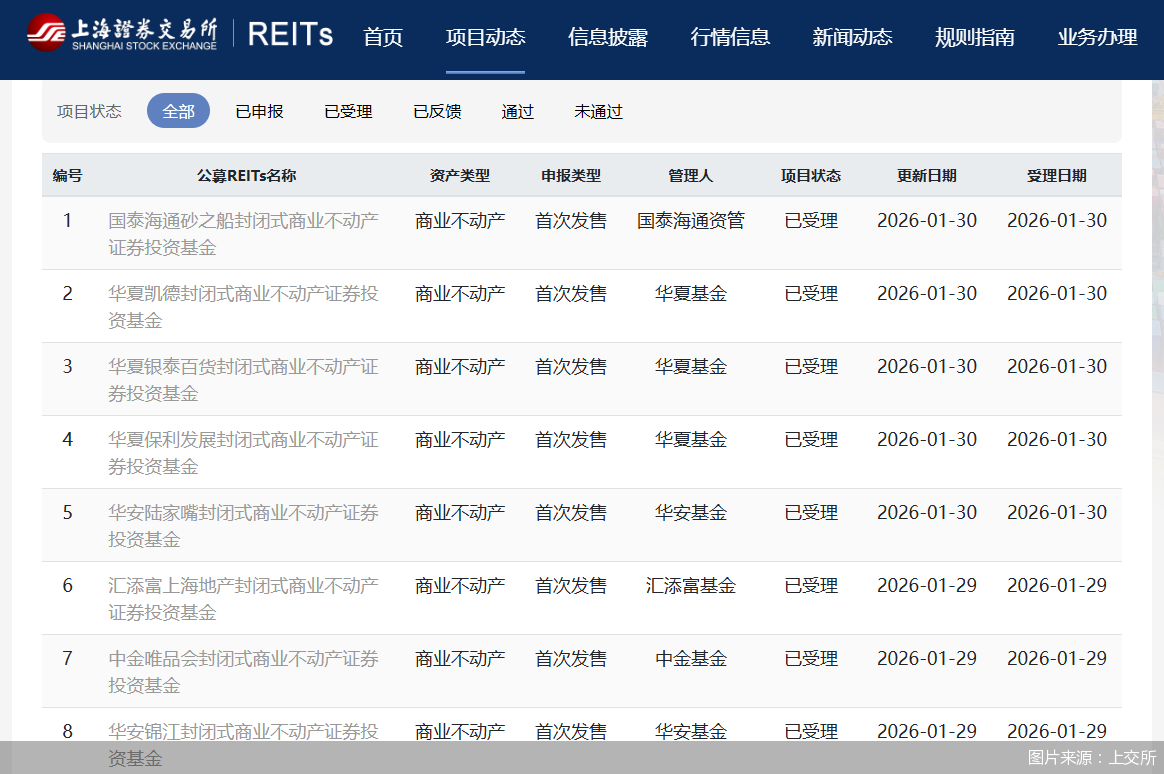
公开数据显示,截至2月1日,境内市场已成立公募REITs共80只,融资金额超2000亿元,资产类型涵盖产业园区、仓储物流、能源、保租房等。此次首批商 业不动产REITs上报,将进一步丰富公募REITs的资产类型,促进商业不动产行业的发展。 北京商报讯(记者 李海媛)在商业不动产投资信托基金(REITs)试点政策落地后,首批产品陆续上报。记者注意到,近日,上交所受理8单商业不动产 REITs项目,基金管理人包括国泰海通资管、华夏基金、汇添富基金、华安基金,预计募集金额合计超300亿元。首批项目的资产形态包括商业综合体、商 业零售、商业办公楼等商业不动产。有观点指出,商业不动产REITs的推出对盘活存量资产具有较好的导向,对于商业地产的开发商而言也意味着更好的融 资渠道的建立。 | | 上海增养交易所 REITS 首页 | 项目动态 | 信息披露 | 行情信息 | 新闻动态 | 规则指南 | 业务 | | --- | --- | --- | --- | --- | --- | --- | --- | | 项目状态 | 美部 己申报 日受理 | 已反馈 通过 | 未通过 | | | | | | 編号 | 公墓REI ...

凯德北京投资基金管理有限公司:美联储对降息按下暂停键
Sou Hu Cai Jing· 2026-01-31 14:56
Group 1 - The Federal Reserve decided to pause its recent series of interest rate cuts, maintaining the key rate in the range of 3.5% to 3.75%, which aligns with market expectations and marks a temporary halt after three consecutive rate cuts [1] - The Federal Open Market Committee adjusted its economic description, indicating that U.S. economic activity is continuing to expand steadily, with moderate job growth and signs of stabilization in the unemployment rate [3] - The statement removed previous language indicating that labor market risks were greater than inflation risks, suggesting a shift towards a more balanced approach to achieving full employment and price stability [3] Group 2 - The U.S. economy is exhibiting mixed signals, with strong economic growth indicators but a slowdown in hiring, while layoffs remain manageable and unemployment claims are low [5] - Inflation remains a significant concern, currently hovering around 3%, which is above the long-term target of 2%, prompting some Federal Reserve officials to advocate for a pause or halt in rate cuts until clearer evidence of easing price pressures is observed [5] - External trade policies are viewed as a factor influencing inflation, with economists believing that current tariff measures may temporarily increase price pressures but are expected to diminish over time [5] Group 3 - The upcoming transition in Federal Reserve leadership is a new focal point for the market, as the successor will need to balance economic expansion, labor market adjustments, and persistent inflation in future rate decisions [7] - The decision to pause rate cuts may reflect the Federal Reserve's cautious assessment of the situation during this critical transition period, allowing for flexibility in future policy [7]
济安金信|2025Q4 五星评级公募基金公司(三年期和五年期评级)
Xin Lang Cai Jing· 2026-01-31 11:13
Group 1 - The core viewpoint of the article is that Jinan Jinxin evaluates fund management companies based on a comparative rating system that considers various risk-return characteristics across different fund types [2][4]. - Jinan Jinxin's rating system includes a comprehensive indicator system tailored for different fund types, focusing on profitability, performance stability, risk resistance, stock selection, and index tracking capabilities [2][3]. - As of the end of Q4 2025, there are 165 fund management institutions in the public market, with 150 being fund management companies and 15 asset management institutions having obtained public qualifications [2][4]. Group 2 - A total of 154 fund management institutions met the rating duration and received comprehensive ratings from Jinan Jinxin, with 72 institutions achieving a five-star rating in their respective product management capabilities [4][5]. - The number of fund management companies participating in the rating varies by fund type, with 117 for money market funds, 133 for pure bond funds, and 151 for mixed funds, among others [5]. - The article lists several fund management companies that received five-star ratings across different fund types, highlighting their profitability, performance stability, and scale appropriateness [6][7][8][9][10][11][12][13][14][15].

博道星航混合型证券投资基金基金份额发售公告
Shang Hai Zheng Quan Bao· 2026-01-30 20:18
Fund Overview - The fund is named "Bodao Xinghang Mixed Securities Investment Fund" and is a mixed-type open-ended fund [15] - The fund's initial fundraising target is capped at 3 billion RMB, excluding interest accrued during the fundraising period [3][17] - The fund will be managed by Bodao Fund Management Co., Ltd., with China Merchants Bank as the custodian [1] Fundraising Period - The fundraising period is set from February 3, 2026, to February 9, 2026, with a maximum duration of 3 months [2][19] - The fund management company may adjust the fundraising period based on subscription conditions [2][19] Subscription Details - The minimum subscription amount for initial subscriptions through direct sales is 2 million RMB, while subsequent subscriptions have a minimum of 10,000 RMB [9][25] - Other sales institutions may accept subscriptions starting from 1 RMB, depending on their specific rules [9][25] - Investors can make multiple subscriptions during the fundraising period, but once submitted, applications cannot be withdrawn [5][25] Fund Management and Operations - Investors must open a fund account with the designated registration institution to subscribe [4] - The fund's shares will be priced at 1 RMB per share [16][21] - Subscription fees will not be charged for direct sales, while other sales institutions may impose fees [21][22] Fund Verification and Effectiveness - The fund will be subject to verification by a legal verification agency within 10 days after the fundraising period ends, provided it meets the necessary conditions [45] - The fund contract will become effective upon completion of the verification and receipt of confirmation from the China Securities Regulatory Commission [45] Investor Information - Investors can access detailed information about the fund on the management company's website and the China Securities Regulatory Commission's fund disclosure website [6] - Customer service is available through the management company's hotline for inquiries regarding subscriptions and fund details [7][46]

1/30财经夜宵:得知基金净值排名及选基策略,赶紧告知大家
Sou Hu Cai Jing· 2026-01-30 15:57
Core Viewpoint - The article provides an objective ranking of open-end mutual funds based on their net asset value (NAV) growth, highlighting the top and bottom performers in the market without any subjective investment advice [1]. Fund Performance Summary Top 10 Funds by NAV Growth - The top-performing funds for the 30th of the month include: 1. Guotai Youxuan Linghang One-Year Holding (FOF) with a NAV of 1.7001 and a growth of 6.88% 2. Puyin Ansheng Digital Economy Mixed A with a NAV of 1.4112 and a growth of 6.79% 3. Puyin Ansheng Digital Economy Mixed C with a NAV of 1.4096 and a growth of 6.78% 4. Great Wall Jiuxiang Mixed A with a NAV of 1.7830 and a growth of 5.78% 5. Great Wall Jiuxiang Mixed C with a NAV of 1.7508 and a growth of 5.78% 6. Qianhai Kaiyuan Shanghai-Hong Kong Deep Enjoy Life with a NAV of 3.7916 and a growth of 5.60% 7. Ping An Technology Selected Mixed Initiated C with a NAV of 1.1485 and a growth of 5.42% 8. Ping An Technology Selected Mixed Initiated A with a NAV of 1.1492 and a growth of 5.41% 9. GF Emerging Growth Mixed A with a NAV of 1.8172 and a growth of 5.31% 10. GF Emerging Growth Mixed C with a NAV of 1.7843 and a growth of 5.31% [2][4]. Bottom 10 Funds by NAV Decline - The funds with the worst performance for the same period include: 1. Shenwan Lingxin Industry Selected Mixed A with a NAV of 1.0313 and a decline of 8.66% 2. Shenwan Lingxin Industry Selected Mixed C with a NAV of 1.0286 and a decline of 8.66% 3. Huitianfu Hongrui Return Mixed Initiated C with a NAV of 1.5545 and a decline of 8.12% 4. Huitianfu Hongrui Return Mixed Initiated A with a NAV of 1.5605 and a decline of 8.12% 5. Wanjia Cycle Vision Stock Initiated A with a NAV of 1.4873 and a decline of 7.80% 6. Wanjia Cycle Vision Stock Initiated C with a NAV of 1.4853 and a decline of 7.80% 7. Huaxia Nonferrous Metals ETF Link C with a NAV of 2.1886 and a decline of 7.77% 8. Huaxia Nonferrous Metals ETF Link A with a NAV of 2.2100 and a decline of 7.77% 9. Huaxia Nonferrous Metals ETF Link D with a NAV of 2.1888 and a decline of 7.77% 10. Southern Gold Stock C with a NAV of 2.3864 and a decline of 7.75% [3][4]. Market Analysis - The Shanghai Composite Index opened lower but experienced a recovery, closing with a small decline, while the ChiNext Index showed a stronger V-shaped recovery, closing with a small gain. The total trading volume reached 2.86 trillion, with a ratio of advancing to declining stocks at 2453 to 2896 [6]. - Leading sectors included communication equipment with gains exceeding 2%, while the worst-performing sectors were non-ferrous metals, mineral products, and liquor, which saw declines exceeding 3% [6]. Fund Strategy Insights - The fund with the fastest NAV growth is Puyin Ansheng Digital Economy Mixed A, which has a concentrated holding in the communication sector, with a top ten holding concentration of 66.67% [7][8]. - Conversely, Shenwan Lingxin Industry Selected Mixed A has shown significant NAV decline, with a top ten holding concentration of 60.70%, indicating a shift in investment strategy towards resource sectors [8][9].

2 Unstoppable Growth ETFs to Buy and Hold for Decades
Yahoo Finance· 2026-01-30 15:50
Core Viewpoint - Exchange-traded funds (ETFs) are ideal for long-term investments due to their ability to provide exposure to multiple top companies through a single investment, facilitating portfolio diversification [1] Group 1: Invesco QQQ Fund - The Invesco QQQ Fund tracks the Nasdaq-100 index, comprising the top 100 non-financial stocks on the Nasdaq exchange, making it a prime choice for growth investors [3] - The fund has an expense ratio of 0.18% and has increased over 510% in value over the past decade, significantly outperforming the S&P 500's 270% gains [4] - The fund's heavy exposure to technology stocks (64% of the portfolio) may lead to volatility, but it also offers the potential for substantial long-term returns [5] Group 2: Vanguard Growth Index Fund - The Vanguard Growth Index Fund includes around 150 stocks, providing a more diversified option compared to the Invesco ETF, while focusing on large-cap stocks [6] - This fund has a lower expense ratio of 0.04% and has produced gains of about 400% over the past 10 years, aligning closely with the performance of the S&P 500 and the Invesco Fund [7] - The Vanguard fund is positioned as another market-beating option with the potential for continued superior gains in the long run [7]
证监会核准法巴资管成为浦银安盛基金主要股东
Sou Hu Cai Jing· 2026-01-30 11:41
批复称,浦银安盛基金及各股东应当按规定及时办理工商变更登记等相关事宜,完善公司治理结构,维 护公司及基金份额持有人的合法权益。 证监会近日发布《关于核准浦银安盛基金管理有限公司变更主要股东的批复》。经审核,核准法国巴黎 资产管理控股公司成为浦银安盛基金主要股东;对法巴资管依法承接浦银安盛基金46800万元人民币出 资(占注册资本比例39%)无异议。 ...
5单商业不动产REITs今日上报
Di Yi Cai Jing· 2026-01-30 11:30
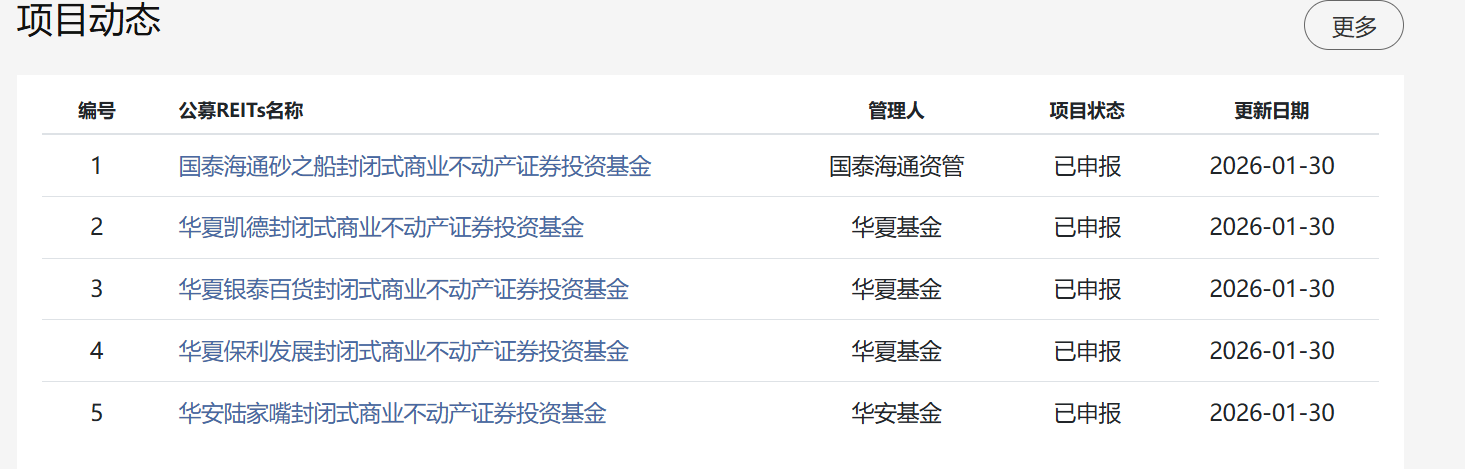
| 编号 | 公募REITs名称 | 管理人 | 项目北 | | --- | --- | --- | --- | | 1 | 国泰海通砂之船封闭式商业不动产证券投资基金 | 国泰海通资管 | 己申 | | 2 | 华夏凯德封闭式商业不动产证券投资基金 | や夏基金 | 己申 | | 3 | 华夏银泰百货封闭式商业不动产证券投资基金 | や直事等 | 己申 | | ব | 华夏保利发展封闭式商业不动产证券投资基金 | で直基等 | 日中 | | 5 | 华安陆家嘴封闭式商业不动产证券投资基金 | 华安基金 | 己申 | (文章来源:第一财经) 证监会官网信息显示,华夏基金于30日上报3单商业不动产REITs,分别为华夏凯德封闭式商业不动产证券投资基金、华夏银泰百货封闭式商业不动产证券 投资基金、华夏保利发展封闭式商业不动产证券投资基金。此外,30日上报的商业不动产REITs,还有国泰海通砂之船封闭式商业不动产证券投资基金、华 安陆家嘴封闭式商业不动产证券投资基金。 ...
多家外资机构认为A股今年将延续涨势
21世纪经济报道· 2026-01-30 11:24
Group 1 - The core viewpoint of the article is that foreign investment institutions are optimistic about the A-share market in 2026, highlighting the potential for high-quality core assets, sectors related to overseas expansion, and areas with improving supply-demand dynamics [1][4][5] - Morgan Asset Management's strategist indicates that the attractiveness of the A-share market is expected to increase further, driven by a recovery in corporate earnings and a favorable domestic policy environment [1][3] - The article notes that the A-share market performed well in 2025, with the Shanghai Composite Index rising by 18.41%, and forecasts that this upward trend will continue into 2026 [3][4] Group 2 - Macro factors such as a gradual decline in interest rates and a resilient corporate earnings performance are expected to support global economic growth in early 2026 [4][5] - The article emphasizes the importance of active stock selection due to significant market and industry differentiation within Asia, with a focus on companies with strong balance sheets and sustainable profit growth [4][5] - Specific investment recommendations include sectors such as technology AI, innovative pharmaceuticals, and stable new consumption enterprises, which are seen as key areas for potential growth [5][6]

证监会核准法巴资管成为浦银安盛主要股东
Jin Rong Jie· 2026-01-30 10:15
证监会核准法国巴黎资产管理控股公司(BNP Paribas Asset Management Holding S.A)成为浦银安盛基 金管理有限公司主要股东;对法巴资管依法承接浦银安盛46,800万元人民币出资(占注册资本比例 39%)无异议。 ...