
华安黄金ETF

Search documents
跌超20%后反弹!金价过山车,基民吵翻了:割肉还是硬扛?基金经理最新发声
凤凰网财经· 2026-03-25 13:15
Core Viewpoint - The article discusses the recent fluctuations in gold prices and the performance of gold-themed funds, highlighting the debate on whether to hold or redeem these funds amid significant price drops and market volatility [3][4]. Group 1: Gold Price Trends - Since March 3, gold prices have significantly declined, with spot gold dropping below $4,100 per ounce on March 23, a decrease of over 20% from the March 2 high of $5,419.32 [3][4]. - The gold sector in the A-share market saw a year-to-date increase of 73.38% in January, ranking first among 31 Shenwan primary industries, but has since faced a downturn [4]. Group 2: Fund Performance - By March, the year-to-date return of gold funds fell below 5%, with many ETFs experiencing substantial outflows and declines in net asset value [4][5]. - On March 23, the largest gold-themed ETF, managed by Huashan Fund, reported a year-to-date return of -5.12%, with a decrease in circulation scale by 143.13 billion [5][6]. Group 3: Market Sentiment and Future Outlook - The article notes that the recent downturn in gold prices is attributed to pressures from "monetary policy repricing" and "liquidity squeeze," leading to increased selling pressure in the market [8][9]. - Despite short-term volatility, long-term investment managers believe that gold still holds value as a hedge against inflation and uncertainty, suggesting a potential rebound in interest for gold as a strategic asset [9][10].


多个品种创年内新低!贵金属新一轮暴跌“冲击波”有多大?
证券时报· 2026-03-23 14:31
Core Viewpoint - Precious metals, including gold, silver, platinum, and palladium, are experiencing a significant decline in prices, marking a new low for the year, which has also impacted the stock and ETF markets [1][2][3]. Price Decline Details - Gold prices have seen a drastic drop, with the Shanghai Gold Exchange's Au99.99 contract closing down 11.23% on March 23, reaching a low of 911 yuan per gram, over 20% lower than its recent peak [3][4]. - Silver prices have plummeted even more, with the main silver futures contract on the Shanghai Futures Exchange dropping over 13% on March 23, hitting a low of 15,070 yuan per kilogram, effectively halving from its yearly high [3][4]. - Platinum and palladium prices also fell sharply, with platinum futures dropping over 15% and palladium futures over 14% on March 23, both reaching new yearly lows [3][4]. Market Impact - The decline in precious metal prices has led to a significant drop in the Shenyin Wanguo Precious Metals Index, which fell 8.38% on March 23, with a cumulative decline of 20.75% since February [6]. - Stocks related to precious metals have also seen substantial declines, with companies like Hunan Silver and Zhaojin Gold experiencing over 40% pullbacks from their yearly highs [6][7]. - Major ETFs tracking precious metals have seen their scales shrink dramatically, with the Huaan Gold ETF dropping from 126.8 billion yuan to a loss of approximately 61 billion yuan over a few days [8]. Expert Analysis - According to Zhu Shanying, the escalation of geopolitical conflicts and strong energy prices have delayed interest rate cuts and worsened market risk appetite, which are key factors behind the recent adjustments in precious metal prices [10][11]. - In the short term, precious metals are expected to remain under pressure due to ongoing geopolitical tensions, but the long-term outlook remains bullish, driven by rising inflation expectations and potential stagflation risks [11].

ETF基金资金跟踪:目前周期板块资金热度较高
Dongguan Securities· 2026-03-13 08:52
Market Performance Review - The equity market has shown strong performance this year, with the CSI 2000, CSI 1000, and CSI Dividend indices performing relatively well. The cyclical style leads the market, followed by growth and stability styles. Strong sectors include coal, oil and petrochemicals, non-ferrous metals, building materials, electric equipment, and new energy [3][8] - In the commodity market, the South China crude oil index has performed relatively well this year [11] - The commodity fund index has also shown strong performance, benefiting from the rise in oil and gold prices [11] ETF Fund Capital Tracking - As of now, the cyclical sector (real estate, oil, coal, non-ferrous metals, steel, building materials, chemicals) has a relatively high capital heat. The top 5 ETFs by capital heat are: Huaan Gold ETF, Haifutong CSI Short Bond ETF, Fortune CSI Hong Kong Stock Connect Internet ETF, Huaxia CSI Electric Grid Equipment Theme ETF, and Hang Seng Technology [15][17] - The capital heat is assessed based on net inflows over various time frames, with the cyclical sector showing a capital heat score of 100 [15][16] Future Strategy Outlook - The year 2026 marks the beginning of the "14th Five-Year Plan." Key tasks outlined in the government work report include building a strong domestic market, fostering new growth drivers, and enhancing technological self-reliance [18][19] - The economic recovery transmission chain indicates that in a context of interest rate cuts and weakened dollar credit, financial assets (gold, silver) perform strongly first, followed by industrial metals (copper), and then energy and chemical sectors due to supply constraints and demand recovery [22] - The current market cycle can be compared to the 2014 cycle, which was divided into three phases. The current cycle is characterized by growth leading, followed by a potential catch-up phase for cyclical and consumer styles [24][25]
黄金ETF,2026年2月复盘与3月展望
Soochow Securities· 2026-03-03 10:06
Market Performance - In February 2026, the Shanghai gold price experienced a "deep correction followed by stabilization and a V-shaped recovery," with a monthly decline of -4.10%[11] - The price initially dropped sharply at the beginning of the month, then gradually stabilized and rebounded, returning to early-month levels by month-end[12] - As of February 28, 2026, the risk level of Shanghai gold reached 63.62, indicating a moderately positive market sentiment[16] Volatility and ETF Analysis - Historical volatility of Shanghai gold increased significantly, with implied volatility dropping from a high of 99% to around 90%[17] - Global gold ETF holdings showed a short-term "high followed by a pullback, then a month-end restart" pattern, indicating a long-term growth trend[24] - As of February 27, 2026, the total market value of Huaan Gold ETF reached 123.82 billion yuan, with a trading volume of 24.74 billion yuan on that day[5] Asset and Currency Value - Actual interest rates remain the core anchor for gold prices, influenced by mixed U.S. economic data and geopolitical risks, leading to adjustments in market expectations for monetary easing[24] - The U.S. dollar exhibited fluctuations due to repeated interest rate cut expectations and mixed economic data, impacting gold's currency value[32] Risk and Commodity Value - Geopolitical tensions and global policy uncertainties have heightened demand for gold as a safe-haven asset, with significant risk premiums supporting gold prices[34] - Central bank gold purchases continue to provide mid-term support, with stable demand from official sectors offsetting short-term investment sentiment fluctuations[41] Future Outlook - The pricing logic for gold will continue to be driven by inflation and employment data, Federal Reserve policy adjustments, and geopolitical tensions, maintaining a high volatility and resilience in prices[44] - Key upcoming events include the U.S. non-farm payroll report and the Federal Reserve's FOMC meeting, which will significantly influence market expectations and gold pricing[46]
满屏涨停!原油基金,太火爆!这些产品却大跳水,是何缘故?
券商中国· 2026-03-03 09:42
Core Viewpoint - The article highlights the ongoing surge in oil prices and the strong performance of oil and gas-related funds, while also noting a significant pullback in military, silver, and gold funds, indicating a mixed sentiment in the resource sector [1][3][4]. Oil and Gas Sector Performance - Multiple oil and gas ETFs, including those from 嘉实, 银华, 富国, 博时, and 汇添富, have hit the daily limit up, reflecting a robust market sentiment [1][4]. - As of March 3, the WTI crude oil price increased by 5.02% to $74.803 per barrel, while Brent crude rose by 5.03% to $81.653 per barrel [2]. - Year-to-date, several oil and gas ETFs have recorded gains exceeding 40%, with some surpassing 60% [4][5]. Fund Performance and Market Trends - The article provides a detailed table of various funds, showing significant daily and year-to-date returns for oil-related funds, with some funds like 原油LOF易方达 and 石油基金LOF achieving daily increases of around 10% [2][6]. - Conversely, military and precious metal funds experienced notable declines, with silver funds dropping over 8% and military funds falling by approximately 6% [3][5]. Market Sentiment and Future Outlook - The article notes a divergence in resource fund performance, with oil and gas funds continuing to rise while other sectors like military and precious metals face corrections [4][5]. - Analysts suggest that while the resource sector remains promising, there is a need for caution regarding short-term trading risks, emphasizing a return to fundamental analysis for investment decisions [8][10]. - The geopolitical landscape, particularly tensions involving Iran, is influencing oil prices and market dynamics, with potential implications for supply chains and inflation [9][11]. Strategic Insights - Investment strategies are shifting towards a focus on long-term fundamentals rather than short-term market movements, with an emphasis on cost analysis and sector rotation within the resource space [10]. - The article suggests that the demand structure is transitioning from real estate-driven to manufacturing-driven, particularly in technology and industrial sectors, which may present new investment opportunities [10].

金价大幅波动,背后究竟隐藏了什么秘密?
Sou Hu Cai Jing· 2026-02-24 02:55
Core Insights - The article highlights the significant price discrepancies in the gold market during the Chinese New Year, particularly on February 22, 2026, where international gold prices surged while domestic prices remained stagnant due to the Shanghai Gold Exchange being closed for the holiday [1][3]. Group 1: Price Discrepancies - On February 22, 2026, the international gold price reached $5,104.24 per ounce, increasing by $117, or over 2.35%, while domestic gold jewelry was priced at 1,560 RMB per gram, with buyback prices around 1,100 RMB per gram, creating a price gap of 460 RMB per gram [1][3]. - The domestic wholesale gold prices were frozen at the last trading day before the holiday, with AU9999 spot and gold T D prices at 1,109 RMB and 1,108.5 RMB per gram respectively, leading to a "parallel universe" effect in pricing [3]. Group 2: Market Dynamics - Retailers raised prices to include a "risk premium" due to uncertainty in international gold prices, which could lead to losses if they sold at pre-holiday prices [3]. - The recovery price for gold jewelry is significantly lower because consumers pay for craftsmanship and brand value, while recyclers only consider the raw material value, leading to a substantial price difference [4][6]. Group 3: Investment vs. Consumption - For consumers purchasing gold jewelry for personal use, the emotional and aesthetic value justifies the higher prices, while investors seeking asset preservation should avoid jewelry and focus on bank gold bars or gold ETFs, which are closely aligned with raw gold prices [10][12]. - The article emphasizes the importance of understanding the different pricing layers in the gold market, where gold serves as both an investment asset and a consumer product, each with distinct pricing mechanisms [12]. Group 4: Market Influences - The surge in international gold prices was driven by expectations of the Federal Reserve starting a rate-cutting cycle in 2026, alongside geopolitical tensions that heightened global risk aversion [8]. - Central banks have been net buyers of gold for several years, with the World Gold Council reporting a net purchase of 863 tons in 2025, contributing to a solid price foundation for gold [8].

两市ETF两融余额减少94.83亿元丨ETF融资融券日报
2 1 Shi Ji Jing Ji Bao Dao· 2026-02-24 02:45
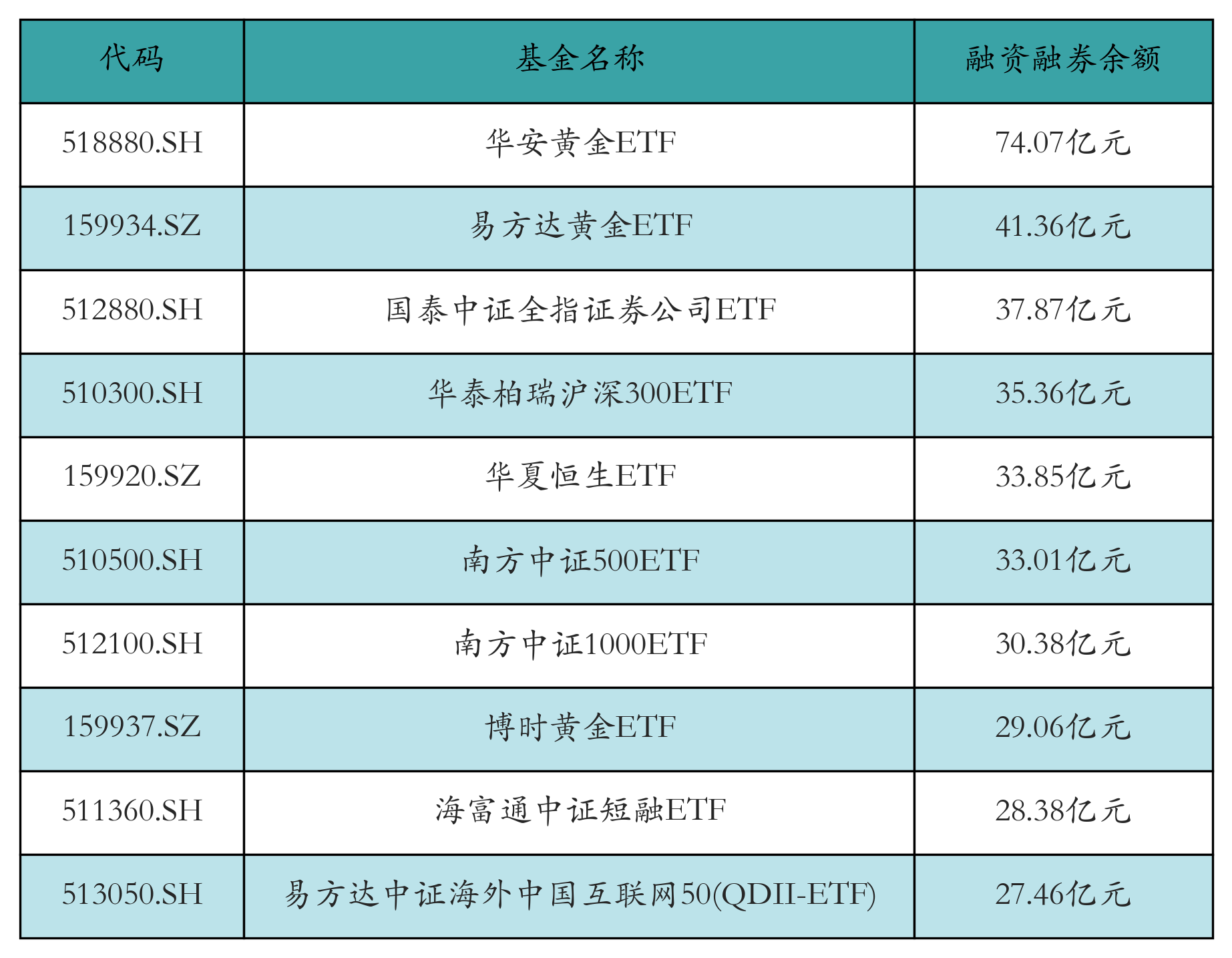
Market Overview - On February 13, the total ETF margin balance in the two markets was 115.864 billion yuan, a decrease of 9.483 billion yuan from the previous trading day [1] - The financing balance was 108.367 billion yuan, down by 9.454 billion yuan, while the securities lending balance was 7.497 billion yuan, a decrease of 29.625 million yuan [1] - In the Shanghai market, the ETF margin balance was 80.922 billion yuan, a decrease of 8.662 billion yuan, with a financing balance of 74.354 billion yuan, down by 8.657 billion yuan [1] - In the Shenzhen market, the ETF margin balance was 34.942 billion yuan, a decrease of 0.822 billion yuan, with a financing balance of 34.013 billion yuan, down by 0.796 billion yuan [1] ETF Margin Financing and Securities Lending - The top three ETF margin balances on February 13 were: Huaan Gold ETF (7.407 billion yuan), E Fund Gold ETF (4.136 billion yuan), and Guotai CSI All-Share Securities Company ETF (3.787 billion yuan) [2] - The top three ETF financing buy amounts were: Hai Futong CSI Short Bond ETF (1.683 billion yuan), Hang Seng Technology ETF (909 million yuan), and Bosera Convertible Bond ETF (874 million yuan) [4] - The top three ETF financing net buy amounts were: Dachen Hang Seng Technology ETF (31.3105 million yuan), Huaan Gold ETF (30.3682 million yuan), and Huatai-PB CSI 300 ETF (27.6497 million yuan) [5] ETF Securities Lending - The top three ETF securities lending sell amounts were: Southern CSI 500 ETF (1.27 billion yuan), Southern CSI 1000 ETF (283.781 million yuan), and Bosera Convertible Bond ETF (229.007 million yuan) [7]
黄金助推“固收+”理财收益走高,机构继续看好黄金配置价值
2 1 Shi Ji Jing Ji Bao Dao· 2026-02-11 08:59
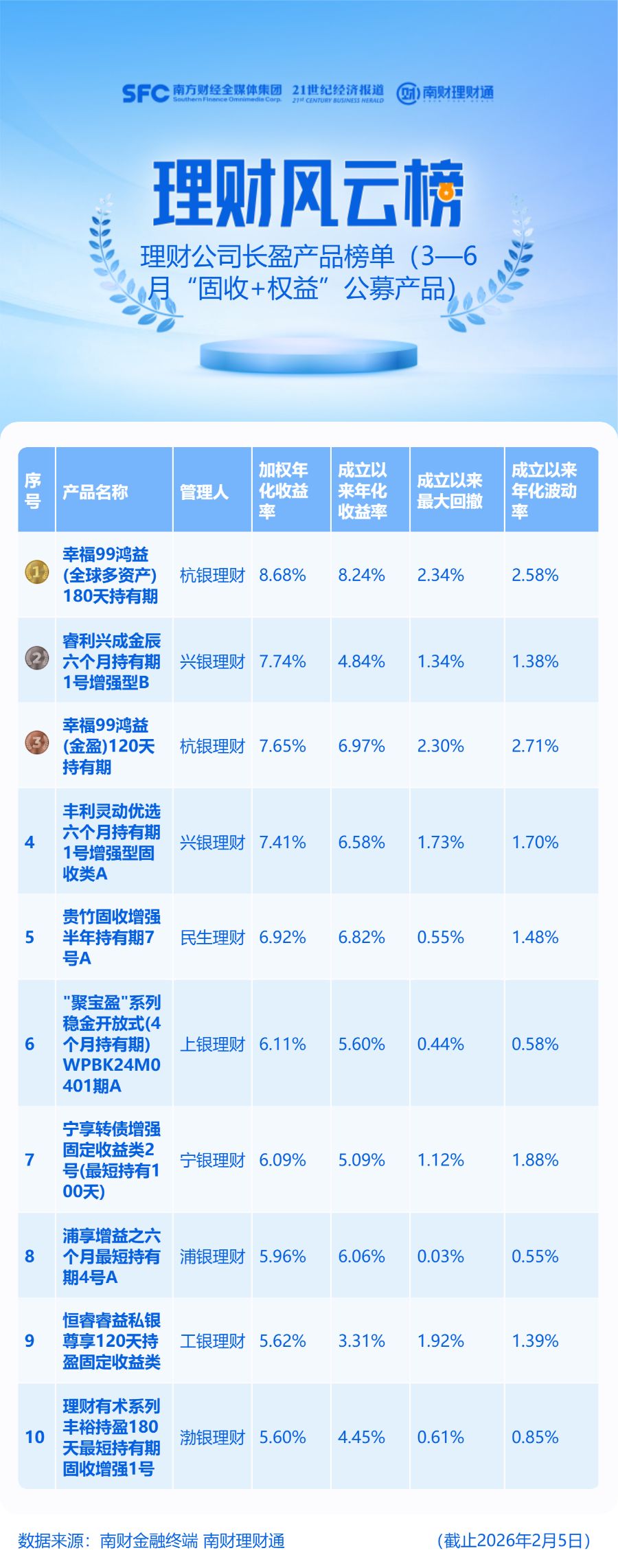
Core Insights - The article discusses the performance of "fixed income + equity" public funds in the investment management sector, highlighting the top products based on their weighted annualized returns as of February 5, 2026 [4][8]. Group 1: Product Performance - The top product, "Happiness 99 Hongyi (Global Multi-Asset) 180-day Holding Period" from Hangyin Wealth Management, achieved a weighted annualized return of 8.68% and has maintained an annualized return above 8% since inception [4][5]. - The second-ranked product, "Ruili Xingcheng Jincheng 6-Month Holding Period 1 Enhanced Type B" from Xingyin Wealth Management, also performed well with a weighted annualized return exceeding 7% [4][5]. - Other notable products include "Happiness 99 Hongyi (Jinying) 120-day Holding Period" from Hangyin Wealth Management with a return of 7.65% and "Fengli Lingdong Youxuan 6-Month Holding Period 1 Enhanced Type A" from Xingyin Wealth Management with a return of 7.41% [4][5]. Group 2: Investment Strategies - The top product focuses on global multi-asset allocation, including fixed income, equities, and gold, with a performance benchmark based on a mix of various indices [5][6]. - The second product emphasizes gold asset allocation, with a performance benchmark that includes a significant portion linked to gold prices [6][7]. - Both products have seen significant growth in asset size, with the top product reaching 473 million yuan, a 50.82% increase from the previous quarter [5][6]. Group 3: Market Outlook - The outlook for 2026 remains positive for gold assets, driven by factors such as lower opportunity costs for gold purchases, ongoing concerns about U.S. credit, and increasing central bank demand for gold [7][8]. - The article notes that the strong performance of gold throughout 2025 was influenced by geopolitical risks and concerns over the U.S. debt situation, which are expected to continue supporting gold prices in the long term [6][7].
东吴证券晨会纪要2026-02-11-20260211
Soochow Securities· 2026-02-11 02:46
Macro Strategy - The core viewpoint indicates that recent liquidity shocks in overseas markets, driven by concerns over the AI software bubble and subsequent momentum selling, have led to significant volatility in equities, commodities, and cryptocurrencies. It suggests that some assets may have been "wrongly killed" due to these liquidity shocks, as the macroeconomic fundamentals and broad liquidity environment have not changed significantly [1][13] - The report anticipates that the upcoming U.S. non-farm employment and CPI data for January may present upward risks, potentially reversing the slight increase in expectations for Federal Reserve rate cuts observed this week [1][13] Financial Products - The report highlights that overseas market liquidity shows signs of stabilization, which may improve market sentiment. It predicts a positive outlook for the A-share market in February, with a historical probability of 78.57% for an increase following a macro timing model score of 0 [1][16] - Fund allocation recommendations suggest a balanced ETF configuration due to expected short-term market fluctuations, with a focus on sectors like chemicals and electric grid equipment, which continue to see increasing fund sizes [1][16] Commodity Market - The report discusses the impact of liquidity shocks on commodity prices, noting that certain commodities, which rely on supply-demand improvements, have been "wrongly hurt" but may return to fundamental pricing logic as market conditions stabilize [2][17] - It emphasizes that the recent volatility in silver and other precious metals indicates a potential end to the liquidity shock, with silver becoming a key indicator of market sentiment [2][17] Environmental Industry - The report stresses the importance of advancing the national carbon market and outlines investment recommendations in clean energy, energy conservation, and recycling sectors. It highlights specific companies such as Longjing Environmental and others involved in renewable energy and waste management [6][10] Non-Banking Financial Sector - The report notes a recovery in the IPO and refinancing market, with significant year-on-year growth in both areas. It indicates that the capital market reforms and increased market activity are expected to benefit brokerage firms' investment banking revenues [9] AI Industry and Bond Financing - The report focuses on the AI industry, highlighting the need for a diversified financing system to support technology companies, particularly private firms with high growth potential. It reviews case studies of leading tech companies' bond financing paths to assess the feasibility of similar strategies in China [4]

东吴证券晨会纪要2026-02-09-20260209
Soochow Securities· 2026-02-09 01:37
Macro Strategy - The report discusses the impact of liquidity shocks on commodity markets, highlighting that certain commodities, which are fundamentally sound, have been "misjudged" during these shocks and may present better entry points as the market stabilizes [1][6]. - The report indicates that after the liquidity shock, the core logic of commodity markets remains unchanged, with a focus on supply-demand dynamics and the potential for recovery in mispriced commodities [6]. Financial Products - The report reviews the performance of gold ETFs, noting that macroeconomic data and policy expectations have fluctuated, with interest rate cut expectations providing temporary support for gold [2][9]. - It emphasizes the importance of geopolitical risks and central bank gold purchases in supporting gold prices, while also indicating that the market may experience high volatility in February 2026 [2][9]. Fixed Income - The report provides an analysis of the Hai Tian convertible bond, predicting a listing price between 125.75 and 139.83 CNY, with a conversion premium of approximately 30% [3][10]. - It highlights the company's stable revenue growth and the strategic use of raised funds for infrastructure projects, indicating a solid credit rating and good debt protection [10][11]. Industry Analysis - The report identifies a shift in the semiconductor and storage industry driven by AI demand, suggesting that storage capacity is becoming a critical bottleneck for AI performance [4][12]. - It recommends focusing on companies like SanDisk, SK Hynix, Samsung Electronics, and Micron Technology, as they are positioned to benefit from the increasing demand for high-capacity storage solutions [4][12]. - The report notes that the chemical sector is expected to see continued improvement in market conditions due to structural changes in demand, particularly from emerging industries [7][12]. Company Recommendations - The report maintains a positive outlook on Yum China, highlighting its robust dividend yield and steady revenue growth, with projections for continued expansion in store numbers and profitability [5][13][14]. - It notes that the company has successfully improved operational efficiency and cost management, contributing to its strong financial performance [13][14].