
水务

Search documents
北控水务集团(00371)拟发行本金额为10亿元的中期票据
Zhi Tong Cai Jing· 2025-12-05 09:31
(原标题:北控水务集团(00371)拟发行本金额为10亿元的中期票据) 智通财经APP讯,北控水务集团(00371)发布公告,公司已向中国银行间市场交易商协会提交申请统一注 册额度为人民币150亿元的多品种债务融资工具及于2025年6月获得批准,可适时发行。 公司拟于中华人民共和国境内发行2025年度第三期本金额为人民币10亿元的中期票据,期限为五年。公 司拟将2025年度第三期中期票据募集资金全部用于偿还境外金融机构借款的用途。 ...
北控水务集团拟发行本金额为10亿元的中期票据
Zhi Tong Cai Jing· 2025-12-05 09:30
公司拟于中华人民共和国境内发行2025年度第三期本金额为人民币10亿元的中期票据,期限为五年。公 司拟将2025年度第三期中期票据募集资金全部用于偿还境外金融机构借款的用途。 北控水务集团(00371)发布公告,公司已向中国银行间市场交易商协会提交申请统一注册额度为人民币 150亿元的多品种债务融资工具及于2025年6月获得批准,可适时发行。 ...
重庆水务:预计新增2025年度日常关联交易金额1.62亿元
2 1 Shi Ji Jing Ji Bao Dao· 2025-12-05 03:34
Core Points - Chongqing Water Authority (601158.SH) expects to add daily related transactions amounting to 162.26 million yuan for the year 2025, involving the purchase of raw water from Chongqing Water Conservancy Investment (Group) Co., Ltd. and providing water supply services, as well as leasing the Chicken Crown Stone Wastewater Treatment Plant Phase IV project from Chongqing Water Environment Holding Group Co., Ltd. [1] - The adjusted total for daily related transactions in 2025 is projected to be 510.26 million yuan [1]

重庆水务拟以2.55亿元收购污水处理项目;建设银行:2025年半年度拟派发现金股息486.05亿元|公告精选
Mei Ri Jing Ji Xin Wen· 2025-12-04 14:32
Mergers and Acquisitions - Chongqing Water announced plans to acquire wastewater treatment projects for a total of 255 million yuan, which includes assets and related debts from three wastewater treatment plant expansion projects [1] - Beijiete plans to acquire controlling interest in Yunnan Wenye Nonferrous Metals Co., Ltd. through a share acquisition agreement [2] - Suhao Huihong intends to conduct an asset swap with its controlling shareholder, Suhao Holdings, involving the transfer of a 2.33% stake in Zijin Property Insurance for a transaction value of 262 million yuan [3] Shareholding Changes - Sun Cable's major shareholder, Xiamen Xiangyu Group, and its concerted parties plan to reduce their holdings by up to 3%, amounting to a maximum of 21.67 million shares [4] - Haike Xinyuan's shareholder, a strategic asset management plan, intends to reduce its holdings by up to 2.50%, equating to 557.41 million shares [5] - Dongwang Times' shareholder, Dongyang Xinling Technology Co., Ltd., plans to reduce its holdings by up to 1.20%, which is approximately 10.13 million shares [6] Other Developments - Meilixin plans to raise up to 1.2 billion yuan through a private placement of A-shares, with proceeds allocated for semiconductor equipment projects and working capital [7] - China Construction Bank announced a cash dividend distribution plan for the first half of 2025, totaling approximately 48.605 billion yuan, with a per-share dividend of 0.1858 yuan [8]






重庆水务:12月4日召开董事会会议
Mei Ri Jing Ji Xin Wen· 2025-12-04 10:22
每经头条(nbdtoutiao)——让"铁疙瘩"从数万米高空精准"踩刹车",中国商业航天"降本复用"只差"最 后一公里"!朱雀之后,同行排队接力 (记者 曾健辉) 每经AI快讯,重庆水务(SH 601158,收盘价:4.67元)12月4日晚间发布公告称,公司第六届第二十一 次董事会会议于2025年12月4日在公司11楼会议室以现场加视频方式召开。会议审议了《重庆水务集团 股份有限公司关于预计新增2025年度日常关联交易的议案》等文件。 2024年1至12月份,重庆水务的营业收入构成为:污水处理服务占比58.94%,自来水销售占比24.92%, 其他业务占比7.79%,污泥处理处置占比3.44%,工程施工占比3.06%。 截至发稿,重庆水务市值为224亿元。 ...
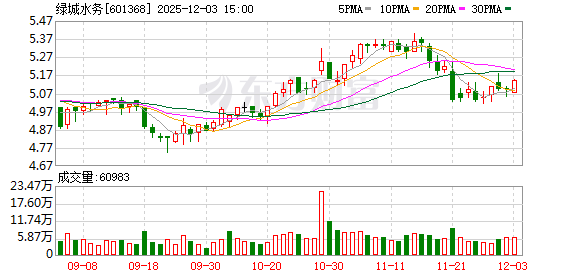
绿城水务:截至11月28日公司普通股股东总数为两万七千多户
Zheng Quan Ri Bao· 2025-12-03 10:13
Group 1 - The core point of the article is that Greentown Water stated on an interactive platform that as of November 28, 2025, the total number of common stock shareholders will exceed 27,000 [2]

中国水务(0855.HK):中期核心业务保增长 项目提价步伐料可超预期
Ge Long Hui· 2025-12-03 04:23
Core Insights - The company reported a 12.9% year-on-year decline in total revenue and a 24.4% drop in net profit attributable to shareholders for FY26H1, amounting to HKD 5.18 billion and HKD 570 million respectively, primarily due to fluctuations in the mainland real estate market and a decrease in water connection income [1] - Despite the overall decline, the core water supply business showed growth, with related revenue and water sales increasing by 4.5% and 5.0% to HKD 1.80 billion and 7.6 million tons respectively [1] - The company has accelerated water price increases, with 8 water supply projects approved for price hikes, achieving the annual target of 8 to 10 projects, which is expected to exceed expectations for FY26 [1] Financial Performance - The company's capital expenditure decreased by 31.8% year-on-year to HKD 1.24 billion for FY26H1, with a full-year target of less than HKD 2 billion, representing a decline of at least 40.4% [2] - The reduction in capital expenditure is anticipated to support the company's high dividend policy [2] Ratings and Forecasts - The company has revised down its net profit forecasts for FY26-28 by 10.8%, 14.8%, and 14.8% respectively, and adjusted the target price from HKD 6.90 to HKD 6.52, reflecting a potential upside of 10.1% and a price-to-earnings ratio of 9.5 times for FY27 [2] - The company maintains a "Buy" rating based on the FY26H1 performance and anticipated water price increases [2]
募投项目必要性和前次募投项目未达预期遭问询,海天股份回复
2 1 Shi Ji Jing Ji Bao Dao· 2025-12-03 03:27
Core Viewpoint - Haitian Co., Ltd. plans to issue convertible bonds to raise no more than 801 million yuan, prompting inquiries from the Shanghai Stock Exchange regarding the necessity of the fundraising projects, capacity planning, and changes in previous fundraising projects [1] Group 1: Necessity of Fundraising Projects - The company stated that the fundraising aims to address the current challenges faced by its water supply business, particularly due to aging facilities at the Jianyang First Water Plant, which has seen its actual supply capacity decline significantly [1] - The company highlighted that the second water plant in Ziyang is operating at over 90% capacity, making it difficult to meet future regional demand, while the sewage treatment plant in Jiajiang is also under pressure due to urbanization [1] Group 2: Capacity Planning Rationality - The company referenced local planning data indicating that by 2035, the water demand in Jianyang's central urban area is expected to exceed the current production capacity of water plants [1] - For the sewage treatment project in Jiajiang, the company predicts that the demand for sewage treatment will continue to grow from 2025 to 2035, surpassing the total capacity after expansion, indicating no significant uncertainty in capacity absorption [1] Group 3: Previous Fundraising Project Performance - The company explained that the underperformance of previous fundraising projects, such as the Ya'an Daxing Sewage Treatment Plant, was due to short-term factors like insufficient inflow and not yet entering the pricing adjustment period [2] - The company asserted that these factors would have limited impact on the current fundraising projects [2] Group 4: Financing Scale - The company indicated that its debt-to-asset ratio is within a reasonable range for the industry, and future funding gaps are significant, making the current financing scale appropriate [2] - The proportion of funds allocated for non-capital expenditures is 29.96%, which complies with regulatory requirements of not exceeding 30% [2]

滇池水务(03768)被列为被执行人 公司及法定代表人曾锋被采取限制消费措施
智通财经网· 2025-12-02 13:46
根据中国执行信息公开网公佈的信息,昆明市呈贡区人民法院在执行申请人贵州建工集团第四建筑工程 有限责任公司申请执行该公司建设工程施工合同纠纷一案中,因公司未在指定的期间履行生效法律文书 确定的给付义务(执行标的:约人民币2080.87万元),因此将该公司列为被执行人,限制公司及公司法定 代表人曾锋先生不得实施以下高消费及非生活和工作必需的消费行为:(i)乘坐交通工具时选择飞机、列 车软卧、轮船二等以上舱位;(ii)在星级以上宾馆、酒店、夜总会、高尔夫球场等场所进行高消费;(iii)购 买不动产或者新建、扩建、高档装修房屋;(iv)租用高档写字楼、宾馆、公寓等场所办公;(v)购买非经营 必须车辆;(vi)旅游、度假;(vii)子女就读高收费私立学校;(viii)支付高额保费购买保险理财产品;及(ix)乘坐 G字头动车组列车全部座位、其他动车组列车一等以上座位等其他非生活和工作必需的消费行为。限制 消费措施自限制消费令发出之日起生效,履行完毕生效法律文书确定的义务后解除。 就上述案件,公司正在与相关当事人积极沟通,公司将持续关注相关事件进展,按照法律法规及时履行 相应的信息披露义务。为免生歧义,公司谨此说明,上述案 ...
兴蓉环境:关联方中标控股子公司项目
Ge Long Hui· 2025-12-02 12:58
格隆汇12月2日丨兴蓉环境(000598.SZ)公布,公司控股子公司成都市自来水有限责任公司(简称:自来 水公司)通过公开招标实施聚氯化铝集中采购,经评审和公示,确定成都汇锦水务发展有限公司(简 称:汇锦水务公司)为中标人。根据中标结果,本次采购合同金额合计为人民币9,564.09万元(含 税),加上合同允许的增补采购额度(不超过合同金额的15%),金额预计不超过10,998.70万元(含 税)。药剂采购单位包括公司合并报表范围内23家下属公司,中标人汇锦水务公司为公司关联方,因此 上述交易构成关联交易。各采购单位将分别与汇锦水务公司签署采购合同。按照《深圳证券交易所股票 上市规则》有关规定,本次关联交易达到董事会审议标准。 ...
