可持续航空燃料

Search documents
可持续航空燃料行业突围之路在何方?
Zhong Guo Hua Gong Bao· 2025-09-30 03:23
Core Insights - The sustainable aviation fuel (SAF) industry is experiencing significant growth opportunities due to the global carbon neutrality trend, despite facing challenges such as high costs, limited raw material supply, and the need for improved standards [2][3]. Industry Developments - The establishment of the China Sustainable Aviation Fuel Industry Alliance and the launch of the first SAF industry-specific policy in Chengdu highlight the growing support for SAF development [2]. - Recent projects, such as the SAF raw material production and biomass energy research base in Chengdu and the full production of the Anhui Yisheng biodiesel and SAF project, indicate a proactive approach to expanding SAF capabilities [2]. Market Potential - SAF can reduce carbon dioxide emissions by 69% to 90% compared to traditional fuels, making it a viable path for the aviation industry's decarbonization [3]. - The demand for SAF in China is projected to reach 1.3 to 1.5 million tons by 2030, accounting for 2% to 3% of aviation fuel demand [4]. Challenges - The high cost of SAF, which is 2 to 7 times that of fossil-based jet fuel, remains the biggest challenge for the industry [5]. - The current production cost of SAF using HEFA technology ranges from 15,000 to 31,000 yuan per ton, significantly higher than traditional jet fuel prices [5]. - The collection rate of waste oils is below 50%, leading to potential raw material supply issues, with only 35,000 tons of SAF capacity currently built compared to 3.28 million tons planned [5]. Strategic Recommendations - Strengthening policy guidance and support at the national level is essential, including the establishment of a sustainable standard certification system and a clear roadmap for carbon reduction in the aviation sector [7]. - Enhancing raw material collection and management systems for waste oils and agricultural residues is crucial for ensuring a stable supply [7]. - Increasing investment in core SAF technology research and promoting collaboration between research institutions and enterprises can improve production efficiency and reduce costs [7][8]. Collaborative Efforts - The SAF industry should focus on establishing a stable supply chain through collaboration among raw material suppliers, producers, and end-users [8]. - The geographical layout of SAF production should consider proximity to raw material sources and consumption areas, particularly in regions like East China and Sichuan-Chongqing [8].
亚洲SAF行业面临三重挑战
Zhong Guo Hua Gong Bao· 2025-09-22 02:56
Core Insights - The Asian aviation industry is intensifying efforts to scale up sustainable aviation fuel (SAF) production, but fragmented policy support, infrastructure gaps, and rising raw material costs may hinder growth in the coming years [2][3] Policy and Regulation - The founder and Chief Sustainability Officer of the Asian Sustainable Fuel Association emphasized the need for customized development roadmaps that consider regional collaboration to position Asia as a major SAF hub [2] - Singapore is viewed as a benchmark in SAF policy, with its passenger fuel surcharge mechanism providing predictable demand signals for SAF producers [2] - Countries like India, Malaysia, Indonesia, and South Korea are expected to introduce mandatory SAF blending quotas starting in 2027, which will create clear demand expectations and attract new project investments [2][3] Supply Chain and Infrastructure - Supply chain traceability and infrastructure gaps are significant barriers to SAF development in Asia, despite the region's abundant agricultural waste and underutilized plantation resources [3] - The lack of a robust logistics system, including pipelines and rail networks, poses challenges for SAF production and distribution, potentially increasing logistics costs as production capacity expands [3] Technology and Production - Hydroprocessed esters and fatty acids (HEFA) technology remains the dominant method for SAF production in Asia, while alcohol-to-jet (ATJ) and e-fuels are rapidly emerging [3][4] - Future SAF development may focus on the integration of biofuels and renewable energy, utilizing biomass or captured CO2 to produce synthetic gas combined with green hydrogen [4] Economic Viability - The price of HEFA-based SAF is significantly higher than traditional aviation fuel, with a price difference of $1,300.90 per ton, while e-SAF costs could exceed $8,000 per ton [4] - There is a consensus among industry experts that Asia must accelerate the improvement of policies, infrastructure, and financing systems to meet SAF market demand [4]
可持续航空燃料(SAF)行业点评:欧盟SAF强制添加需求拉动,国内生物航煤出口量价齐升
Guoxin Securities· 2025-09-18 11:29
Investment Rating - The report maintains an "Outperform" rating for the sustainable aviation fuel (SAF) industry, indicating expected performance above the market average [2][7]. Core Insights - The demand for SAF is primarily driven by policy initiatives, particularly in the EU, which mandates a 2% blending ratio by 2025, with a long-term goal of 70% by 2050. The IATA projects that SAF demand could reach 358 million tons by 2050, indicating significant growth potential [3][11]. - There is a notable supply-demand gap in the European SAF market, with consumption expected to reach 1.9 million tons this year against a production capacity of only 1 million tons. This gap is likely to be filled by producers in the Asia-Pacific region, including China, which has the potential to significantly increase its SAF production capacity [3][13]. - The high cost of SAF compared to traditional jet fuel has led to a general reluctance among airlines to adopt it. However, the EU's stringent blending requirements are pushing airlines to increase their SAF procurement, resulting in a rapid price increase for SAF [4][18]. - The report recommends investing in "Zhuoyue New Energy" and related SAF companies, highlighting Zhuoyue as a leading domestic biodiesel producer with significant SAF production capacity planned [4][26]. Summary by Sections Market Dynamics - As of September 17, the price of high-end SAF in China reached $2,480 per ton, a 55% increase from $1,800 per ton at the beginning of the year. This price surge is attributed to the scarcity of SAF raw materials and the unchanged mandatory blending targets [3][21]. - The European market is experiencing a significant increase in SAF consumption, with a projected 216% year-on-year growth, while the production capacity remains limited [13][18]. Policy Framework - The EU has established comprehensive SAF application targets and carbon reduction goals, with regulations mandating a 2% SAF blend starting in 2025 and a long-term goal of 70% by 2050 [5][10]. - Other countries, including the UK, the US, Japan, and South Korea, are also implementing policies to promote SAF usage, with specific blending targets set for the coming years [6][8][9]. Production Capacity - China is expected to play a crucial role in filling the SAF production gap in Europe, with domestic companies planning to establish over 1 million tons of SAF production capacity by the end of 2024 [3][13]. - The report outlines various projects across China, detailing planned and existing SAF production capacities, indicating a robust growth trajectory for the industry [14][17].

东北证券:可持续航空燃料为航空业减碳赋能 PtL路线未来降本空间广阔
智通财经网· 2025-08-14 02:04
Core Viewpoint - Sustainable Aviation Fuel (SAF) is identified as a key driver for the aviation industry's goal of achieving carbon neutrality by 2050, expected to contribute 65% of carbon reduction efforts [1] Industry Overview - The global SAF production capacity is significantly lacking, requiring a 60-fold expansion within 25 years to meet a trillion RMB market demand [2] - Current SAF production processes are primarily based on the HEFA route, with 11 SAF production processes certified by ASTM, and HEFA being the only technology currently used for large-scale commercial SAF production [1][3] Policy Environment - Multiple countries, including the EU, UK, and the US, have implemented or are planning to implement mandatory blending policies for SAF, which will drive demand [2] - China is set to launch pilot SAF blending in 2024, indicating a broad future development space for the SAF industry in the country [2] Production and Supply Chain - The upstream raw materials for SAF include waste cooking oils, agricultural and forestry waste, municipal solid waste, and industrial emissions [1] - The production process involves technology licensing and construction phases, with foreign companies currently dominating the technology supply [1][3] - Domestic companies like Jianlong Micro-Nano are focusing on breakthroughs in heterogeneous catalysis for SAF production [1] Economic Factors - The profitability of HEFA-based SAF production is heavily influenced by raw material costs, with companies that can secure raw materials at lower prices likely to enhance their profitability [3] - The G+FT, AtJ, and PtL processes may increase SAF prices in the short term due to high production costs, but PtL has the greatest potential for cost reduction in the long term [3]

中国航油2.6亿入股生物航煤企业!连云港嘉澳最新财务数据披露
Sou Hu Cai Jing· 2025-07-28 08:12
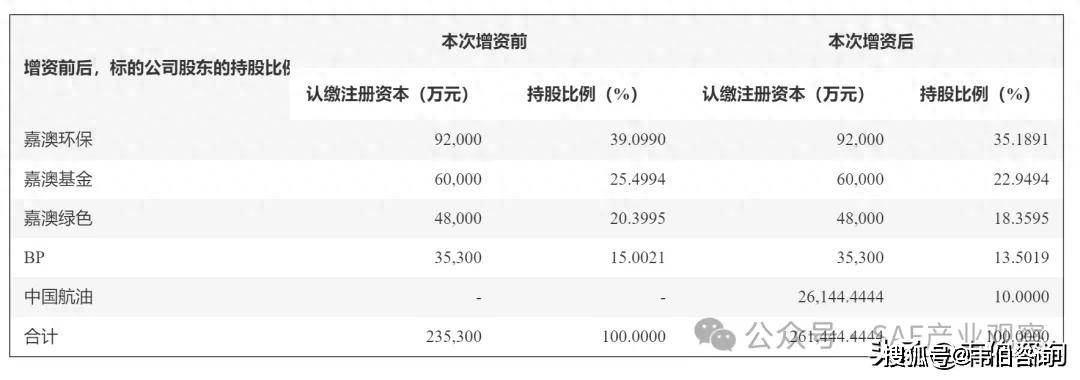
Core Points - Zhejiang Jiaao Environmental Protection Technology Co., Ltd. (referred to as "Jiaao Environmental") is planning to increase capital and introduce investors through its subsidiary Lianyungang Jiaao New Energy Co., Ltd. (referred to as "Lianyungang Jiaao") [1] - China Aviation Oil Group Investment Co., Ltd. (referred to as "China Aviation Oil") intends to invest 261,444,444 RMB to acquire new registered capital of the target company [1][6] - After the capital increase, the registered capital of the target company will rise from 2,353,000,000 RMB to 2,614,444,444 RMB [2][6] Summary by Sections Capital Increase Details - The existing shareholders of the target company will waive their preemptive rights for this capital increase, which is in compliance with relevant laws and regulations [2][5] - The capital increase aims to enhance the capital strength of the target company and promote the development of new projects [5] Shareholding Structure Post-Investment - After the capital increase, the shareholding structure will change, with Jiaao Environmental's stake decreasing from 39.10% to 35.19%, and China Aviation Oil acquiring a 10% stake [7] - The updated shareholding percentages post-capital increase are as follows: - Jiaao Environmental: 35.19% - Jiaao Fund: 22.95% - Jiaao Green: 18.36% - BP Global Investments: 13.50% - China Aviation Oil: 10.00% [7] Approval and Compliance - The capital increase has been approved by the sixth board of directors of the company and does not require submission to the shareholders' meeting for further approval [4][8] - This capital increase does not constitute a major asset restructuring as defined by the relevant regulations [3][8] Company and Financial Information - Lianyungang Jiaao has total assets of 404,225.53 million RMB and total liabilities of 281,983.61 million RMB as of March 31, 2025 [11] - The company reported a net profit of 167.66 million RMB for the same period [11]


势银研究 | 预估2030年中国SAF行业氢气需求量近百万吨
势银能链· 2025-05-28 03:25
Core Viewpoint - The article emphasizes the critical role of Sustainable Aviation Fuel (SAF) in achieving net-zero carbon emissions in the aviation industry by 2050, highlighting the importance of green hydrogen in SAF production [3][7]. Group 1: SAF Market Overview - In 2023, global aviation fuel consumption reached 306 million tons, resulting in carbon emissions of 962 million tons, accounting for approximately 2.6% of global carbon emissions [3]. - The International Civil Aviation Organization (ICAO) has set a long-term climate goal to achieve net-zero emissions for international aviation by 2050 [3]. Group 2: SAF Production Technologies - As of May 2025, there are 11 recognized production pathways for SAF, with a maximum blending ratio of 50%. The main processes include HEFA, AtJ, FT, MtJ, and PtL, with MtJ and PtL still undergoing recognition [3]. - It is projected that by 2030, HEFA will dominate SAF production in China, while PtL is expected to become mainstream after 2050 due to its mature technology and near-zero carbon emissions [3]. Group 3: Hydrogen Demand in SAF Production - Different SAF production processes have varying hydrogen requirements. The PtL process requires the most hydrogen, consuming between 0.38 to 0.58 tons of hydrogen per ton of SAF produced [5]. - By the end of 2025, China's SAF projects are expected to have a production capacity of 2.146 million tons per year, primarily using the HEFA process, leading to a hydrogen demand of 172,000 tons [5]. - In an optimistic scenario, hydrogen demand for domestic SAF projects is projected to reach 1 million tons by 2030 and 22 million tons by 2050 as PtL becomes the dominant process [5]. Group 4: Green Hydrogen and Emission Reduction - Utilizing green hydrogen instead of gray hydrogen in SAF production can reduce carbon emissions by over 40% [7]. - As of March 2025, domestic green hydrogen production capacity is estimated to reach 112,400 tons per year, but gray hydrogen remains the preferred choice due to cost advantages and established supply chains [7]. - The transition to green hydrogen is expected to accelerate as costs decrease, policy incentives strengthen, and technology advances [7].

东南亚努力打造全球SAF中心
Zhong Guo Hua Gong Bao· 2025-05-26 02:41
Group 1 - Southeast Asia is emerging as a significant center for sustainable aviation fuel (SAF) development, with potential driven by abundant agricultural and forestry residues [1] - Countries like Indonesia, Malaysia, the Philippines, Thailand, and Vietnam are expected to become net exporters of SAF by 2040, while Japan and South Korea are projected to be major importers [1] - The study highlights that optimizing agricultural practices, mechanization, irrigation improvements, and large-scale biomass utilization will drive the growth of SAF raw material supply, rather than merely expanding land use [1][2] Group 2 - The "Alcohol-to-Jet" pathway is more advantageous for agricultural and forestry residues compared to the Hydroprocessed Esters and Fatty Acids (HEFA) pathway, which has limitations due to its reliance on oils [2] - Indonesia aims to increase the SAF blending ratio to 2.5% by 2030 and 30% by 2050, while Thailand targets a 60% blending ratio by 2050 [2] - National airlines in Vietnam, the Philippines, and Thailand have begun using SAF, marking significant progress in practical applications [2] Group 3 - The ASEAN Secretariat and partners emphasize the need for collaboration among governments, industry leaders, research institutions, and investors to create favorable policy frameworks and enhance technological capabilities [3] - Southeast Asia has the potential to become a key player in global SAF supply, ensuring regional energy security and contributing to global climate goals [3] - Challenges include policy coordination, technological innovation, and attracting investment to meet the funding needs for SAF industry expansion [3]
海外SAF政策:9国/地区以强制掺混、补贴促减排
势银能链· 2025-05-09 04:11
Core Viewpoint - The article emphasizes the significance of Sustainable Aviation Fuel (SAF) in achieving net-zero emissions in the aviation industry by 2050, highlighting the role of various global policies and market potential for SAF [3][6][9]. Policy Development - The development of the SAF industry is heavily influenced by government policies, with many countries implementing mandatory blending requirements and supportive measures to promote SAF [6][9]. - The European Union, UK, Norway, and Sweden have established clear pathways for mandatory SAF blending ratios, with the EU and UK set to implement these policies by 2025 [6][9]. Market Potential - According to IATA, 65% of the net-zero emissions contribution in aviation is expected to come from SAF, indicating a substantial market opportunity for the SAF sector [3][6]. - The global demand for SAF is projected to reach 6.3 million tons by 2025 and 18.35 million tons by 2030, driven by the implementation of mandatory blending policies [9][10]. Specific Policies - Various countries have set specific targets for SAF blending, such as: - The EU aims for a blending ratio of at least 2% by 2025, increasing to 6% by 2030 and 70% by 2050 [9]. - The UK plans to require a minimum of 10% SAF in aviation fuel by 2030, with a long-term goal of 75% by 2050 [8][9]. - The US targets an annual SAF production of 3 billion gallons by 2030 and 35 billion gallons by 2050 [8]. Conclusion - The article outlines the critical role of SAF in the aviation industry's transition to sustainability, driven by regulatory frameworks and market dynamics that are expected to shape the future of aviation fuel consumption [3][6][9].