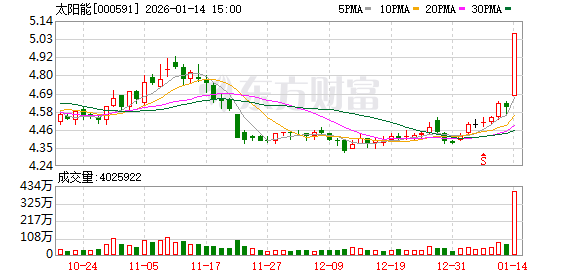
太阳能发电

Search documents
中节能太阳能股份有限公司 关于2025年度装机容量及发电量完成情况的公告
Zhong Guo Zheng Quan Bao - Zhong Zheng Wang· 2026-01-27 23:40
登录新浪财经APP 搜索【信披】查看更多考评等级 证券代码:000591 证券简称:太阳能 公告编号:2026-07 债券代码:127108 债券简称:太能转债 债券代码:149812 债券简称:22太阳G1 债券代码:148296 债券简称:23太阳GK02 中节能太阳能股份有限公司 关于2025年度装机容量及发电量完成情况的公告 2025年1月1日至2025年12月31日,公司累计完成发电量83.71亿千瓦时,同比增加20.17%。 上述数据为公司内部初步统计结果,可能与公司后期披露的定期报告存在差异,最终以公司披露的定期 报告为准,提醒投资者不宜以此数据简单推算公司业绩,并注意投资风险。 特此公告。 中节能太阳能股份有限公司 董 事 会 本公司及董事会全体成员保证信息披露的内容真实、准确、完整,没有虚假记载、误导性陈述或重大遗 漏。 为便于广大投资者了解公司运营情况,现将中节能太阳能股份有限公司(以下简称公司)2025年度装机 容量及发电量完成情况公告如下: 一、公司装机容量情况 经初步统计,2025年1月1日至2025年12月31日,公司新增运营、开工、取得备案的项目容量,及占2024 年度总装机容量 ...

努奥瓦尔扎扎特电站一期2025年发电500吉瓦时
Shang Wu Bu Wang Zhan· 2026-01-22 04:26
摩洛哥《晨报》1月21日报道,努奥瓦尔扎扎特电站一期2025年发电量达500.8吉瓦时,创下历史新高, 首次超过其设计产能。该成果标志着电站运行进入成熟阶段,也为摩洛哥实现2030年可再生能源占比超 52%的目标提供了有力支撑。 电站在降低能源进口依赖、改善国际收支方面成效显著,同时每年可减少约24万吨二氧化碳排放。其稳 定运行为摩洛哥乃至全球大规模聚光太阳能发电积累了宝贵数据与运营经验,为同类项目在全球范围内 的推广提供了重要示范。 电站一期总投资8.41亿美元,装机容量160兆瓦,采用抛物面镜聚光太阳能技术,设计年发电量500吉瓦 时,配备的熔盐储热系统可在无日照条件下满负荷运行3小时,有效保障电力持续供应。电站自2016年 投入运营以来,已为超过50万家庭提供清洁电力。 ...
科技日报:强制淘汰中国设备危害欧盟自身发展
Ke Ji Ri Bao· 2026-01-21 00:07
Core Viewpoint - The European Union is advancing a cybersecurity bill that mandates the gradual elimination of equipment from "high-risk suppliers" such as Huawei and ZTE in critical infrastructure, primarily targeting Chinese tech companies in sectors like telecommunications and solar energy [1][2]. Group 1: Legislative Actions - The proposed bill is a significant escalation in the EU's policy against Chinese tech firms, following previous measures like the 2020 "5G Cybersecurity Toolbox" and investigations under the "Foreign Subsidies Regulation" [1][2]. - The new legislation aims to completely exclude high-risk suppliers from all critical infrastructure, marking a shift from previous advisory policies to mandatory regulations [1][2]. Group 2: Economic Implications - Replacing Chinese telecom equipment in the EU is estimated to cost billions of euros, with over 90% of solar panels in the EU sourced from China, making local production significantly more expensive [2]. - The EU relies heavily on Chinese inverters for solar power, with 70% of new installations in 2023 using imported Chinese products, which are priced over 20% lower than EU alternatives [2]. - The financial impact of the bill could delay or hinder projects in the EU, affecting the region's digital and low-carbon transitions [2]. Group 3: Political Context - The bill is perceived as a trade barrier disguised as a cybersecurity measure, with critics arguing that it discriminates against Chinese products without substantial evidence of security risks [2][3]. - The narrative surrounding the security risks of Chinese equipment is seen as politically motivated, lacking concrete proof and contributing to a climate of distrust [3]. Group 4: Industry Perspective - Chinese technology has been integral to the EU's advancements in 5G communication and green energy, providing cost-effective solutions that support the region's technological and environmental goals [2]. - The EU's approach may lead to self-inflicted harm, as it risks stifling innovation and cooperation that could benefit both parties [3].

强制淘汰中国设备危害欧盟自身发展
Xin Lang Cai Jing· 2026-01-20 23:10
Core Viewpoint - The European Union is advancing a cybersecurity bill that mandates member states to gradually eliminate equipment from "high-risk suppliers" such as Huawei and ZTE in critical infrastructure, primarily targeting Chinese tech companies [1] Group 1: Legislative Actions - The proposed legislation focuses on sectors including telecommunications, solar power generation, and security scanners [1] - The EU's actions are perceived as a response to China's technological advancements and manufacturing system advantages [1] Group 2: China's Position - China argues that its industrial leadership is a result of continuous technological innovation and should be viewed as a global opportunity rather than a threat to certain countries [1] - The article suggests that the EU should avoid viewing China as a "hypothetical enemy" and instead foster a fair and friendly operational environment for Chinese tech companies [1] Group 3: Call for Cooperation - The emphasis is placed on the need for open cooperation between the EU and Chinese tech firms to achieve mutual benefits [1]
2025全国固投成绩单:产业结构优化,“两重两新”政策引领
2 1 Shi Ji Jing Ji Bao Dao· 2026-01-19 06:28
Core Insights - In 2025, China's fixed asset investment (excluding rural households) reached 48.5186 trillion yuan, a decrease of 3.8% from the previous year, with infrastructure investment down by 2.2% and real estate investment down by 17.2% [1][2] - Despite the overall decline in fixed asset investment, manufacturing investment grew by 0.6%, indicating a shift towards high-quality development in the economy [3][4] Investment Breakdown - Infrastructure investment saw a notable decline of 2.2%, while manufacturing investment increased by 0.6%, with specific sectors like railway, shipbuilding, and aerospace manufacturing experiencing a growth of 17.5% [1][2] - Real estate development investment fell by 17.2%, with new commercial housing sales area down by 8.7% and sales value down by 12.6% [1][2] - High-tech industries, particularly information services and aerospace equipment manufacturing, reported significant investment growth of 28.4% and 16.9% respectively [2][3] Policy Impact - The "Two New, Two Heavy" policy framework has played a crucial role in guiding investment trends, with infrastructure investment in key areas showing rapid growth [4][5] - The issuance of long-term special government bonds has facilitated increased investment in infrastructure, with pipeline transportation investment rising by 36.0% [4][5] - Equipment and tool procurement investment grew by 11.8%, contributing significantly to overall investment growth [5]
国家统计局:2025年汽车制造业投资增长11.7%
Sou Hu Cai Jing· 2026-01-19 04:20
Core Viewpoint - The article discusses the trends and statistics of fixed asset investment in China for 2025, highlighting the focus on effective investment in key areas and the optimization of investment structure, despite an overall decline in fixed asset investment compared to the previous year. Group 1: Overall Investment Trends - In 2025, the total fixed asset investment (excluding rural households) reached 48,518.6 billion yuan, a decrease of 3.8% from the previous year [1] - Investment in the primary industry grew by 2.3%, while the secondary industry saw a growth of 2.5%. However, the tertiary industry experienced a decline of 7.4% [1] Group 2: Industrial Investment - Industrial investment in 2025 increased by 2.6%, contributing 0.9 percentage points to overall investment growth [2] - Mining investment rose by 2.5%, contributing 0.1 percentage points, while manufacturing investment grew by 0.6%, also contributing 0.1 percentage points [2] - Notable growth in specific manufacturing sectors included transportation equipment (17.5%), chemical fiber (12.3%), and automotive manufacturing (11.7%) [2] - Investment in electricity, heat, gas, and water production and supply increased by 9.1%, contributing 0.7 percentage points to overall investment growth [2] Group 3: Infrastructure Investment - Infrastructure investment in key areas saw significant growth, with pipeline transportation investment increasing by 36.0% [3] - Investment in internet and related services grew by 23.8%, while multimodal transport and logistics services increased by 22.9% [3] - Private investment in infrastructure rose by 1.7%, accounting for 21.0% of total infrastructure investment, an increase of 0.8 percentage points from the previous year [3] Group 4: Equipment Investment - Investment in equipment and tools saw a substantial increase of 11.8%, contributing 1.8 percentage points to overall investment growth [4] - This category accounted for 18.0% of total investment, an increase of 2.5 percentage points from the previous year [4] Group 5: High-Tech Service Investment - Investment in high-tech services grew by 3.5%, representing 5.6% of total service investment, an increase of 0.6 percentage points [5] - Information service investment surged by 28.4% [5] Group 6: Social Welfare Investment - In 2025, investments in social welfare sectors showed positive trends, with forestry investment increasing by 28.5% and fisheries investment by 12.4% [6] - Other sectors such as electricity and heat production (11.1%), agricultural processing (9.2%), and wholesale and retail (5.6%) also experienced growth [6] - The government aims to enhance investment effectiveness in 2026, focusing on major national strategies and the optimization of traditional industries while fostering emerging sectors [6]
印度2.45GW光伏发电项目招标,配套6.4GWh电池储能系统
中关村储能产业技术联盟· 2026-01-18 23:40
Core Viewpoint - The Rajasthan Solar Park Development Company (RSDCL) has issued a tender for a solar photovoltaic project with a total capacity of 2,450MW in the Pugal solar park, Rajasthan, which will include a battery storage system of 1,600MW/6,400MWh, developed under a Build-Own-Operate (BOO) model [2][4]. Group 1 - The Rajasthan Energy Development and Information Technology Services Limited (RUVITL) will sign a 25-year power purchase agreement with the winning bidders on behalf of three distribution companies [4]. - Solar developers are required to integrate a 4-hour battery storage system and necessary transmission infrastructure to provide solar power to RUVITL [4]. - The total capacity is divided into two segments, with bidders required to indicate land preferences, and allocation will occur through an electronic reverse auction starting from the lowest bid [5]. Group 2 - Segment one includes 2,000MW of solar capacity and a battery storage of 1,320MW/5,280MWh, consisting of eight plots of 250MW each, with a minimum bid capacity of 250MW [7]. - Segment two consists of 450MW of solar capacity and a battery storage of 280MW/1,120MWh, comprising two plots of 225MW each, with a minimum bid capacity of 225MW [7]. - RSDCL will provide land for the solar projects through a lease agreement, and the battery storage system must be installed on the allocated project land [5].

太阳能:公司不断加强投资要素分析
Zheng Quan Ri Bao Wang· 2026-01-14 13:14
Core Viewpoint - The company is enhancing its investment analysis to ensure the feasibility of power consumption and improve the value of green electricity through various strategies [1] Group 1: Investment Strategies - The company is conducting in-depth research on consumption conditions and analyzing node sections to ensure feasible consumption [1] - The company is proactively increasing energy storage to achieve stable output and enhance the value of green electricity [1] - The company is strengthening power marketing to lock in loads, thereby improving consumption and electricity prices [1] Group 2: Existing Power Plants - The company is currently undertaking energy storage renovation work on existing power plants in suitable areas to enhance consumption rates [1]
太阳能:公司目前储能主要为光伏电站配套储能,合计规模约为1500MWh
Zheng Quan Ri Bao Wang· 2026-01-14 13:12
Core Insights - The company currently focuses on energy storage primarily for photovoltaic power plants, with a total capacity of approximately 1500 MWh [1] - The company operates two independent energy storage stations with a capacity of about 250 MW/500 MWh [1] - The profitability of the energy storage business is influenced by factors such as electricity pricing mechanisms, charge and discharge efficiency, and operational costs [1]
太阳能:目前公司储能主要为光伏电站配套储能
Zheng Quan Ri Bao· 2026-01-14 12:08
Group 1 - The core viewpoint of the article is that the company is actively involved in energy storage solutions, primarily supporting photovoltaic power plants, while also exploring independent energy storage projects [2] - The company is closely monitoring and researching grid-type energy storage technologies, as well as the feasibility and application of long-duration storage technologies such as flow batteries and compressed air [2] - The company plans to actively expand its presence in commercial and industrial energy storage in the future [2] Group 2 - Currently, the company has no plans related to space solar energy [2]