
管道运输业

Search documents
锐财经|促进有效投资,更多举措落地
Ren Min Ri Bao Hai Wai Ban· 2026-02-10 06:31
Group 1 - The State Council's recent meeting emphasized the need to innovate and improve policies to promote effective investment, utilizing various financial tools such as central budget investments, ultra-long-term special bonds, and local government special bonds [1] - A series of policy measures aimed at promoting effective investment have been implemented, which are expected to stabilize investment and enhance its role in expanding domestic demand, optimizing supply, and benefiting people's livelihoods [1] Group 2 - In 2025, national fixed asset investment (excluding rural households) reached 48,518.6 billion yuan, a decrease of 3.8% from the previous year, indicating downward pressure on fixed asset investment due to local government debt and economic transition factors [2] - Investment in key sectors showed faster growth, with industrial investment increasing by 2.6%, contributing 0.9 percentage points to overall investment growth [2] Group 3 - In infrastructure investment, pipeline transportation investment grew by 36.0%, internet and related services investment increased by 23.8%, and multimodal transport and agency services investment rose by 22.9% in 2025 [3] - Private investment in infrastructure grew by 1.7%, accounting for 21.0% of total infrastructure investment, with significant growth in water management and road transport sectors [3] Group 4 - Equipment and tool purchase investment increased by 11.8% in 2025, contributing 1.8 percentage points to overall investment growth, with a focus on supporting over 8,400 equipment renewal projects through ultra-long-term special bonds [4] - The first batch of 936 billion yuan in ultra-long-term special bonds for 2026 has been allocated to support approximately 4,500 projects across various sectors, driving total investment exceeding 460 billion yuan [4] Group 5 - The National Development and Reform Commission (NDRC) is optimizing the implementation of "two new" policies to support equipment renewal by lowering investment thresholds and enhancing project review standards [5] - The NDRC aims to strengthen the management of equipment renewal projects and improve the efficiency of fund utilization through better coordination and monitoring [5] Group 6 - The NDRC highlighted the importance of effective government investment to avoid inefficient and redundant construction, focusing on improving project quality and maturity for central budget investments and special bonds [7] - The recent fiscal and financial policies aim to stimulate private investment, with measures including credit support, interest subsidies, and guarantees to lower financing costs and barriers for private enterprises [8]
促进有效投资,更多举措落地
Ren Min Ri Bao Hai Wai Ban· 2026-02-10 03:56
Group 1 - The core viewpoint of the article emphasizes the need for innovative and effective investment policies to stabilize and promote investment, particularly through the use of central budget investments, special bonds, and new policy financial tools [2][7]. - In 2025, national fixed asset investment (excluding rural households) reached 48,518.6 billion yuan, a decrease of 3.8% from the previous year, indicating downward pressure on fixed asset investment due to various factors [3]. - Key sectors such as industrial investment grew by 2.6%, contributing 0.9 percentage points to overall investment growth, with significant increases in electricity, heat, gas, and water supply sectors, which saw a 9.1% increase [3][4]. Group 2 - Infrastructure investment in key areas showed robust growth, with pipeline transportation investment increasing by 36.0% and internet-related services growing by 23.8% in 2025 [4]. - Equipment and tool purchase investment rose by 11.8%, contributing 1.8 percentage points to total investment growth, with a focus on supporting over 8,400 equipment renewal projects through special bonds [5][6]. - The government aims to enhance the effectiveness of investment by optimizing the structure of government investments, particularly in social welfare projects, and by utilizing new policy financial tools to stimulate private investment [8].

加力提效用好相关资金和新型政策性金融工具——促进有效投资,更多举措落地
Sou Hu Cai Jing· 2026-02-10 01:20
Core Viewpoint - The recent State Council meeting emphasized the need to innovate and improve policy measures to promote effective investment, aiming to stabilize investment and enhance its role in expanding domestic demand, optimizing supply, and benefiting people's livelihoods [3]. Investment Trends - In 2025, China's fixed asset investment (excluding rural households) reached 48,518.6 billion yuan, a decrease of 3.8% from the previous year, indicating downward pressure on investment due to local government debt and economic transition factors [4]. - Key sectors showed rapid investment growth, with industrial investment increasing by 2.6%, contributing 0.9 percentage points to overall investment growth [4]. - Infrastructure investment in key areas saw significant increases, such as pipeline transportation investment growing by 36.0% and internet-related services investment increasing by 23.8% [5]. Equipment Investment - Equipment and tool purchase investment rose by 11.8% in 2025, contributing 1.8 percentage points to total investment growth, with a focus on supporting over 8,400 equipment renewal projects through special bonds [6]. - The government plans to continue large-scale equipment renewal policies into 2026, with an initial allocation of 93.6 billion yuan in special bonds for various sectors [7]. Government Investment Strategy - The State Council meeting highlighted the importance of precise government investment to avoid inefficient and redundant construction, emphasizing the need for high-quality project planning and collaboration between investment, fiscal, and financial policies [8]. - The government aims to enhance support for private investment through a comprehensive policy package, addressing financing costs and barriers for private enterprises [9]. - The focus will be on increasing government investment in livelihood projects and utilizing new policy financial tools to attract more private and social capital [9].
促进有效投资,更多举措落地(锐财经)
Ren Min Ri Bao Hai Wai Ban· 2026-02-09 22:48
Group 1 - The core viewpoint of the article emphasizes the need for innovative and effective investment policies to stabilize and promote investment growth in China, particularly through the use of central budget investments, special bonds, and new financial tools [2][7] - The State Council's recent meeting highlighted the importance of optimizing government investment to avoid inefficient and redundant construction, focusing on improving project quality and readiness [7][8] - The article notes that private investment is crucial for economic growth, with new policies aimed at reducing financing costs and barriers for private enterprises [8] Group 2 - In 2025, China's fixed asset investment (excluding rural households) was reported at 48.5186 trillion yuan, a decrease of 3.8% from the previous year, indicating downward pressure on investment [3] - Industrial investment grew by 2.6% in 2025, contributing 0.9 percentage points to overall investment growth, with significant increases in sectors such as electricity and water supply [3][4] - Infrastructure investment in key areas showed rapid growth, with pipeline transportation investment increasing by 36.0% and internet services by 23.8% in 2025 [4] Group 3 - Equipment and tool investment saw an 11.8% increase in 2025, contributing 1.8 percentage points to total investment growth, highlighting its importance in driving overall investment [5][6] - The government plans to support approximately 8,400 equipment renewal projects with over 1 trillion yuan in total investment, indicating a strong push for modernization [6] - The implementation of policies to lower investment thresholds and enhance project management is aimed at improving the efficiency of equipment renewal projects [6]
国家统计局:2025年1—10月份全国固定资产投资408914亿元
Zhong Guo Xin Wen Wang· 2026-01-27 08:20
Core Insights - National fixed asset investment (excluding rural households) in China for January to October 2025 reached 408.914 billion yuan, representing a year-on-year decline of 1.7% on a comparable basis [1] - Private fixed asset investment decreased by 4.5% year-on-year [1] Investment by Industry - Investment in the primary industry was 80.75 billion yuan, showing a year-on-year increase of 2.9% [1] - Investment in the secondary industry totaled 1,484.11 billion yuan, with a growth of 4.8% [1] - Investment in the tertiary industry fell by 5.3%, amounting to 2,524.29 billion yuan [1] - Within the secondary industry, industrial investment grew by 4.9%, with mining investment increasing by 3.8%, manufacturing investment rising by 2.7%, and investment in electricity, heat, gas, and water production and supply surging by 12.5% [1] - In the tertiary industry, infrastructure investment (excluding electricity, heat, gas, and water production and supply) saw a slight decline of 0.1% [1] - Notable growth in infrastructure investment included pipeline transportation (up 13.8%), water transportation (up 9.4%), and railway transportation (up 3.0%) [1] Regional Investment Trends - Eastern region investment decreased by 5.4% year-on-year [1] - Central region investment declined by 0.5% [1] - Western region investment increased by 0.4% [1] - Northeastern region investment experienced a significant drop of 11.7% [1] Investment by Registration Type - Domestic enterprise fixed asset investment fell by 1.7% year-on-year [1] - Investment from Hong Kong, Macau, and Taiwan enterprises decreased by 1.8% [1] - Foreign enterprise fixed asset investment saw a notable decline of 12.1% [1]
2025年全国固定资产投资比上年下降3.8%
Guo Jia Tong Ji Ju· 2026-01-21 05:54
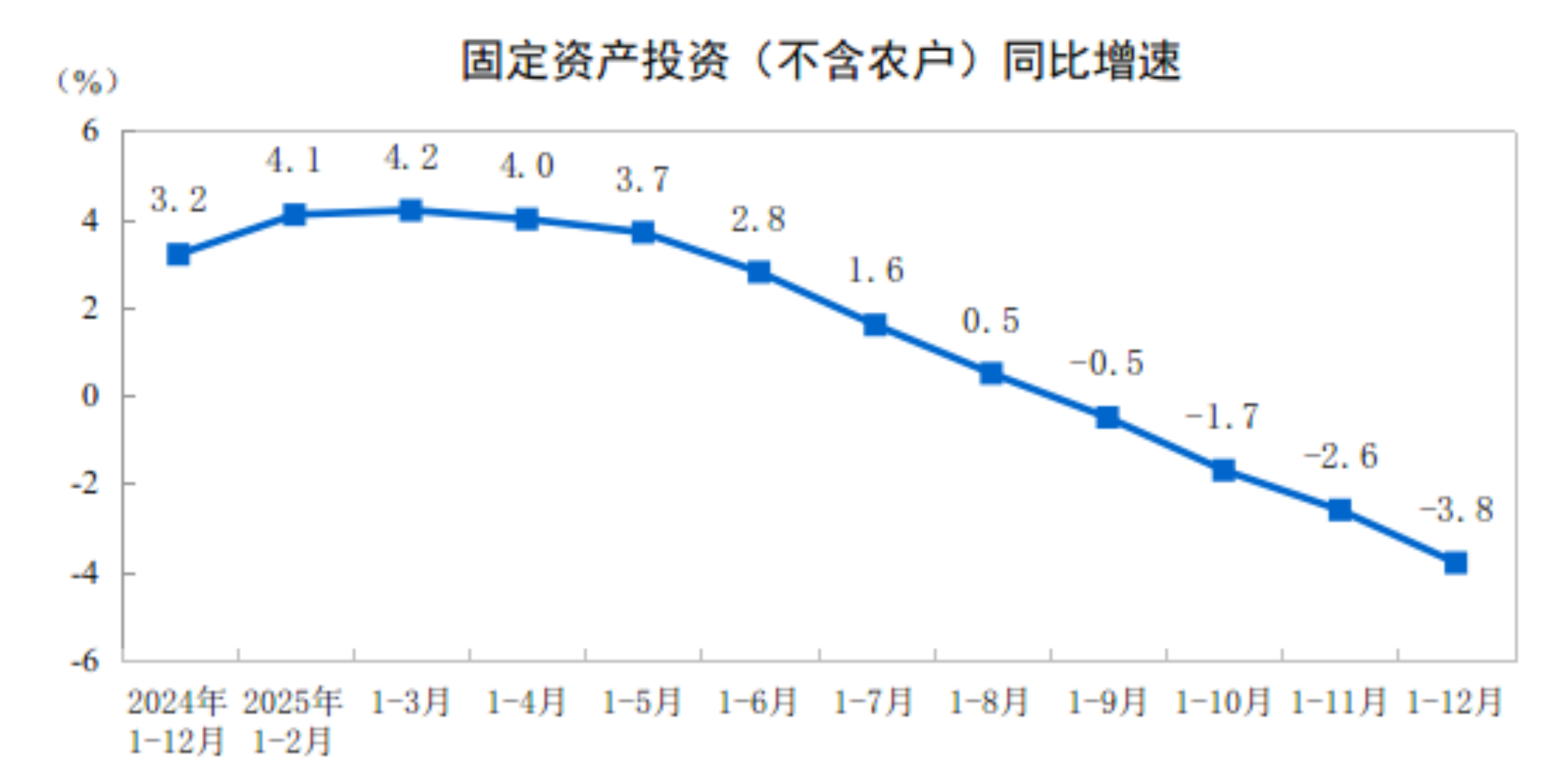
Summary of Fixed Asset Investment in 2025 Core Viewpoint - In 2025, China's total fixed asset investment (excluding rural households) reached 48,518.6 billion yuan, representing a decline of 3.8% compared to the previous year, with private fixed asset investment decreasing by 6.4% [1][3]. Group 1: Investment by Industry - Investment in the primary industry amounted to 957 billion yuan, showing a growth of 2.3% year-on-year [3]. - The secondary industry saw an investment of 177,368 billion yuan, with a growth rate of 2.5%. Industrial investment within this sector increased by 2.6%, with mining investment growing by 2.5%, manufacturing investment rising by 0.6%, and investment in electricity, heat, gas, and water production and supply increasing by 9.1% [3]. - The tertiary industry experienced a decline in investment, totaling 298,248 billion yuan, which is a decrease of 7.4% year-on-year. Infrastructure investment (excluding electricity, heat, gas, and water production and supply) fell by 2.2%, while pipeline transportation investment surged by 36.0%, multimodal transport and transportation agency investment grew by 22.9%, and water transportation investment increased by 7.7% [3]. Group 2: Investment by Region - Investment in the eastern region decreased by 8.4% compared to the previous year, while the central region saw a decline of 2.7%, the western region a decrease of 1.3%, and the northeastern region experienced a significant drop of 15.5% [3]. Group 3: Investment by Registration Type - Domestic enterprises' fixed asset investment fell by 3.8% year-on-year, while investment from Hong Kong, Macau, and Taiwan enterprises decreased by 2.2%. Foreign enterprises saw a more substantial decline, with fixed asset investment dropping by 13.8% [4].
国家管网取得管道设备数据管理方法及相关系统专利
Sou Hu Cai Jing· 2026-01-20 00:43
Group 1 - The National Petroleum and Natural Gas Pipeline Group Co., Ltd. and the Northern Pipeline Co., Ltd. have obtained a patent for a data management method, system, medium, and equipment related to pipeline devices, with the patent announcement number CN116578614B and application date of April 2023 [1] - The National Petroleum and Natural Gas Pipeline Group Co., Ltd. was established in 2019, located in Beijing, with a registered capital of 50 billion RMB. The company has invested in 57 enterprises, participated in 5,000 bidding projects, and holds 3,941 patent records [1] - The Northern Pipeline Co., Ltd. was established in 2020, located in Langfang, with a registered capital of 2 billion RMB. The company has invested in 1 enterprise, participated in 1,138 bidding projects, and holds 536 patent records [1]
投资结构不断优化
Jing Ji Ri Bao· 2026-01-19 22:23
Group 1 - In 2025, fixed asset investment (excluding farmers) reached 48,518.6 billion yuan, driven by large-scale equipment upgrades and the replacement of consumer goods [1] - Industrial investment grew by 2.6% year-on-year, contributing 0.9 percentage points to overall investment growth, with mining investment up by 2.5%, manufacturing investment up by 0.6%, and electricity, heat, gas, and water production and supply investment up by 9.1% [1] - Infrastructure investment in key areas saw significant growth, with pipeline transportation investment increasing by 36.0%, internet and related services investment up by 23.8%, and multimodal transport and agency investment rising by 22.9% [1] Group 2 - Equipment and tool purchase investment grew by 11.8% year-on-year, contributing 1.8 percentage points to overall investment growth, and accounted for 18.0% of total investment, an increase of 2.5 percentage points from the previous year [1] - High-tech service industry investment increased by 3.5% year-on-year, representing 5.6% of total service industry investment, up by 0.6 percentage points from the previous year [2] Group 3 - Investment in forestry rose by 28.5%, fisheries investment increased by 12.4%, and investment in electricity and heat production and supply grew by 11.1% [3] - The investment in agricultural and sideline food processing increased by 9.2%, while wholesale and retail investment grew by 5.6%, and accommodation and catering investment rose by 5.5% [3]
2025全国固投成绩单:产业结构优化,“两重两新”政策引领
2 1 Shi Ji Jing Ji Bao Dao· 2026-01-19 06:28
Core Insights - In 2025, China's fixed asset investment (excluding rural households) reached 48.5186 trillion yuan, a decrease of 3.8% from the previous year, with infrastructure investment down by 2.2% and real estate investment down by 17.2% [1][2] - Despite the overall decline in fixed asset investment, manufacturing investment grew by 0.6%, indicating a shift towards high-quality development in the economy [3][4] Investment Breakdown - Infrastructure investment saw a notable decline of 2.2%, while manufacturing investment increased by 0.6%, with specific sectors like railway, shipbuilding, and aerospace manufacturing experiencing a growth of 17.5% [1][2] - Real estate development investment fell by 17.2%, with new commercial housing sales area down by 8.7% and sales value down by 12.6% [1][2] - High-tech industries, particularly information services and aerospace equipment manufacturing, reported significant investment growth of 28.4% and 16.9% respectively [2][3] Policy Impact - The "Two New, Two Heavy" policy framework has played a crucial role in guiding investment trends, with infrastructure investment in key areas showing rapid growth [4][5] - The issuance of long-term special government bonds has facilitated increased investment in infrastructure, with pipeline transportation investment rising by 36.0% [4][5] - Equipment and tool procurement investment grew by 11.8%, contributing significantly to overall investment growth [5]
国家统计局:2025年汽车制造业投资增长11.7%
Sou Hu Cai Jing· 2026-01-19 04:20
Core Viewpoint - The article discusses the trends and statistics of fixed asset investment in China for 2025, highlighting the focus on effective investment in key areas and the optimization of investment structure, despite an overall decline in fixed asset investment compared to the previous year. Group 1: Overall Investment Trends - In 2025, the total fixed asset investment (excluding rural households) reached 48,518.6 billion yuan, a decrease of 3.8% from the previous year [1] - Investment in the primary industry grew by 2.3%, while the secondary industry saw a growth of 2.5%. However, the tertiary industry experienced a decline of 7.4% [1] Group 2: Industrial Investment - Industrial investment in 2025 increased by 2.6%, contributing 0.9 percentage points to overall investment growth [2] - Mining investment rose by 2.5%, contributing 0.1 percentage points, while manufacturing investment grew by 0.6%, also contributing 0.1 percentage points [2] - Notable growth in specific manufacturing sectors included transportation equipment (17.5%), chemical fiber (12.3%), and automotive manufacturing (11.7%) [2] - Investment in electricity, heat, gas, and water production and supply increased by 9.1%, contributing 0.7 percentage points to overall investment growth [2] Group 3: Infrastructure Investment - Infrastructure investment in key areas saw significant growth, with pipeline transportation investment increasing by 36.0% [3] - Investment in internet and related services grew by 23.8%, while multimodal transport and logistics services increased by 22.9% [3] - Private investment in infrastructure rose by 1.7%, accounting for 21.0% of total infrastructure investment, an increase of 0.8 percentage points from the previous year [3] Group 4: Equipment Investment - Investment in equipment and tools saw a substantial increase of 11.8%, contributing 1.8 percentage points to overall investment growth [4] - This category accounted for 18.0% of total investment, an increase of 2.5 percentage points from the previous year [4] Group 5: High-Tech Service Investment - Investment in high-tech services grew by 3.5%, representing 5.6% of total service investment, an increase of 0.6 percentage points [5] - Information service investment surged by 28.4% [5] Group 6: Social Welfare Investment - In 2025, investments in social welfare sectors showed positive trends, with forestry investment increasing by 28.5% and fisheries investment by 12.4% [6] - Other sectors such as electricity and heat production (11.1%), agricultural processing (9.2%), and wholesale and retail (5.6%) also experienced growth [6] - The government aims to enhance investment effectiveness in 2026, focusing on major national strategies and the optimization of traditional industries while fostering emerging sectors [6]