
机器人研发

Search documents
视频 丨 埃夫特游玮:上市前是“补课式”研发,上市后在“无人区”摸索
Zhong Guo Jing Ying Bao· 2025-12-22 02:54
Core Viewpoint - The chairman and general manager of Evert (688165.SH), You Wei, stated that prior to its listing on the Sci-Tech Innovation Board, the company engaged in "following" or "catch-up" style R&D. Post-listing, due to accelerated iterations of new-generation artificial intelligence technology and foreign technology blockades, the company has shifted to independent innovation and is exploring in "unmanned areas" [2]. Group 1 - Before its listing, Evert's R&D approach was characterized as "following" or "catch-up" [2] - After going public, the company has faced challenges due to accelerated AI technology iterations and foreign technology restrictions [2] - Evert is now focusing on independent innovation and exploring new areas without existing case studies [2]

“软实力”锻造“硬支撑”,生产性服务业撑起制造业高质量发展
Xin Lang Cai Jing· 2025-12-19 23:35
Group 1 - The production service industry acts as a "behind-the-scenes hero" for manufacturing, providing essential services such as R&D design, logistics, financial services, and information services, which enhance the efficiency of manufacturing operations [1] - A robotics R&D company has partnered with an experienced firm in the electric and garden tools sector to modify R&D designs and establish a shared manufacturing platform [3] - A Shenzhen-based technology company faced challenges in transforming a lawn mowing robot design into a product due to high production costs and quality issues [4] Group 2 - The initial phase of building the platform lacked experience and technology, prompting the digital project leader and team to seek assistance from an industrial internet company in Qingdao to explore how digitalization can empower small and medium-sized enterprises [6] - A traditional electric tool manufacturer faced a dilemma of either losing orders by not lowering prices or incurring losses by reducing prices, leading them to consider "shared manufacturing" to integrate various resources into a single platform [7] - This collaborative model enabled the transition from traditional electric tool manufacturing to industries such as robotics, 3D printing, and small appliances [9] Group 3 - The Qingdao industrial internet company has built platforms for 15 industries and provided comprehensive support in developing the platform, including framework, organizational structure, operational processes, and an intelligent decision support system to enhance collaboration efficiency [10] - The production service industry is likened to the "smart brain" of manufacturing, addressing the "last mile" challenges from R&D to market, thus injecting new momentum into the high-quality development of the real economy [12] - In September, a car company in Ningbo implemented an AI tool that automatically records quality engineers' voice reports during car dimension inspections, streamlining the data collection process [14] Group 4 - Dimension matching verification is a critical step in new car R&D, and the traditional method relied heavily on experienced engineers, which was time-consuming and prone to errors [16] - The newly implemented AI tool transformed the data recording process from manual entry to voice-generated measurements, saving the company millions in investment costs [18] - A steel company developed a "Blast Furnace Expert Assistant" using an AI tool that collects vast amounts of data in real-time, improving operational efficiency and reducing decision-making errors [20] Group 5 - The Central Committee's "14th Five-Year Plan" emphasizes the need to promote the production service industry towards specialization and high-end value chain extension, which is essential for industrial upgrading and cultivating new productive forces [22] - The production service industry is seen as a key soft power that enhances the "hard strength" of manufacturing, with expectations for it to drive sustainable economic growth in China by 2026 [22]

新华全媒头条|谱写新时代中国高水平对外开放的崭新篇章——写在海南自由贸易港正式启动全岛封关之际
Xin Hua She· 2025-12-18 13:38
Core Points - The Hainan Free Trade Port officially launched its full island closure on December 18, 2025, marking a significant milestone in China's opening-up strategy [2][4] - The closure is not a restriction but an expansion of openness, aimed at countering unilateralism and protectionism while promoting global economic integration [2][17] - The policies implemented will provide substantial benefits to enterprises, including a significant increase in the proportion of "zero tariff" goods to 74%, covering most production equipment and raw materials [7][16] Group 1: Economic Opportunities - The full closure of the free trade port presents a historic opportunity for Hainan's leapfrog development [6] - The "zero tariff" policy will significantly reduce production costs for companies, as evidenced by the successful import of "zero tariff" components valued at over 23 million yuan from Russia [7][11] - The simplified customs processes and expanded policy benefits are expected to enhance the competitiveness of local enterprises [11][12] Group 2: Policy and Institutional Innovation - Hainan's policy framework encompasses various aspects such as trade, investment, transportation, and cross-border capital flow, which will continue to evolve post-closure [9][12] - The region has developed 173 institutional innovation cases that serve as models for nationwide reform and opening-up [12] - The free trade port is positioned as a testing ground for institutional reforms and integrated development strategies [12][13] Group 3: Regional and Global Integration - Hainan is becoming a hub for regional cooperation, with cross-provincial industrial parks emerging as successful examples of collaborative development [14][15] - The port's strategic location and policies are expected to enhance Hainan's role in the Belt and Road Initiative and deepen ties with major economic regions [15][18] - The free trade port is anticipated to attract global investors, with significant foreign capital inflow and a growing number of foreign enterprises establishing operations in Hainan [18][19]
航天智装,挂牌“甩卖”亏损子公司
Shen Zhen Shang Bao· 2025-12-18 11:02
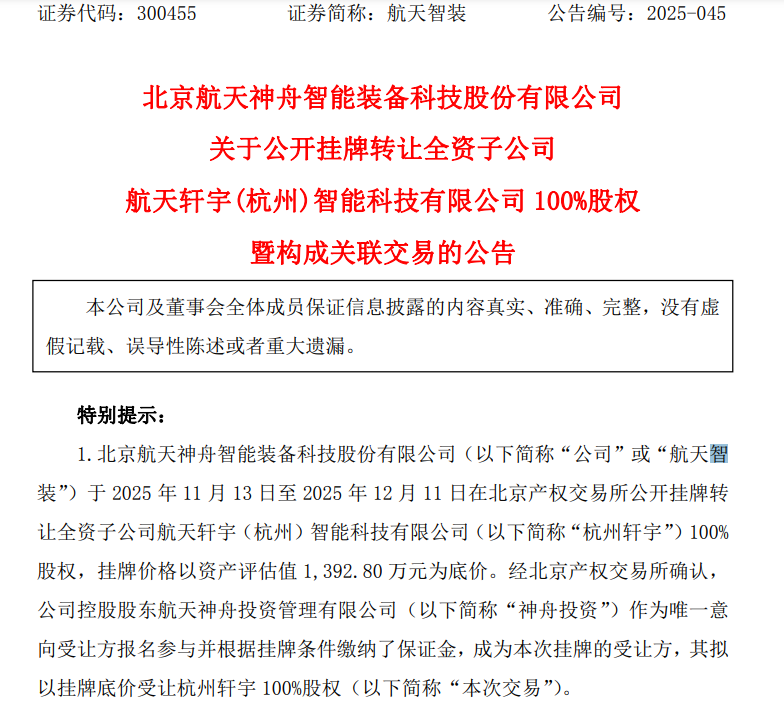
Group 1 - The company announced the public transfer of 100% equity of its wholly-owned subsidiary, Aerospace Xuan Yu (Hangzhou) Intelligent Technology Co., Ltd., at a base price of 13.928 million yuan, scheduled from November 13 to December 11, 2025 [1][4] - The controlling shareholder, Aerospace Shenzhou Investment Management Co., Ltd., intends to acquire the equity at the base price, resulting in Shenzhou Investment holding 100% of Xuan Yu's shares post-transaction [1][4] - The transfer aligns with the company's strategic focus on its core business and operational realities, leading to Xuan Yu being excluded from the consolidated financial statements of the company [4] Group 2 - Aerospace Xuan Yu specializes in the research and development of special robots for railway freight inspection and nuclear industry scenarios, reporting revenue of 11.3305 million yuan and a net loss of 2.952 million yuan for the first seven months of 2025 [4] - The company's performance has significantly declined, with a reported revenue of 696 million yuan for the first three quarters of 2025, a year-on-year decrease of 2.6%, and a net loss of 158 million yuan, a decline of 674.1% [4] - As of December 18, the company's stock price closed at 26.02 yuan per share, with a total market capitalization of 18.68 billion yuan [5]

破局“首公里” 金融陪伴企业跑赢科创“马拉松”
Jing Ji Ri Bao· 2025-12-16 23:32
Core Viewpoint - The recent Central Economic Work Conference emphasizes the integration of technological and industrial innovation to develop new productive forces, highlighting the role of financial services in supporting the entire lifecycle of technological innovation [1] Group 1: Challenges in Financing Technology Startups - Technology innovation is characterized as a high-investment, long-cycle "marathon," with the most challenging phase often being the initial stage where startups face difficulties in obtaining loans due to lack of revenue and collateral [2] - Shenzhen Guarantee Group has introduced the "Crossing Loan" program to address the financing challenges faced by startups, providing 4 million yuan in initial loan support to a technology company focused on AI-driven manufacturing systems [2] Group 2: Credit and Financing Solutions - The People's Bank of China in Shenzhen is promoting collaboration among local credit platforms, government financing guarantee institutions, and banks to provide credit scoring and guarantee services for "no-loan" technology enterprises, resulting in 2 billion yuan in loans approved for 69 companies through the "Crossing Loan" program [3] - The "Technology Startup Pass" initiative offers a digital credit solution for early-stage tech companies, utilizing public and industry data to create comprehensive credit scores and reports, helping over 5,000 companies secure 8 billion yuan in loans [3] Group 3: Investment and Support for Technological Development - Shenzhen Zhujidongli Technology Co., known for its humanoid robots, has attracted investment from Dongfang Fuhai, which issued a 400 million yuan technology innovation bond to support hard tech sectors like AI and semiconductors [4] - Guangdong Blue Potential Marine Technology Co. has developed underwater robots and received nearly 20 million yuan in integrated financing support through a collaborative model involving equity investment and credit loans, aiding in their production expansion [6][7] Group 4: Cross-Border Financial Innovations - The "Kehui Tong" pilot program facilitates cross-border flow of innovation elements between Shenzhen and Hong Kong, with over 77 million yuan in research funds successfully transferred to research institutions in the Qianhai Shenzhen-Hong Kong Cooperation Zone [8][9] - Financial institutions are expanding their services to include high-end research talent and providing comprehensive financial services to core research institutions and scientists in the cooperation zone [9]
中央财办发声,信号很大
21世纪经济报道· 2025-12-16 13:49
Core Viewpoint - The article discusses the outcomes and expectations of China's economic performance as it approaches the end of the 14th Five-Year Plan and the beginning of the 15th, highlighting the resilience and vitality of the economy despite challenges [1][2]. Economic Performance and Outlook - The overall economic operation is stable, with a projected growth rate of around 5% for the year, leading to an economic total of approximately 140 trillion yuan [1]. - The construction of a modern industrial system is progressing, with advancements in technology and innovation, particularly in artificial intelligence, biomedicine, and robotics [1]. - Reforms and opening-up measures are advancing, with a focus on building a unified national market and addressing "involution" competition [2]. - There are positive developments in risk mitigation in key areas, including the orderly replacement of local government hidden debts and the completion of housing delivery tasks [2]. Challenges and Policy Directions - The article identifies ongoing challenges such as external environmental changes, weak domestic demand, and risks in key sectors [2]. - The economic foundation remains strong, with long-term supportive conditions for growth, including the advantages of the socialist system and a large market [3]. - The government plans to implement more proactive macroeconomic policies, maintaining necessary fiscal deficits and debt levels while enhancing the precision and effectiveness of fiscal spending [3][4]. Domestic Demand and Investment - Expanding domestic demand is a top priority, with domestic demand contributing 71% to economic growth in the first three quarters [5]. - The government aims to stimulate consumption by addressing structural changes and enhancing the supply of quality goods and services [5][6]. - Investment is expected to stabilize, with a focus on infrastructure and social welfare projects, while also encouraging private investment in high-tech and service sectors [6]. Technological Innovation and Market Development - The construction of international technology innovation centers in Beijing, Shanghai, and the Guangdong-Hong Kong-Macau Greater Bay Area is emphasized as a strategic move to enhance global competitiveness [7][8]. - The article discusses the need for a unified national market to improve resource allocation and market efficiency, addressing barriers to competition and market entry [9][10]. Trade and Foreign Investment - The government plans to expand high-level opening-up measures, including increasing service sector access and signing more trade agreements [11][12][13]. - Efforts will be made to optimize the business environment for foreign investment, including easing market access and enhancing support for foreign enterprises [13]. Regional Development and Coordination - The article outlines strategies for promoting regional coordinated development, focusing on the collaborative growth of different regions and supporting major economic provinces [14][15][16]. - Emphasis is placed on urban-rural integration and the development of new productive forces tailored to local conditions [15]. Green Transition and Employment - The government is committed to a green transition, with plans to achieve carbon peak and neutrality goals while enhancing the resilience of the energy system [16][17][18]. - Employment policies will focus on stabilizing job growth, particularly for key groups such as graduates and migrant workers, while promoting flexible employment and skills training [19][20]. Real Estate Market Stability - The article discusses the need for a stable real estate market, highlighting the potential for high-quality development despite current challenges [21][22]. - Measures will be taken to support the transformation of real estate companies and to encourage a new development model in the sector [22][23].

一年融四轮!超仿生机器人研发商首形科技再获融资,具身智能领域再布局
机器人圈· 2025-12-16 09:55
Group 1 - The core viewpoint of the article highlights that AheadForm, a bionic robot developer, has successfully completed a new round of financing, led by the China Internet Investment Fund and Ant Group, with additional participation from various investors. This funding will primarily be used for product matrix expansion, small-scale production system establishment, and continuous iteration of core models and software algorithms [1] - AheadForm has completed four rounds of financing this year, with the most recent round occurring at the end of September, indicating strong investor confidence in the company's embodied intelligence approach, which focuses on humanoid interfaces [1] - The company aims to enhance embodied intelligence by focusing on human-like facial expressions, emotional communication, and natural interaction, emphasizing that the face is crucial for initiating dialogue [1] Group 2 - AheadForm has developed an emotional foundation model and ultra-bionic facial robots, introducing the Origin and Sprite plans. The emotional foundation model integrates multimodal information, serving as the "emotional engine" for robots to understand and express emotions [2] - The ultra-bionic facial robot combines a multimodal emotional system with high-precision expression control algorithms, aiming for realism in skin texture, muscle movement, and expression rhythm through interdisciplinary design [2] - The company has launched the "Sprite·Xuan," which has garnered significant attention for its ultra-bionic appearance and high recognition design, positioning the robot as both a humanoid and an art piece [2] Group 3 - Recently, AheadForm has significantly enhanced its eye movement system, allowing robots to exhibit stable focus and emotional cues through coordinated optimization of gaze direction, eye micro-movements, and neck rhythm [4] - The company has achieved high-precision lip synchronization with real-time voice, enabling the same humanoid system to support natural lip movements across different languages and vocal tones [4]

智元机器人等入股陪伴机器人研发商炽梦科技
Sou Hu Cai Jing· 2025-12-16 04:20
上海炽梦科技有限公司成立于2025年9月,法定代表人为李林天,经营范围含工业机器人制造、专用设 备制造、服务消费机器人制造、通用设备制造、智能机器人的研发、人工智能理论与算法软件开发、人 工智能应用软件开发等,现由李林天、上海全向三号科技合伙企业(有限合伙)及上述新增股东等共同 持股。公开信息显示,炽梦科技是一家陪伴机器人研发商。 天眼查App显示,12月12日,上海炽梦科技有限公司发生工商变更,新增智元机器人关联公司智元创新 (上海)科技股份有限公司等为股东,注册资本由100万人民币增至约111万人民币,同时,部分高管也 发生变更。 ...

梅安森(300275.SZ):公司已完成矿山防爆四足机器人的整体设计方案论证
Ge Long Hui· 2025-12-09 07:31
Core Viewpoint - The company has completed the overall design verification of the explosion-proof quadruped robot for mining, with key components validated through specialized testing [1] Group 1 - The core key components, including explosion-proof motors and specialized explosion-proof batteries, have passed verification tests [1] - The next steps involve the assembly of prototypes, system integration, and site adaptability testing [1] - There is a certain level of uncertainty in the research and development progress of the mining robot [1]

领益智造:公司积极投身于机器人相关领域的创新研发工作
Zheng Quan Ri Bao Wang· 2025-12-05 11:46
证券日报网讯12月5日,领益智造(002600)在互动平台回答投资者提问时表示,今年以来,公司积极 投身于机器人相关领域的创新研发工作,围绕该领域陆续开展了多项发明专利的申请事宜,截至2025年 12月5日,这些专利申请均处于审核流程之中。 ...
