跨境支付

Search documents
才获巨额融资又牵手国有大行,空中云汇的跨境金融突围
21世纪经济报道· 2026-01-06 01:48
Core Viewpoint - Airwallex has announced a significant partnership with China Construction Bank to launch a new personal cross-border remittance product called "Full Amount Arrival," which aims to reduce costs and improve convenience in cross-border transactions [1][6]. Group 1: Financing and Valuation - Airwallex recently completed a Series G financing round, raising $330 million, with a valuation of $8 billion, reflecting a nearly 30% increase from the previous round [4][5]. - The company is projected to surpass $1 billion in annual revenue by October 2025, representing a 90% year-on-year growth [1][5]. Group 2: Product Launch and Features - The "Full Amount Arrival" service addresses long-standing pain points in traditional cross-border remittance, such as complex processes and high fees, by providing a more efficient and transparent experience [7][8]. - The service integrates the strengths of both Airwallex and China Construction Bank, optimizing transaction paths and enhancing processing efficiency [7][8]. Group 3: Strategic Partnerships and Ecosystem - Airwallex has established partnerships with major global banks, including JPMorgan, Standard Chartered, and Deutsche Bank, to create a robust global payment network [11]. - The collaboration with China Construction Bank marks a significant milestone in the development of China's financial ecosystem, showcasing Airwallex's capabilities in fintech and cross-border finance [11][12]. Group 4: Future Plans and Market Expansion - Airwallex plans to set up a second global headquarters in San Francisco, aiming to double its team size in the U.S. to over 400 people within a year [5]. - The company intends to invest over $1 billion in the U.S. market from 2026 to 2029 to support its strategic expansion [5].



人民币升破7,跨境消费怎样花最省钱
Xin Lang Cai Jing· 2026-01-05 09:37
Core Viewpoint - The Chinese yuan has experienced a significant appreciation against the US dollar, with the offshore yuan breaking the 7.0 mark for the first time in 15 months, driven by a weakening dollar and improved trade dynamics between China and the US [2][3][4]. Exchange Rate Dynamics - As of December 31, 2025, the US dollar index fell by 9.04%, while the onshore and offshore yuan appreciated by approximately 4.43% and 5.18%, respectively [2][4][26]. - The yuan's exchange rate fluctuated around the 7.0 mark, with the offshore yuan reaching a high of 6.9988 on December 26, 2025, marking the highest level since September 2024 [2][9][42]. - The People's Bank of China (PBOC) adjusted the yuan's central parity rate to 7.023, an increase of 58 basis points from the previous trading day [2][35]. Trade Surplus and Currency Demand - China's trade surplus reached a record $1.08 trillion in the first 11 months of 2025, a year-on-year increase of 21.7%, providing a solid foundation for the yuan's strength [5][18][49]. - There has been a notable increase in currency settlement demand from export enterprises, particularly as the yuan approached the 7.0 level, leading to a surge in consultations regarding exchange rates [3][49]. Central Bank's Role - The PBOC has actively managed the yuan's exchange rate to prevent excessive appreciation that could harm export profits, utilizing tools such as the counter-cyclical factor and offshore central bank bills [4][47]. - The central bank's intervention strategy has shifted from preventing depreciation to controlling appreciation, indicating a more nuanced approach to managing market expectations [47][50]. Market Sentiment and Future Outlook - Analysts predict a "moderate bullish, two-way fluctuation" for the yuan in 2026, with expectations that the exchange rate will gradually rise to a range of 6.80-7.00 [40][27]. - The narrowing of the interest rate differential between China and the US, alongside potential concentrated currency settlements by enterprises, is expected to support the yuan's appreciation [27][40].

PingPong联合创始人卢帅:中企出海模式发生本质变化,数字化建设成第一步
Xin Lang Cai Jing· 2026-01-04 14:56
Core Viewpoint - The anxiety of "if not going abroad, then facing elimination" is prevalent among domestic companies, making international expansion a realistic choice for growth in 2024 and beyond [1] Group 1: Changes in International Expansion Strategies - Chinese companies are shifting from traditional manufacturing and export models to high-value-added strategies that incorporate branding and innovation [1][2] - The approach to cultural output is evolving, focusing on the integration of Chinese and foreign cultures with local adaptations [1] - Companies are increasingly relying on local talent with strong operational and digital capabilities instead of overseas agents to enhance brand competitiveness [1] Group 2: Digitalization as a Foundation - Digital infrastructure is becoming the first step for companies going abroad, with a focus on establishing global systems and data centers to support operations across multiple countries [2][3] - The digitalization process is viewed as a core component of the business model, enabling direct connections with overseas customers [4] Group 3: Trends in Global Trade - The structure of global trade has shifted from being dominated by large companies to including more small and medium-sized enterprises, facilitated by advancements in network technology and mobile internet [5] - The geopolitical landscape has accelerated the restructuring of global trade chains, leading to a more interconnected trade network [5] Group 4: Cross-Border Payment Landscape - The changing dynamics of global trade present challenges for cross-border payment companies, as customer demographics and needs evolve [6] - The company plans to expand its payment licenses in several developing countries by 2025, reflecting a strategy to diversify market coverage based on demand [6] Group 5: Future Outlook - The next decade is expected to see a significant increase in the contribution of overseas clients to the company's business, potentially surpassing that of domestic clients [8] - Despite uncertainties in the global market, the growth of the best companies is increasingly tied to deepening globalization [10]
XTransfer荣获钛媒体EDGE AWARDS “出海全球化服务标杆”
Sou Hu Cai Jing· 2025-12-31 03:21
Core Insights - XTransfer has been recognized in the 2025 EDGE AWARDS as a benchmark for globalized services, being the only B2B cross-border payment platform from China to receive this accolade [2] - The award highlights XTransfer's role in reducing barriers for Chinese enterprises in global markets and enhancing their competitiveness [2] Group 1: Company Achievements - XTransfer has served over 800,000 enterprises globally, with more than 47% of its clients located overseas, showcasing its extensive reach and recognition in cross-border financial services [3] - The company has developed a local collection account service that covers 80% of countries and regions worldwide, processing a monthly transaction volume of $12 billion [3] - XTransfer's mobile app for B2B foreign trade finance has been launched on major platforms, enhancing user experience and facilitating mobile operations for foreign trade practitioners [4] Group 2: User Experience and Security - Users have reported significant improvements in transaction speed and security, with features like the GPI real-time payment tracking enhancing trust and efficiency in the payment process [4][5] - XTransfer has established a global unified anti-money laundering risk control system, addressing challenges in the cross-border payment industry and ensuring the safety of funds [4] - The company has received international recognition for its AI-driven anti-money laundering infrastructure, marking it as a leader in compliance and security within the cross-border financial sector [6] Group 3: Future Directions - XTransfer aims to continue building a secure and reliable financial infrastructure to support enterprises of all sizes in their global expansion efforts, emphasizing the importance of safe and efficient capital flow [6]

今日财经要闻TOP10|2025年12月30日
Xin Lang Cai Jing· 2025-12-30 11:37
Group 1: Military Exercises - The Eastern Theater Command of the People's Liberation Army (PLA) is conducting significant military exercises and live-fire drills in designated maritime and aerial areas from 8 AM to 6 PM today, emphasizing a strong stance against separatism and interference to maintain national sovereignty and territorial integrity [1] - On December 30 at 1 PM, the Eastern Theater Command's army, in coordination with the navy, air force, and rocket forces, executed a long-range joint fire strike in the southern waters related to Taiwan, achieving the expected results [2] - The PLA organized naval and air forces to conduct verification, warning, and simulated strike exercises in the northern and southern waters of Taiwan, testing their integrated control capabilities [4] Group 2: Tax Policy Announcement - The Ministry of Finance announced that individuals selling residential properties purchased for less than two years will be subject to a full 3% value-added tax, while those selling properties held for two years or more will be exempt from this tax. This policy will take effect on January 1, 2026 [3] Group 3: Market Performance - The Shenzhen Component Index saw a slight increase of 0.23% during the morning session, while the Shanghai Composite Index decreased by 0.1%. The total trading volume across the Shanghai, Shenzhen, and Beijing markets was 1.3039 trillion yuan, down by 103.9 billion yuan from the previous day [6] - Sectors such as gaming, film, and AI applications showed strong performance, with stocks like Baidu and Jin Yi Films hitting the daily limit, while sectors like the Hainan Free Trade Zone and retail faced declines [6]
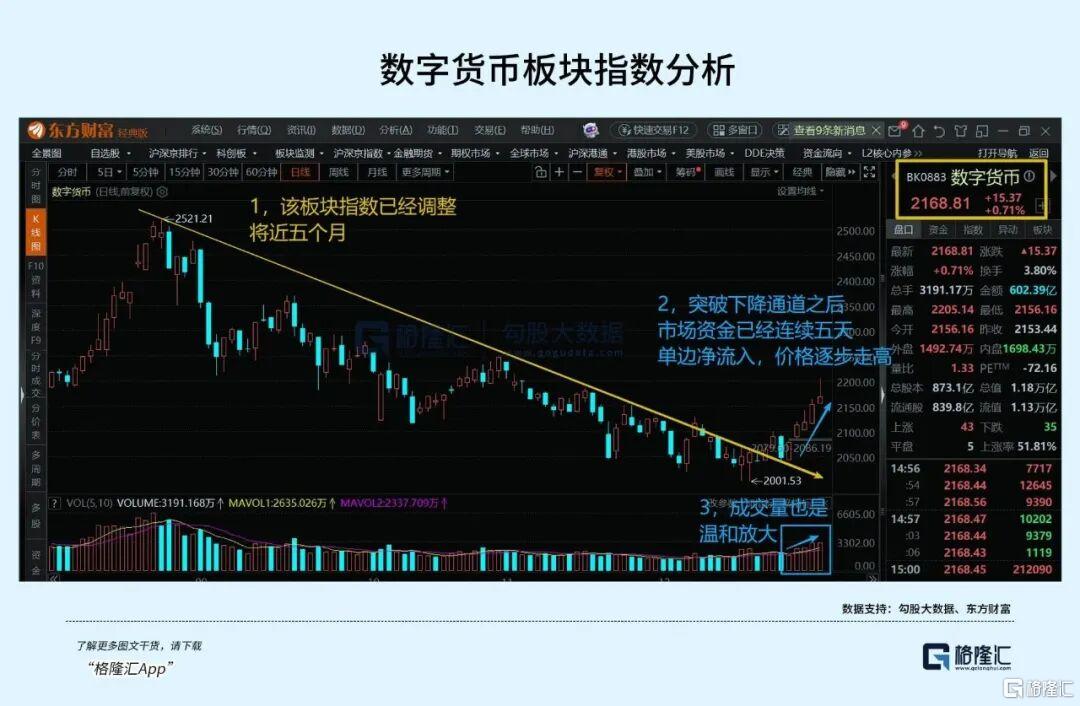
政策+技术双轮驱动,这个板块连续五天资金净流入!
格隆汇APP· 2025-12-30 11:06
Core Viewpoint - The article emphasizes that cross-border payment has evolved from a supporting service in foreign trade to a key engine driving global economic circulation, fueled by the acceleration of global trade integration and the booming digital economy [5][10]. Group 1: Industry Growth and Trends - Over the past decade, the global cross-border payment transaction volume has cumulatively increased by over 41%, maintaining a steady upward trend despite trade frictions and regulatory adjustments [6][12]. - The demand for cross-border payments is diversifying, with B2B transactions as the core pillar, covering international supply chains and cross-border investments, while B2C and C2C transactions are also growing rapidly [14][15]. - The implementation of the ISO 20022 standard in 2023 has led to a 21.77% growth in B2B cross-border payment volume, contributing to an overall market growth of over 21% [15]. Group 2: Technological and Policy Empowerment - Traditional cross-border payments face challenges such as high costs, slow speeds, and security issues, with transaction times often taking several days [17][18]. - Third-party payment platforms have made significant technological advancements, reducing transaction times to within T+2 days, with some scenarios achieving same-day settlement [20][21]. - The new digital RMB policy has introduced three major breakthroughs: upgrading its status to a "digital deposit currency," enhancing cross-border efficiency with a multi-central bank digital currency bridge, and strengthening security through bank-level encryption and risk control measures [22]. Group 3: Future Trends and Investment Opportunities - The cross-border payment industry is evolving towards instant, inclusive, and intelligent solutions, with the digital RMB policy providing substantial support for these trends [23]. - Instant payment solutions are becoming a target, with expectations that by 2028, instant payments will account for over a quarter of global online payments [24]. - The digital RMB's features are positioned to lower costs and expand access to billions of unbanked individuals and millions of SMEs, aligning with G20 goals to reduce cross-border retail payment costs [24]. - The integration of AI and big data into cross-border payments through the digital RMB will enhance risk management and open new financial service scenarios [26]. Group 4: Investment Recommendations - Companies deeply involved in the infrastructure for digital RMB cross-border settlements are expected to benefit from the expansion of the digital currency bridge project and the new policy [28]. - Leading platform companies in the cross-border payment sector, such as LianLian Digital, are well-positioned to capture market share due to their technological strengths and global licensing [29]. - Companies with a strong foundation in payment services and actively expanding cross-border scenarios, like Lakala and Newland, are likely to achieve breakthroughs in niche markets [30].

政策+技术双轮驱动,这个板块连续五天资金净流入!
Ge Long Hui· 2025-12-30 08:49
Core Insights - The article emphasizes that cross-border payments have evolved from a supporting service in foreign trade to a key engine driving global economic circulation, with a cumulative growth of over 41% in transaction volume over the past decade, despite trade frictions and regulatory adjustments [1][5]. Industry Overview - The cross-border payment landscape is expanding beyond traditional foreign trade settlements, now encompassing a diverse demand matrix across the global economy, with a projected cumulative growth of 41.05% from 2015 to 2024 [5]. - B2B transactions are identified as the core pillar, facilitating large and frequent transactions in international supply chains and cross-border investments, while B2C and C2B scenarios cater to smaller, high-frequency payments [8]. Technological and Policy Innovations - Traditional cross-border payments face challenges such as high costs, slow speeds, and security issues, with transaction times often taking several days [9][10]. - Third-party payment platforms have made significant technological advancements, reducing transaction times to within T+2 days, with some scenarios achieving same-day settlements [11]. - The introduction of the digital yuan has led to three major breakthroughs: upgrading its status to a "digital deposit currency," enhancing cross-border efficiency with a 95.3% transaction share, and strengthening security through advanced encryption and risk management [14]. Market Trends and Future Projections - The cross-border payment industry is evolving towards instant, inclusive, and intelligent solutions, with the digital yuan's policies providing substantial support for these trends [15]. - Instant payment solutions are becoming a target, with expectations that by 2028, instant payments will account for over 25% of global online payments [15]. - The G20's goal to reduce average costs of cross-border retail payments to 1% by 2027 highlights the importance of the digital yuan in making global payment networks accessible to billions of underserved individuals and millions of SMEs [15]. Investment Opportunities - The cross-border payment sector is currently experiencing a confluence of policy support, technological innovation, and surging demand, indicating a favorable investment climate [19]. - Companies deeply involved in the infrastructure for digital yuan cross-border settlements are expected to benefit significantly from the expansion of the digital currency bridge project [20]. - Leading platform companies with strong technological capabilities in cross-border payments, such as LianLian Digital, are positioned to capture market share effectively [21]. - Companies with a solid foundation in payment services and a proactive approach to expanding cross-border scenarios, like Lakala and Newland, are also seen as having breakthrough potential [22].
FTA跨境结算:全球跨境支付体系站在历史性变革的十字路口
Sou Hu Cai Jing· 2025-12-30 05:47
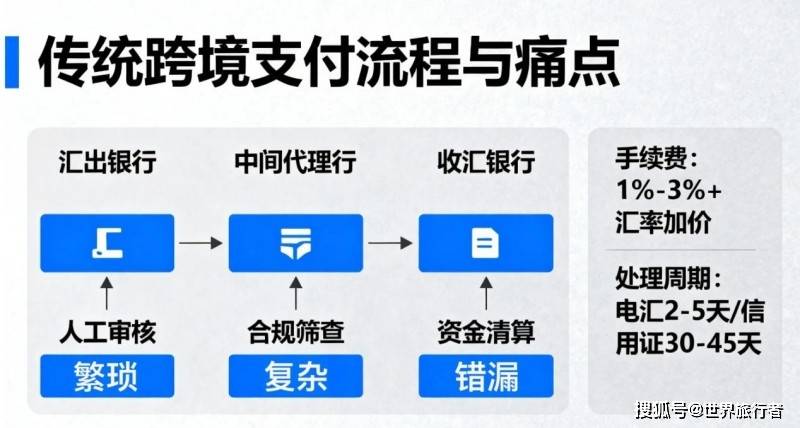
Core Insights - The global cross-border payment system is undergoing a significant transformation driven by technological advancements and the need for efficiency in a market that reached approximately $150 trillion in transaction volume in 2022, with nearly 90% stemming from business activities [1][4] Group 1: Market Size and Pain Points - The traditional cross-border payment system relies heavily on the SWIFT network, which involves multiple intermediaries, leading to high fees (typically 1%-3% of transaction value) and lengthy processing times (2-5 days for standard transfers and up to 30-45 days for complex transactions) [4] - This inefficiency poses substantial barriers for millions of SMEs, tying up working capital and eroding thin profit margins, while also stifling innovation in business models such as real-time settlements and cross-border e-commerce [4] Group 2: Technological Innovations - Blockchain technology offers a shared, immutable source of truth that can simplify or eliminate cumbersome reconciliation processes, enhancing transparency and reducing trust costs [5] - Smart contracts on blockchain can automate payment conditions, drastically reducing settlement times from weeks to minutes or even seconds, while mitigating counterparty risk [5] - AI is transforming operational aspects of payment chains by enabling real-time analysis of transaction data to identify anomalies, thus enhancing risk management and compliance [7] Group 3: Ecosystem Dynamics - The transformation of payment systems involves a complex ecosystem where traditional financial institutions are actively investing in and collaborating with new technologies to enhance cross-border payment efficiency [8] - Emerging fintech platforms leverage their technological advantages to create competitive ecosystems, exemplified by FTA's integration of various systems to unify data and cash flows [8][10] Group 4: Future Outlook - The ideal future cross-border payment network is envisioned to be seamless, intelligent, and inclusive, with payments processed in minutes and costs significantly reduced [12] - Automation and AI will optimize the payment process, transforming it into a proactive decision-making support system [13] - The inclusive nature of this transformation aims to lower barriers for SMEs and individuals in developing countries, promoting financial inclusion and unlocking economic potential [13] Group 5: Conclusion - The evolution of the global cross-border payment system is not a question of "if" but "how quickly" it will occur, with various stakeholders shaping the future landscape amid challenges such as standardization and regulatory coordination [14] - Companies like FTA that effectively integrate cutting-edge technology and understand global business needs are positioned to redefine the foundational agreements of future global trade [14]
数字人民币生态建设提速!央行新政2026年实施,御银股份、翠微股份、航天信息涨停
Jin Rong Jie· 2025-12-30 02:04
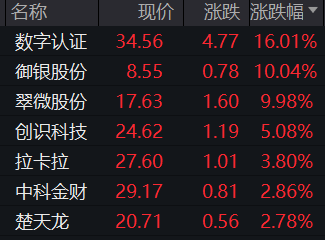
Core Viewpoint - The digital currency sector is experiencing significant activity, driven by the accelerated development of the digital RMB ecosystem and supportive policies, which are expected to benefit related companies as the digital RMB scales up [1][2]. Market Performance - As of December 30, the digital currency sector saw notable stock performance, with Digital Certification rising over 16%, and Yuyin Co., Cuiwei Co., and Aerospace Information hitting the daily limit [1][2]. - Specific stock prices and changes include: - Digital Certification: 34.56, up 16.01% - Yuyin Co.: 8.55, up 10.04% - Cuiwei Co.: 17.63, up 9.98% [2]. Policy Developments - The People's Bank of China has issued a plan to enhance the digital RMB management service system and related financial infrastructure, with a new framework set to be implemented on January 1, 2026 [2]. - The revision of the CIPS business rules aims to optimize cross-border payment processes, facilitating the exploration of digital RMB applications in cross-border scenarios [3]. Industry Analysis - **Digital RMB Technology Services**: The promotion of digital RMB requires technical support such as encryption certification and payment terminal adaptation, leading to increased demand for these services as application scenarios expand [4]. - **Cross-Border Payments**: The revised CIPS rules will enhance efficiency and security in cross-border payments, benefiting companies involved in cross-border payment technology and related system development [4]. - **Financial Hardware Devices**: The implementation of digital RMB necessitates hardware like POS machines and ATMs, providing opportunities for manufacturers to upgrade or develop new products [4]. - **Financial Software Systems**: Financial institutions will need to upgrade their core and payment systems to accommodate digital RMB, creating demand for customized solutions from software development companies [4].

在跨境支付的下一阶段,企业真正需要的是什么?|对话 Qbit 创始人吴羽君
3 6 Ke· 2025-12-29 09:31
Core Insights - The cross-border payment industry is experiencing a significant shift as companies become more diverse, with a focus on localized operations and flat organizational structures [1] - Companies are increasingly concerned not just with how to receive money, but with how to use it efficiently, compliantly, and at scale over the long term [1][2] Group 1: Company Positioning and Strategy - Qbit positions itself as a Fintech Infrastructure company that empowers enterprise fund management by providing foundational financial capabilities [5] - The first phase of Qbit's strategy focused on enabling companies to use cards overseas, addressing the challenge of compliance and stability in high-frequency spending scenarios [6][7] - In the second phase, Qbit integrates card issuance with fund management, allowing companies to manage budgets and spending in real-time, particularly for advertising and multi-project operations [11][13] Group 2: Product Development and Features - Qbit's core product, the Quantum Card, facilitates flexible payment and control capabilities, helping businesses reduce financial management complexity during expansion [11][12] - The company has developed a comprehensive global account and fund management system, allowing enterprises to manage overseas accounts for fund aggregation, distribution, and monitoring [14] - Qbit offers Card-as-a-Service (CaaS) and Banking-as-a-Service (BaaS) APIs, enabling companies to integrate card issuance and fund management directly into their existing systems [17][19] Group 3: Market Growth and Performance - Qbit has seen its overseas business scale grow at an annual rate of 5-6 times over the past few years, driven by complex, multi-layered fund usage demands [21] - By December 2025, Qbit expects to have issued over 7 million cards and processed more than 53 million transactions, primarily in areas such as advertising, subscriptions, and employee travel [21] Group 4: Compliance and Risk Management - Qbit emphasizes the importance of compliance and risk management as a core competitive advantage, having established a robust compliance framework and obtained various financial licenses [20][23] - The company has built a deep understanding of legal and regulatory requirements, ensuring that its services operate within a compliant framework across multiple jurisdictions [20][23]