
金融业等

Search documents
国泰海通证券:港股交投情绪持续升温
Ge Long Hui· 2025-07-29 02:25
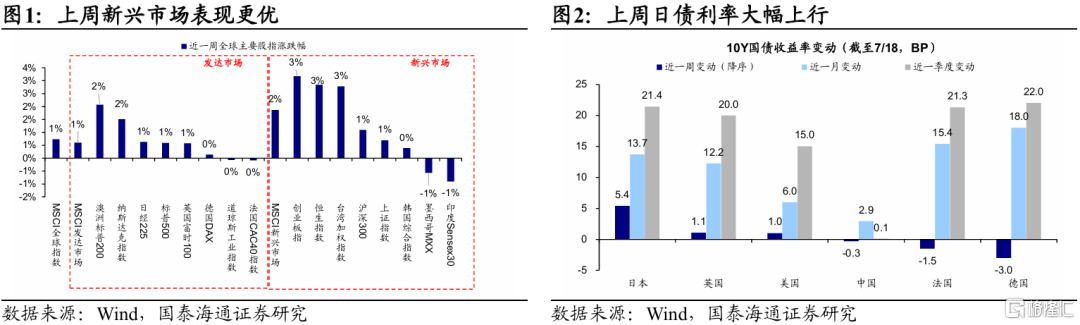
Market Performance - Developed markets outperformed last week, with MSCI global index up by 1.3%, MSCI developed markets up by 1.4%, and MSCI emerging markets up by 0.7% [3] - Among developed markets, Nikkei 225 had the strongest performance (+4.1%), while S&P/ASX 200 was the weakest (-1.0%) [3] - In emerging markets, ChiNext Index was the best performer (+2.8%), while India’s Sensex 30 was the worst (-0.4%) [3] Trading Sentiment - Trading volume increased in Hong Kong and European markets, while it decreased in the US market [10][11] - Hong Kong's Hang Seng Index saw a trading volume of 186 billion shares and a turnover of 705.5 billion USD, reflecting a week-on-week increase [11] - The short-selling ratio in Hong Kong decreased to 11.5%, indicating high investor sentiment [11] Valuation - Developed markets' overall valuation improved, with the latest PE and PB ratios at 23.8x and 3.8x, respectively, placing them in the 93% and 100% percentile levels since 2010 [13] - Nasdaq and Dow Jones Industrial Average had the highest PE ratios at 43.1x and 32.0x, respectively [13] - Emerging markets also saw a valuation increase, with PE and PB ratios at 16.5x and 2.0x, respectively, in the 86% and 92% percentile levels since 2010 [14] Fund Flows - Global macro liquidity expectations tightened, with significant capital inflows into France, Germany, and India, while outflows were noted from the US [19][21] - In Hong Kong, a total of 21.3 billion HKD flowed into the market, with stable foreign capital inflows of 13.4 billion HKD [21] Earnings Expectations - Hong Kong's consumer sector saw an upward revision in earnings expectations, with the Hang Seng Index's 2025 EPS forecast adjusted from 2215 to 2210 [22] - The US S&P 500's earnings expectations remained stable at 265, while the Eurozone's STOXX50 index saw a slight downward adjustment from 338 to 337 [22][23]


透视上海经济“半年报”:高技术制造业产值增长16%
第一财经· 2025-07-26 01:35
Core Viewpoint - Shanghai's economy demonstrates strong resilience and stable growth despite increasing international economic uncertainties, with a GDP growth of 5.1% year-on-year in the first half of the year, achieving the goal of "half the time, half the task" [1] Group 1: Economic Performance - Shanghai's industrial added value increased by 5.0% year-on-year in the first half of the year, with total industrial output value growing by 5.6%, accelerating by 2.1 percentage points compared to the first quarter [2] - The manufacturing output of key industries such as computer, communication, and other electronic equipment grew by 21.7%, while the aerospace and other transportation equipment manufacturing increased by 18.1% [2] - High-tech manufacturing output rose by 16.0%, significantly outpacing the overall industrial growth, with integrated circuits and artificial intelligence sectors growing by 11.7% and 12.3% respectively [2][3] Group 2: Service Sector Growth - The tertiary industry in Shanghai saw a 5.4% year-on-year increase in added value, with the information transmission, software, and IT services sector growing by 14.6% [5] - The financial sector also performed well, with an 8.8% increase in added value, contributing over 60% to the city's GDP growth [5] - The software and IT services industry reported a 27.1% increase in revenue from January to May, with AI-related IT consulting services revenue growing by 130% [5] Group 3: Consumer Market Recovery - Shanghai's retail sales of consumer goods showed signs of recovery, with a 1.7% year-on-year growth in the first half of the year, marking a 2.8 percentage point increase from the first quarter [7] - Specific categories such as furniture and home appliances saw significant growth, with retail sales increasing by 18.8% and 18.7% respectively [7] - The fixed asset investment in Shanghai rose by 6.2% year-on-year, with industrial investment increasing by 19.8% [7] Group 4: Foreign Trade and Investment - Shanghai's total import and export volume grew by 2.4% in the first half of the year, with exports increasing by 11.1% and imports decreasing by 3.6% [8] - The export of intermediate goods surged by 20.5%, contributing significantly to overall export growth [8] - The city saw a notable increase in foreign investment, with 30 new multinational company regional headquarters and 19 foreign R&D centers recognized in the first half of the year [9] Group 5: Innovation and Development - The number of valid invention patents in Shanghai reached 293,700, a year-on-year increase of 12.2%, indicating a strong focus on technological innovation [4] - The logistics and transportation sectors also showed improvement, with cargo transport turnover and international container throughput increasing by 7.5% and 6.1% respectively [9] - Overall, Shanghai's economy is characterized by enhanced innovation momentum and resilience, with ongoing efforts to stimulate market vitality and foster new growth engines [9]

云南连发10个文件支持就业,网络主播纳入职业培训补贴
Di Yi Cai Jing· 2025-05-28 13:17
Group 1 - Yunnan province is implementing various employment measures, including promoting return-to-hometown entrepreneurship, e-commerce startups, and leveraging特色产业 to create new employment channels and growth points [1][5] - The Yunnan provincial government has issued the "15 Measures" to support employment, focusing on enhancing industrial strength, enterprise growth, and employment stability [1][3] - The employment priority strategy aims to ensure at least 500,000 new urban jobs annually and maintain rural labor transfer employment at over 15 million [3][4] Group 2 - In Q1 2025, Yunnan's employment monitoring showed 365,000 employees in 901 surveyed companies, with the wholesale and retail sector experiencing the highest reduction in employment at 1.16% [2] - The "Unemployment Insurance Policy" allows eligible companies to apply for unemployment insurance refunds, with large enterprises receiving 30% and small to medium enterprises receiving 60% of their contributions back [3][4] - The province plans to conduct over 1 million training sessions annually, with at least 500,000 being subsidized vocational skills training [4] Group 3 - The "Return-to-Hometown Entrepreneurship Measures" encourage young graduates to engage in e-commerce, fostering the development of e-commerce industry clusters and promoting high-quality employment [5][6] - The measures focus on highland特色农业, cultural tourism, and cross-border e-commerce, while also emphasizing the training of e-commerce skills [6] - A project library for e-commerce startups will be established, providing financial support and mentorship for promising projects, with annual selections of exemplary returnee entrepreneurs [6]