Home Appliances

Search documents
AB Electrolux publishes 2025 Annual Report
Prnewswire· 2026-02-19 09:34
Core Insights - AB Electrolux has published its 2025 Annual Report, highlighting a renewed strategy focused on growth and operating margin targets [1] Group 1: Renewed Strategy - The renewed strategy is centered around four key pillars: cash generation, cost leadership, lifetime value creation, and consumer preference [1] - Cash generation aims for organic growth and healthy margins through disciplined financial management, reduced capital expenditure, and investment decisions focused on measurable returns [1] - Cost leadership emphasizes product cost-out, value engineering, and enhanced supplier strategy to drive efficiency and reduce costs [1] - Lifetime value creation focuses on connected products that enhance durability and consumer value, aiming to engage consumers throughout the ownership journey [1] - Consumer preference involves refining brand positioning and launching new products under Electrolux, AEG, and Frigidaire, which received high consumer ratings [1] Group 2: Sustainability Highlights - The Group achieved a total case incident rate of 0.33, indicating strong health and safety performance [1] - Recycled materials accounted for 23% of the materials used in products manufactured by the Group [1] - In 2025, 97% of electricity and 67% of total energy in operations came from renewable sources [1] - Emissions were reduced by 45% in Scope 1 and 2, and by 33% in Scope 3 compared to 2021 [1] - The most resource-efficient products accounted for 26% of total units sold and 36% of gross profit [1]


不只春晚露了一手,清洁背后,MOVA在下一盘全场景智慧生态大棋
36氪· 2026-02-19 04:07
Core Viewpoint - MOVA's rise is not merely a technological arms race but a carefully planned strategy focused on "humanizing technology" [2][19]. Market Dynamics - The smart cleaning appliance market is experiencing a fundamental shift from "replacing human labor" to "surpassing human capabilities" [3]. - The global cleaning appliance market is projected to reach $19.4 billion (approximately 1340.29 billion RMB) by 2031, growing at a compound annual growth rate (CAGR) of 5.90% from 2025 to 2031 [5]. - Consumer preferences are shifting from traditional metrics like suction power and battery life to deeper needs for convenience, such as self-cleaning capabilities and ease of maintenance [6]. Product Innovation - MOVA's P70 Pro vacuum and M50 Ultra washing machine exemplify the industry's transition towards smart assistants that truly understand home environments [8]. - The P70 Pro features MOVA's "new generation roller active water washing technology," which addresses common issues with traditional cleaning devices, ensuring effective cleaning even in heavily soiled areas [9]. - The M50 Ultra has received multiple international design awards, showcasing its innovative features like the "bionic fin lifting mechanical arm" that enhances edge cleaning capabilities [13]. Comprehensive Product Range - MOVA's cleaning business encompasses a wide range of products, including high-speed digital motor vacuum cleaners, mite removal devices, hair dryers, and window cleaning machines, creating a "full-scene cleaning solution" [15][17]. Globalization Strategy - MOVA's global expansion strategy diverges from conventional paths, opting to enter high-end markets in developed countries directly, rather than starting in Southeast Asia [28]. - The company believes that the highest standards in global markets serve as the true testing ground for brand technology and market positioning [29]. - MOVA's approach includes a phased strategy where it first validates its model in culturally similar regions before tackling more complex markets like Europe and North America [31][32]. Market Performance - During the 2025 Black Friday period in Southwestern Europe, MOVA's vacuum robots achieved a GMV of 200 million RMB in the high-end market, ranking among the top twenty in overall platform sales [33]. - In the North American market, MOVA's products ranked in the top ten of the Best Seller list during Prime Day, indicating successful market penetration [33]. Future Directions - In 2026, MOVA plans to focus on four key areas: driving product upgrades through technological innovation, accelerating global expansion with over 700 domestic stores and deepening its presence in high-end overseas markets, enhancing service upgrades with a three-year warranty across all categories, and improving supply chain and marketing strategies [35].

不只春晚露了一手,清洁背后,MOVA在下一盘全场景智慧生态大棋
3 6 Ke· 2026-02-18 13:38
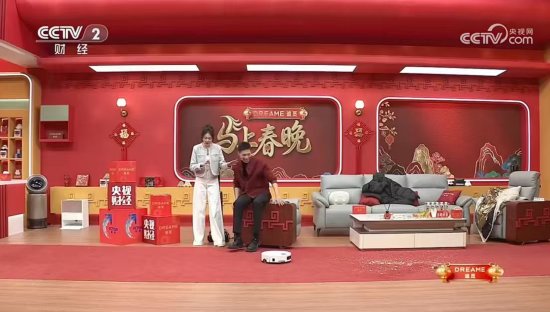
"咱们家有MOVA扫地机,哪能让你累着啊。" 2026年除夕夜,当小品《你准喜欢》里的男主角说出这句台词时,观众或许只把它当作一个轻松的包袱。但放在行业视角下,这句台词恰恰暗合了智能清 洁电器正在经历的一场根本性转变:从"替代人力"到"超越人力"的进化。 这一晚,MOVA以央视春晚消费电子战略合作伙伴的身份完成了一次高规格的国内亮相。但对一家已覆盖全球60多个国家和地区的超高端科技品牌而言, 这并非一次单纯的曝光合作,而是一种主流公信体系内的品牌确认。 更值得关注的问题是:在行业其他品牌已经深耕多年的赛道上,MOVA为何能在短时间内"反超",以智能清洁品牌代表的身份站上这个位置?它的崛起, 反映了行业变局背后怎样的逻辑? 需求重构下,清洁电器要更理解家庭场景 智能清洁电器市场蓝海一直存在。 艾瑞咨询发布的《2025-2026年春节年货消费趋势报告》显示,2026年科技类年货消费占比预计达32.7%,其中智能家居、健康科技产品的认可度高达 89.4%,智能清洁家电成为绝对主力。 根据6Wresearch内部数据库及行业洞察显示,全球清洁电器市场预计到2031年将增至194亿美元(约为人民币1340.29亿元), ...

追觅扫地机现身《马上春晚》,米雪、秦岚等明星点赞
Xin Lang Cai Jing· 2026-02-16 13:03
Core Viewpoint - The appearance of the Chasing S60 Pro robotic vacuum at the CCTV Spring Festival Gala marks a significant milestone as the first robotic vacuum to be featured on the main stage of the event, highlighting the growing recognition and popularity of smart cleaning devices in modern households [1][3]. Group 1: Product Features - The Chasing S60 Pro is equipped with a globally innovative dual mechanical arm design, allowing it to extend its side brushes and mop to fit snugly into corners and achieve thorough cleaning without dead spots [1][3]. - It incorporates pioneering dual-eye dynamic navigation technology, capable of recognizing over 280 types of objects and executing rapid obstacle avoidance in just 0.3 seconds, enabling it to navigate complex home environments effortlessly [1][3]. Group 2: Celebrity Endorsements - During the gala, various celebrities praised the robotic vacuum, with Mi Xue highlighting its role in maintaining an elegant lifestyle, Qin Lan discussing how it frees up hands, and Hou Peicen mentioning that she has purchased one for her elderly relatives [1][3].
【新春走基层】以旧换新购年货 乡村消费再升级
Yang Shi Wang· 2026-02-15 12:17
Group 1 - The core viewpoint of the news is that the upgraded "National Subsidy" policy has been fully implemented, enhancing rural consumption during the Spring Festival [1] - The implementation of the "National Subsidy" policy has led to a significant increase in orders for home appliances, particularly in rural areas [3] - There has been a notable surge in sales of major appliances such as air conditioning sets and wall-mounted washing machines, with sales increasing over six times year-on-year in rural counties [5] Group 2 - The logistics improvements have facilitated a rise in the volume of orders for trade-in products at the beginning of the year [3] - Regions like Heilongjiang, Hunan, and Guizhou have experienced substantial growth in orders for subsidized products like televisions, air conditioners, and refrigerators [5]

扫地机坏4次想退货先扣1000元
Xin Lang Cai Jing· 2026-02-15 08:33
Group 1 - The core issue revolves around a consumer's experience with the Dreame S30 robot vacuum, which has faced multiple malfunctions within a year, leading to dissatisfaction and a potential return request [1] - The consumer, Mr. Miao from Changzhou, purchased the robot vacuum for 4689 yuan and has had it repaired three times, with a replacement unit failing shortly after [1] - Customer service indicated that the new unit does not qualify for the previous warranty policy, and a return would incur a deduction of 1000 yuan [1] Group 2 - Customer service attributed the frequent malfunctions to factors such as usage scenarios, frequency, and specific user operations [1] - The warranty period for the robot vacuum is generally between 2 to 3 years, depending on the model, with costs incurred by the user for repairs after the warranty expires [1]
换新补贴+年味盛宴 兴安盟多场活动迎春接福
Xin Lang Cai Jing· 2026-02-14 09:16
Group 1 - The core theme of the consumption promotion in Xing'an League is "Warm Spring on the Ridge, Beneficial Purchase in Xing'an," featuring enhanced policy subsidies and integration of commerce, culture, and tourism [1] - A total of 8.5 million yuan in consumption vouchers will be distributed across the region, with trade-in subsidies for automobiles and home appliances reaching up to 20,000 yuan [1] - The new trade-in policy, effective from January 1, 2026, will cover 12 categories of home appliances and digital products, offering a 15% subsidy on the selling price for energy-efficient appliances and digital products [1] Group 2 - The new spring lantern festival at the Guiliuhe Ecological Park in Keyou Qianqi will run until March 4, featuring over 40 unique lantern displays and a variety of cultural performances [3] - The second annual New Year goods festival in Xing'an League, which started on February 4, attracted over 150 merchants and showcased more than 1,000 specialty products, achieving sales of 500,000 yuan on the first day [3] - Online live-streaming sales through platforms like Douyin and JD.com are promoting local agricultural products nationwide as part of the "Xing'an Cloud New Year Goods Festival" [3]

2025年上海市嘉定区家用电器(噪声)产品质量监督抽查结果公布
Zhong Guo Zhi Liang Xin Wen Wang· 2026-02-14 04:23
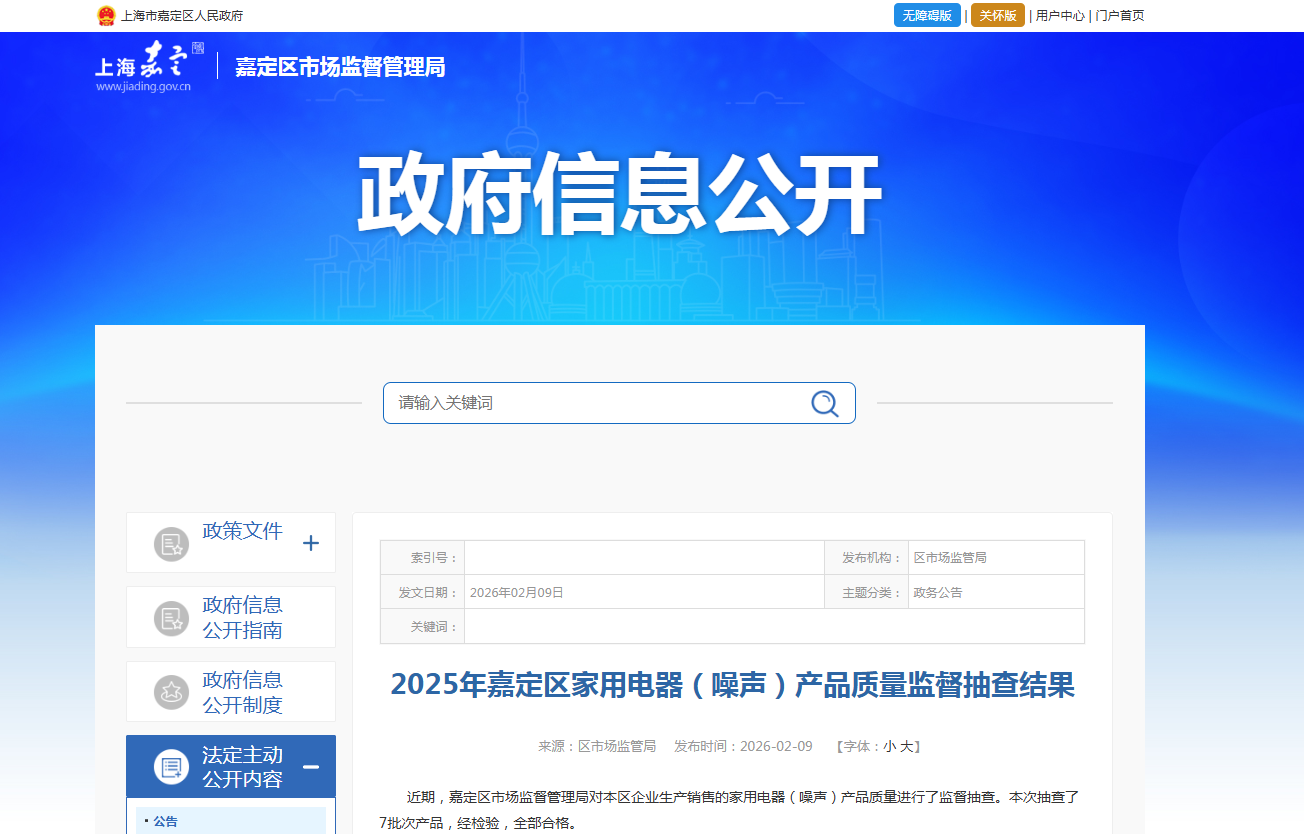
Core Viewpoint - The recent quality supervision inspection results for household electrical appliances (noise) in Jiading District, Shanghai, indicate that all sampled products passed the quality tests, reflecting positively on the local manufacturing standards and compliance with regulations [4]. Group 1: Inspection Results - The Jiading District Market Supervision Administration conducted a quality inspection on household electrical appliances (noise) and tested a total of 7 batches of products, all of which were found to be compliant [4]. - The inspection was based on the implementation guidelines SHJDSSXZ0004-2025 for quality supervision of household electrical appliances (noise) in Shanghai's Jiading District [4]. Group 2: Sampled Products - The inspected products included various types of household appliances such as fans, washing machines, range hoods, and microwaves, with notable brands like Midea and Vatti represented [5]. - Specific products that passed the inspection include: - Table fan from Wenzhou Jiayou Electric Factory - Floor fan from Shanghai Jingteng Electric Co., Ltd. - Fully automatic washing machines from Wuxi Little Swan Electric Co., Ltd. and Hefei Midea Washing Machine Co., Ltd. - Range hoods from Vatti and Guangdong Vanward Electric Co., Ltd. - Microwave from Guangdong Midea Kitchen Appliances Manufacturing Co., Ltd. [5].
换家电、购数码产品可享15%政府补贴
Xin Lang Cai Jing· 2026-02-13 22:45
Group 1 - The core initiative involves a government subsidy of 15% for consumers purchasing new home appliances and digital products, aimed at upgrading consumption in Hebei province [1] - The subsidy applies to six categories of home appliances, including refrigerators, washing machines, televisions, air conditioners, water heaters, and computers, as well as four categories of digital products, such as smartphones, tablets, smartwatches, and smart glasses, with specific price limits for each category [1] - The maximum subsidy per home appliance is capped at 1,500 yuan, while for digital products, it is capped at 500 yuan, with each consumer eligible for one subsidy per category [1] Group 2 - A collaborative mechanism involving provincial, municipal, and county levels will be established to ensure effective implementation, data sharing, and fund security [2] - The program will include a price filing and public announcement system for subsidized products, prohibiting temporary price increases or misleading discounts by participating vendors [2] - Efforts will be made to enhance convenience for rural residents by increasing offline service providers and promoting online channels to facilitate access to the subsidy program [2]
Proscenic-More Time for Love. Less Time Cleaning.
Globenewswire· 2026-02-13 15:00
Core Insights - The Q20Plus Robot Vacuum & Mop is designed to enhance user experience by minimizing cleaning chores and allowing more time for personal connections, particularly during Valentine's Day [8][10] Product Features - The Q20Plus features automatic dust collection, which reduces the need for manual intervention and allows users to focus on other activities [3][10] - It utilizes stable laser navigation with DTOF technology, ensuring efficient cleaning in various home environments, including older apartments with dense furniture [5] - The compact design of the Q20Plus, with a body size of 306mm, enables it to access tight spaces and navigate under furniture effectively [7] Marketing Strategy - Proscenic positions the Q20Plus as a practical gift for Valentine's Day, emphasizing the importance of a clean and harmonious home for nurturing relationships [8][11] - The company promotes the idea that technology should serve people, with the Q20Plus embodying this principle through its efficient and thoughtful design [10]