
New Energy Vehicles

Search documents
上海“十五五”锚定世界级高端产业集群,加快建设“五个中心”
2 1 Shi Ji Jing Ji Bao Dao· 2026-01-19 13:13
Core Insights - Shanghai aims to build a world-class high-end industrial cluster and achieve a per capita GDP that doubles from 2020 levels by 2035, marking a significant step in China's urban development strategy [1][2] Group 1: High-Quality Development Goals - The primary goal for Shanghai during the 14th Five-Year Plan period is to achieve significant results in high-quality development, maintaining economic growth within a reasonable range and improving total factor productivity [1][2] - Shanghai's development strategy emphasizes a shift from scale expansion to high-quality development and structural optimization, impacting both economic sectors and individual income levels [2] Group 2: Five Centers Construction - The construction of the "Five Centers" (economic, financial, trade, shipping, and technological innovation) is a strategic task assigned to Shanghai, with a focus on enhancing its international economic center status [2][4] - Shanghai plans to accelerate the development of three leading industries, including integrated circuits, innovative pharmaceuticals, and artificial intelligence, to strengthen its industrial capabilities [2][4] Group 3: Focus on Advanced Industries - Shanghai's strategy includes a clear focus on high-end industrial clusters, aiming to tackle key technologies and enhance its position in the global urban system [4][6] - The city intends to build a modern industrial system characterized by advanced manufacturing, aiming to create a strong "Shanghai Manufacturing" brand [4][6] Group 4: Emerging and Future Industries - Shanghai is set to establish six emerging pillar industry clusters, focusing on new energy vehicles, advanced materials, and green low-carbon industries, among others [8][10] - The city emphasizes "agile layout" in future industries, which involves strategic positioning in cutting-edge technologies and innovation [8][9] Group 5: Financial Support for Innovation - To support the high-end industrial cluster, Shanghai plans to enhance its international financial center capabilities, including the establishment of a financial asset trading platform and the development of technology finance [10][11] - The city aims to create a comprehensive technology finance service system that supports early-stage investments and long-term capital for high-tech industries [10][11]
沪指微跌守住4100点大关 全市场3100股飘绿
Mei Ri Shang Bao· 2026-01-16 00:15
Market Overview - A-shares exhibited mixed performance with the Shanghai Composite Index declining by 0.33% to close at 4112.6 points, barely holding above the 4100 mark, while the Shenzhen Component Index rose by 0.41% and the ChiNext Index increased by 0.56% [1] - The total trading volume in the A-share market fell below 3 trillion yuan, decreasing by approximately 1 trillion yuan compared to the previous day [1] Semiconductor Sector - The semiconductor sector showed strong performance in the afternoon, with notable gains in lithography machines and memory chips, leading to stocks like Blue Arrow Electronics and Silicon Power reaching a 20% limit up [2] - The U.S. semiconductor equipment stocks also surged, with companies like ASML and TSMC rising over 4% [3] - Blue Arrow Electronics announced plans to acquire at least 51% of Chengdu Xinyi Technology, a move aimed at expanding its capabilities in the semiconductor design industry [3] - The semiconductor industry is experiencing price increases across various segments due to heightened demand from AI applications, with expectations of improved profitability [4] Non-Ferrous Metals Sector - The non-ferrous metals sector was notably active, with stocks like Sichuan Gold and Xianglu Tungsten hitting the daily limit up [5] - Silver prices surged over 7%, reaching historical highs, while gold also hit record levels at $4643 per ounce [5] - Geopolitical tensions are expected to drive demand and price appreciation for strategic metals such as copper, tungsten, and cobalt [6] Energy Storage Sector - The energy storage sector saw active performance, particularly in battery stocks, with lithium carbonate prices reaching a two-year high [8] - A meeting on the new energy vehicle industry emphasized the need for fair competition and innovation, projecting that by 2025, China's automobile production and sales will exceed 34 million units, with new energy vehicles accounting for over 50% of domestic sales [8]



脉脉公布互联网大厂人才数据:万人以上规模企业中,加薪员工占比达17.4%
Xin Lang Cai Jing· 2026-01-14 09:42
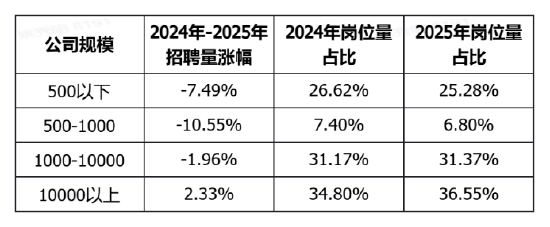
Group 1 - The core point of the articles indicates that companies with over 10,000 employees are the only category to see an increase in new job postings in 2025, with a growth rate of 2.33% year-on-year [1][3] - Notable companies such as DJI, Didi, and Xiaomi have achieved significant growth in new job postings [1][3] - Among large companies, 17.44% of employees received salary increases, which is significantly higher than other company sizes [1][3] Group 2 - Salary increases are concentrated in the internet and new energy vehicle sectors, with BYD's new "AI infra algorithm engineer" position seeing an average monthly salary increase of over 36% [2][4] - DJI's "industrial designer" position has an average monthly salary increase of 20%, while Tencent's "AI product manager" position has increased by 5.56% [2][4] - AI positions have become a focal point for recruitment and salary increases, with companies like DJI, Xiaopeng, JD, Didi, Xiaohongshu, and Kuaishou seeing new AI job postings increase by over tenfold [2][4]

光谷商学院成立,3年培育超500名科技企业家
Xin Lang Cai Jing· 2026-01-13 14:35
Core Insights - The establishment of the Guanggu Business School aims to empower technology companies to overcome growth bottlenecks by focusing on "cognitive transformation" and "team enhancement" [1] - The school is led by Ma Xinqiang, Chairman of Huagong Technology, and has a strong advisory committee comprising leaders from various industries, including new energy vehicles and biomedicine [1] - The school’s mission is to serve as an "empowerment engine" for cultivating globally-minded technology entrepreneurs through practical courses and a connected industrial ecosystem [1] Summary by Sections School Structure and Objectives - Guanggu Business School is positioned as a "cognitive elevation engine, team acceleration base, and resource linkage hub" with a three-tiered training system: "Navigator Class," "Excellence Class," and "Startup Class" [2] - The school plans to launch a "Market Partner Program" to help over 50 companies recruit high-end market talent within three years, addressing the common issue of "heavy R&D, light market" [2] - The goal for the next three years includes training over 500 technology entrepreneurs and helping at least 50 companies achieve annual revenues exceeding 100 million yuan [2] Student Profile and Initial Class - The first cohort of the "Excellence Class" consists of over 30 students from specialized and innovative enterprises, with revenue scales between 100 million and 500 million yuan, indicating they are at a critical stage for scaling [2] - Notable students include Sun Chengliang, Chairman of Wuhan Minsheng, who recently completed a strategic financing round of 688 million yuan [2][3] Personal Insights from Students - Sun Chengliang expressed that as a technology professional, he lacks expertise in management and operations, emphasizing the importance of learning to enhance the company's strategic positioning for greater international market reach [3]
MoonFox Data | Li Auto’s Performance Plunges, BEV Transition Faces Formidable Headwinds
Globenewswire· 2026-01-09 10:00
Core Viewpoint - Li Auto has reported a significant net loss in Q3 2025, marking a shift from its previous profitability and indicating challenges in its transition to battery electric vehicles (BEVs) amid increasing competition in the new energy vehicle market [1][4][6]. Financial Performance - In Q3 2025, Li Auto recorded a net loss of RMB 625 million (approximately USD 89.286 million), ending a streak of 11 profitable quarters [1][4]. - Vehicle sales revenue fell to RMB 25.9 billion (approximately USD 3.7 billion), a decrease of 37.4% from RMB 41.3 billion (approximately USD 5.9 billion) in Q3 2024 [3]. - Total revenue for Q3 2025 was RMB 27.4 billion (approximately USD 3.914 billion), down 36.2% from RMB 42.9 billion (approximately USD 6.129 billion) in Q3 2024, and down 9.5% quarter-over-quarter from RMB 30.2 billion (approximately USD 4.314 billion) in Q2 2025 [4]. - Total deliveries were 93,211 units, reflecting a 39.0% year-over-year decline [3]. Market Challenges - Li Auto is facing intensified competition in the new energy vehicle market, particularly from brands like AITO and Deepal in the extended-range electric vehicle (EREV) segment, and Tesla and NIO in the BEV segment [7][8]. - The company is experiencing a late transition to BEVs and insufficient production capacity, which are critical issues that need to be addressed to enhance competitiveness [7][10]. Production Capacity and Supply Chain - Despite positive market response to newly launched BEV models i6 and i8, supply chain challenges have limited their deliveries to only 18% of total deliveries in Q3 [11]. - Li Auto is attempting to increase production capacity through a dual-supplier system but faces urgent supply chain stability issues [11]. Strategic Expansion and New Ventures - Li Auto has begun expanding into new business lines, including "Space Robotics" and "Wearable Robotics," and launched AI smart glasses, but the market response has been lukewarm [12][13]. - The AI smart glasses market is highly competitive, with established brands dominating, making it difficult for Li Auto to gain traction [13]. Consumer Engagement - Despite declining deliveries, Li Auto maintains a relatively stable consumer base with high app user engagement, indicating strong customer loyalty [14]. Q4 Outlook - For Q4 2025, Li Auto is projected to continue facing challenges, with revenue expected to decline to RMB 26.5 billion (approximately USD 3.786 billion), a 40% year-over-year decrease [18].



从“用电量突破50亿千瓦时”看贵州贵安产业迭代
Xin Lang Cai Jing· 2026-01-06 03:59
Core Insights - Guian New Area's electricity consumption exceeded 5 billion kWh, reaching 5.016 billion kWh by December 25, 2025, marking a significant increase from 3.763 billion kWh in 2024, with a growth of over 1 billion kWh in one year [1] - The region's electricity consumption serves as an indicator of its economic and social development, reflecting the vitality of Guian New Area's high-quality growth [1] Industry Development - Guian New Area has established itself as a hub for data centers, with 26 large-scale data centers, including those from Huawei, Tencent, and Apple, achieving a total computing power of over 113 EFlops, with over 98% being intelligent computing [3] - The digital economy in Guian New Area is thriving, with the core industries' VAT invoicing amount reaching 75.2 billion yuan, a year-on-year increase of 12.28%, and the number of core industry enterprises exceeding 1,200, up by 7.03% from the previous year [3] - The new energy battery and materials sector, along with advanced equipment manufacturing, are also flourishing, with significant production capabilities demonstrated by companies like CATL and Jiangling Motors [4] Electricity Consumption Trends - The secondary industry remains the primary electricity consumer, with a year-on-year increase of 34.3% in electricity consumption, while the manufacturing sector saw a growth of 35.3% [5] - The third industry also experienced rapid growth, with a year-on-year increase of 45.2%, particularly in information transmission and software services, which saw a consumption of 20.59 billion kWh, up by 58.1% [5] Urban Development and Infrastructure - Guian New Area is enhancing its urban infrastructure, with new educational institutions and improved transportation networks, including the opening of the Guiyang Rail Transit S1 line and the establishment of a comprehensive public service system [6] - The area is witnessing a surge in commercial activities, with several well-known brands, including Luckin Coffee and others, establishing a presence, indicating strong regional development potential [8] Population Growth and Community Engagement - The population of Guian New Area is approaching 500,000, with a significant influx of young talent attracted by the region's industrial prospects and quality of life [10] - Community events and cultural activities are becoming more frequent, enhancing the area's liveliness and attracting visitors from surrounding regions [9] Power Supply and Service Enhancement - Guian Power Supply Bureau is implementing a "three full and three transformation" service model to improve electricity supply and service levels, including the construction of multiple substations to support the growing demand [11] - The bureau has also introduced a dual-ring power supply model to ensure stable electricity for data centers, addressing the challenges of power supply in the region [12]

千里科技12月新能源汽车销量同比下降19.23%
Zhi Tong Cai Jing· 2026-01-05 08:09
Core Viewpoint - Qianli Technology (601777.SH) announced a significant increase in its production of new energy vehicles (NEVs) for December 2025, while experiencing a decline in sales compared to the previous year [1] Group 1: Production and Sales Data - The company is projected to produce 5,384 new energy vehicles in December 2025, representing a year-on-year increase of 154.08% [1] - The sales of new energy vehicles are expected to reach 3,835 units, which reflects a year-on-year decrease of 19.23% [1]

新能源汽车如何跑赢“下半场”
Jing Ji Ri Bao· 2026-01-04 21:47
Core Insights - The development of new energy vehicles (NEVs) is a crucial direction for the global automotive industry's green transformation, and it is essential for China to transition from a major automotive country to a strong automotive nation [1] Industry Growth - NEV exports from China increased by 62% year-on-year in the first 11 months of 2025, with a remarkable 156% growth in November alone, significantly outpacing the overall automotive export growth [1] - China has established itself as the world's largest automotive producer and seller, enhancing its global competitiveness in the automotive sector [1] - The domestic market shows a penetration rate of approximately 80% for Chinese brands in NEV retail sales as of November 2025 [1] - The infrastructure for electric vehicle charging has surpassed 19 million units, supporting the rapid development of the NEV industry [1] Challenges and Solutions - The industry faces challenges such as supply structure optimization, reliance on external procurement for key battery materials like lithium, cobalt, and nickel, and limitations in core technologies like automotive chips and operating systems [2] - To address these issues, the industry aims to enhance global competitiveness through policy improvements, technological innovation, brand strengthening, and risk mitigation [2] - Expanding demand will lead to optimized NEV supply, with measures including reducing consumption restrictions and improving tax systems for NEVs [2] Technological Innovation - There is a push for breakthroughs in solid-state batteries and efficient drive technologies to enhance safety and range in NEVs [3] - The focus is on strengthening independent research and development of automotive chips and operating systems to improve smart driving capabilities [3] - The integration of NEVs with artificial intelligence, new materials, and resource recycling is encouraged to enhance competitive advantages [3] Enterprise Development - The industry is implementing policies that emphasize quality and efficiency, guiding companies to focus on profitability, technological strength, and brand value [3] - There is support for leading enterprises to grow and increase industry concentration, as well as encouragement for capable companies to engage in global mergers and acquisitions [3] Risk Management - Companies are encouraged to enhance their ability to respond to trade barriers and external shocks, promoting orderly international expansion to avoid concentrated investments in a few countries [3]
New Year’s Day Pause: Futures Hint at Continued Momentum as Markets Eye 2026 Kickoff
Stock Market News· 2026-01-01 11:07
Market Overview - U.S. stock markets, including NYSE and Nasdaq, are closed for New Year's Day, providing a moment for investors to reflect on 2025 and anticipate market drivers for 2026 [1] - Futures market activity indicates a mildly positive sentiment, with the US500 rising to 6856 points, a 0.15% gain from the previous session [2] - Global market participation is limited due to the holiday, but some Asian markets, like India, show cautious optimism with domestic institutional buying [3] 2025 Performance Review - U.S. equities saw significant gains in 2025, with the Dow increasing by 13%, the S&P 500 by 16.4%, and the Nasdaq Composite by 20.4% [4] - These gains were attributed to interest rate cuts by the Federal Reserve and a booming tech sector driven by AI investments [4] 2026 Outlook - Wall Street analysts project an 11% rise for the S&P 500 in 2026, supported by strong corporate earnings and continued AI spending [5] - Anticipation of further interest rate easing by the Federal Reserve in the first half of 2026 is expected to support a cooling labor market [5] Upcoming Economic Indicators - Key economic data releases in early January 2026 include Initial Claims, ISM Manufacturing PMI, ADP National Employment Report, and Employment Situation report, which will influence market sentiment [6][8] Corporate Developments - Lundin Mining Corporation completed a share buyback program, acquiring over 15 million shares for approximately US$150 million [13] - Li Auto Inc. reported strong December deliveries of 44,246 vehicles, totaling 109,194 for Q4 2025, and expanded its global footprint [13] - The retail sector faced challenges, with over 8,100 store closures in 2025, a 12% increase from 2024, affecting notable brands [13] - The tech sector, particularly AI-related companies, dominated headlines, with Google achieving its best year since 2009 and Nvidia driving market gains despite valuation concerns [13]

中国硬件 - 2026 年新补贴政策的影响-China Hardware Implications of Newly Announced 2026 Subsidies
2025-12-31 16:02
Summary of Conference Call Notes on China Hardware Industry Industry Overview - The conference call discusses the implications of newly announced subsidies for the China hardware industry, particularly focusing on digital products, home appliances, and new energy vehicles (NEVs) [1][2]. Key Points and Arguments Digital Products - The National Development and Reform Commission (NDRC) has maintained subsidies for handsets, tablets, and smartwatches, while adding smart glasses to the list. - The maximum selling price cap for these products is set at Rmb6,000, with a maximum subsidy amount of Rmb500, which is 15% of the selling price [1][2]. Home Appliances - The number of eligible home appliance categories has been reduced from 12 to 6. - The maximum subsidy amount for home appliances is now Rmb1,500, down from Rmb2,000, with the subsidy percentage remaining at 15% of the selling price [1][2]. New Energy Vehicles (NEVs) - For NEVs, the maximum subsidy amount remains at Rmb20,000. - New caps have been introduced: 12% of the selling price for scrapping old vehicles and Rmb15,000 or 8% for vehicle replacements [1][2]. Market Sentiment - The inclusion of handset subsidies is viewed positively, alleviating investor concerns about their potential removal in 2026. - The reduction in home appliance subsidies is expected to have a limited impact on the smartphone supply chain, but overall market sentiment may improve due to the reaffirmation of subsidies and the upcoming CES 2026 event [1][2]. Additional Important Information - The report emphasizes that the changes in subsidies could influence consumer behavior and market dynamics in the hardware sector. - The analysts express a cautious optimism regarding the potential for market sentiment to bottom out, driven by the subsidy announcements and upcoming industry events [1][2].