
化肥

Search documents
亚钾国际:2025年度业绩预告
Zheng Quan Ri Bao· 2026-01-23 12:16
Group 1 - The core viewpoint of the article is that Yara International has forecasted a significant increase in net profit for the year 2025, projecting a range of 166,000 million to 197,000 million yuan, which represents a growth of 75.00% to 107.00% compared to the previous year's net profit of 95,046.59 million yuan [2] Group 2 - The expected net profit for 2025 is between 166,000 million yuan and 197,000 million yuan [2] - The projected growth rate of net profit is between 75.00% and 107.00% compared to the previous year [2] - The previous year's net profit was reported at 95,046.59 million yuan [2]


中国心连心化肥(01866.HK)1月23日耗资884.3万港元回购87.4万股
Ge Long Hui· 2026-01-23 11:51
Group 1 - The company China Heartland Fertilizer (01866.HK) announced a share buyback on January 23, 2023, spending HKD 8.843 million to repurchase 874,000 shares [1]
中国心连心化肥(01866)1月23日耗资约884.33万港元回购87.4万股
智通财经网· 2026-01-23 11:47
Group 1 - The company China Heartlink Fertilizer (01866) announced a share buyback plan, spending approximately HKD 8.8433 million to repurchase 874,000 shares on January 23, 2026 [1]
供应恢复,反弹高度有限
Yin He Qi Huo· 2026-01-23 11:35
Group 1: Report Industry Investment Rating - Not mentioned in the provided content Group 2: Core Viewpoints of the Report - This week, urea continues its oscillating pattern with low - price procurement. Attention should be paid to external disturbances. Mainstream factory ex - factory prices in most regions are stable, but market sentiment is low and trading is weak. Industrial compound fertilizer开工率 has increased, but raw material and finished - product inventories are high, and grass - roots orders are scarce. Agricultural procurement is mainly for rigid demand, and traders are starting to sell due to fear of high prices. New orders are weak [4]. - Domestic gas - head maintenance devices have partially returned, and the daily output has rebounded to over 200,000 tons, running at a high level. The Indian tender result is CFR $420 per ton, with a total counter - offer of around 960,000 tons from the east and west coasts. Although international prices have been rising, the domestic - international price difference is still large, but there are no new domestic quotas, so the overall impact is limited [4]. - The compound fertilizer开工率 in the Central Plains and Northeast regions is stable. Compound fertilizer enterprises that stopped production due to environmental protection in Hebei and Henan have resumed production, and enterprises with low raw material inventories are purchasing at low prices. The procurement progress of off - season storage enterprises has basically reached over 70%, and the procurement intensity will gradually slow down [4]. - As the ex - factory price rises, downstream resistance increases, traders sell due to fear of high prices, agricultural procurement enthusiasm cools down, factory orders weaken, and ex - factory quotes start to decline. The futures price decline further cools the spot market sentiment. Although the overall order - receiving situation has improved after the urea manufacturers lower the ex - factory quotes, downstream customers in high - price sales areas still resist. In the short term, it will continue to oscillate, and cautious operation is recommended [4]. - Trading strategy: For single - side trading, short at high prices and do not chase short positions; for arbitrage, wait and see; for over - the - counter trading, wait and see [4] Group 3: Summary of Each Section 2. Core Data Changes - **Supply - National**: In the 3rd week of 2026 (20260115 - 0121), the capacity utilization rate of coal - based urea was 95.30%, a week - on - week increase of 0.70%; the capacity utilization rate of gas - based urea was 54.07%, a week - on - week increase of 2.72%. There were 3 new coal - based device shutdowns and 4 coal - based enterprise shutdown devices resumed production during the period [5]. - **Supply - Shandong**: In the 3rd week of 2026 (20260115 - 0121), the capacity utilization rate of Shandong urea was 97.53%, a week - on - week decrease of 0.37%. The Ming Shui device had a slight production reduction, and other enterprises' production was basically normal [5]. - **Demand - Melamine**: In the 4th week of 2026 (20260116 - 0122), the weekly average capacity utilization rate of Chinese melamine was 63.65%, an increase of 1.47 percentage points from the previous week [5]. - **Demand - Compound Fertilizer**: From 20260116 - 0122, the capacity utilization rate of compound fertilizer in this cycle was 42.96%, a week - on - week increase of 2.88 percentage points [5]. - **Demand - Compound Fertilizer Urea Demand**: As of January 23, 2026, the urea demand of sample compound fertilizer production enterprises in Linyi, Shandong was 1,840 tons, an increase of 460 tons from the previous week, a week - on - week increase of 33.33% [5]. - **Demand - Northeast Arrival Volume**: From 20260116 - 20260123, the arrival volume of urea in the Northeast was 90,000 tons, a decrease of 5,000 tons from the previous week. Downstream factories and traders mainly purchase low - price goods for rigid demand and resist price increases [5]. - **Demand - Advance Receipts**: As of January 21, 2026, the advance order days of Chinese urea enterprises were 5.88 days, a decrease of 0.18 days from the previous cycle, a week - on - week decrease of 2.97% [5]. - **Inventory - Enterprise**: On January 21, 2026, the total inventory of Chinese urea enterprises was 946,000 tons, a decrease of 40,100 tons from the previous week, a week - on - week decrease of 4.07%. The inventory reduction was mainly concentrated in Inner Mongolia [5]. - **Inventory - Port**: As of January 22, 2026, the sample inventory of Chinese urea ports was 134,000 tons, unchanged from the previous week [5]. - **Valuation**: In terms of profit, the price of Jincheng anthracite lump coal rebounded, the price of Yulin pulverized coal was weak, the urea spot price increased, and the urea production profit expanded. The fixed - bed production profit was 70 yuan/ton, the water - coal - slurry production profit was 150 yuan/ton, and the entrained - flow bed production profit was 390 yuan/ton. The futures price rebounded, the basis was around - 80 yuan/ton, and the 5 - 9 spread was 28 yuan/ton [5]
尿素日报:窄幅波动,整体偏强-20260123
Guan Tong Qi Huo· 2026-01-23 11:34
Report Summary 1. Report Industry Investment Rating No information provided. 2. Core Viewpoint The urea market shows a narrow - range fluctuation and is overall strong. The supply is stable, and downstream demand is continuous, leading to a bullish trend in the market [1]. 3. Summary by Related Catalogs 3.1.行情分析 - Urea opened flat and moved higher today, showing strength during the day. Trading volume improved, but overall activity was not high. The ex - factory quotes of small - particle urea from factories in Shandong, Henan, and Hebei are mostly in the range of 1,690 - 1,720 yuan/ton [1][3]. - Multiple data sources show that the daily production of urea is around 200,000 tons. No devices are planned for shutdown and maintenance, and previously shut - down gas - based enterprises are resuming production, with stable supply [1]. - After the weather cleared, agricultural dealers' purchases increased. The purchases in the Su - Wan region and the next round of green - returning top - dressing are short - term demand growth points. The operating load of compound fertilizer continued to rise, expected to be firm in the short term (1 - 2 weeks) and then decline [1]. - With the increase in production, finished product inventories are accumulating, and there is less sinking supply. Other industrial demands are also replenishing stocks before the holiday. This week, inventories continued to decline, mainly due to increased demand in Northeast China, and the downward trend is likely to continue [1]. - The national weather is expected to warm up in about half a month, agricultural demand will gradually start, and there is also an inventory replenishment expectation before the Spring Festival. Downstream demand is continuous, making the futures market bullish [1]. 3.2.期现行情 - **Futures**: The main urea 2605 contract opened at 1,781 yuan/ton, moved higher during the day, and finally closed at 1,788 yuan/ton, up 0.39%. The trading volume was 246,360 lots (+4,108 lots). Among the top 20 positions, long positions increased by 469 lots and short positions increased by 4,667 lots. For example, Dongzheng Futures had a net long position of - 2,546 lots, Zhongjin Fortune had a net long position of - 222 lots, Zhongtai Futures had a net short position of +1,508 lots, and Galaxy Futures had a net short position of +658 lots [2]. - **Spot**: The trading volume improved, but overall activity was not high. The ex - factory quotes of small - particle urea from factories in Shandong, Henan, and Hebei are mostly in the range of 1,690 - 1,720 yuan/ton [3]. - **Warehouse receipts**: On January 23, 2026, the number of urea warehouse receipts was 13,274, a decrease of 40 from the previous trading day, with 40 fewer from Hebei Dongguang (factory warehouse) [2]. 3.3.基本面跟踪 - **Basis**: The mainstream spot market quotes remained stable today, while the futures closing price increased. Based on the Henan region, the basis weakened compared to the previous trading day, with the May contract basis at - 48 yuan/ton (- 12 yuan/ton) [6]. - **Supply**: According to Feiyitong data, on January 23, 2026, the national daily urea production was 204,200 tons, unchanged from yesterday, and the operating rate was 83.93% [7].
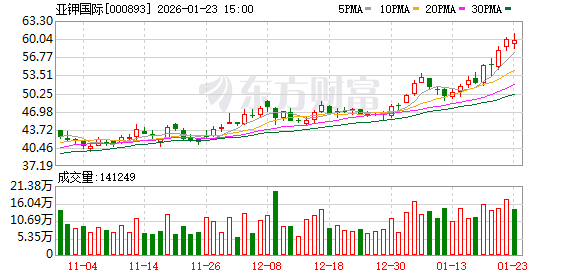
亚钾国际:预计2025年归属于上市公司股东的净利润16.6亿元~19.7亿元
Sou Hu Cai Jing· 2026-01-23 10:11
Core Viewpoint - The company, International Potash, forecasts a net profit attributable to shareholders of 1.66 billion to 1.97 billion yuan for 2025, representing a year-on-year growth of 75% to 107% [1] Group 1: Financial Performance - The company's operating performance has improved year-on-year, primarily due to stable production in its potash fertilizer production lines, leading to an increase in potash output compared to the same period last year [1] - The company has adopted a flexible and diversified sales strategy, focusing on both international and domestic markets, resulting in increased sales volume compared to the previous year [1] - The rise in both international and domestic potash fertilizer prices has positively impacted the company's sales prices, contributing to an increase in the gross profit margin of its potash fertilizer business year-on-year [1]
亚钾国际:预计2025年全年归属净利润盈利16.6亿元至19.7亿元
Sou Hu Cai Jing· 2026-01-23 09:03
Core Viewpoint - The company, Yara International, forecasts a net profit attributable to shareholders of between 1.66 billion to 1.97 billion yuan for the full year of 2025, driven by stable production and increased sales in both domestic and international markets [1] Group 1: Performance Overview - For the first three quarters of 2025, the company's main revenue reached 3.867 billion yuan, an increase of 55.76% year-on-year [1] - The net profit attributable to shareholders for the same period was 1.363 billion yuan, reflecting a significant year-on-year increase of 163.01% [1] - The company's net profit excluding non-recurring items was 1.362 billion yuan, up 164.56% year-on-year [1] Group 2: Quarterly Performance - In the third quarter of 2025, the company's single-quarter main revenue was 1.345 billion yuan, representing a year-on-year increase of 71.37% [1] - The net profit attributable to shareholders for the third quarter was 508 million yuan, showing a year-on-year increase of 104.69% [1] - The net profit excluding non-recurring items for the third quarter was 506 million yuan, up 105.0% year-on-year [1] Group 3: Operational Factors - The increase in performance is attributed to stable production of potash fertilizer, leading to a continuous rise in output compared to the previous year [1] - The company has adopted a flexible and diversified sales strategy, focusing on both domestic and international markets, resulting in increased sales volume [1] - The rise in potash fertilizer prices, both internationally and domestically, has positively impacted the company's sales prices and gross profit margins [1]
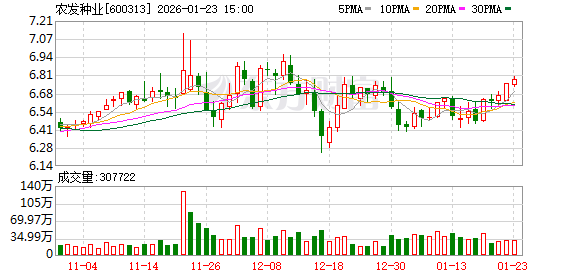
农发种业:预计2025年净利同比增长59.96%-79.15%
Zhong Guo Zheng Quan Bao· 2026-01-23 08:51
Group 1 - The company, Nongfa Seed Industry (600313), forecasts a net profit attributable to shareholders of 75 million to 84 million yuan for 2025, representing a year-on-year increase of 59.96% to 79.15% [2] - The company expects a non-recurring net profit of 19.19 million to 28.19 million yuan, recovering from a loss of 27.516 million yuan in the same period last year [2] - As of January 23, the company's price-to-earnings ratio (TTM) is approximately 87.35 to 97.83 times, with a price-to-book ratio (LF) of about 3.72 times and a price-to-sales ratio (TTM) of about 1.18 times [2] Group 2 - The company's main business includes the research, production, and sales of crop seeds, production and sales of pesticide products, fertilizer trading, and specialty grain order business [6] - The increase in performance is attributed to several factors: expansion of sales channels in the seed business, significant growth in revenue and profit in the fertilizer business due to active sourcing of imports, and improved market share in the pesticide business through enhanced production processes and cost reduction measures [6]

亚钾国际发预增,预计2025年度归母净利润16.6亿元至19.7亿元,同比增长75%至107%
Zhi Tong Cai Jing· 2026-01-23 08:45
智通财经APP讯,亚钾国际(000893.SZ)披露2025年度业绩预告,公司预计归属于上市公司股东的净利润 16.6亿元至19.7亿元,同比增长75%至107%;扣除非经常性损益后的净利润16.6亿元至19.7亿元,同比增 长86% 至121%。 报告期内,公司经营业绩同比上升,主要原因一是公司钾肥生产线稳定生产,钾肥产量较上年同期持续 提升。二是公司秉承着国际和国内双循环、境内外联动的弹性多元化销售策略,持续深耕国际及国内市 场,销量较上年同期也实现增长。三是受国际和国内钾肥价格上涨影响,公司钾肥销售价格同比上升, 公司钾肥业务毛利率同比上升。 ...
亚钾国际(000893.SZ)发预增,预计2025年度归母净利润16.6亿元至19.7亿元,同比增长75%至107%
智通财经网· 2026-01-23 08:35
报告期内,公司经营业绩同比上升,主要原因一是公司钾肥生产线稳定生产,钾肥产量较上年同期持续 提升。二是公司秉承着国际和国内双循环、境内外联动的弹性多元化销售策略,持续深耕国际及国内市 场,销量较上年同期也实现增长。三是受国际和国内钾肥价格上涨影响,公司钾肥销售价格同比上升, 公司钾肥业务毛利率同比上升。 智通财经APP讯,亚钾国际(000893.SZ)披露2025年度业绩预告,公司预计归属于上市公司股东的净利润 16.6亿元至19.7亿元,同比增长75%至107%;扣除非经常性损益后的净利润16.6亿元至19.7亿元,同比增 长86% 至121%。 ...