
智能家居

Search documents
刚刚,重磅利好!直线封板!
Zhong Guo Ji Jin Bao· 2025-11-26 07:17
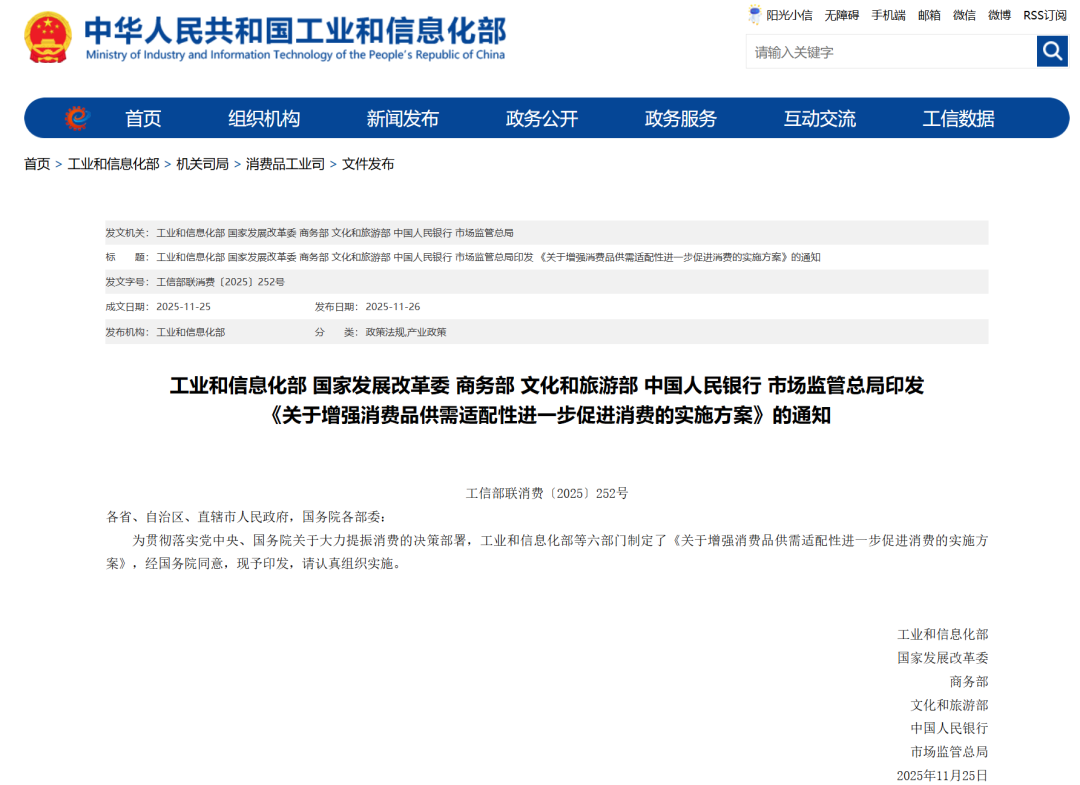
【导读】六部门联合印发《关于增强消费品供需适配性进一步促进消费的实施方案》 刚刚,消费领域迎来利好! 11月26日,工业和信息化部、国家发展改革委、商务部、文化和旅游部、中国人民银行、市场监管总局印发《关于增强消费品供需适配性进一步促进消费 的实施方案》(以下简称《方案》)。 | | 中华人民共和国工业和信息化部 | | | | 阳光小信 无障碍 手机端 邮箱 微信 微博 | RSS订阅 | | --- | --- | --- | --- | --- | --- | --- | | | Ministry of Industry and Information Technology of the People's Republic of China | | | | 请输入关键字 | Q | | | ల్ల 首页 组织机构 | 新闻发布 | 政务公开 | 政务服务 | 互动交流 工信数据 | | | | 首页 > 工业和信息化部 > 机关司局 > 消费品工业司 > 文件发布 | | | | | | | | 发文机关: 工业和信息化部 国家发展改革委 商务部 文化和旅游部 中国人民银行 市场监管总局 | | | | ...

促进消费新方案来了!
清华金融评论· 2025-11-26 07:01
Core Viewpoint - The article outlines a comprehensive plan to enhance the adaptability of supply and demand in consumer goods, aiming to significantly optimize the supply structure by 2027 and establish a high-quality development pattern by 2030, with a focus on cultural and high-quality consumer products [6][7]. Group 1: Key Tasks - The plan includes 19 key tasks across five main areas: expanding new increments, deepening existing stock, segmenting markets, empowering scenarios, and optimizing the environment [4]. - It emphasizes the acceleration of new technology and model innovation, including the promotion of flexible manufacturing and the integration of artificial intelligence in the consumer goods sector [8][9]. Group 2: Product Supply Enhancement - The plan aims to expand the supply of distinctive and new products, focusing on green products, rural consumption upgrades, and the development of leisure and sports products [10][11]. - It encourages innovation in health products and aims to enhance the influence of historical classic products, promoting traditional crafts and cultural heritage [11][12]. Group 3: Market Segmentation - The strategy includes precise matching of different demographic needs, such as enriching the supply of children's products, enhancing quality student supplies, and expanding fashionable "trendy" products [13][14]. - It also focuses on optimizing products for the elderly, ensuring comfort and functionality in elder care products [14][15]. Group 4: New Consumption Scenarios - The plan promotes the establishment of new consumption scenarios and business models, including the support for flagship stores and innovative retail formats [16]. - It encourages the development of platform consumption and shared consumption models, leveraging technology to enhance consumer experiences [16][17]. Group 5: Supportive Environment - The plan outlines measures to strengthen financial support for the consumer goods industry, including the promotion of consumption finance products and government procurement [17]. - It emphasizes the importance of maintaining market order and enhancing regulatory measures to ensure product quality and safety [18].

六部门:鼓励平台企业依法合规利用人工智能技术挖掘用户需求
Sou Hu Cai Jing· 2025-11-26 06:58
Core Viewpoint - The implementation plan aims to enhance the adaptability of supply and demand for consumer goods, with a target to optimize the supply structure by 2027 and establish a high-quality development pattern by 2030, contributing steadily to economic growth [1][12]. Group 1: Key Tasks - The plan outlines 5 main areas with 19 key tasks, including expanding new technologies and innovative applications, enhancing the supply of unique and new products, and accurately matching different consumer needs [2][3]. - It emphasizes the development of new consumption scenarios and business models, such as live e-commerce and instant retail, while encouraging the use of advanced technologies like AI and virtual reality [3][18]. - The plan also focuses on creating a favorable environment for development, including financial support and maintaining market order [2][19]. Group 2: Consumer Goods Supply - By 2027, the goal is to form three trillion-level consumption fields and ten hundred-billion-level consumption hotspots, creating high-quality consumer goods with cultural significance [10][12]. - The plan aims to expand the supply of diverse interest-based consumer products, including pet-related items, anime, and trendy clothing, while also promoting low-altitude tourism and automotive aftermarket consumption [4][17]. - There is a specific focus on enhancing the supply of quality student products and age-appropriate products for the elderly, including innovative educational tools and health monitoring devices [5][17]. Group 3: Market Segmentation - The plan seeks to enrich the supply of products for different demographics, such as children's products, quality student supplies, and fashionable items, while optimizing products for the elderly [2][17]. - It encourages the development of personalized and modular learning kits for students, as well as comfortable and functional products for the elderly [5][17]. Group 4: Innovation and Technology - The plan promotes the application of new technologies in consumer goods, focusing on sectors like smart connected vehicles, smart home devices, and green building materials [3][4]. - It aims to establish a series of pilot projects showcasing innovative products and companies, enhancing the overall consumer experience [3][14].

六部门发文提出2027年形成3个万亿级消费领域
Sou Hu Cai Jing· 2025-11-26 06:56
Core Viewpoint - The implementation plan aims to enhance the adaptability of supply and demand in consumer goods, targeting significant improvements in supply structure by 2027 and establishing a high-quality development pattern by 2030 [1][2] Group 1: Supply Structure Optimization - By 2027, the plan envisions a noticeable optimization in the supply structure of consumer goods, creating three trillion-level consumption sectors and ten hundred-billion-level consumption hotspots [1] - The focus is on leading industrial upgrades through consumption upgrades and achieving a dynamic balance between supply and demand [1] Group 2: Key Tasks and Areas of Focus - The plan outlines 19 key tasks across five areas: accelerating innovation in new technologies and models, expanding the supply of unique and new products, precisely matching diverse consumer needs, cultivating new consumption scenarios and business formats, and creating a favorable development environment [1] - Specific industries targeted include smart connected new energy vehicles, smart home products, consumer electronics, modern textiles, food, and green building materials [1] Group 3: Enhancing Existing Supply - The plan emphasizes the need to promote the expansion and iteration of green products, improve the quality of rural consumer goods, and significantly develop leisure and sports products [2] - It includes adapting to trends in green and low-carbon consumption, enhancing product efficiency standards, and focusing on new demands from event economies and outdoor activities [2] Group 4: Targeting Niche Markets - The plan aims to enrich the supply of baby and children's products, enhance quality student supplies, expand fashionable "trendy" products, and optimize products for the elderly [2] - It promotes the refined, quality, and intelligent development of baby and children's products, including the design of writing tools that protect vision and posture [2]
事关促消费,六部门印发重磅文件
财联社· 2025-11-26 06:56
工业和信息化部、国家发展改革委、商务部、文化和旅游部、中国人民银行、市场监管总局印发《关于增强消费品供需适配性进一步促进消 费的实施方案》。方案指出,到2027年,消费品供给结构明显优化,形成3个万亿级消费领域和10个千亿级消费热点,打造一批富有文化 内涵、享誉全球的高品质消费品。到2030年,供给与消费良性互动、相互促进的高质量发展格局基本形成,消费对经济增长的贡献率稳步 提升。 工业和信息化部 国家发展改革委 商务部 文化和旅游部 中国人民银行 市场监管总局印发《关于增强消费品供需适配性进一步促进消费的实 施方案》的通知 各省、自治区、直辖市人民政府,国务院各部委: 为贯彻落实党中央、国务院关于大力提振消费的决策部署,工业和信息化部等六部门制定了《关于增强消费品供需适配性进一步促进消费的 实施方案》,经国务院同意,现予印发,请认真组织实施。 工业和信息化部 国家发展改革委 商务部 文化和旅游部 中国人民银行 市场监管总局 2025年11月25日 / / 关于增强消费品供需适配性进一步促进消费的实施方案 / / 为贯彻落实党中央、国务院关于大力提振消费的决策部署,增强供给与需求的适配性,进一步释放消费潜力, ...

六部门:增强消费品供需适配性 进一步促进消费
智通财经网· 2025-11-26 06:50
Core Viewpoint - The implementation plan aims to enhance the adaptability of supply and demand for consumer goods, promoting consumption through various new business models and technologies [1][4]. Group 1: Overall Requirements - The plan is guided by Xi Jinping's thoughts and aims to achieve a dynamic balance between supply and demand, with a target of optimizing the supply structure of consumer goods by 2027 and establishing a high-quality development pattern by 2030 [5]. Group 2: Accelerating Innovation in New Technologies and Models - Focus on key industries such as smart connected vehicles, smart home, and green building materials, with initiatives to create flagship products and innovative enterprises [7]. - Promote flexible and customized manufacturing models, establishing a digital system that connects user demand with intelligent design and flexible production [7]. - Encourage the integration of artificial intelligence across the consumer goods sector, supporting the development of smart home products and digital art [8]. Group 3: Expanding Supply of Unique and New Products - Promote green products and set standards for energy efficiency and emissions, encouraging low-carbon consumption in various sectors [9]. - Support the upgrade of consumer goods in rural areas, enhancing infrastructure and promoting high-quality products [9]. - Develop leisure and sports products to meet new demands from events and outdoor activities [10]. Group 4: Precise Matching of Different Consumer Needs - Enhance the supply of baby and children's products, focusing on safety and quality [12]. - Improve the availability of quality student supplies, integrating traditional and smart products [12]. - Expand the supply of fashionable products, fostering independent designers and high-end brands [12]. Group 5: Cultivating New Consumption Scenarios and Business Models - Support the establishment of flagship stores and new concept stores, enhancing core business districts [14]. - Encourage the development of platform consumption models such as live e-commerce and instant retail, utilizing AI and other technologies [14]. - Promote shared consumption models in public spaces, ensuring quality and safety [14]. Group 6: Creating a Favorable Development Environment - Strengthen financial support for the consumer goods industry, enhancing the adaptability of financial services [15]. - Organize promotional activities to highlight quality consumer goods and brands [15]. - Maintain market order by addressing issues like local protectionism and ensuring product safety standards [16].
云鲸中国区负责人王俊刚已于近期离职
3 6 Ke· 2025-11-26 03:08
Core Insights - Cloud Whale faces significant pressure in 2025 with established competitors ahead and emerging challengers behind [4] - The recent unexpected departure of Wang Jun, the head of Cloud Whale's China operations, may impact the company's market momentum [2][3] Company Performance - Cloud Whale experienced rapid growth over the past year, with sales exceeding 1.7 billion during the 2024 Double 11 shopping festival, marking a 200% year-on-year increase [3] - In the third quarter of 2025, Cloud Whale held a 14.7% market share in China's online vacuum cleaner market, ranking fourth behind Ecovacs, Roborock, and Xiaomi [3] Competitive Landscape - Established players like Ecovacs and Roborock have developed mature production and sales networks, maintaining a strong market presence [4] - Emerging competitors such as Chasing Technology are gaining traction among younger consumers through cost-effective products and rapid iterations [4] - Companies like Lianlaifen and DJI are diversifying into the vacuum cleaner and floor washing machine markets, intensifying competition [4] Future Challenges - Cloud Whale is at a critical juncture, having initiated Pre-IPO financing, with its market performance directly influencing future capital market actions [4] - The company must focus on maintaining stability and continuous growth to meet upcoming challenges in the competitive landscape [4]
匠心家居股价涨5.09%,人保资产旗下1只基金重仓,持有1.31万股浮盈赚取6.5万元
Xin Lang Cai Jing· 2025-11-26 02:37
Group 1 - The core viewpoint of the news is that Jiangxin Home has seen a stock price increase of 5.09%, reaching 102.36 CNY per share, with a total market capitalization of 22.393 billion CNY [1] - Jiangxin Home specializes in the research, design, production, and sales of smart electric sofas, smart electric beds, and their core components, with the main revenue sources being smart electric sofas (78.76%), components (12.06%), smart electric beds (8.34%), and others (0.84%) [1] Group 2 - According to data, a fund under Renbao Asset holds a significant position in Jiangxin Home, with Renbao Transformation Mixed A (005953) owning 13,100 shares, accounting for 1.97% of the fund's net value, ranking as the eighth largest holding [2] - The fund has achieved a year-to-date return of 21.95% and a one-year return of 25.29%, with a total fund size of 57.9317 million CNY [2] Group 3 - The fund manager of Renbao Transformation Mixed A is Liu Shikai, who has been in the position for 1 year and 69 days, with the fund's total asset size at 1.858 billion CNY [3] - During Liu's tenure, the best fund return was 48.5%, while the worst was -3.22% [3]
25天升级40年老宅!海尔智慧家庭亮相浙江省“好房子”展
Quan Jing Wang· 2025-11-25 09:38
Core Insights - The article highlights the increasing demand for home-based elderly care in China, where over 90% of the elderly population prefers to age at home, yet faces challenges such as outdated housing facilities and safety concerns [1] - Haier Smart Home showcased a comprehensive elderly care solution at the 2025 Zhejiang "Good House" exhibition, demonstrating a model home that integrates elderly-friendly design, smart health management, and health monitoring [1][3] Group 1: Smart Home Features - The smart home model offers seamless interaction and proactive services, such as automatic lighting upon entry, voice-controlled furniture, and kitchen safety features like automatic gas shut-off and smoke detection [2] - Safety is prioritized with a barrier-free design and thoughtful living space layout, including supportive furniture and safety features in kitchens and bathrooms to assist elderly residents [2] - Space efficiency is enhanced through multifunctional furniture, allowing for flexible use of small living areas, such as convertible coffee tables and integrated storage solutions [2] Group 2: Upgrade Efficiency - Haier Smart Home utilizes prefabricated interior design technology to achieve a complete home upgrade in just 25 days, addressing the lengthy renovation times typical of traditional methods [3] - The upgrade process is designed to minimize noise and disruption, making it easier for elderly residents to remain in their homes during renovations [3] - The showcased model not only addresses current elderly care needs but also sets a direction for the future of home-based elderly care solutions in the industry [3]


海尔智慧家庭与奇瑞瑞享生活共筑“人-车-家”互联生态
Quan Jing Wang· 2025-11-25 09:29
Core Insights - The collaboration between Haier Smart Home and Chery's Rui Xiang Life aims to create a seamless "human-vehicle-home" interconnected ecosystem, enhancing smart living experiences across different environments [1][3] - The UhomeCar platform by Haier Smart Home extends smart services from home to travel, allowing for proactive management of home environments while on the road [2][3] Group 1: Strategic Collaboration - Haier Smart Home and Chery Rui Xiang Life have officially signed a strategic agreement to build a smart ecosystem alliance [1] - This partnership seeks to eliminate barriers between travel and home scenarios, enabling uninterrupted smart services across vehicles and home environments [1][3] Group 2: Technological Integration - Haier Smart Home leverages its UhomeCar platform to provide integrated smart services, such as pre-conditioning home environments while driving [2] - The platform's architecture includes standardized protocols, functional sets, and decision models, facilitating efficient data communication and proactive service delivery [2] Group 3: Industry Impact - The partnership signifies a maturation of the all-scenario smart ecosystem, enhancing the quality of smart living experiences for millions of users [3] - Haier Smart Home's role as the creator of the UhomeCar platform positions it as a leader in breaking down scenario boundaries through collaboration with major automotive companies [3]
