
花卉种植

Search documents
新疆和田地区坚持“生态产业化、产业生态化”发展路径:沙漠种玫瑰 治沙又致富
Ren Min Ri Bao· 2025-09-15 04:18
Core Insights - The article highlights the successful integration of rose cultivation in the desert region of Xinjiang, which not only contributes to ecological restoration but also enhances local economic development [1][2][3] Group 1: Economic Impact - The rose cooperative in Yutian County has expanded to cultivate 30,000 acres of roses, providing stable employment for over 30 villagers [1] - The expected rose production in Yutian County for 2024 is over 12,000 tons, with an average output value of 3,975 yuan per acre, benefiting 4,238 households [2] - The total output value of rose cultivation in the Hotan region reached 110 million yuan last year, with projections exceeding 284 million yuan this year [3] Group 2: Ecological Benefits - The Yutian desert rose has a unique growth pattern that helps stabilize sand dunes and improve the ecological environment by reducing wind erosion [2] - The planting of 100,000 rose plants contributed to the ecological restoration efforts along the edge of the Taklamakan Desert [1] Group 3: Industry Development - The rose industry has diversified from simple cultivation to include over 70 derivative products, such as essential oils and rose tea, marketed through a cooperative-e-commerce-farmer model [2] - The Hotan region is also developing other medicinal plants, with a total planting area of 740,000 acres, contributing to a comprehensive agricultural industry chain [3]
沙漠种玫瑰 治沙又致富(砥砺奋进七十载 天山南北谱华章)
Ren Min Ri Bao· 2025-09-15 00:27
Core Insights - The article highlights the development path of the Hotan region in Xinjiang, focusing on the integration of ecological sustainability and economic growth through the cultivation of desert roses [1][2]. Group 1: Ecological and Economic Impact - The cultivation of the Yutian desert rose effectively stabilizes shifting sands and improves the local ecology, with 100,000 rose plants planted in a desert area to combat sand encroachment [2]. - The rose planting area in Hotan has expanded significantly, with an expected production of over 12,000 tons in 2024, generating an average output value of 3,975 yuan per mu, benefiting 4,238 households [2][3]. - The region's total rose planting area reached 85,700 acres, with a reported output value of 110 million yuan last year, projected to exceed 284 million yuan this year [3]. Group 2: Industry Development and Diversification - The rose industry has evolved from simple cultivation to diversified deep processing, producing over 70 derivative products such as essential oils, flower tea, and rose-flavored bread, marketed through a "cooperative + e-commerce + farmers" model [2][3]. - The Hotan region is also focusing on differentiated development with other desert plants, such as medicinal herbs, covering 740,000 acres, contributing to a shift from "sand harm" to "sand benefit" [3]. - The establishment of two traditional Chinese medicine industrial parks and four large-scale planting bases is part of a broader strategy to create an integrated industry chain from planting to processing and sales, providing stable employment for 12,600 people and flexible jobs for 53,500 others [3].
新疆和田地区坚持“生态产业化、产业生态化”发展路径 沙漠种玫瑰 治沙又致富(砥砺奋进七十载 天山南北谱华章)
Ren Min Ri Bao· 2025-09-14 22:09
Core Insights - The article highlights the successful integration of rose cultivation in the agricultural practices of the Yutian County, Xinjiang, which not only contributes to ecological restoration but also enhances local economic development [1][3][4] Group 1: Economic Impact - The Yutian County rose production is projected to exceed 12,000 tons in 2024, with an average output value of 3,975 yuan per mu, benefiting 4,238 households [2] - The total rose planting area in the Hotan region has reached 85,700 acres, generating a revenue of 110 million yuan last year, with expectations to surpass 284 million yuan this year [3] - The rose industry has diversified from simple cultivation to over 70 derivative products, including essential oils and rose tea, marketed through a "cooperative + e-commerce + farmers" model [2] Group 2: Ecological Benefits - The Yutian desert rose has a rapid growth rate, forming flower ridges that can effectively block wind and reduce soil erosion, contributing to ecological stability [2] - The planting of 100,000 rose plants was part of a successful ecological restoration effort along the edge of the Taklamakan Desert, showcasing the dual benefits of sand control and economic gain [1][2] Group 3: Community Development - The rose cultivation initiative has created stable employment for 12,600 individuals and flexible job opportunities for 53,500 people in the region [3] - The integration of rose elements into local landscape design has enhanced the aesthetic appeal of rural areas, promoting eco-tourism and community engagement [2][3]
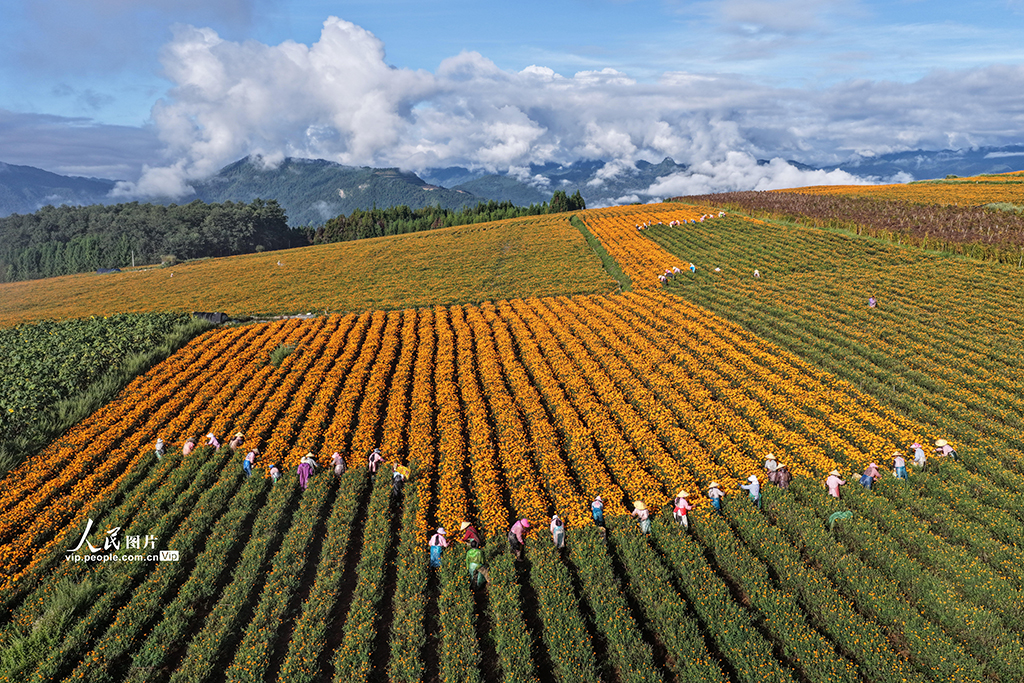
云南腾冲:采收万寿菊
Ren Min Wang· 2025-09-06 02:52
Group 1 - The core viewpoint of the article highlights the harvesting of marigold flowers in Tengchong, Yunnan, which is a significant agricultural activity in the region [1][2][3] Group 2 - The marigold flowers are primarily cultivated for their medicinal properties and are used in various industries, including cosmetics and pharmaceuticals [1][2] - The harvesting process involves local farmers who have been engaged in this activity for several years, contributing to the local economy [2][3] - The article emphasizes the importance of sustainable agricultural practices in the cultivation of marigold flowers to ensure long-term viability [1][3]

北京通州建设林下宿根花卉基因库
Zhong Guo Zi Ran Zi Yuan Bao· 2025-09-04 22:53
Core Insights - The project in Tongzhou, Beijing, aims to establish the first comprehensive resource library and demonstration park for perennial flowers in the Beijing-Tianjin-Hebei region, integrating research, production, education, and tourism [1] Group 1: Project Overview - The project plans to construct a multifunctional park within three years, including a germplasm resource nursery, a parent material nursery, a science popularization display area, and an under-forest flower production base [1] - Currently, 233 varieties of perennial flowers have been introduced, and the germplasm and parent material nurseries have been initially established [1] Group 2: Production and Education - Over 10 advantageous varieties have been selected from the resource nurseries, with mass production set to begin in September, supplying seedlings directly for the construction of scenic landscapes across 10,000 acres [1] - The park is also focusing on the color control technology of hydrangeas to enhance the seasonal flower sea in the Peony Garden of Huaxian, while launching educational tours to promote practical science education on perennial flowers [1]
今年前7月云南出口鲜切花6.3亿元
Zhong Guo Xin Wen Wang· 2025-08-27 14:17
Core Insights - In the first seven months of this year, Yunnan's export of fresh-cut flowers reached 630 million RMB, making it the largest exporter in China [1][2] - The main export destinations include the Philippines, Russia, Kazakhstan, Australia, and Japan [1] - Yunnan has become a global hub for flower production due to its unique geographical advantages and industry innovation [1] Export Process and Quality Assurance - Fresh-cut flowers undergo multiple processes including harvesting, quality inspection, grading, and packaging, where time is critical to maintain quality [1] - The implementation of a "batch inspection and quarantine" reform by customs allows over 80% of fresh-cut flowers to be quickly released, reducing operational costs by more than 5% [1] - The new regulatory model reduces on-site inspection frequency, enabling eligible batches of fresh-cut flowers to complete the declaration, release, and certification processes within 30 minutes, saving an average of 2 to 3 days in time costs per batch [2]
粤桂协作在上林:一朵花中见真情
Nan Fang Nong Cun Bao· 2025-08-27 01:01
Core Viewpoint - The collaboration between Guangdong and Guangxi provinces is a significant initiative to deepen cooperation between eastern and western regions, promoting coordinated regional development [2][3]. Group 1: Overview of Guangdong-Guangxi Cooperation - Guangdong-Guangxi cooperation has achieved remarkable results in areas such as industrial collaboration, talent exchange, and consumer assistance [3][4]. - The year 2023 marks the final year of the five-year transition period for consolidating and expanding poverty alleviation achievements and effectively linking them with rural revitalization [3][4]. Group 2: Agricultural Development in Shanglin County - Shanglin County has established a modern agricultural industrial park focused on flower cultivation, featuring various flower species such as butterfly orchids and red palms [6][10]. - The total investment in the flower rural revitalization modern agricultural industrial park is 460 million yuan, with projected sales of 183 million yuan in 2024 [12][31]. - The park aims to integrate breeding, cold chain storage, e-commerce, and logistics, creating a modern flower industry cluster [27][30]. Group 3: Economic Impact and Employment - The flower industry in Shanglin County is expected to produce 4 million butterfly orchid seedlings, 2 million premium orchids, and 9 million potted orchids, generating an annual output value of 270 million yuan [32][33]. - The introduction of the largest orchid research and breeding company in Guangxi has led to the establishment of several other flower enterprises, creating an industrial cluster effect [49][51]. - The company has reported an annual average collective economic dividend of 900,000 yuan and aims for a production value of 80 million yuan in the current year [54][56]. Group 4: Integration of Agriculture and Tourism - The triangle plum, a key flower variety in Shanglin, is becoming a vital link between agriculture and tourism, with plans for a 1,500-acre mother plant garden and a 1,200-acre collection area [63][65]. - The project is expected to generate over 30 million yuan in output value and attract more than 100,000 visitors annually, contributing to local employment [66][68]. Group 5: Future Development and Strategy - The park will implement a "smart flower industry" model, integrating artificial intelligence with flower cultivation, aiming to create a comprehensive ecosystem from planting to sales [34][35]. - The strategy focuses on digitalization, standardization, and moderate scaling to enhance the overall value chain of the flower economy [37][48].

广州花卉:“美丽产业”织就“美丽经济”
Nan Fang Nong Cun Bao· 2025-08-25 16:03
Core Viewpoint - The flower industry in Guangzhou is experiencing significant growth, with a focus on high-quality development and digital transformation, aiming to enhance its global competitiveness and economic contribution [3][30][92]. Industry Overview - Guangzhou's flower planting area accounts for approximately 30% of the province, with an estimated area of 320,000 acres and a transaction value exceeding 15 billion yuan in 2024 [3][30]. - The Lingnan flower market has a daily sales volume of 200,000 to 300,000 fresh-cut flowers, with an annual transaction value exceeding 2 billion yuan [4]. Development Initiatives - In 2024, a proposal for promoting high-quality development in the flower industry was prioritized by the Guangzhou Municipal People's Congress [6]. - A three-year action plan (2024-2026) was established to maintain a flower production area of around 340,000 acres and achieve a total industry chain value of 40 billion yuan by 2026, with the primary industry value reaching 10 billion yuan [9][10]. Technological and Market Innovations - The city is focusing on creating a "Silicon Valley" for flower breeding, collaborating with top research institutions to develop new varieties [46][50]. - In 2024, 66 new flower varieties received national authorization, and 51 varieties passed provincial evaluation, showcasing Guangzhou's leadership in flower breeding [48][52]. Digital Transformation - The city is implementing digital marketing strategies, including the "cloud flower market," which connects growers and buyers through interactive platforms [72][74]. - Online sales have surged, with platforms like Douyin seeing a 50% increase in orders, contributing to 1.5 billion yuan in online sales, accounting for 8% of the national market [80][86]. Economic Impact - The flower industry is becoming a vital part of rural revitalization, with significant contributions to local economies and job creation [29][92]. - The establishment of a representative contact point for the flower industry in Conghua District aims to enhance market competitiveness and inject new momentum into local economic development [32][40].
以“绿”生“金”,海南自贸港绿色账本“提现”了
Hai Nan Ri Bao· 2025-08-25 12:40
Group 1: Economic Contributions of Agriculture and Forestry - The integration of holly leaves cultivation under rubber trees in Hainan has generated over 8 million yuan in annual income for local farmers, with each household earning approximately 10,000 yuan per year [1] - Hainan's forestry production value reached 5.68 billion yuan in the first half of the year, marking an 18% year-on-year increase, contributing to a 0.7 percentage point growth in the province's agricultural sector [1] - The total area of flower and tree planting in Hainan reached approximately 140,100 acres, with a production value of about 2.58 billion yuan in the first half of the year [3] Group 2: Development of Specialty Industries - The establishment of 12 large-scale orchid planting bases in Hainan has made it the largest single area for orchid cultivation in the country, accounting for one-fourth of the national total [2] - Hainan's tropical flower industry is experiencing rapid growth, with the introduction of tax incentives under the free trade port policy significantly boosting innovation and research investments in the sector [3] Group 3: Underutilized Land and Economic Potential - Hainan has identified 8.766 million acres of land suitable for developing under-forest economies, indicating significant potential for agricultural diversification [5] - The area dedicated to under-forest economic development increased by 300,000 acres in the first half of the year, nearing the total output value of the previous year [5] Group 4: Ecological Restoration and Tourism - Hainan's ecological restoration efforts have led to the successful growth of red mangrove trees, enhancing coastal protection and biodiversity [6] - The province recorded 28.62 million visits to forest tourism sites, generating 2.241 billion yuan in revenue, while forest wellness tourism attracted 8.02 million visitors, contributing 780 million yuan [7] Group 5: Future Development Plans - Hainan aims to complete 430,000 acres of afforestation and 5.1 million acres of forest maintenance by the end of the year, while also focusing on the development of the forestry industry [8] - The province has planned 42 various forestry industry investment projects, achieving a signed investment amount of 1.51 billion yuan in the first half of the year, exceeding annual targets [8]
菏泽牡丹成为增收“富贵花”
Ren Min Wang· 2025-08-25 10:17
Core Viewpoint - The cultivation of peony in Heze, Shandong Province, has become a significant source of income for local farmers, contributing to rural revitalization and economic growth through both oilseed and ornamental peony production [1][5][6]. Group 1: Peony Cultivation and Economic Impact - The cooperative manages over 5,000 acres of peony, primarily focusing on oilseed peony, which has two main uses: oil extraction and seedling production [1]. - The income from one acre of peony seedling cultivation can reach approximately 40,000 yuan, while the processed peony oil is sold by weight, becoming a popular item in households [1]. - The annual sales revenue from the Tianxiang Qingcheng Agricultural Planting Cooperative exceeds 30 million yuan, significantly benefiting local villagers [4]. Group 2: Employment and Community Benefits - Local villagers, such as Li Jilai, have transitioned to industrial workers within the cooperative, enjoying stable employment and regular wages [2]. - The cooperative's operations have led to increased income for surrounding villagers, with reported earnings exceeding 5 million yuan [4]. Group 3: Market Demand and Pricing - The price of five-year-old peony seedlings has increased from around 160 yuan to over 500 yuan, reflecting the growing market demand [5]. - Fresh-cut peonies are now in high demand, with domestic prices ranging from 6 to 8 yuan per stem, and international sales fetching even higher prices [4]. Group 4: Historical and Cultural Significance - Heze has a long history of peony cultivation, known for its reputation as "the best in the world," which supports the region's agricultural identity and economic strategy [6].