军工电子

Search documents
军工ETF(512660)盘中回调,资金逢回调布局,近5日净流入超3.4亿元,规模居同类第一,覆盖海陆空天信全产业链
Mei Ri Jing Ji Xin Wen· 2025-11-18 02:35
(文章来源:每日经济新闻) 申万宏源表示,军贸有望开启供需共振大格局:随着全球地缘政治不确定性增加,全球军贸需求不断扩 大,国际军贸市场发生新的格局变化。而随着产品迭代加快且体系能力强化,我国产品性能和供给能力 获得高度认可,中国潜在需求明显扩大,中东、亚洲等市场订单催化不断,所以预计我国军贸的需求与 供给将会持续强烈共振,从而造就中国军贸未来大格局。 军工ETF(512660)跟踪的是中证军工指数(399967),该指数从沪深市场中选取涉及航空、航天、船 舶、兵器及军事电子等领域的上市公司证券作为指数样本,以反映中国军工行业上市公司证券的整体表 现。指数成分股呈现中小盘风格,主要聚焦于航空装备与军工电子行业。 ...

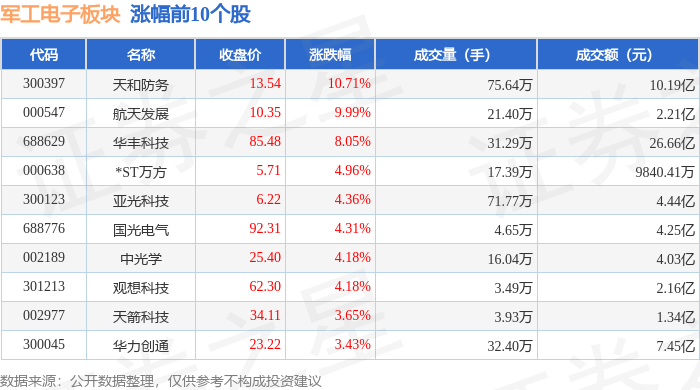
军工电子板块11月17日涨1.46%,天和防务领涨,主力资金净流入5.05亿元
Zheng Xing Xing Ye Ri Bao· 2025-11-17 08:53
Core Viewpoint - The military electronics sector experienced a rise of 1.46% on November 17, with Tianhe Defense leading the gains, while the overall Shanghai Composite Index fell by 0.46% [1] Group 1: Stock Performance - Tianhe Defense (300397) closed at 13.54, up 10.71% with a trading volume of 756,400 shares and a transaction value of 1.019 billion [1] - Aerospace Development (000547) closed at 10.35, up 9.99% with a trading volume of 214,000 shares and a transaction value of 221 million [1] - Huafeng Technology (688629) closed at 85.48, up 8.05% with a trading volume of 312,900 shares and a transaction value of 2.666 billion [1] - Other notable performers include ST Wanfang (000638) up 4.96%, Yaguang Technology (300123) up 4.36%, and Guoguang Electric (688776) up 4.31% [1] Group 2: Capital Flow - The military electronics sector saw a net inflow of 505 million from institutional investors, while retail investors experienced a net outflow of 446 million [2][3] - Major stocks with significant net inflows include Tianhe Defense with 64.29 million and Aerospace Development with 10 million [3] - Conversely, stocks like Shanghai Hanyun and Huafeng Technology faced net outflows from retail investors, indicating a mixed sentiment among different investor classes [3]



军工ETF(512660)涨超1.7%,近5日净流入超1.7亿元,规模居同类第一,覆盖海陆空天信全产业链
Mei Ri Jing Ji Xin Wen· 2025-11-17 05:25
Core Viewpoint - The commissioning of China's first electromagnetic catapult aircraft carrier, Fujian, on November 7, showcases advanced electromagnetic launch technology and highlights breakthroughs in domestic aviation equipment [1] Industry Summary - The military industry sector is experiencing a reduction in the trend of passive capital outflows, coupled with strong demand recovery expectations for 2025-2026, indicating a positive outlook for capital flow [1] - The military industry is expected to benefit significantly from multiple catalysts, including the approaching 14th Five-Year Plan, the centenary of the military, and military trade development, leading to substantial growth in both domestic and international demand from 2025 to 2027 [1] - The military equipment sector, particularly aviation equipment, is poised to see significant benefits from the upcoming new prosperity cycle [1] ETF and Index Summary - The military ETF (512660) tracks the CSI Military Index (399967), which selects listed companies in aviation, aerospace, shipbuilding, weaponry, and military electronics to reflect the overall performance of China's military industry [1] - The index components exhibit a small and medium-cap style, primarily focusing on the aviation equipment and military electronics sectors [1] - As of November 14, 2025, the military ETF has a scale of 14.12 billion, ranking first among 12 similar products [2]
通用航空ETF基金(561660)军工权重占比77%,盘中上涨1.41%
Sou Hu Cai Jing· 2025-11-17 02:28
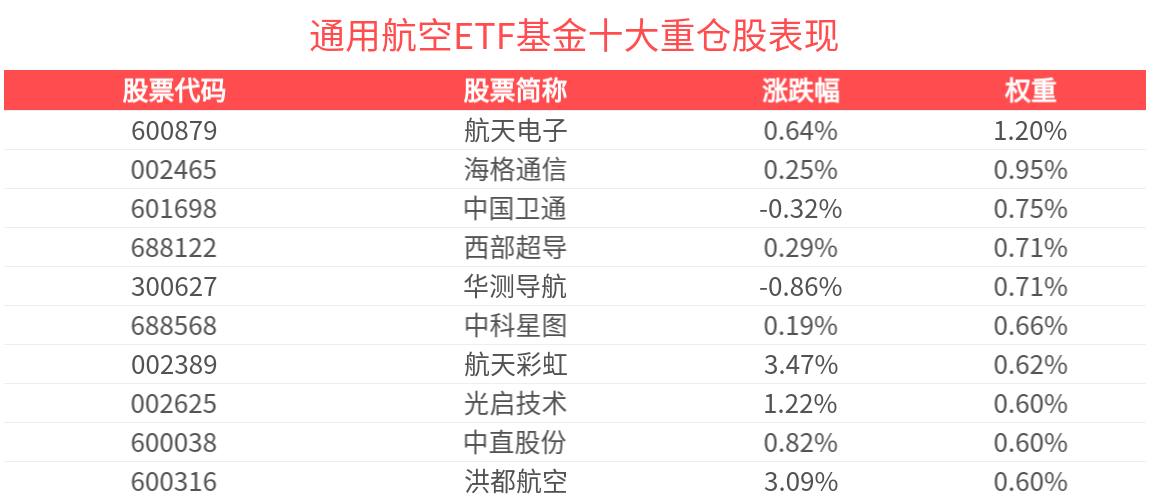
Core Insights - The General Aviation ETF closely tracks the CSI General Aviation Theme Index, with military industry stocks accounting for 76.9% of the index composition [1] - The CSI General Aviation Theme Index includes 50 listed companies involved in aviation materials and components, general aviation aircraft manufacturing, infrastructure, operations, and applications [1] - As of November 17, 2025, the CSI General Aviation Theme Index rose by 1.10%, with notable stock performances from companies like Morningstar Aviation (up 13.49%) and Zhong UAV (up 5.75%) [1] Group 1 - The top ten weighted stocks in the CSI General Aviation Theme Index as of October 31, 2025, include Aerospace Electronics, Haige Communication, China Satellite Communications, and others, collectively accounting for 40.97% of the index [2] - The performance of individual stocks within the top ten includes Aerospace Electronics at 0.64% increase and China Satellite Communications at a decrease of 0.32% [4] - The General Aviation ETF (561660) increased by 1.41%, with the latest price reported at 1 yuan [1]
雷电微力11月14日获融资买入1684.20万元,融资余额6.70亿元
Xin Lang Cai Jing· 2025-11-17 01:29
Core Viewpoint - 雷电微力's financial performance shows a significant decline in revenue and net profit for the first nine months of 2025, indicating potential challenges in the company's operations and market conditions [2]. Group 1: Financial Performance - As of September 30, 2025, 雷电微力 reported a revenue of 690 million yuan, a year-on-year decrease of 41.10% [2]. - The net profit attributable to shareholders for the same period was 157 million yuan, reflecting a year-on-year decline of 58.07% [2]. - Cumulative cash dividends since the A-share listing amount to 251 million yuan, with 232 million yuan distributed over the past three years [2]. Group 2: Shareholder and Market Activity - The number of 雷电微力 shareholders decreased to 35,500, a reduction of 7.02% compared to the previous period [2]. - The average number of circulating shares per shareholder increased by 7.55% to 5,852 shares [2]. - As of September 30, 2025, the top ten circulating shareholders include new entrant Hong Kong Central Clearing Limited, holding 1.83 million shares, while other significant shareholders have reduced their holdings [2]. Group 3: Financing and Trading Activity - On November 14, 雷电微力's stock price fell by 0.46%, with a trading volume of 112 million yuan [1]. - The financing buy-in for the day was 16.84 million yuan, with a net buy of 1.83 million yuan, indicating low financing activity relative to the past year [1]. - The total margin trading balance reached 673 million yuan, with the financing balance accounting for 5.98% of the circulating market value, which is below the 10% threshold for the past year [1].
北京雷科防务科技股份有限公司2025年第一次临时股东大会决议公告
Shang Hai Zheng Quan Bao· 2025-11-14 19:13
Core Points - The company held its first extraordinary general meeting of shareholders in 2025 on November 14, 2025, with a combination of on-site and online voting [4][5][6] - All resolutions proposed during the meeting were approved without any dissenting votes [2][3] Group 1: Meeting Details - The meeting was held at the company's conference room located at 6 Yuan Da South Street, Haidian District, Beijing [5] - A total of 879 shareholders and their proxies attended the meeting, representing 136,351,632 shares, which is 10.3533% of the total shares [6] - The meeting was presided over by the chairman, Mr. Gao Lining, and complied with relevant laws and regulations [5][21] Group 2: Voting Results - Proposal 1: The resolution to cancel the supervisory board and amend the Articles of Association was approved with 132,158,699 votes in favor, accounting for 96.9249% of the valid votes [10] - Proposal 2: The amendment to the Rules of Procedure for Shareholders' Meetings was approved with 130,661,792 votes in favor, representing 95.8271% of the valid votes [12] - Proposal 3: The amendment to the Rules of Procedure for Board Meetings was approved with 130,693,292 votes in favor, which is 95.8502% of the valid votes [14] - Proposal 4: The establishment of a Compensation Management System for Directors and Senior Management was approved with 131,946,399 votes in favor, accounting for 96.7692% of the valid votes [17] - Proposal 5: The appointment of an accounting firm was approved with 132,780,299 votes in favor, representing 97.3808% of the valid votes [19] Group 3: Legal Opinions - The lawyers from Beijing Wanshang Tianqin Law Firm confirmed that the meeting's procedures complied with the Company Law and other relevant regulations, and the resolutions passed were legally valid [21]

公司问答丨振华风光:目前已有6款产品可应用于T/R组件 部分已开始小批量订货
Ge Long Hui A P P· 2025-11-14 09:05
Core Viewpoint - The company has achieved mass production of T/R chips and received pre-orders from 12 military units, indicating strong demand in the industry and a positive outlook for future orders [1] Group 1: Production and Delivery - The delivery cycle for T/R chips has been extended to 12-18 months, reflecting overall industry demand growth and current supply chain conditions [1] - The company has six products applicable to T/R components, with some already starting small batch orders [1] Group 2: Capacity and Supply Chain Management - The company plans to continuously optimize its capacity layout and supply chain management to ensure order delivery [1]

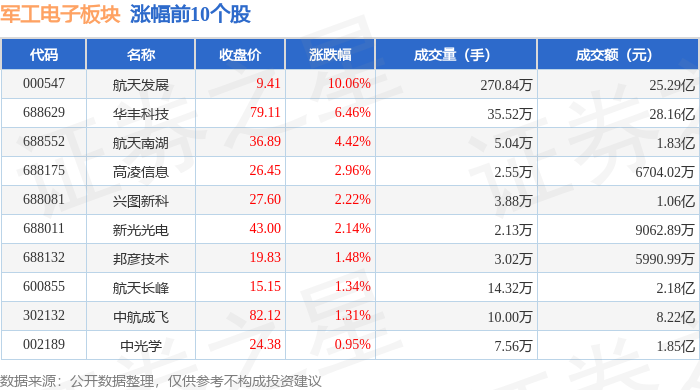
军工电子板块11月14日跌0.25%,国光电气领跌,主力资金净流入11.2亿元
Zheng Xing Xing Ye Ri Bao· 2025-11-14 08:58
Core Viewpoint - The military electronics sector experienced a decline of 0.25% on November 14, with Guoguang Electric leading the drop. The Shanghai Composite Index closed at 3990.49, down 0.97%, while the Shenzhen Component Index closed at 13216.03, down 1.93% [1]. Group 1: Stock Performance - Aerospace Development (000547) saw a significant increase of 10.06%, closing at 9.41, with a trading volume of 2.7084 million shares [1]. - Huafeng Technology (688629) rose by 6.46%, closing at 79.11, with a trading volume of 355,200 shares and a transaction amount of 2.816 billion [1]. - Guoguang Electric (688776) experienced a notable decline of 9.42%, closing at 88.50, with a trading volume of 65,000 shares and a transaction amount of 591 million [2]. Group 2: Capital Flow - The military electronics sector saw a net inflow of 1.12 billion from institutional investors, while retail investors experienced a net outflow of 505 million [2][3]. - Aerospace Development (000547) had a net inflow of 738 million from institutional investors, representing 29.19% of its total trading volume [3]. - Huafeng Technology (688629) recorded a net inflow of 424 million from institutional investors, accounting for 15.04% of its total trading volume [3].

十五五开局之年,关注订单增长与军贸提速 - 2026年度国防军工行业策略报告
2025-11-14 03:48
Summary of Key Points from the Conference Call Industry Overview - The defense and military industry in China has shown significant growth, with revenue reaching 451.1 billion yuan in the first three quarters of 2023, representing a year-on-year increase of 31.8% [1][2][3] - The military electronics sector experienced a remarkable growth rate of 81%, while naval equipment grew by 70%, indicating a strong demand for shipbuilding and risk diversification in the manufacturing sector [1][2][5] Core Insights and Arguments - The defense budget for 2025 is expected to increase by over 7%, accounting for approximately 7% of GDP, primarily allocated for military readiness, barrack construction, and weaponry, with weapons accounting for about 45% to 55% of the budget [1][3][5] - China's military exports have diversified from light weapons to advanced vessels and fighter jets, with plans to transfer drone production lines to friendly nations, enhancing local production capabilities [1][6][4] - The Chinese military aims to achieve several strategic goals: becoming a strong military by 2027, a global military power by 2035, and a world-class power by 2050, necessitating significant upgrades in weaponry and equipment [1][7][8] Performance of Sub-sectors - Different sub-sectors within the defense industry have varied performances: aerospace grew by 7%, aviation declined by 2%, ground equipment increased by 21%, naval equipment surged by 70%, and military electronics soared by 81% [2][5] - The naval equipment sector's revenue and profit growth reflects the development of the shipbuilding industry, with Chinese manufacturers seeking alternative suppliers due to U.S. restrictions on new contracts [5] Military Trade Developments - China's military exports have expanded significantly, with a focus on advanced military hardware and a shift towards exporting complete production lines rather than just individual products [6][4] - New fighter jets like the J-20E, J-20S, and the upcoming J-35 are expected to enhance China's competitiveness in the international military market [6] Future Military Modernization Goals - The Chinese Air Force aims to achieve a world-class operational capability by 2035, with a projected fleet of over 100 advanced fighter jets, including J-20, J-35, J-16, and J-15, along with the development of unmanned systems [1][10][8] - The modernization strategy includes converting retired J-6 aircraft into drones to establish a comprehensive unmanned combat system [10] Technological Advancements - Significant advancements in electromagnetic catapult technology have been achieved, with over 6,000 successful tests of new systems, showcasing China's leading position in this area [3][36] - The development of nuclear-powered aircraft carriers is progressing, with a mature nuclear power system that enhances safety and reduces maintenance costs [40] Impact of Military Trade on Financial Performance - Military trade significantly impacts the financial performance of defense companies, with net profit margins potentially increasing from 5% to 15%-20% upon securing contracts [54] Overall Industry Outlook - The defense sector is expected to continue its growth trajectory in 2026, driven by genuine and sustained demand, despite some companies potentially underperforming [55]
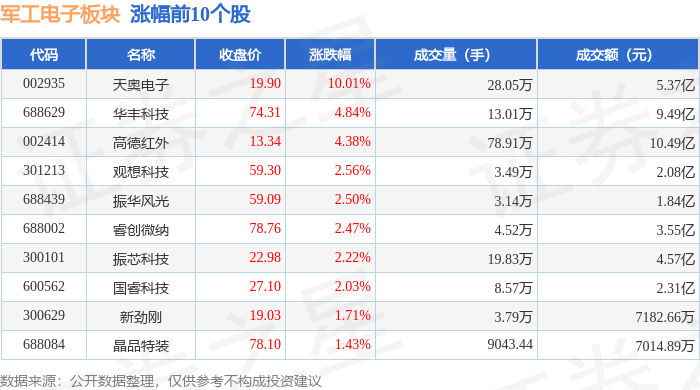
军工电子板块11月13日涨0.75%,天奥电子领涨,主力资金净流出1.74亿元
Zheng Xing Xing Ye Ri Bao· 2025-11-13 08:45
Market Overview - The military electronics sector increased by 0.75% on November 13, with Tianao Electronics leading the gains [1] - The Shanghai Composite Index closed at 4029.5, up 0.73%, while the Shenzhen Component Index closed at 13476.52, up 1.78% [1] Stock Performance - Tianao Electronics (002935) closed at 19.90, up 10.01% with a trading volume of 280,500 shares and a transaction value of 537 million [1] - Huafeng Technology (688629) rose by 4.84% to 74.31, with a trading volume of 130,100 shares and a transaction value of 266.6 million [1] - Other notable performers include Gaode Infrared (002414) up 4.38% and Guanshang Technology (301213) up 2.56% [1] Fund Flow Analysis - The military electronics sector experienced a net outflow of 174 million from institutional investors, while retail investors saw a net inflow of 232 million [2] - The overall retail investor net outflow was 58.05 million [2] Individual Stock Fund Flow - Tianao Electronics had a net inflow of 86.99 million from institutional investors, while retail investors experienced a net outflow of 66.25 million [3] - Huafeng Technology saw a net inflow of 79.78 million from institutional investors, with retail investors also facing a net outflow of 45.70 million [3] - Gaode Infrared recorded a net inflow of 63.34 million from institutional investors, while retail investors had a net outflow of 62.83 million [3]