
化妆品

Search documents
敷尔佳:重组III型人源化胶原蛋白冻干纤维项目临床试验已经做完
Zheng Quan Ri Bao Wang· 2026-02-04 13:12
Core Viewpoint - The company, Fuhua Jia (敷尔佳), has completed clinical trials for its recombinant type III humanized collagen freeze-dried fiber project and is preparing a summary report for registration application this year [1] Group 1 - The clinical trials for the recombinant type III humanized collagen freeze-dried fiber project have been completed [1] - The company is currently in the stage of preparing the clinical trial summary report [1] - The registration application for the project is expected to be submitted this year [1]
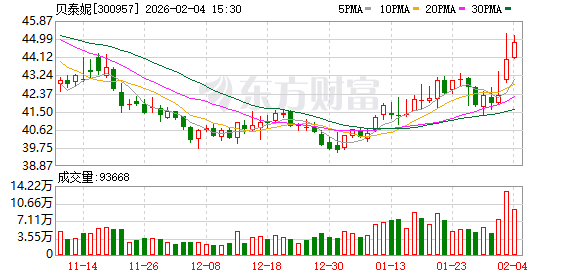
贝泰妮:薇诺娜等品牌在中东等新兴市场的业务正处于市场引入与本土化运营的早期阶段
Mei Ri Jing Ji Xin Wen· 2026-02-04 13:05
Core Viewpoint - The company expresses confidence in the long-term development of its brands, such as Winona and Pomei, in emerging markets like the Middle East, emphasizing a focus on market education and channel development [2]. Group 1: Market Performance - The brands Winona and Pomei are currently in the early stages of market introduction and localization in the Middle East [2]. - The company is committed to providing professional skincare solutions for sensitive skin to local consumers [2]. Group 2: Strategic Focus - The company is steadily advancing foundational work, including market education and channel construction, to support its overseas market initiatives [2]. - Investors are encouraged to monitor the company's upcoming periodic reports for specific market performance and financial data [2].

敷尔佳:目前线下渠道优化进展符合公司预期
Zheng Quan Ri Bao Wang· 2026-02-04 12:46
Core Viewpoint - The company, Fuhua (301371), is making progress in optimizing its offline channels, which aligns with its expectations, particularly in sales channel and retail terminal optimization [1] Group 1: Channel Optimization - The company is enhancing cooperation with service-oriented distributors through a dual approach of "strong regulation + strong optimization" to strengthen control over the offline market [1] - The focus of the strong regulation is on the meticulous management of inventory levels at agents and retail terminals to avoid stockpiling risks, while ensuring a stable pricing order through comprehensive and continuous dynamic monitoring of the pricing system across all channels [1] - The optimization aspect emphasizes the careful selection of strategic partners among agents and retail terminals, transitioning the channel model from traditional distribution to value-driven sales [1] Group 2: Future Strategies - The company aims to provide more professional and comprehensive product and service support to its partners and end consumers as part of its channel transformation strategy [1]
贝泰妮:薇诺娜等品牌在中东等新兴市场业务正处于市场引入与本土化运营早期阶段
Jin Rong Jie· 2026-02-04 11:23
Core Viewpoint - The company is in the early stages of market introduction and localization for its brands, such as Winona and Pomei, in emerging markets like the Middle East, and expresses confidence in long-term development [1] Group 1 - The company is currently focusing on market education and channel development as part of its foundational work in new markets [1] - The company aims to provide professional skincare solutions for sensitive skin to local consumers [1] - Specific market performance and financial data will be disclosed in future periodic reports [1]
雅诗兰黛眼线产品被指含“永久性化学物质”,客服:店内未售卖
Bei Ke Cai Jing· 2026-02-04 11:21
据加拿大环境保护相关法律法规,进口、销售或分销含有全氟壬基聚二甲基硅氧烷成分的化妆品,属 于"重大新活动",需要提前向有关部门申报,但雅诗兰黛集团未履行申报义务。 新京报贝壳财经讯(记者李铮)雅诗兰黛集团在环保上"栽了跟头"?2月4日,有媒体报道称,该公司因 违反加拿大环境保护相关条例被罚款。 事件可以追溯至2023年5月,加拿大环境与气候变化部的执法人员在例行检查中发现,雅诗兰黛集团销 售的眼线产品中,含有"全氟壬基聚二甲基硅氧烷"成分。该成分属于全氟和多氟烷基物质(PFAS)的 一种,因PFAS在自然条件下难以分解,拥有"永久性化学物质"的别称。 针对这一事件,2月4日,雅诗兰黛旗舰店客服回应新京报贝壳财经记者称,确保消费者安全是其首要任 务,"我们所有产品和成分都执行最严苛的安全评估标准。我们的产品符合中国及所有销售市场的政策 法规,可以安全使用。"在记者的追问下,该客服表示,目前店内未售卖眼线产品。 编辑 陈莉 校对 穆祥桐 ...

破解消费结构短板,上海市人大代表陈娟玲建议上海建设世界级国货化妆品零售功能区
Sou Hu Cai Jing· 2026-02-04 08:51
本报(chinatimes.net.cn)记者方凤娇 上海报道 上海作为国家首批培育建设的国际消费中心城市,持续推动消费升级与市场创新,着力提升全球消费吸 引力与资源配置能力。上海市政府工作报告将"大力提振消费"列为核心任务,明确要求"加快打造以国 货潮牌为引领的消费自主品牌,优化入境消费服务体系,提升入境人士消费便利度,大力发展免退税经 济"。国货化妆品产业,特别是以上海"东方美谷"为代表的产业集群,兼具扎实的品牌基础、高度的产 业集聚和广阔的市场潜力,是链接入境消费、打响国货品牌、激活高端零售的优质突破口。 2月2日至3日,中国人民政治协商会议上海市第十四届委员会第四次会议和上海市第十六届人民代表大 会第四次会议相继在上海世博中心开幕,标志着2026年上海两会正式拉开帷幕。今年上海市人大代表、 自然堂集团公共事务总经理陈娟玲带来了《关于在上海建设面向全球入境人士的世界级国货化妆品零售 功能区,大力提振消费的建议》。陈娟玲对《华夏时报》记者表示,在当前入境旅游市场快速复苏的背 景下,聚焦国货化妆品品类,在沪规划建设世界级入境零售功能区,不仅能够有效承接并转化入境客流 红利,更能成为向世界展示"中国制造"品质 ...

美妆行业周度市场观察-20260204
Ai Rui Zi Xun· 2026-02-04 06:45
Investment Rating - The report does not explicitly provide an investment rating for the beauty industry Core Insights - The beauty industry is undergoing significant changes due to various factors including policy shifts, consumer preferences, and technological advancements Industry Trends - Hainan's "zero tariff, low tax rate, and simplified tax system" policy is expected to transform the region into a global beauty industry hub, allowing international brands to penetrate the market while enhancing the competitiveness of domestic brands [1] - The beauty sector is experiencing a shift from price competition to value competition, driven by the need for genuine product efficacy and core ingredient transparency [4] - The clean beauty segment is facing polarization, with some brands exiting the market while major players continue to invest, indicating a potential growth opportunity in this area [5] - The emergence of beauty robots is seen as a blue ocean market, with companies testing consumer acceptance in 2026 [5] - Multi-functional makeup products that combine skincare benefits are gaining popularity, reflecting a trend towards efficiency and convenience among consumers [6] - The men's skincare market is projected to grow significantly, with domestic brands gaining traction in a traditionally dominated space [8] - The beauty industry is transitioning to a "hardcore metrics" era, emphasizing scientific validation and emotional resonance in branding [8] - The withdrawal of foreign beauty brands from the Chinese market indicates a shift in competitive dynamics, with local brands rising and online costs increasing [9] - ESG (Environmental, Social, Governance) considerations are becoming crucial for brand differentiation and competitive advantage in the beauty sector [10] - The global beauty market is witnessing increased mergers and acquisitions, reshaping the competitive landscape [11] - The Chinese beauty market is expected to reach a transaction volume of over 1.1 trillion yuan, with domestic brands capturing a significant market share [12] Brand Dynamics - New domestic brands are successfully leveraging unique ingredients and precise marketing strategies to thrive in the competitive landscape [14] - The brand "C咖" has emerged as a leader in the oil skin care segment by focusing on scientific innovation and consumer needs [15] - The brand "半亩花田" is seeking to go public, reflecting the trend of marketing optimization and product upgrade in the domestic beauty industry [15] - The introduction of high-end fragrance cleaning products indicates a shift towards quality in the home cleaning market, targeting the upgrading consumer demand [16]

研报掘金丨华源证券:首予福瑞达“买入”评级,认为中长期公司业绩乐观可期
Ge Long Hui A P P· 2026-02-04 06:10
Core Viewpoint - The report from Huayuan Securities indicates that Furida has streamlined its operations by divesting its real estate business, leading to stable growth in its cosmetics segment. The company is building core competitive advantages through a combination of products, research and development, and distribution channels [1] Group 1: Business Strategy - The company is actively promoting innovations in synthetic biological materials and terminal pharmaceuticals, as well as beauty applications, while continuously increasing R&D investment to strengthen its core business competitiveness [1] - The divestiture of the real estate business allows the company to focus on its core operations, enhancing its growth potential in the cosmetics and pharmaceutical sectors [1] Group 2: Market Position and Comparables - Comparable companies in the domestic market, such as Proya, Shanghai Jahwa, and Huaxi Biological, are expected to have an average PE ratio of 28 times by 2026 according to Wind consensus forecasts [1] - Given the company's strategic focus on optimizing its product mix and deepening its multi-channel layout in the cosmetics business, a positive long-term performance outlook is anticipated [1] Group 3: Investment Rating - The report initiates coverage of the company with a "Buy" rating, reflecting optimism about its mid-to-long-term performance following the strategic changes [1]

备战IPO:从招股书看植物医生的崛起密码
Jin Tou Wang· 2026-02-04 04:30
Core Insights - The company, Plant Doctor, is accelerating its IPO amidst intensifying competition in the Chinese cosmetics industry, focusing on high-altitude plant skincare as its niche market [1] - The brand's positioning of "high-altitude plants, pure beauty" aligns with consumer demand for natural, safe, and effective skincare ingredients, establishing a unique competitive advantage [1] Financial Performance - From 2021 to the first half of 2024, the company's revenue has consistently exceeded 2.1 billion yuan, with net profit increasing from 158 million yuan to 243 million yuan in 2023, reflecting a compound annual growth rate of 24% from 2022 to 2024 [2] - The net profit scale significantly surpasses the median level of industry peers, indicating strong profitability and industry representation [2] Channel Strategy - The company has developed a multi-channel strategy, with a focus on offline single-brand stores and an extensive online presence, achieving 4,269 offline stores by June 2025 [2] - The offline network not only generates substantial sales revenue but also serves as a brand image showcase and customer experience center, enhancing customer loyalty [2] Online Growth - Online channels act as a growth engine, with deep operations on platforms like Tmall and Douyin, and the introduction of the "Little Plant City" new retail model, which effectively channels offline traffic to online private domains [3] - This integration of online and offline sales has positioned the company as the top single-brand cosmetics store in China [3] R&D Investment - The company has invested nearly 250 million yuan in R&D during the reporting period, establishing a comprehensive research framework that includes basic plant research, formula development, and clinical testing across multiple locations [3] - As of October 2025, the company has secured 223 patents, ensuring continuous product innovation and rapid market responsiveness [3] Future Strategy - The IPO proceeds will be allocated to brand marketing, upgrading the R&D center, technological transformation of production bases, and information system development, outlining a clear strategic path for future growth [3] - By leveraging its focus on high-altitude plants, ongoing R&D, differentiated channel strategies, and clear brand positioning, the company aims to establish a competitive moat in the skincare market [3]
海口:统筹推进岛内居民日用消费品免税店布局
Hai Nan Ri Bao· 2026-02-04 03:45
Group 1 - The core objective of Haikou's economic and social development by 2026 includes a GDP growth of over 6%, a local public budget revenue growth of around 3%, fixed asset investment growth of about 7%, and a retail sales growth of 6% [2] - Haikou aims to enhance the free trade port's core leading area with 28 specific tasks, including expanding the encouraged industry directory and promoting zero tariffs on goods [2] - The city plans to increase the sales of offshore duty-free shops by 10% while improving the shopping experience and diversifying the "duty-free+" consumption scenarios [2] Group 2 - The Jiangdong New Area will focus on the "two zones and one land" positioning, accelerating the construction of 10 key projects and aiming for an 8% growth in both park revenue and fixed asset investment [3] - Haikou National High-tech Zone will concentrate on becoming a hub for innovation, with 38 projects under construction and a target of double-digit growth in industrial output [3] - The city plans to host over 17 major domestic and international events, promoting sports consumption and event economy, with a goal of increasing tourist numbers and spending by 6% and 8%, respectively [3]