出版

Search documents
出版传媒股价涨1.02%,大成基金旗下1只基金位居十大流通股东,持有229.83万股浮盈赚取16.09万元
Xin Lang Cai Jing· 2025-12-31 03:24
Group 1 - The stock price of Northern United Publishing and Media Co., Ltd. increased by 1.02% to 6.90 CNY per share, with a trading volume of 13.91 million CNY and a turnover rate of 0.37%, resulting in a total market capitalization of 3.801 billion CNY [1] - The company, established on August 29, 2006, and listed on December 21, 2007, focuses on the publication, distribution, and printing of educational materials, general books, and related supplies [1] - The revenue composition of the company includes educational materials at 39.60%, paper and printing supplies at 37.19%, general books at 30.73%, and other sources at 4.13% [1] Group 2 - The top circulating shareholder of Northern United Publishing is the Dachen CSI 360 Internet + Index A fund, which increased its holdings by 166,800 shares to a total of 2.2983 million shares, representing 0.42% of the circulating shares [2] - The Dachen CSI 360 Internet + Index A fund, established on February 3, 2016, has a current size of 788 million CNY and has achieved a year-to-date return of 39.65%, ranking 1145 out of 4189 in its category [2] - The fund has a cumulative return of 229.36% since its inception [2]

出版传媒股价涨1.02%,广发基金旗下1只基金位居十大流通股东,持有152.9万股浮盈赚取10.7万元
Xin Lang Cai Jing· 2025-12-31 03:24
Group 1 - The core point of the article highlights the performance of Northern United Publishing and Media Co., Ltd., which saw a stock increase of 1.02%, reaching a price of 6.90 yuan per share, with a total market capitalization of 3.801 billion yuan [1] - The company, established on August 29, 2006, and listed on December 21, 2007, primarily engages in the publishing, distribution, and printing of educational materials and general books, with its main revenue sources being educational materials (39.60%), printing supplies (37.19%), general books (30.73%), and other sources (4.13%) [1] Group 2 - From the perspective of the top ten circulating shareholders, GF Fund's fund, GF ChiNext Index Enhanced A (025195), has entered the top ten shareholders, holding 1.529 million shares, which accounts for 0.28% of the circulating shares, with an estimated profit of approximately 107,000 yuan today [2] - The fund manager of GF ChiNext Index Enhanced A is Sun Di, who has been in the position for 8 years and 20 days, managing a total asset size of 3.438 billion yuan, with the best fund return during his tenure being 234.15% and the worst being -46.52% [4]
山东出版股价涨1.05%,南方基金旗下1只基金位居十大流通股东,持有912.25万股浮盈赚取82.1万元
Xin Lang Cai Jing· 2025-12-31 03:24
数据显示,南方基金旗下1只基金位居山东出版十大流通股东。南方中证500ETF(510500)三季度减持 21.34万股,持有股数912.25万股,占流通股的比例为0.44%。根据测算,今日浮盈赚取约82.1万元。 南方中证500ETF(510500)成立日期2013年2月6日,最新规模1400.98亿。今年以来收益32.53%,同类 排名1569/4189;近一年收益28.64%,同类排名1677/4188;成立以来收益151.47%。 南方中证500ETF(510500)基金经理为罗文杰。 12月31日,山东出版涨1.05%,截至发稿,报8.67元/股,成交4517.30万元,换手率0.25%,总市值 180.93亿元。 资料显示,山东出版传媒股份有限公司位于山东省济南市英雄山路189号,成立日期2011年12月28日, 上市日期2017年11月22日,公司主营业务涉及以出版、发行、印刷、印刷物资贸易等为主,拥有以出版 物编辑出版、印刷复制、发行及零售、物资贸易为主的全产业链业务,逐步融合互联网媒体、数字出 版、信息技术等新兴业态,延伸开拓研学文旅等领域,形成了产业链完整并不断延伸发展的产业格局。主 营业务 ...

中原传媒涨2.06%,成交额4867.85万元,主力资金净流入352.81万元
Xin Lang Cai Jing· 2025-12-31 02:50
Core Viewpoint - Zhongyuan Media's stock price has shown a mixed performance, with a year-to-date increase of 10.50% but a slight decline in the recent trading periods, indicating potential volatility in investor sentiment [1][2]. Financial Performance - For the period from January to September 2025, Zhongyuan Media reported a revenue of 6.62 billion yuan, a year-on-year decrease of 1.17%, while the net profit attributable to shareholders increased by 46.94% to 747 million yuan [2]. - The company has distributed a total of 3.33 billion yuan in dividends since its A-share listing, with 1.43 billion yuan distributed over the past three years [3]. Shareholder Information - As of December 19, 2025, Zhongyuan Media had 19,100 shareholders, a slight decrease of 0.04% from the previous period, with an average of 34,945 circulating shares per shareholder, which increased by 0.04% [2]. - The top ten circulating shareholders include Hong Kong Central Clearing Limited as the second-largest shareholder with 45.96 million shares, a decrease of 3.036 million shares from the previous period [3].

山东出版传媒股份有限公司第四届董事会第三十九次(临时)会议决议公告
Shang Hai Zheng Quan Bao· 2025-12-30 22:53
登录新浪财经APP 搜索【信披】查看更多考评等级 山东出版传媒股份有限公司(简称"公司")第四届董事会第三十九次(临时)会议于2025年12月30日下 午在公司9楼会议室以现场会议方式召开。公司全体董事于2025年12月26日全部收到公司当日发出的召 开本次会议的书面或电子邮件通知。 证券代码:601019 证券简称:山东出版 公告编号:2025-055 山东出版传媒股份有限公司 第四届董事会第三十九次(临时)会议决议公告 本公司董事会及全体董事保证本公告内容不存在任何虚假记载、误导性陈述或者重大遗漏,并对其内容 的真实性、准确性和完整性承担法律责任。 重要内容提示: ● 公司董事长刘文强先生因工作原因不能出席会议,书面授权委托董事郭海涛先生代为出席会议并表 决。 ● 全体董事对全部议案投赞成票。 一、董事会会议召开情况 董事长刘文强先生因工作原因,无法召集和主持会议,会前经全体董事一致推举,本次会议由公司董事 郭海涛先生召集和主持。会议应出席董事7名,实际出席董事6名,董事长刘文强先生因工作原因未能出 席会议,书面授权委托董事郭海涛先生代为出席会议并表决。公司全体高管成员列席了会议。会议的通 知、出席人数、 ...
周敏、张云:当AI介入创意,如何守护“真实”
Huan Qiu Wang Zi Xun· 2025-12-30 22:42
Core Viewpoint - The controversy surrounding a photography competition where an AI-generated work allegedly won the top prize highlights the broader impact of AI technology on creative fields, raising questions about existing evaluation, certification, and copyright rules [1] Group 1: Current Issues in Creative Competitions - The photography competition faced scrutiny as the winning piece exhibited signs of AI generation, such as distorted architectural lines and overly perfect details, prompting the organizers to reaffirm their ban on AI submissions and initiate a review process [1] - Previous incidents, such as an AI-generated work winning third place in a different competition before being disqualified, indicate a pattern of challenges in identifying AI-generated content [1] - The lack of technical verification standards in many competitions allows for AI-generated works to bypass scrutiny, as many events focus primarily on artistic evaluation rather than technical authenticity [1] Group 2: Proposed Solutions - Establishing a rigorous work traceability and technical verification mechanism is essential, including requiring supporting materials for key submissions and integrating authoritative AI detection tools into the review process [2] - The creation of parallel competition categories, such as "Traditional Photography" (prohibiting AI) and "Digital Creative Art" (allowing AI), with clear evaluation criteria, can help maintain fairness and clarity in judging [2] Group 3: Ethical Considerations and Industry Dialogue - The fundamental challenge lies in the lack of consensus and ethical boundaries regarding AI's role in creative fields, necessitating industry dialogue to establish new ethical standards and agreements [3] - Stakeholders, including associations, event organizers, creators, and technology experts, should engage in discussions about the use of AI, authorship rights, and definitions of originality to create a contemporary industry charter [3] - Implementing an industry blacklist and credit system for violators, along with administrative oversight, can deter fraudulent activities and enhance the legal framework surrounding copyright infringement [3]
中国科技出版传媒股份有限公司2025年第四次临时股东大会决议公告
Shang Hai Zheng Quan Bao· 2025-12-30 19:38
Meeting Overview - The fourth extraordinary general meeting of shareholders was held on December 30, 2025, at a designated location in Beijing [2] - The meeting was convened by the board of directors and conducted through a combination of on-site and online voting, presided over by Chairman Hu Huaqiang [2][3] Attendance - Out of 9 current directors, 3 attended the meeting, including Chairman Hu Huaqiang, Director Huang Chen, and Employee Director Liu Junlai [3] - All 3 current supervisors attended the meeting, including Supervisor Chairman Zhang Fang [3] - The company’s Vice General Manager and Board Secretary Zhang Fan also attended [3] Resolutions Passed - The following resolutions were approved during the meeting: - Cancellation of the supervisory board and the repeal of the "Supervisory Meeting Rules" [4] - Amendments to the company’s articles of association [5] - Amendments to the "Shareholders Meeting Rules" [5] - Amendments to the "Board Meeting Rules" [5] - Amendments to the "Independent Director Work System" [5] - Amendments to the "Special Fund Storage and Usage Management System" [5] - Amendments to the "External Guarantee Management Measures" [5] - Amendments to the "External Investment Management Measures" [5] - Amendments to the "Related Party Transaction Management Measures" [6] - Amendments to the "Cumulative Voting Implementation Rules" [6] Voting Results - Resolutions 1.01, 1.02, 1.03, and 1.04 were special resolutions and were passed with more than two-thirds of the valid voting shares [6] Legal Compliance - The meeting was witnessed by lawyers from Beijing Deheng Law Firm, confirming that the convening and procedures of the meeting complied with relevant laws and regulations [6]

今年十大最惨板块,跌麻了
3 6 Ke· 2025-12-30 12:11
Core Viewpoint - The consumer sector has faced significant challenges in the past year, with many industries within this sector experiencing declines despite overall market growth. The focus on domestic demand and consumption has not translated into positive performance for many consumer-related industries [1]. Group 1: Consumer Sector Performance - In the first half of the year, 10 out of 16 industries that saw declines were from the consumer sector, indicating a troubling trend for consumer-related stocks [1]. - The white liquor sector, a key component of the consumer market, has seen a year-to-date decline of 12.44%, with major brands like Wuliangye experiencing significant drops in revenue and profit [5][8]. - The professional chain sector has been particularly hard hit, with a year-to-date decline of 14.72%, as traditional retail models struggle to adapt to changing consumer behaviors [13][14]. Group 2: White Liquor Industry - The white liquor industry is facing its eighth consecutive year of production decline, with both volume and price dropping, leading to increased inventory pressure and cash flow issues for many companies [9]. - Wuliangye reported a 10.26% decline in revenue and a 13.72% drop in net profit for the first three quarters, marking its first negative growth in nearly a decade [8]. - The changing consumer landscape, with a shift towards lower-alcohol and healthier options, is forcing white liquor companies to adapt or risk further declines [12]. Group 3: Professional Chain Sector - The professional chain sector is experiencing a crisis, with many traditional stores closing and business models failing to adapt to the digital age [14][19]. - The decline of major players like Renrenle, which has seen its market value plummet and faced continuous losses, exemplifies the struggles within this sector [18]. - The shift towards online shopping and personalized consumer experiences is reshaping the retail landscape, leaving traditional large-format stores at a disadvantage [20]. Group 4: Non-White Liquor Sector - The non-white liquor sector, including beer and wine, has also faced challenges, with a year-to-date decline of 11.61% [22]. - Budweiser APAC reported an 8.2% drop in domestic sales and a 24.4% decline in net profit, reflecting broader issues within the beer industry [25]. - The rise of cross-industry competition, with liquor companies diversifying into other beverage categories, indicates a shift in market dynamics [27]. Group 5: Publishing Industry - The publishing industry has seen a decline in the overall market, with a 10.4% drop in the domestic paper book market, yet some companies have managed to increase profits through cost control [35][38]. - Chinese Media, a leading player in the sector, has faced significant revenue and profit declines, highlighting the challenges of adapting to changing educational policies [36][38]. Group 6: Seasoning Industry - The seasoning industry has experienced a 6.04% decline, with companies like Qianhe Flavor struggling due to a drop in sales across key product lines [43][47]. - The industry is facing increased competition and changing consumer preferences, necessitating a shift in strategy for many companies [52]. Group 7: Traditional Chinese Medicine - The traditional Chinese medicine sector has seen a 5.02% decline, with companies like Pian Zai Huang facing significant revenue and profit drops due to rising costs and regulatory pressures [53][56]. - The industry is undergoing a transformation as companies seek to innovate and diversify their product offerings in response to market challenges [62]. Group 8: Digital Media - The digital media sector has faced a 4.95% decline, with traditional advertising models struggling to keep pace with new digital trends [67]. - Companies like Mango TV have reported significant revenue declines, indicating the need for adaptation in a rapidly changing media landscape [66]. Group 9: Kitchen and Bathroom Appliances - The kitchen and bathroom appliance sector has seen a 4.11% decline, largely due to a slowdown in new housing demand and increased competition [69][70]. - Companies like Boss Appliances are experiencing revenue declines for the first time in years, reflecting broader industry challenges [69]. Group 10: White Goods - The white goods sector has faced a 2.02% decline, with major players like Gree Electric experiencing significant revenue and profit drops due to increased competition and market saturation [76][80]. - The industry is shifting towards a focus on product quality and operational efficiency as traditional growth drivers diminish [80]. Group 11: Hotel and Catering - The hotel and catering sector has seen a 1.37% decline, with many businesses struggling to convert increased travel demand into profits due to high commission fees from online platforms [84][85]. - The industry is witnessing a shift towards more refined operational models as companies seek to adapt to changing consumer behaviors and market conditions [86].

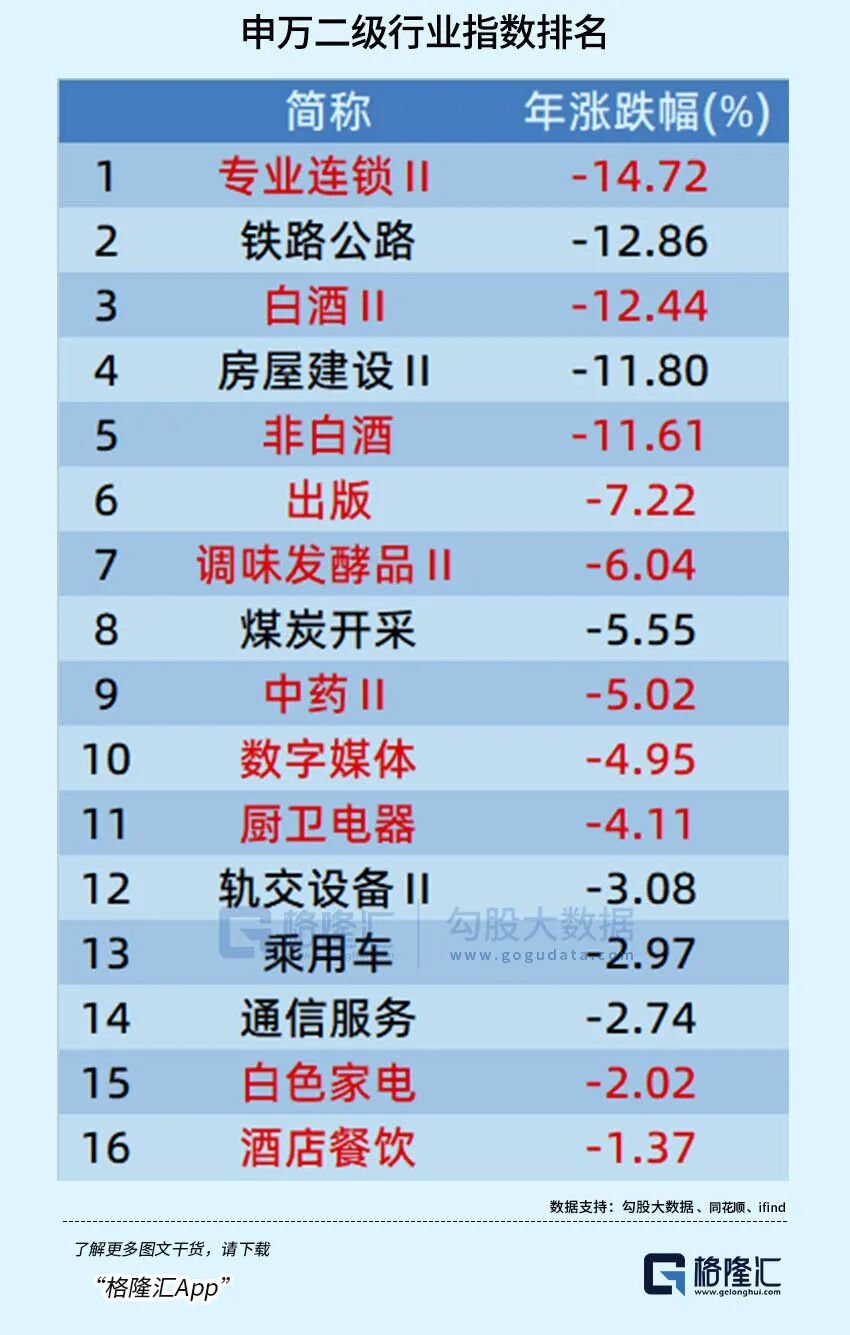
2025年A股十大最惨板块,跌麻了
Ge Long Hui· 2025-12-30 11:30
Core Viewpoint - The consumer sector has faced significant challenges in the past year, with many sub-sectors experiencing declines despite overall market growth. The focus on domestic demand and consumption has not translated into positive performance for many consumer-related industries [1][5]. Consumer Sector Performance - In the first half of the year, 10 out of 16 declining industries were from the consumer sector, indicating a broader trend of underperformance [1]. - The white liquor sector, a key component of the consumer market, has seen a year-to-date decline of 12.44%, with major brands like Wuliangye experiencing significant drops in revenue and profit [6][9]. - The professional chain sector has been particularly hard-hit, with a year-to-date decline of 14.72%, exemplified by the struggles of companies like Renrenle [16][20]. White Liquor Sector - The white liquor industry is facing its eighth consecutive year of production decline, with both volume and price dropping simultaneously [10]. - Wuliangye reported a 10.26% decline in revenue and a 13.72% drop in net profit for the first three quarters, marking its first negative growth in a decade [9]. - The industry is shifting from a growth-driven model to one focused on consumer choice, with a need for companies to adapt to changing consumer preferences [15]. Professional Chain Sector - The professional chain sector is experiencing a crisis, with many physical stores closing and traditional business models failing [16][20]. - Renrenle, once a leading private supermarket, has seen its market value plummet and is now facing delisting due to ongoing financial struggles [21][24]. - The shift towards online shopping and personalized consumer demands has further exacerbated the challenges faced by traditional retail chains [24][25]. Non-White Liquor Sector - The non-white liquor sector, including beer and wine, has also faced declines, with the beer segment seeing a notable drop in sales and profits [27][32]. - Budweiser APAC reported an 8.2% decline in domestic sales and a 24.4% drop in net profit, reflecting broader industry challenges [32][33]. - The market is witnessing a trend of cross-industry competition, with liquor companies diversifying into new beverage categories [34]. Publishing Sector - The publishing industry has shown resilience despite a 10.4% decline in the overall market for printed books, with listed companies managing to increase net profits by 14.65% [43][44]. - However, leading companies like Zhongwen Media are struggling, with significant revenue and profit declines due to changes in educational material procurement policies [45][48]. Seasoning Sector - The seasoning industry has faced a 6.04% decline, with companies like Qianhe Flavor struggling due to falling revenues and a loss of consumer trust [51][55]. - The industry is experiencing a shift in consumer preferences and increased competition, necessitating a reevaluation of business strategies [60]. Traditional Chinese Medicine Sector - The traditional Chinese medicine sector is facing challenges, with companies like Pian Zai Huang reporting significant declines in revenue and profit due to rising costs and regulatory pressures [61][66]. - The industry is undergoing a transformation as companies seek to innovate and diversify their product offerings [70]. Digital Media Sector - The digital media industry has seen a 4.95% decline, with companies like Mango TV reporting significant drops in revenue and profit due to changing consumer behaviors and market dynamics [71][74]. - The sector is grappling with the need to adapt to new content consumption trends while facing pressure from traditional advertising models [75]. Kitchen and Bathroom Appliances Sector - The kitchen and bathroom appliance sector has experienced a 4.11% decline, largely due to reduced demand from the real estate market [78][79]. - Companies like Boss Electric are facing revenue declines for the first time in years, highlighting the challenges of adapting to a changing market landscape [79][80]. White Goods Sector - The white goods sector has seen a 2.02% decline, with major players like Gree Electric facing significant revenue and profit pressures due to increased competition and market saturation [83][84]. - The industry is shifting towards a focus on product quality and brand strength as external stimuli diminish [88]. Hotel and Restaurant Sector - The hotel and restaurant sector has faced a 1.37% decline, with revenue pressures stemming from changing consumer spending habits and increased competition from online platforms [89][92]. - Companies are beginning to adopt more refined operational strategies to navigate the challenging market environment [96].




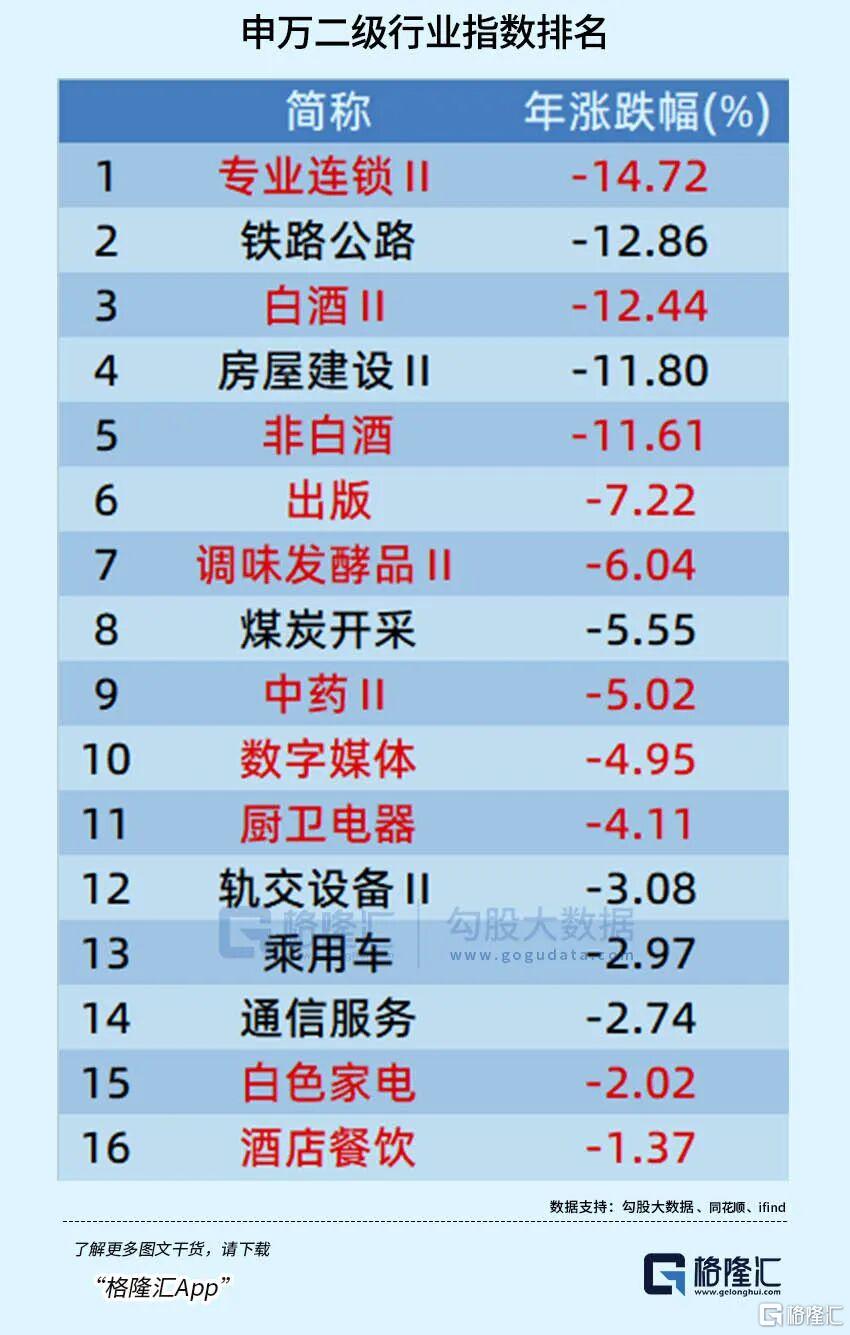
今年十大最惨板块,跌麻了
格隆汇APP· 2025-12-30 11:04
Core Viewpoint - The article discusses the significant downturn in various consumer sectors, particularly the liquor and retail industries, highlighting the challenges and potential opportunities for recovery amidst changing consumer behaviors and market dynamics [2][4][43]. Group 1: Liquor Industry - The liquor sector, especially the white liquor segment, has faced substantial declines, with the overall white liquor market down by 12.44% this year [9][15]. - Major brands like Wuliangye have reported significant drops in revenue and profit, with a 10.26% decline in revenue and a 13.72% drop in net profit for the first three quarters [17]. - The white liquor industry is experiencing a shift from a growth-driven model to one focused on consumer preferences, with a need for companies to adapt to changing consumption patterns [26][27]. Group 2: Retail Industry - The professional chain sector has seen a dramatic decline of 14.72%, with many traditional retail models struggling to survive [28][30]. - Companies like Renrenle have faced severe financial difficulties, leading to a significant reduction in store numbers and ultimately triggering delisting procedures [34][35]. - The shift towards online shopping and changing consumer preferences have forced traditional retailers to innovate or face extinction [36][39]. Group 3: Non-White Liquor Sector - The non-white liquor sector, including beer and wine, has also suffered, with a reported decline of 11.61% this year [40]. - Major players like Budweiser APAC have experienced significant sales drops, with a 9.5% revenue decrease and a 24.4% decline in net profit [46]. - The industry is witnessing a trend of cross-industry competition, with liquor companies diversifying into other beverage categories to adapt to market changes [51][56]. Group 4: Publishing Industry - The publishing sector has faced a 7.22% decline, with the overall market for printed books down by 10.40% [60]. - Despite the downturn, some publishing companies have managed to increase profits through cost control and operational efficiency, with a 14.65% rise in net profit for listed companies [61][62]. - The industry is undergoing significant transformation, moving from traditional sales models to more dynamic content management and IP development strategies [70][71]. Group 5: Seasoning Industry - The seasoning sector has seen a 6.04% decline, with companies like Qianhe Flavor struggling due to a drop in revenue and profit [74]. - The industry is facing challenges from both market saturation and changing consumer preferences, necessitating a shift in strategy for many companies [81]. Group 6: Traditional Chinese Medicine - The traditional Chinese medicine sector has experienced a 5.02% decline, with companies like Pian Zai Huang facing significant revenue and profit drops [86]. - The industry is under pressure from regulatory changes and increased competition, pushing companies to innovate and diversify their product offerings [91][92]. Group 7: Digital Media - The digital media sector has reported a 4.95% decline, with traditional advertising models struggling to adapt to new market realities [97][100]. - Companies like Mango TV have seen significant revenue drops, highlighting the challenges of maintaining profitability in a rapidly changing landscape [101][104]. Group 8: Kitchen and Bathroom Appliances - The kitchen and bathroom appliance sector has faced a 4.11% decline, with major players like Boss Electric experiencing revenue drops for the first time in years [112]. - The industry is grappling with reduced demand due to a slowdown in the real estate market, necessitating a shift towards innovation and international expansion [117][118]. Group 9: White Goods - The white goods sector has seen a 2.02% decline, with companies like Gree Electric facing significant challenges due to market saturation and increased competition [126][129]. - The industry is shifting towards a more rational consumer base that prioritizes product quality and brand reputation over traditional growth drivers [133]. Group 10: Hotel and Restaurant Industry - The hotel and restaurant sector has experienced a 1.37% decline, with many businesses struggling to convert increased tourism into profits [140][141]. - The industry is witnessing a shift towards more refined operational models, with companies focusing on member engagement and digital transformation to enhance profitability [142][143].