
家具制造

Search documents
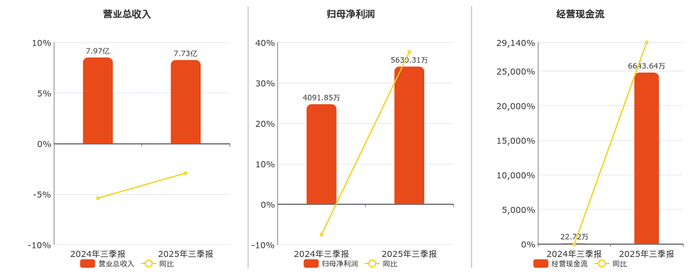
梦天家居(603216.SH):2025年三季报净利润为5630.31万元
Xin Lang Cai Jing· 2025-10-30 03:33
Core Insights - The company reported a total revenue of 773 million yuan for Q3 2025, ranking 44th among disclosed peers, which represents a decrease of 23.36 million yuan or 2.93% year-on-year [1] - The net profit attributable to shareholders was 56.30 million yuan, ranking 32nd among peers [1] - The net cash inflow from operating activities was 66.44 million yuan, ranking 33rd among peers [1] Financial Ratios - The latest debt-to-asset ratio is 21.44%, an increase of 1.48 percentage points from the previous quarter [3] - The gross profit margin stands at 29.39% [4] - The return on equity (ROE) is 3.14%, ranking 29th among disclosed peers [4] Earnings and Turnover - The diluted earnings per share (EPS) is 0.25 yuan [5] - The total asset turnover ratio is 0.34 times, ranking 46th among peers, remaining flat compared to the same period last year, with a decrease of 0.50% year-on-year [5] - The inventory turnover ratio is 5.67 times, a decrease of 0.48 times or 7.81% year-on-year [5] Shareholding Structure - The number of shareholders is 11,300, with the top ten shareholders holding 171 million shares, accounting for 76.62% of the total share capital [5] - The largest shareholder is Zhejiang Mengtian Holdings Co., Ltd., holding 55.91% [5]


皮阿诺:2025年前三季度净利润约-753万元
Mei Ri Jing Ji Xin Wen· 2025-10-29 16:30
Company Performance - Pianuo (SZ 002853) reported a revenue of approximately 420 million yuan for the first three quarters of 2025, representing a year-on-year decrease of 37.27% [1] - The net profit attributable to shareholders of the listed company was a loss of approximately 7.53 million yuan [1] - The basic earnings per share showed a loss of 0.04 yuan [1]

增收不增利 慕思股份第三季度净利润同比下滑26.80%
Bei Jing Shang Bao· 2025-10-29 15:08
Core Viewpoint - Mousse Health Sleep Co., Ltd. reported a mixed performance in Q3 2025, with revenue growth but a significant decline in net profit [1] Financial Performance - In Q3 2025, the company achieved revenue of 1.284 billion yuan, representing a year-on-year increase of 2.79% [1] - The net profit for Q3 2025 was 109 million yuan, showing a year-on-year decline of 26.80% [1] - For the first three quarters of 2025, the company reported total revenue of 3.761 billion yuan, which is a year-on-year decrease of 3.01% [1] - The net profit for the first three quarters was 467 million yuan, reflecting a year-on-year decline of 10.61% [1]
顾家家居(603816):25Q3利润表现超预期 转型变革成果初显
Xin Lang Cai Jing· 2025-10-29 14:31
Core Insights - The company reported a revenue of 15.01 billion yuan for Q1-Q3 2025, representing a year-on-year increase of 8.8%, with a net profit attributable to shareholders of 1.54 billion yuan, up 13.2% year-on-year [1] - The company plans to raise up to 1.997 billion yuan through a private placement to its indirect controlling shareholder, demonstrating confidence in long-term development [1] - The company is investing 1.12 billion yuan to establish an overseas production base in Indonesia, with expected annual revenue of approximately 2.52 billion yuan once fully operational [2] Financial Performance - For Q3 2025, the company achieved a revenue of 5.21 billion yuan, a year-on-year increase of 6.5%, and a net profit of 520 million yuan, up 12.0% year-on-year [1] - The gross profit margin for Q1-Q3 2025 was 32.4%, an increase of 0.5 percentage points year-on-year, while the net profit margin was 10.2%, up 0.4 percentage points year-on-year [1] - In Q3 2025, the gross profit margin was 31.4%, an increase of 1.6 percentage points year-on-year, with a net profit margin of 9.9%, up 0.5 percentage points year-on-year [1] Strategic Initiatives - The company plans to use the funds raised from the private placement for various projects, including smart upgrades of home product production lines, expansion of functional iron frame production lines, R&D for smart home products, and digital transformation projects [1] - The establishment of the Indonesian production base is part of the company's ongoing global expansion strategy, with a construction period of four years and partial production lines expected to commence during this period [2] - The company is undergoing a strategic transformation towards retail models through digitalization and improved logistics systems, alongside a steady global expansion in foreign trade [2] Profit Forecast - The company forecasts net profits attributable to shareholders of 1.91 billion yuan, 2.11 billion yuan, and 2.31 billion yuan for the years 2025, 2026, and 2027, respectively, indicating a positive outlook for long-term development [2]

梦百合:2025年第三季度归属于上市公司股东的净利润同比增长122.55%
Zheng Quan Ri Bao Zhi Sheng· 2025-10-29 14:10
Core Insights - The company reported a revenue of 2,440,056,641.62 yuan for the third quarter of 2025, representing a year-on-year growth of 11.98% [1] - The net profit attributable to shareholders of the listed company was 46,347,700.05 yuan, showing a significant year-on-year increase of 122.55% [1]

慕思股份董事会扩容至9人并取消监事会 多项治理制度同步修订
Xin Lang Cai Jing· 2025-10-29 12:32
Core Viewpoint - Mousse Health Sleep Co., Ltd. is adjusting its board structure and internal governance to enhance operational standards and comply with regulatory requirements [1][2]. Group 1: Board Structure Changes - The board size will increase from 7 to 9 members, maintaining 3 independent directors while increasing non-independent directors from 4 to 6, including 1 employee representative [2]. - The supervisory board will be abolished, with its functions transferred to the audit committee of the board [2]. Group 2: Internal Governance Revisions - A total of 28 internal governance systems will be revised, including 27 existing systems and 1 new system [3]. - Eight key systems, such as the Rules of Procedure for Shareholders' Meetings and the Independent Director System, will require shareholder approval [3][4]. Group 3: Future Arrangements - The proposals regarding board adjustments and governance revisions will be voted on at the fourth extraordinary general meeting of shareholders in 2025 [5]. - The governance optimization is expected to improve decision-making efficiency and strengthen board oversight, aligning with modern corporate governance trends [5].
增收不增利 喜临门第三季度净利润同比下滑8.5%
Bei Jing Shang Bao· 2025-10-29 12:16
Core Insights - The company reported a revenue of 6.196 billion yuan for the first three quarters of 2025, representing a year-on-year increase of 3.68% [1] - The net profit for the same period was 437 million yuan, showing a year-on-year growth of 1.88% [1] - In the third quarter alone, the company achieved a revenue of 2.176 billion yuan, which is a year-on-year increase of 7.78% [1] - However, the net profit for the third quarter declined to 140 million yuan, reflecting a year-on-year decrease of 8.50% [1] Financial Performance - Total revenue for the first three quarters: 6.196 billion yuan, up 3.68% year-on-year [1] - Net profit for the first three quarters: 437 million yuan, up 1.88% year-on-year [1] - Third quarter revenue: 2.176 billion yuan, up 7.78% year-on-year [1] - Third quarter net profit: 140 million yuan, down 8.50% year-on-year [1]

梦天家居1—9月净利润同比增长37.6%
Bei Jing Shang Bao· 2025-10-29 11:59
Core Insights - The core viewpoint of the article highlights the financial performance of Dream Home Group Co., Ltd. for the third quarter of 2025, indicating a decline in revenue but an increase in net profit compared to the previous year [1] Financial Performance - For the first three quarters, the company achieved a revenue of 773 million yuan, a year-on-year decrease of 2.93% [1] - The net profit for the same period was 56.3 million yuan, reflecting a year-on-year increase of 37.6% [1] - In the third quarter alone, the company reported a revenue of 289 million yuan, down 4.13% year-on-year [1] - The net profit for the third quarter was 21.1 million yuan, which is a year-on-year increase of 31.22% [1] Product Segmentation - Revenue from different product categories for the first nine months includes: - Doors: 314 million yuan, up 2.16% year-on-year [1] - Cabinets: 267 million yuan, down 1.54% year-on-year [1] - Wall panels: 102 million yuan, up 1.88% year-on-year [1] - Other furniture: 1.39 million yuan, down 5.14% year-on-year [1]
家居消费升级驱动数字化转型,慕思IPO后首创 “沙发算法适配系统”
Quan Jing Wang· 2025-10-29 10:50
Group 1 - The home industry is undergoing a digital transformation from "functional satisfaction" to "emotional resonance" due to rising consumer demands for both functionality and emotional value in home spaces [1] - Mousse Group's brands "Kaliya" and "Xianmu Home" launched the industry's first "Sofa Algorithm Adaptation System" at their autumn dealer conference, marking a significant innovation in enhancing consumer comfort experiences [1][2] Group 2 - The Sofa Algorithm Adaptation System integrates multiple dimensions including demand insights, home design, product design, ergonomics, showroom flow, consumer experience, and algorithm applications, featuring four intelligent modules [2] - The algorithm prediction module utilizes nationwide sales data to accurately forecast regional product demand trends, while the aesthetic analysis module combines insights from Mousse's design team and global color institutions [2] - The system ensures optimal seating comfort through a combination of Industrial 4.0 flexible supply chains and craftsmanship, alongside an ergonomics module that provides precise support for various postures [2] Group 3 - To validate the system's effectiveness, a "body sensation experiment" was conducted in collaboration with the Ergonomics Application Association, evaluating sofa products across eight dimensions including comfort, fabric feel, cleanliness, noise level, smart features, and design [3] - The first products equipped with the system have been launched, including the Xianmu Home RMA1-100 sofa inspired by premium chocolate and the Kaliya RIA2-830 "Ocean Dew" sofa inspired by Mediterranean aesthetics, both achieving top sales at the order meeting [3] - The innovation exemplifies a deep dialogue between digital technology and lifestyle aesthetics, providing a replicable model for high-quality development in the home industry through data-driven precision adaptation [3]

好莱客(603898) - 广州好莱客创意家居股份有限公司关于2025年前三季度主要经营情况的公告
2025-10-29 10:18
证券代码:603898 证券简称:好莱客 公告编号:2025-045 广州好莱客创意家居股份有限公司 关于2025年前三季度主要经营情况的公告 本公司董事会及全体董事保证本公告内容不存在任何虚假记载、误导性陈述 或者重大遗漏,并对其内容的真实性、准确性和完整性承担法律责任。 | 门店类型 | 2025 | 年年初 | 2025 年 | 1-9 | 月 | 2025 年 | 1-9 | 月 | 2025 | 年 9 | 月 | 30 日数 | | --- | --- | --- | --- | --- | --- | --- | --- | --- | --- | --- | --- | --- | | | 数量(家) | | 新开(家) | | | 关闭(家) | | | | | 量(家) | | | 经销商门店 | 1,848 | 356 | 221 | 1983 | | --- | --- | --- | --- | --- | | 直营店 | 9 | 0 | 7 | 2 | | 合计 | 1,857 | 356 | 228 | 1985 | 2、主营业务分渠道情况 | 分渠道 | 营业收入(元) | 营 ...
