
服装制造

Search documents
安正时尚: 安正时尚集团股份有限公司内部审计工作制度
Zheng Quan Zhi Xing· 2025-08-27 16:40
General Provisions - The internal audit system of Anzheng Fashion Group Co., Ltd. is established to enhance internal audit work based on relevant laws and regulations, as well as the company's actual situation [2] - Internal audit refers to an evaluation activity conducted by internal personnel to assess the effectiveness of internal controls, risk management, and the authenticity and completeness of financial information [2] Internal Audit Organization and Personnel - The company has established an internal audit department responsible for internal audit work, which must be staffed with at least two dedicated personnel with relevant professional knowledge [4][5] - The head of the internal audit department must be a full-time position, and the department should maintain independence from the financial center [3][4] Responsibilities and Authority of Internal Audit - The internal audit department is responsible to the board's audit committee and must report significant issues directly to the committee [9] - Key responsibilities include evaluating the completeness and effectiveness of internal control systems, auditing financial and economic data, and assisting in establishing anti-fraud mechanisms [10][11] Specific Audit Implementation Measures - The internal audit department must conduct annual evaluations of internal controls and submit reports to the audit committee [17] - Audits should focus on significant external investments, asset purchases and sales, guarantees, related transactions, and the use of raised funds [21][22][23][24] Supervision and Violation Handling - The company should establish an incentive and restraint mechanism for the internal audit department, evaluating the performance of audit personnel [27] - Internal auditors who perform their duties diligently may receive rewards, while those who abuse their power or violate regulations may face penalties [28][29] Applicability and Effectiveness - The internal audit system applies to the company's wholly-owned subsidiaries, controlling subsidiaries, and significant investees [30] - The system will take effect after being approved by the company's board of directors [32]

开润股份:服装制造业务收入同比增长148.25% 第二增长曲线战略持续有效实施
Zheng Quan Shi Bao· 2025-08-27 15:42
Core Insights - In the first half of 2025, KaiRun Co., Ltd. achieved a main business revenue of 2403.93 million RMB, a year-on-year increase of 32.81%, while the net profit attributable to shareholders decreased by 24.77% to 186.68 million RMB due to a high base from a one-time investment gain last year [1] - The company plans to distribute a cash dividend of 1.57 RMB per 10 shares, totaling 37.35 million RMB [1] Group 1: Business Performance - The OEM manufacturing business of KaiRun is focused on a core strategy of major clients and is accelerating data-driven lean production and digital transformation, significantly enhancing operational efficiency [2] - The company has leveraged its global production capacity in China, Indonesia, and India to strengthen its leading position in the bag manufacturing sector and enhance its competitive edge in apparel manufacturing [2] - The bag manufacturing segment generated revenue of 1418.76 million RMB, a year-on-year increase of 13.03%, while the apparel manufacturing segment saw revenue rise by 148.25% to 678.81 million RMB [2] Group 2: Strategic Developments - Following the acquisition of Shanghai Jiale, the company is integrating its operations to enhance efficiency, with Shanghai Jiale reporting a revenue of 685 million RMB and a net profit of 34.75 million RMB in the first half of 2025 [3] - The company is investing in automation and digitalization, launching a self-developed Product Lifecycle Management (PLM) system to improve management efficiency and delivery quality [3] Group 3: Brand Management - In brand management, the company has launched several new products in collaboration with Xiaomi, enhancing the visibility and influence of its bag category [4] - The self-owned brand "90 Points" is optimizing its online channel operations while expanding into overseas distribution channels and offline markets [4] - During the 2025 "618" e-commerce event, Xiaomi's luggage and backpacks achieved top sales and revenue rankings on JD.com [4]
开润股份:服装制造业务收入同比增长148.25% 第二增长曲线战略持续有效实施
Zheng Quan Shi Bao Wang· 2025-08-27 14:49
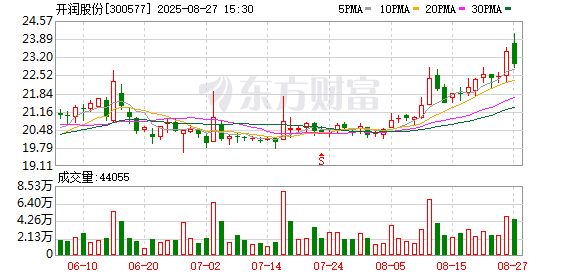
Core Insights - The company is focusing on a core strategy of major clients and accelerating data-driven lean production and digital transformation to enhance operational efficiency [1] - The company has maintained strategic communication with top global brands like Nike, ADIDAS, and Uniqlo to ensure stable and high-quality orders amidst complex external environments [1] Financial Performance - In the first half of 2025, the company achieved a main business revenue of 240,392.56 million RMB, a year-on-year increase of 32.81% [4] - The net profit attributable to shareholders decreased by 24.77% to 18,667.70 million RMB, primarily due to a high base effect from one-time investment income in the previous year [4] - The net profit excluding non-recurring gains increased by 13.98% to 18,068.38 million RMB [4] Business Segments - The bag manufacturing business generated revenue of 141,875.52 million RMB, up 13.03%, while the apparel manufacturing business saw a significant increase of 148.25% to 67,881.21 million RMB [1] - The company is enhancing product design and manufacturing capabilities through increased automation and digital investment, including the launch of a self-developed PLM system [2] Brand Development - The company has launched new products in collaboration with Xiaomi, enhancing brand visibility and sales in the bag category [3] - The self-owned brand "90分" is optimizing online channel operations and expanding into overseas markets, including participation in the ILM international luggage exhibition in Germany [3] Operational Efficiency - Following the acquisition of Shanghai Jiale, the company is integrating its operations to improve efficiency, with Shanghai Jiale achieving a revenue of 685 million RMB and a net profit of 34.75 million RMB in the first half of 2025 [2]

申洲国际发布中期业绩,股东应占利润31.77亿元 同比增加8.39%
Zhi Tong Cai Jing· 2025-08-27 04:22
Core Viewpoint - Shenzhou International (02313) reported a revenue of RMB 14.966 billion for the six months ending June 30, 2025, representing a year-on-year increase of 15.34% [1] - The net profit attributable to shareholders was RMB 3.177 billion, up 8.39% year-on-year, with earnings per share of RMB 2.11 and an interim dividend of HKD 1.38 per share proposed [1] Revenue Breakdown - Sales of sports products accounted for approximately 67.7% of total sales, with a year-on-year increase of about 9.9% [1] - Sales of leisure products represented approximately 25.3% of total sales, showing a significant year-on-year increase of about 37.4% [1] - Sales of underwear products made up approximately 6.3% of total sales, with a year-on-year increase of about 4.1% [1] Operational Highlights - During the reporting period, the company expanded its overseas production capacity and advanced the upgrade of domestic production facilities [1] - The company also focused on refining and improving its internal control systems [1]
以民企之“进”促区域之“兴”——宝鸡市渭滨区谱写民营经济高质量发展新篇章
Sou Hu Cai Jing· 2025-08-27 03:50
Core Viewpoint - The private economy is an essential driving force for economic growth, market vitality, and innovative development, with significant advancements in the Weibi District of Baoji City, focusing on both scale and quality improvements in the private sector [1] Group 1: Private Economy Development - In 2024, the Weibi District is expected to have over 13,000 private enterprises, accounting for 92% of the total number of enterprises in the region [1] - The added value of the private economy is projected to reach 28.39 billion yuan, representing 47.1% of the district's GDP [1] Group 2: Financial Support for Enterprises - The "Qin Zengxin" pilot program was launched to address financing needs for small and micro enterprises, resulting in 596 credit agreements totaling 26.03 million yuan by the end of June [5] - The Weibi District has successfully granted 10 million yuan in credit to alleviate financing pressures for enterprises facing challenges in organic agriculture [4] Group 3: Innovation and Upgrading of Enterprises - Lvxia Clothing Co., Ltd. is set to launch a modern intelligent digital factory in September, which will double its production efficiency, producing 650,000 sets annually [7] - The company has received substantial support from the Weibi District government, including funding for research and development and equipment upgrades [9] Group 4: Digital Economy and Transformation - The Weibi District Digital Economy Industrial Park hosts over 160 digital economy-related enterprises, fostering a vibrant digital industry ecosystem [10] - Companies like Libang Software are providing comprehensive digital transformation services, supporting over 5,000 enterprises nationwide and participating in nine national-level demonstration projects [12][13]

*ST步森2025年中报简析:净利润同比下降66.92%
Zheng Quan Zhi Xing· 2025-08-26 23:08
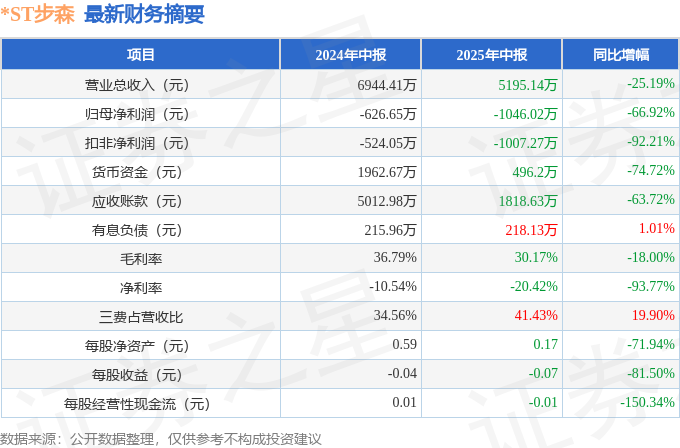
Financial Performance - *ST Bosen (002569) reported a significant decline in net profit, down 66.92% year-on-year [1] - Total operating revenue for the first half of 2025 was 51.95 million yuan, a decrease of 25.19% compared to the previous year [1] - The company recorded a net loss of 10.46 million yuan for the first half of 2025, worsening from a loss of 6.27 million yuan in the same period of 2024 [1] Quarterly Analysis - In Q2 2025, total operating revenue was 19.61 million yuan, down 41.95% year-on-year [1] - The net profit for Q2 2025 was a loss of 6.29 million yuan, a staggering decline of 463.81% compared to the previous year [1] Key Financial Ratios - Gross margin decreased to 30.17%, down 18.0% year-on-year [1] - Net margin fell to -20.42%, a decline of 93.77% compared to the previous year [1] - Total expenses (selling, administrative, and financial) amounted to 21.53 million yuan, accounting for 41.43% of revenue, an increase of 19.9% year-on-year [1] Cash Flow and Assets - Cash and cash equivalents decreased significantly, with monetary funds at 4.96 million yuan, down 74.72% year-on-year [1] - Accounts receivable also saw a decline, totaling 18.19 million yuan, down 63.72% from the previous year [1] - The company reported a negative operating cash flow per share of -0.01 yuan, a decrease of 150.34% year-on-year [1] Investment Returns - Historical data indicates a median Return on Invested Capital (ROIC) of -19.51% over the past decade, with the worst year being 2024 at -78.09% [3] - The company has reported losses in 7 out of 13 annual reports since its listing, indicating poor investment returns [3] Financial Health Indicators - The ratio of cash to current liabilities is only 6.61%, suggesting liquidity concerns [4] - The average net cash flow from operating activities over the past three years has been negative, indicating ongoing financial challenges [4]

江苏舜天: 江苏舜天关于变更公司名称并完成工商变更登记的公告
Zheng Quan Zhi Xing· 2025-08-26 16:40
Core Viewpoint - The company has officially changed its name from "Jiangsu Shuntian Co., Ltd." to "Jiangsu Suhao Fashion Group Co., Ltd." and updated its English name accordingly, reflecting a strategic shift in branding and business focus [1][2]. Group 1 - The name change was approved during the 9th meeting of the 11th Board of Directors on August 8, 2025, and at the first extraordinary general meeting of shareholders on August 25, 2025 [1]. - The company has completed the business registration change and received a new business license from the Jiangsu Provincial Market Supervision Administration [2]. - The registered capital of the company is 438.847974 million RMB, and it is classified as a publicly listed joint-stock company [2]. Group 2 - The company was established on October 21, 1981, and is located at 21 Software Avenue, Yuhuatai District, Nanjing [2]. - The business scope includes a wide range of activities such as import and export, textile and clothing wholesale and retail, food sales, and various manufacturing and consulting services [2].

乔治白上半年净利润下降68.09%
Bei Jing Shang Bao· 2025-08-26 13:35
Group 1 - The company reported a revenue of 524 million yuan for the first half of 2025, representing a year-on-year increase of 1.46% [1] - The net profit attributable to shareholders of the listed company was 14.56 million yuan, showing a year-on-year decrease of 68.09% [1] - The net profit attributable to shareholders of the listed company, after deducting non-recurring gains and losses, was 19.53 million yuan, reflecting a year-on-year decline of 19.92% [1]

乔治白(002687.SZ)发布上半年业绩,归母净利润1455.92万元,同比下降68.09%
智通财经网· 2025-08-26 12:44
Core Insights - The company, George White (002687.SZ), reported a revenue of 524 million yuan for the first half of 2025, reflecting a year-on-year growth of 1.46% [1] - The net profit attributable to shareholders of the listed company was 14.56 million yuan, showing a significant decline of 68.09% year-on-year [1] - The net profit attributable to shareholders after deducting non-recurring gains and losses was 19.53 million yuan, which represents a year-on-year decrease of 19.92% [1] - The basic earnings per share stood at 0.03 yuan [1]
市场监管总局公布一批“守护品牌”商标行政执法典型案例
Yang Shi Wang· 2025-08-26 12:41
Core Viewpoint - The article emphasizes the ongoing efforts of market regulatory authorities in China to combat trademark infringement and counterfeiting, highlighting the importance of protecting intellectual property rights and creating a favorable environment for brand value preservation [1]. Group 1: Case Summaries - Case 1: Li and others were found to have sold counterfeit "Nanfu" batteries, with a total purchase value of over 2.48 million yuan and sales amounting to 1.39 million yuan from 2017 to 2024 [2][3][4]. - Case 2: A wedding car rental company was penalized for using counterfeit "Rolls-Royce" cars, resulting in fines totaling over 710,000 yuan for 15 companies involved [5][6][7]. - Case 3: A joint operation in Guangdong led to the dismantling of 27 counterfeit shoe production sites, seizing 21,000 pairs of counterfeit products with a total value of 216 million yuan [8][9][10]. - Case 4: A significant case involving the sale of counterfeit "Arc'teryx" jackets across nine provinces, with a total value exceeding 300 million yuan, resulted in the arrest of 42 individuals [11][12][13]. - Case 5: A business in Jilin was fined for using a similar name to "City Hero" while infringing on the trademark, leading to a fine of 49,000 yuan [14][15][17]. - Case 6: A company in Gansu was penalized for selling automotive products falsely labeled as "China First Automobile Group" products, resulting in a fine of 50,000 yuan [18][19][20]. - Case 7: A karaoke hall in Guizhou was reported for unauthorized use of the "Hilton" trademark, generating revenue of 11.14 million yuan [21][22][23]. - Case 8: A tourism company in Yunnan was fined 75,000 yuan for using a similar peacock logo without authorization [24][26]. - Case 9: A food counterfeiting operation in Sichuan was dismantled, with a total value of over 20.1 million yuan in counterfeit products seized [27][28][29]. - Case 10: A tea shop in Hainan was fined 76,000 yuan for continuing to use the "Yihe Tang" trademark despite a prior court ruling against them [30][31][32]. - Case 11: A packaging materials store in Ningxia was penalized for printing unauthorized packaging for "Ningxia Goji Berries," resulting in fines totaling 4,770 yuan [33][34]. - Case 12: A tea shop in Guangxi was found selling counterfeit "Sanhe" tea, leading to criminal charges [35][36]. - Case 13: A case involving counterfeit "Shede" liquor resulted in the seizure of 3,026 bottles and over 2.57 million yuan in value [38][39][40]. - Case 14: A company in Xinjiang was found producing counterfeit liquor, with a total value of 61,500 yuan [41][42]. - Case 15: A brewery in Henan was penalized for producing beer with a label similar to "Wusu Beer," resulting in a fine of 470,000 yuan [43][44]. - Case 16: A brewery in Hebei was found to have used a similar trademark to "Budweiser," leading to fines of over 250,000 yuan [46][47][49]. - Case 17: A brewery in Heilongjiang was penalized for using a similar trademark, resulting in a fine of 26,000 yuan [50][51]. - Case 18: A case involving counterfeit alcoholic beverages with a total value exceeding 20 million yuan was reported, highlighting the challenges of tracking down unlicensed vendors [52][53].


