
装备制造业

Search documents
连续四个月保持增长!重要数据公布
Zhong Guo Zheng Quan Bao· 2025-12-27 04:23
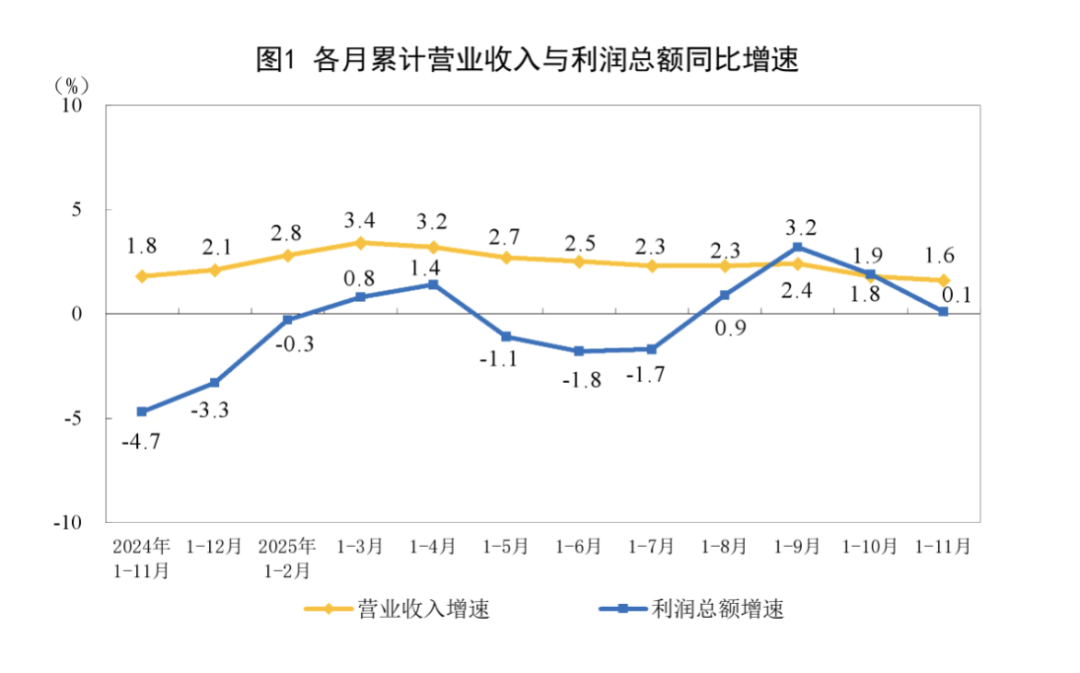
从三大门类看,于卫宁表示,1—11月份,制造业增长5.0%;电力、热力、燃气及水生产和供应业增长8.4%;采矿业下降27.2%,降幅较1—10月份收窄0.6 个百分点。 1—11月份,装备制造业利润带动作用明显。于卫宁表示,1—11月份,规模以上装备制造业利润同比增长7.7%,拉动全部规模以上工业企业利润增长2.8 个百分点,是对规模以上工业企业利润增长拉动作用最强的板块。 从行业看,装备制造业的8个大类行业中有7个行业利润实现同比增长,其中,铁路船舶航空航天、电子行业利润两位数增长,增速分别达27.8%、 15.0%;汽车行业利润增长7.5%,较1—10月份加快3.1个百分点;通用设备、专用设备、电气机械行业利润继续增长,增速分别为4.8%、4.6%、4.2%。 国家统计局12月27日发布数据显示,1—11月份,全国规模以上工业企业实现利润总额66268.6亿元,同比增长0.1%,自今年8月份以来累计增速连续四个 月保持增长。1—11月份,规模以上工业企业营业收入同比增长1.6%。 图片来源:国家统计局 国家统计局工业司首席统计师于卫宁表示,1—11月份,规模以上工业企业利润增速有所回落,但仍然延续8月份以 ...

重磅数据发布,连续四个月保持增长!
Zheng Quan Ri Bao Wang· 2025-12-27 04:14
Core Insights - The profit of industrial enterprises above designated size increased by 0.1% year-on-year in the first 11 months, maintaining a growth trend for four consecutive months since August [1] - The manufacturing sector grew by 5.0%, while the electricity, heat, gas, and water production and supply sector grew by 8.4%. However, the mining sector saw a decline of 27.2% [1] - The revenue of industrial enterprises above designated size increased by 1.6% year-on-year [1] Group 1: Equipment Manufacturing - The profit of the equipment manufacturing sector increased by 7.7% year-on-year, contributing 2.8 percentage points to the overall profit growth of industrial enterprises [2] - Seven out of eight major categories in the equipment manufacturing sector reported profit growth, with the railway, shipbuilding, and aerospace industries seeing profits grow by 27.8% and 15.0% respectively [2] - The automotive industry experienced a profit increase of 7.5%, accelerating by 3.1 percentage points compared to the previous ten months [2] Group 2: High-Tech Manufacturing - The profit of high-tech manufacturing increased by 10.0% year-on-year, outpacing the average growth of all industrial enterprises by 9.9 percentage points [3] - The "Artificial Intelligence+" initiative positively impacted related equipment manufacturing, with profits in the semiconductor equipment sector growing by 97.2% and electronic components by 46.0% [3] - The aerospace industry also saw significant profit growth, with aerospace equipment manufacturing profits increasing by 13.3%, including a 192.9% increase in space-related equipment manufacturing [3] Group 3: Raw Materials Manufacturing - The profit of the raw materials manufacturing sector grew by 16.6% year-on-year, contributing 2.0 percentage points to the overall profit growth of industrial enterprises [4] - The steel industry showed significant improvement in profitability, aided by low base effects, while the non-ferrous metals sector maintained double-digit profit growth due to increased market demand [4] - Overall, the profit growth trend of industrial enterprises is supported by new industrial dynamics, although challenges remain in the transition from old to new growth drivers [4]
权威数读|装备制造业等新动能行业利润保持较快增长
Xin Hua Wang· 2025-12-27 03:44
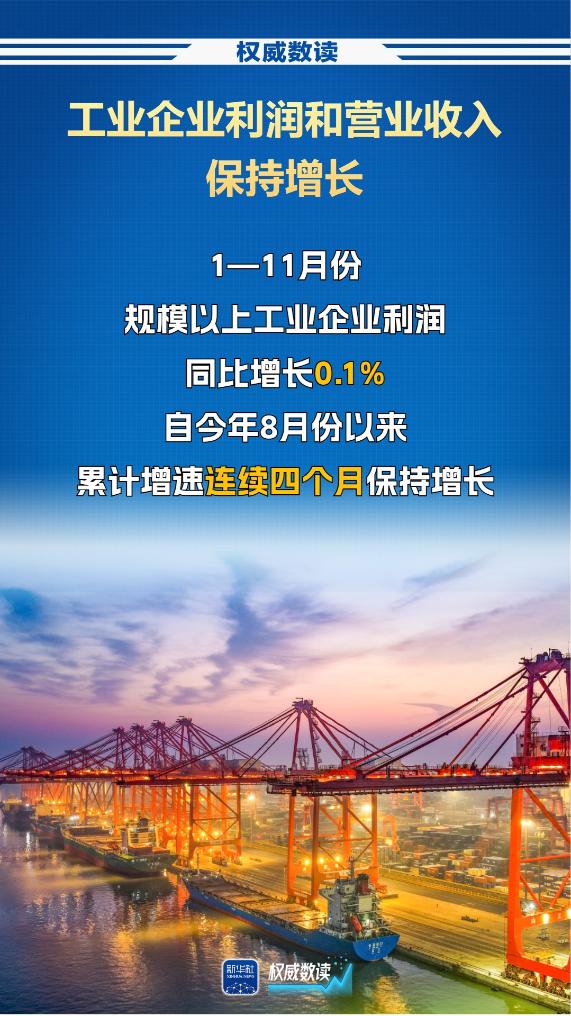
国家统计局27日发布数据显示,1-11月份,我国规模以上工业企业利润增速有所回落,但仍然延续8月 份以来的增长态势,以装备制造业、高技术制造业为代表的新动能行业保持较快增长,工业经济转型升 级有序推进。跟随海报,一起了解。 权威持恒 高技术制造业利润 增速加快 1—11月份 规模以上高技术制造业利润 同比增长10.0% 较1至10月份加快2。0个百分点 增速高于全部规模以上工业平均水平 9.9个百分点 工业企业利润和营业收入 保持增长 1—11月份 规模以上工业企业利润 同比增长0.1% 自今年8月份以来 ẩ 什噜 蜜៍ 四个月保持增长 装备制造业利润 带动作用明显 1—11月份 规模以上装备制造业利润 同比增长7.7% 拉动全部规模以上工业企业制润 增长2.8个百分点 双 同不可 2 57 57 50 策划:令伟家 【纠错】 【责任编辑:王萌萌】 统筹:杨侠 制作:缪异星 ...
国家统计局,最新公布!
Zheng Quan Shi Bao· 2025-12-27 03:33
Group 1 - The core viewpoint is that the support of new industrial momentum is becoming increasingly evident, with industrial profits showing a slight increase despite a slowdown in growth rate [1] - From January to November, the total profit of industrial enterprises above designated size reached 66,268.6 billion yuan, a year-on-year increase of 0.1%, maintaining growth for four consecutive months [1][2] - High-tech manufacturing profits grew by 10.0% year-on-year, accelerating by 2.0 percentage points compared to the previous period, significantly outpacing the average growth of all industrial enterprises [2] Group 2 - The equipment manufacturing sector played a crucial role, with profits increasing by 7.7% year-on-year, contributing 2.8 percentage points to the overall profit growth of industrial enterprises [3] - Among the eight major categories in the equipment manufacturing sector, seven achieved year-on-year profit growth, with notable performances in the railway, shipbuilding, aerospace, and electronics industries [3] - The automotive industry also showed steady profit growth of 7.5%, with an acceleration of 3.1 percentage points compared to the previous period, indicating positive recovery signals [3] Group 3 - The raw materials manufacturing sector saw a significant profit increase of 16.6% year-on-year, contributing 2.0 percentage points to the overall profit growth of industrial enterprises [4] - The steel industry has shown marked improvement in profitability this year, driven by increased market demand and rapid revenue growth in the non-ferrous sector [4] - In 2025, the steel industry is expected to experience distinct phase fluctuations, with improved profitability compared to 2024, supported by falling coal prices and unexpected export growth [5]
国家统计局,最新公布!
证券时报· 2025-12-27 03:27
工业新动能的支撑作用进一步显现。 高技术制造业利润累计增速加快 数据显示,1—11月份,全国规模以上工业企业实现利润总额同比增长0.1%,连续4个月保持增长。 12 月 27 日,国家统计局公布数据显示, 1 — 11 月份,全国规模以上工业企业实现利润总额 66268.6 亿元,同比增长 0.1% ,连续 4 个月 保持增长。其中,规模以上高技术制造业利润同比增长 10.0% ,较 1 — 10 月份加快 2.0 个百分点。 分析认为,规模以上工业企业利润增速有所回落,但累计增速仍然延续8月份以来的增长态势,工业新动能的支撑作用进一步显现。 国家统计局工业司首席统计师于卫宁介绍,1—11月份,规模以上高技术制造业利润同比增长10.0%,较1—10月份加快2.0个百分点,增速 高于全部规模以上工业平均水平9.9个百分点。 在设备制造领域,"人工智能+"行动成效显著,带动相关行业利润向好。其中,电子工业专用设备制造行业利润同比增长达57.4%。细分来 看,半导体器件专用设备制造行业利润增长97.2%,电子元器件与机电组件设备制造行业利润增长46.0%,展现出强劲的发展势头。 航空航天产业同样发展迅猛。航空、航天 ...

前11个月全国规模以上工业企业利润增长0.1%
Xin Hua Wang· 2025-12-27 03:12
新华社北京12月27日电(记者王雨萧)国家统计局27日发布数据显示,1至11月份,全国规模以上工业 企业实现利润总额66268.6亿元,同比增长0.1%,自今年8月份以来累计增速连续四个月保持增长。 数据显示,装备制造业利润带动作用明显。1至11月份,规模以上装备制造业利润同比增长7.7%,拉动 全部规模以上工业企业利润增长2.8个百分点,是对规模以上工业企业利润增长拉动作用最强的板块。 从行业看,装备制造业的8个大类行业中有7个行业利润实现同比增长。 高技术制造业利润增速加快。1至11月份,规模以上高技术制造业利润同比增长10.0%,较1至10月份加 快2.0个百分点,增速高于全部规模以上工业平均水平9.9个百分点。从行业看,"人工智能+"行动深入实 施带动相关设备制造行业利润向好,电子工业专用设备制造行业利润同比增长57.4%;航空航天产业快 速发展推动行业利润增长较快,航空、航天器及设备制造行业利润同比增长13.3%;智能化产品助力数 智化转型,智能消费设备制造行业利润同比增长54.0%。 原材料制造业利润较快增长。1至11月份,规模以上原材料制造业利润增长较快,同比增速达16.6%, 拉动全部规模以上 ...
工业利润累计增速连续4个月增长,装备制造业带动明显
Di Yi Cai Jing· 2025-12-27 02:34
Core Insights - In November, profits of industrial enterprises above designated size decreased by 13.1% year-on-year, with the decline expanding by 7.6 percentage points compared to the previous month [1] - From January to November, profits of industrial enterprises above designated size grew by 0.1%, maintaining a growth trend for four consecutive months since August [1] Group 1: Profit Trends - In the manufacturing sector, profits increased by 5.0% from January to November, while the electricity, heat, gas, and water production and supply sector saw an 8.4% profit growth [3] - The mining industry experienced a profit decline of 27.2%, although the decline was narrowed by 0.6 percentage points compared to the first ten months of the year [3] Group 2: Sector Performance - The equipment manufacturing sector significantly contributed to profit growth, with a 7.7% increase in profits from January to November, accounting for a 2.8 percentage point increase in overall industrial profits [3] - High-tech manufacturing profits accelerated, with a 10.0% year-on-year increase, surpassing the average growth rate of all industrial enterprises by 9.9 percentage points [3] - The raw materials manufacturing sector also saw a robust profit growth of 16.6%, contributing 2.0 percentage points to the overall industrial profit growth [4] Group 3: Future Outlook - The overall profit growth of industrial enterprises indicates a continued upward trend, supported by new industrial dynamics, although challenges remain due to international uncertainties and structural adjustments [5] - The Ministry of Industry and Information Technology has set goals for 2026, prioritizing the stabilization of the industrial economy, with an expected 5.9% year-on-year growth in industrial added value for the year [5] - Analysts predict that industrial profits may recover from low levels, potentially achieving around 10% growth by the end of 2026, indicating a shift from policy-driven to profit-driven market dynamics [5]
国家统计局:高技术制造业利润增速加快 原材料制造业利润较快增长
Xin Hua Cai Jing· 2025-12-27 02:34
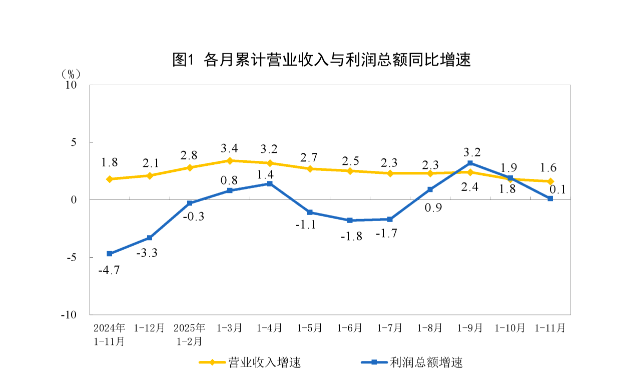
Core Insights - The profit growth of industrial enterprises in China has shown a slight decline but continues to maintain an upward trend since August, with significant contributions from equipment manufacturing and high-tech manufacturing sectors [1][4]. Group 1: Industrial Profit Data - From January to November, the profit of large-scale industrial enterprises increased by 0.1% year-on-year, marking four consecutive months of growth since August [1]. - The manufacturing sector saw a profit increase of 5.0%, while the electricity, heat, gas, and water production and supply sector grew by 8.4%. In contrast, the mining sector experienced a decline of 27.2%, although this decline was 0.6 percentage points less than the previous month [1]. - The total operating revenue for large-scale industrial enterprises rose by 1.6% year-on-year during the same period [1]. Group 2: Equipment Manufacturing Sector - The profit of large-scale equipment manufacturing increased by 7.7% year-on-year, contributing 2.8 percentage points to the overall profit growth of large-scale industrial enterprises, making it the strongest driving sector [2]. - Among the eight major categories in the equipment manufacturing sector, seven reported year-on-year profit growth, with the railway, shipbuilding, aerospace, and electronics industries showing double-digit growth rates of 27.8% and 15.0%, respectively [2]. - The automotive industry also saw a profit increase of 7.5%, accelerating by 3.1 percentage points compared to the previous month [2]. Group 3: High-Tech Manufacturing Sector - The profit of large-scale high-tech manufacturing grew by 10.0% year-on-year, which is 9.9 percentage points higher than the average profit growth of all large-scale industrial enterprises [3]. - The "Artificial Intelligence+" initiative has positively impacted related equipment manufacturing, with profits in the electronic industrial specialized equipment sector increasing by 57.4%, and specific segments like semiconductor device manufacturing and electronic components seeing growth rates of 97.2% and 46.0%, respectively [3]. - The aerospace industry also experienced significant profit growth, with the aerospace and related equipment manufacturing sectors reporting increases of 13.3%, 192.9%, and 36.3% [3]. Group 4: Raw Materials Manufacturing Sector - The profit of large-scale raw materials manufacturing increased significantly by 16.6% year-on-year, contributing 2.0 percentage points to the overall profit growth of large-scale industrial enterprises [4]. - The steel industry has shown marked improvement in profitability this year, aided by low base factors, while the non-ferrous metals sector has maintained double-digit profit growth due to increased market demand and revenue growth [4].
国家统计局:1—11月份规模以上装备制造业利润同比增长7.7%
Xin Lang Cai Jing· 2025-12-27 02:14
Core Insights - The core viewpoint of the article highlights the significant growth in profits for the equipment manufacturing industry, which has positively impacted the overall profits of large-scale industrial enterprises in China [1] Industry Performance - From January to November 2025, profits in the equipment manufacturing sector increased by 7.7% year-on-year, contributing 2.8 percentage points to the profit growth of all large-scale industrial enterprises [1] - Among the eight major categories within the equipment manufacturing industry, seven reported year-on-year profit growth [1] - The railway, shipbuilding, and aerospace sectors experienced substantial profit growth, with increases of 27.8% and 15.0% respectively [1] - The automotive sector's profits grew by 7.5%, accelerating by 3.1 percentage points compared to the previous ten months [1] - Profits in the general equipment, specialized equipment, and electrical machinery sectors continued to grow, with growth rates of 4.8%, 4.6%, and 4.2% respectively [1]
前11月全国规模以上工业企业利润增长0.1%
Xin Lang Cai Jing· 2025-12-27 02:14
Core Insights - The total profit of industrial enterprises above designated size in China reached 66,268.6 billion yuan from January to November, showing a slight year-on-year increase of 0.1% [1] - The profit performance varied across different types of enterprises, with state-owned enterprises experiencing a decline of 1.6%, while foreign-invested enterprises saw a growth of 2.4% [1] - The mining sector faced a significant profit drop of 27.2%, while the manufacturing sector reported a profit increase of 5.0% [1] Summary by Category Profit Performance - In the first eleven months, the profit of state-owned enterprises was 20,083.6 billion yuan, down 1.6% year-on-year; joint-stock enterprises reported 49,565.6 billion yuan, down 0.4%; foreign and Hong Kong, Macao, and Taiwan-invested enterprises achieved 16,355.3 billion yuan, up 2.4%; private enterprises made 19,319.9 billion yuan, down 0.1% [1] - The mining industry recorded a profit of 7,896.3 billion yuan, down 27.2%; the manufacturing industry achieved 50,317.9 billion yuan, up 5.0%; and the electricity, heat, gas, and water production and supply industry reported 8,054.4 billion yuan, up 8.4% [1] Revenue and Costs - The total operating revenue of industrial enterprises above designated size was 125.34 trillion yuan, a year-on-year increase of 1.6%; operating costs were 107.17 trillion yuan, up 1.8% [2] - The operating profit margin was 5.29%, a decrease of 0.08 percentage points year-on-year [2] Asset and Liability Overview - By the end of November, total assets of industrial enterprises amounted to 189.28 trillion yuan, up 4.8%; total liabilities were 109.96 trillion yuan, up 5.0%; and total equity reached 79.32 trillion yuan, up 4.5% [2] - The asset-liability ratio stood at 58.1%, an increase of 0.1 percentage points year-on-year [2] Industry-Specific Insights - The computer, communication, and other electronic equipment manufacturing industry saw a profit increase of 15.0%; the electricity and heat production and supply industry grew by 11.8%; and the automotive manufacturing industry increased by 7.5% [2] - The high-tech manufacturing sector's profit growth accelerated to 10.0%, surpassing the average growth rate of all industrial enterprises [6] - The equipment manufacturing sector's profit increased by 7.7%, contributing significantly to the overall profit growth of industrial enterprises [6] Challenges and Future Outlook - Despite the overall profit growth, challenges remain due to international uncertainties and the need for structural adjustments in the industrial sector [8] - The focus will be on promoting traditional industry upgrades and fostering new productive forces to ensure sustainable industrial economic development [8]