ETF

Search documents
The Best $1,000 Gen Z Can Spend on Their Investment Portfolio This Year
Yahoo Finance· 2025-09-25 22:59
Group 1 - Gen Z has the potential to benefit from long-term investments, as they have more time to navigate market uncertainties [1][2] - Individual risk tolerance is crucial for Gen Z when considering investment options [2] - Index funds, such as the Vanguard S&P 500 ETF (VOO), are recommended for Gen Z investors seeking lower-risk exposure to the stock market [3][4] Group 2 - Artificial intelligence (AI) is expected to be a significant technological advancement in the coming decade, with companies already generating profits from AI [5] - Established chipmakers like Nvidia and Broadcom are leading the AI boom, though they carry risks [6] - Companies in adjacent industries, such as crypto miners and nuclear energy firms, are also benefiting from the AI trend, but require more research due to higher risks [7] Group 3 - Dividend stocks can be categorized into income stocks and growth stocks, with income stocks being more suitable for middle-aged or near-retirement investors [8]


FHLC: Fidelity's U.S. Health Care ETF Balances Quality, Safety, And Growth (NYSEARCA:FHLC)
Seeking Alpha· 2025-09-25 20:01
Core Insights - The Fidelity MSCI Health Care Index ETF (NYSEARCA: FHLC) offers passive market cap-weighted exposure to over 300 U.S. Health Care stocks with a low expense ratio of 0.08% [1] - The ETF has achieved a total return of 119% over the last decade through August [1] Group 1 - The ETF provides a diversified investment option within the U.S. Health Care sector [1] - The Sunday Investor is focused on U.S. Equity ETFs and maintains a comprehensive database tracking nearly 1,000 funds [1] - The Sunday Investor is preparing to become a licensed options and derivatives trading advisor [1]


4 Top-Performing ETF Areas of First Nine Months of 2025
ZACKS· 2025-09-25 11:56
Market Overview - Wall Street has experienced a rally this year, overcoming slowdown fears linked to Trump's tariff tensions, with a significant rebound following trade deals and a tech boom driving markets higher [1] - Major indices such as the S&P 500, Dow Jones, and Nasdaq Composite have reached new all-time highs, with SPDR S&P 500 ETF Trust (SPY) up 13.1%, SPDR Dow Jones Industrial Average ETF Trust (DIA) up 8.8%, Invesco QQQ Trust (QQQ) up 16.8%, and iShares Russell 2000 ETF (IWM) up 9.3% year-to-date [2] Federal Reserve Actions - The Federal Reserve implemented its first rate cut of the year in September to address a softer labor market, indicating potential further easing [3] IPO Market - The IPO market remains robust, with six companies going public in early September, each raising over $100 million, marking a significant milestone not seen since November 2021 [4] Sector Performance Gold & Silver Miners - iShares MSCI Global Silver and Metals Miners ETF (SLVP) is up 129.9%, and iShares MSCI Global Gold Miners ETF (RING) is up 126.6%, with SPDR Gold Trust (GLD) gaining 40% and iShares Silver Trust (SLV) gaining about 48% year-to-date, driven by their safe-haven appeal [5] Bitcoin Miners - CoinShares Bitcoin Mining ETF (WGMI) is up 93.3%, with Bitcoin prices increasing by about 19% this year due to higher institutional adoption; IREN Limited (IREN) is up 350% and Cipher Mining (CIFR) is up 193% year-to-date [6] Uranium - Global X Uranium ETF (URA) is up 88.1%, driven by increasing global electricity needs and renewed interest in nuclear energy, despite facing regulatory and cost challenges [7][8] Defense Sector - Select STOXX Europe Aerospace & Defense ETF (EUAD) is up 86.9% and Global X Defense Tech ETF (SHLD) is up 79.7%, fueled by rising geopolitical tensions and increased global defense spending [9][10] - European Union defense spending is projected to rise by approximately €80 billion ($84 billion) by 2027, equivalent to about 0.5% of GDP [11]
Is John Hancock Multifactor Mid Cap ETF (JHMM) a Strong ETF Right Now?
ZACKS· 2025-09-25 11:21
Core Insights - The John Hancock Multifactor Mid Cap ETF (JHMM) debuted on September 28, 2015, and provides broad exposure to the Mid Cap Blend category of the market [1] Fund Overview - JHMM is managed by John Hancock and has accumulated over $4.4 billion in assets, positioning it as one of the larger ETFs in its category [5] - The fund aims to match the performance of the John Hancock Dimensional Mid Cap Index, which includes U.S. companies ranked between the 200th and 951st largest by market capitalization [5] Cost Structure - The annual operating expenses for JHMM are 0.42%, which is competitive with most peer products [6] - The fund has a 12-month trailing dividend yield of 0.99% [6] Sector Allocation - JHMM's largest sector allocation is in Industrials, comprising approximately 20.5% of the portfolio, followed by Financials and Information Technology [7] - The top 10 holdings account for about 5.47% of the total assets under management, with United Rentals Inc (URI) being the largest individual holding at 0.73% [8] Performance Metrics - As of September 25, 2025, JHMM has gained about 8.21% year-to-date and approximately 8.35% over the past year [10] - The ETF has traded between $50.32 and $65.26 in the past 52 weeks, with a beta of 1.04 and a standard deviation of 17.64% over the trailing three-year period, indicating medium risk [10] Alternatives - Other ETFs in the mid-cap space include Vanguard Mid-Cap ETF (VO) and iShares Core S&P Mid-Cap ETF (IJH), which have significantly larger assets of $88.19 billion and $99.33 billion respectively [12] - VO has a lower expense ratio of 0.04%, while IJH charges 0.05%, making them potentially more attractive options for cost-conscious investors [12]
计算机板块ETF领涨;科创债ETF大幅“吸金”丨ETF晚报
2 1 Shi Ji Jing Ji Bao Dao· 2025-09-25 09:16
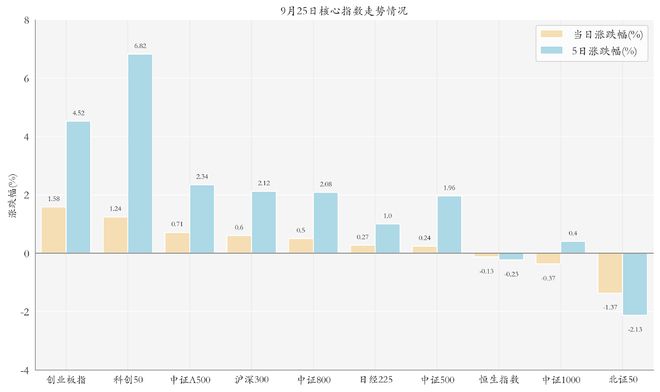
Group 1: ETF Market Overview - The three major indices showed mixed performance, with the Shanghai Composite Index down 0.01%, the Shenzhen Component Index up 0.67%, and the ChiNext Index up 1.58% [1] - Several computer sector ETFs saw significant gains, with Cloud 50 ETF (560660.SH) rising by 4.02%, Big Data Industry ETF (516700.SH) increasing by 3.60%, and Cloud Computing ETF (159890.SZ) also up by 3.60% [1] - Real estate sector ETFs experienced declines, with Real Estate ETF (159768.SZ) down 1.10%, and others also showing negative performance [1] Group 2: AI and Computing Sector Insights - The computer industry is expected to continue its development under a "soft and hard" framework, with strong investment in AI hardware and benefits for domestic AI chip and server manufacturers [2] - The acceleration of enterprise-level AI applications is noted, with technologies like Agent and multimodal capabilities driving B-end commercialization [2] Group 3: Bond ETF Growth - The second batch of 14 newly listed Sci-Tech Bond ETFs attracted significant capital, with five of them reaching over 10 billion yuan in scale, collectively raising 638.94 billion yuan in a single day [2][3] - The total scale of all Sci-Tech Bond ETFs surpassed 230 billion yuan, contributing to the overall bond ETF market exceeding 670 billion yuan [3] Group 4: Sector Performance - In the A-share market, sectors such as media, communication, and non-ferrous metals performed well, with daily increases of 2.23%, 1.99%, and 1.87% respectively [8] - Conversely, textiles, comprehensive sectors, and agriculture showed declines, with daily decreases of -1.45%, -1.30%, and -1.22% respectively [8] Group 5: ETF Performance Rankings - The top-performing ETFs today included Cloud 50 ETF (560660.SH) with a gain of 4.02%, Cloud Computing ETF (159890.SZ) up by 3.60%, and Big Data Industry ETF (516700.SH) also increasing by 3.60% [12] - The average performance of thematic stock ETFs was the best among various categories, with an average increase of 0.85% [9] Group 6: Trading Volume Insights - The top three ETFs by trading volume were the ChiNext ETF (159915.SZ) with 5.2 billion yuan, A500 ETF (512050.SH) with 5.14 billion yuan, and Sci-Tech 50 ETF (588000.SH) with 5.086 billion yuan [14][16]
ETF及指数产品网格策略周报-20250923
HWABAO SECURITIES· 2025-09-23 08:52
Group 1 - The core idea of the report emphasizes the grid trading strategy, which is a high buy-low sell approach that capitalizes on price fluctuations rather than predicting market trends, making it suitable for volatile markets [3][11] - The report identifies key characteristics for suitable grid trading targets, including selecting on-market assets, stable long-term trends, low transaction costs, good liquidity, and high volatility, with equity ETFs being particularly appropriate [3][11] Group 2 - The report highlights two main ETFs for grid trading: - The New Economy ETF (159822.SZ), which focuses on high-quality new economy leaders in China, aligning with government initiatives to promote technological and industrial innovation, and indirectly tracks the S&P China New Economy Index [3][12] - The Financial ETF (510230.SH), which provides a defensive high dividend yield through banks and captures performance recovery through securities and insurance sectors, with banks showing a dividend yield of 5.86% as of June 30, 2025, significantly above market averages [4][14] - The report suggests that investors can enhance returns by combining multiple ETFs with low correlation, such as mixing broad-based and sector-specific ETFs or combining A-shares and Hong Kong stocks [14][16]
美股中国互联网ETF(KWEB)连续第六周资金流入 创2月以来最长连续流入纪录
Ge Long Hui A P P· 2025-09-23 01:44
格隆汇9月23日|截至9月19日当周,在美国上市交易的KraneShares CSI中国互联网ETF(KWEB)实现连 续第六周资金流入,创下2月以来的最长连续流入期。过去六周,KWEB累计流入5.99亿美元,但该流 入规模不及1月和2月同期记录的三分之一,当时Deepseek的推出颠覆了全球对中国科技资产的认知。 ...
中证A500指数发布一周年
Zhong Zheng Wang· 2025-09-23 01:24
Group 1 - The China Securities A500 Index was launched on September 23, 2023, and has quickly become a core broad-based index in the A-share market, second only to the CSI 300, due to its innovative coverage of leading companies across three industry levels and ESG rating screening [1][1][1] - The total scale of funds tracking the A500 Index has rapidly expanded, reflecting widespread recognition from various funding sources [1][1][1] Group 2 - On September 24, 2023, 14 new Sci-Tech Innovation Bond ETFs will be listed, which is expected to direct more funds into the technology innovation sector [1][1][1] Group 3 - The Ministry of Industry and Information Technology, along with four other departments, has issued a work plan for the steel industry, projecting an average annual growth of around 4% in value added for the steel industry from 2025 to 2026 [1][1][1]
Why Rate Cuts Could Benefit an Already Booming ETF Industry
Yahoo Finance· 2025-09-22 10:05
Core Insights - The Federal Reserve's recent interest-rate cut is expected to further stimulate the booming ETF industry [1] - Analysts predict that lower interest rates will lead to a shift of assets from money market funds to ETFs, particularly benefiting the financial services sector and fixed-income products [2][3] ETF Industry Impact - The money market fund industry, valued at $7.4 trillion, may become less attractive as interest rates decline, prompting investors to seek higher returns in ETFs [2] - Historical context shows that the money market industry was approximately $5 trillion when interest rates were last at similar levels in late 2022 [3] - A significant capital flow into ETFs is anticipated as the Fed continues to ease policy, although the transition may not be immediate [3] Financial Sector Trends - Early flows indicate a trend towards financial sector ETFs, with nearly $750 million entering these funds on the day of the Fed's decision [2] - The financial services sector typically outperforms the broader market during periods of rate cuts [2] Fixed-Income Products - Fixed-income products are expected to gain attention in a post-rate cut environment, especially as the yield curve steepens [3] - There is uncertainty regarding whether investors will favor short-term or long-term bonds, as rate cuts enhance the attractiveness of fixed-income products [3][4] - Traditional fixed income may not provide the expected stability against portfolio volatility, raising questions about its pricing and benefits [3] Market Dynamics - Since March 2022, money market assets have increased by over $2.5 trillion, with more than $320 billion gained in 2023 alone [5]
【盘前三分钟】9月22日ETF早知道
Xin Lang Ji Jin· 2025-09-22 01:26
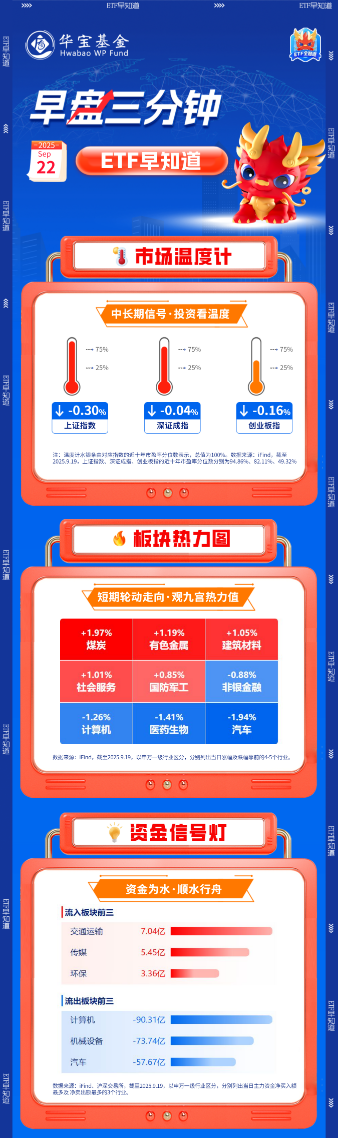
Core Insights - The article discusses the performance and trends of various ETFs, highlighting the sectors that are currently attracting capital inflows and those experiencing outflows [1][2][4]. Group 1: Market Performance - The article notes that the Shanghai Composite Index, Shenzhen Component Index, and ChiNext Index have seen long-term market temperature rates of 94.89%, 82.11%, and 83.32% respectively over the past decade [1]. - The short-term sector rotation shows positive performance in coal (+1.05%), building materials (+1.97%), and non-ferrous metals (+1.19%), while sectors like non-bank financials and social services have seen declines of -1.41% and -1.94% respectively [1]. Group 2: Capital Flows - The top three sectors for capital inflows are transportation (¥7.04 billion), media (¥5.45 billion), and environmental protection (¥3.36 billion) [1]. - Conversely, the sectors with the largest capital outflows include machinery (-¥9.03 billion) and equipment (-¥7.37 billion) [1]. Group 3: ETF Performance - The real estate ETF has shown a 6.93% increase, while the green energy ETF has increased by 21.53% [2]. - The performance of the AI-related ETFs is highlighted, with the light module sector showing resilience and demand driven by AI applications [4]. Group 4: Industry Outlook - The article emphasizes that the AI-driven computing expansion cycle is far from over, with strong demand for light modules indicating a stable fundamental outlook for the industry [4]. - The internet sector is experiencing a valuation reassessment due to policy shifts and new AI narratives, suggesting potential recovery signals [4].