Smartphones

Search documents
Counterpoint Q3中国智能手机市场报告:销量同比下降2.7%,头部厂商分化明显
Feng Huang Wang· 2025-11-06 10:28
Core Insights - In Q3 2025, China's smartphone sales are projected to decline by 2.7% year-on-year due to economic slowdown and reduced demand [1] - The launch of flagship models by Chinese OEMs and the iPhone 17 series contributed to an 11% year-on-year sales growth in the first two weeks of October [1] Group 1: Company Performance - OPPO leads the recovery with a 2.1% year-on-year growth, driven by the Reno 14 series and OnePlus, appealing to younger consumers with gaming performance and stylish design [1] - Xiaomi shows steady growth with a 1.1% year-on-year increase, supported by the Redmi Note 15 and K80 series, and ranks as the second fastest-growing brand after Apple in early October [1] - Huawei's Honor X70 series targets the entry-level market with advantages in battery life and fast charging, but overall brand sales declined by 8.1% year-on-year as the company focuses on AI and ecosystem transformation [1] - Apple's older iPhone models see a slowdown in sales, while the iPhone 17 series is performing well, with the base model's sales doubling year-on-year in September and the Pro version showing significant growth in October [2] Group 2: Market Trends - The smartphone market in China is experiencing a shift with flagship models driving sales, despite an overall decline in volume [1] - The competitive landscape is intensifying as brands like OPPO and Xiaomi leverage new product launches to capture market share [1] - The strong performance of the iPhone 17 series indicates a robust demand for premium smartphones, contrasting with the decline in older models [2]

印度智能手机 Q3 出货量同比增长 5%,Apple 跻身前五
Counterpoint Research· 2025-11-06 07:03
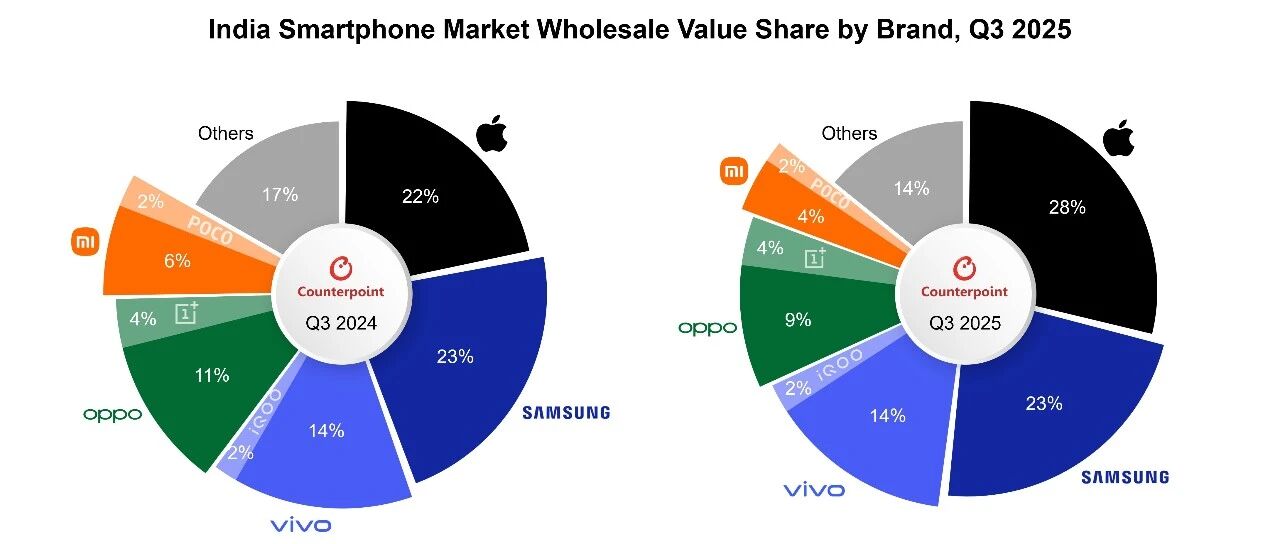
Core Insights - The Indian smartphone market experienced a 5% year-on-year increase in shipment volume and an 18% increase in shipment value in Q3 2025, reaching a historical quarterly high, driven by pre-festival stockpiling and sustained demand for high-end models [4][5][6]. Market Dynamics - The market is transitioning towards a stable growth phase focused on value, supported by festive season stockpiling and promotional activities across online and offline channels. Key drivers include convenient installment payment plans, trade-in policies, and significant discounts [5][6]. - Retail inflation has slowed, and fiscal support has improved household liquidity, leading to a notable recovery in consumer confidence during the festive season [6]. High-End Market Performance - The high-end segment (priced above 30,000 INR, approximately 339 USD) saw a 29% year-on-year increase in shipment volume, making it the fastest-growing segment. The overall market value increased by 18%, with the average selling price (ASP) rising by 13% [9]. - Apple led the market with a 28% share of sales value, driven by strong demand for the iPhone 16 and 15 series, while the newly launched iPhone 17 series outperformed its predecessor [6][9]. Brand Performance - Vivo (excluding iQOO) captured the top market position with a 20% share, benefiting from a robust offline network and the popularity of its mid-range T series [7][9]. - Samsung followed with a 13% market share, supported by its S series and A series, along with successful promotions for its high-end Galaxy Z Fold series [6][7]. - OPPO achieved accelerated growth through a diverse product portfolio and enhanced retailer collaboration [7]. - Apple entered the top five in shipment volume for the first time in Q3 2025, making India the third-largest iPhone market globally [9]. Additional Trends - The online channel accounted for 45% of shipments during the festive season, while offline channels maintained a dominant 55% share [14]. - iQOO emerged as the fastest-growing brand with a 54% year-on-year increase in shipments, driven by a strong gaming-focused product line and community marketing efforts [14]. - Motorola's shipments grew by 53%, fueled by demand for its G series and Edge series [14].

2025 OPPO 手机观察:来自 Counterpoint 研究的10篇报告数据
Counterpoint Research· 2025-11-06 07:03
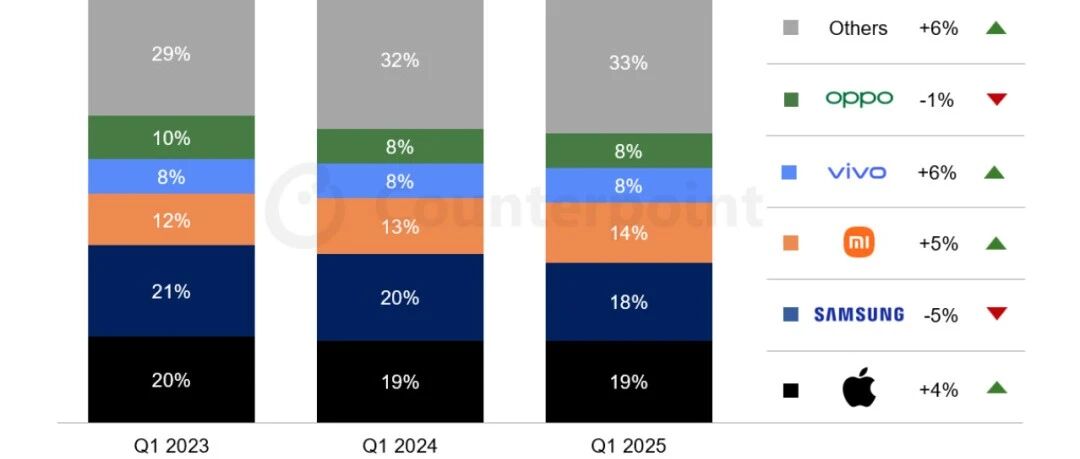
Core Insights - The article discusses the performance of OPPO smartphones in the market, highlighting its growth amidst a general decline in smartphone sales in China [6][10][30]. Group 1: Market Performance - In Q3 2025, China's smartphone sales decreased by 2.7% year-on-year, but OPPO achieved a growth rate of 2.1%, making it the fastest-growing major OEM [6][10]. - OPPO's Reno 14 series has been particularly successful, combining flagship features with mid-range pricing, making it one of the best-selling flagship phones in China after the iPhone 16 series [10][30]. - The overall smartphone market in China is entering an adjustment period, with a 2% decline in sales during the first eight weeks of Q3 2025 [9][29]. Group 2: Regional Insights - In Vietnam, OPPO ranked third in smartphone shipments, benefiting from the Reno 14 series, which supports 5G and offers promotional data incentives [15]. - The Latin American market saw a 4% year-on-year growth in smartphone shipments in Q2 2025, with OPPO leading among Chinese brands in 5G market share [19]. Group 3: Financial Performance - OPPO's average selling price (ASP) increased by 14% year-on-year in Q2 2025, the highest among the top five brands, while its revenue grew by 10% [22]. - Despite a decline in shipment volume, OPPO's revenue growth was driven by high-end models like the Reno 13 series and Find X8 [22][37]. Group 4: Product Strategy - OPPO's product strategy includes a focus on high-end models and a successful launch of the Reno 14 series before major sales events, which helped maintain strong sales momentum [30]. - The OnePlus brand under OPPO has also seen significant growth, targeting tech-savvy male consumers and young audiences with enhanced gaming experiences [30].
“轻薄”成手机新战场:iPhone Air遇冷 华为Mate 70 Air接棒入局
Mei Ri Jing Ji Xin Wen· 2025-11-06 06:32
Core Viewpoint - The smartphone industry is witnessing a trend towards ultra-thin devices, with major brands like Samsung and Apple launching models with thicknesses between 5.5mm and 6mm, aiming to differentiate in a saturated market [1] Group 1: Market Trends - Huawei has launched the Mate 70 Air, which is 6.6mm thick and weighs 208g, featuring a 6500mAh silicon-carbon battery and a 7-inch screen, priced from 4199 yuan [1] - The iPhone Air initially saw strong pre-sale demand, selling out in five minutes, but has since experienced a decline in sales [1][2] Group 2: Product Challenges - Apple is reducing iPhone Air production by approximately 1 million units due to underwhelming market performance, despite the overall iPhone 17 series exceeding expectations [2] - The iPhone Air's reliance on eSIM technology has limited its appeal in the Chinese market, where traditional SIM cards are preferred [2][3] Group 3: Industry Insights - The pursuit of extreme thinness in smartphones has led to compromises in practical features, such as battery life and camera capabilities, with the iPhone Air featuring only a single 48MP main camera [2] - Samsung's Galaxy S25 Edge, another ultra-thin model, faced similar issues, leading to its discontinuation after five months due to problems like reduced battery life and overheating [3] - Innovations such as silicon-carbon batteries and advanced thermal management are being explored to balance performance, pricing, and thinness in future smartphone designs [3]
Q3'25国内市场智能手机复材后盖渗透率达15%,同比增长6个百分点
CINNO Research· 2025-11-05 08:58
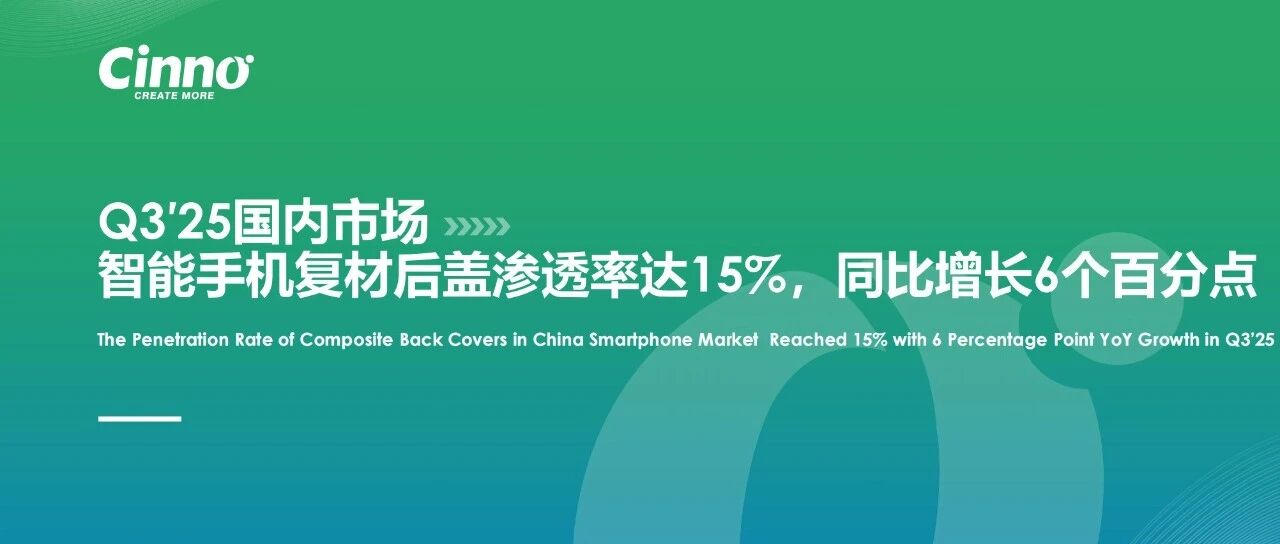
Core Insights - The penetration rate of composite material back covers in the domestic smartphone market reached 15% in Q3 2025, representing a year-on-year increase of 6 percentage points [2]. Group 1: Market Trends - The report covers the changes in the penetration rates of various materials used for smartphone front and back covers in the Chinese market from Q1 2023 to Q3 2025 [3]. - It provides a detailed analysis of the sales volume and market share of different specifications of smartphone back covers across major brands in China [2][3]. Group 2: Brand-Specific Analysis - The report includes data on the sales volume and market share of Honor smartphones' back cover specifications from Q1 2023 to Q3 2025 [3]. - It also details the brand share of glass back covers in the Chinese smartphone market during the same period [3]. - The analysis extends to the brand share of composite material back covers in the market from Q1 2023 to Q3 2025 [3]. - Additionally, it presents the average price trends of different back cover specifications in the market over the specified period [3]. - Specific brand analyses include sales volume and market share for Apple, Huawei, Vivo, Xiaomi, and OPPO smartphones' back cover specifications from Q1 2023 to Q3 2025 [3].
不上不下的中端手机,正陷入“进退两难”
3 6 Ke· 2025-11-04 23:53
Core Insights - The global smartphone market is experiencing a rebound, with sales growth of approximately 4% to 7% year-on-year, primarily concentrated in high-end and low-end segments, while the mid-range market is losing growth opportunities [1][3] - The mid-range segment, which includes 500 million users in China, is highly competitive, with brands focusing on high performance and cost-effectiveness [1][4] - The shift from an incremental to a saturated market is evident, as the average selling price of smartphones is projected to be $356 in 2024, while 70% of consumers are resistant to price increases [3][4] Market Dynamics - The mid-range smartphone market is under unprecedented pressure due to the influx of new models, with 396 new models expected in 2024, most of which are mid-range [4][6] - Price wars are intensifying, leading to a decline in the perceived value of mid-range devices, as many models are seeing price reductions of 200 to 400 yuan compared to previous generations [7][9] - High-end smartphones are also reducing prices, further eroding the competitive edge of mid-range devices, as consumers can access high-end features at lower prices [8][9] Consumer Behavior - Consumers are increasingly price-sensitive, preferring low-cost practical options or being attracted to discounted high-end models, which complicates the mid-range market's dynamics [9][10] - The gaming segment is becoming a focal point for mid-range brands, with several new models emphasizing gaming performance to attract younger consumers [10][12] - The demand for smartphones among younger users is growing, with a significant portion of the market being captured by brands that cater to gaming and social media needs [12][13] Profitability Challenges - Despite a stable production increase in the smartphone industry, profitability is declining, with major brands like Xiaomi and Huawei reporting significant drops in profit margins [14][15] - Rising component costs, particularly for memory chips, are squeezing margins, leading to a dilemma where brands must choose between raising prices or absorbing costs [16][20] - Companies are exploring strategies to enhance product value through technology investments and expanding user bases to offset rising costs [21][22]

Vivo X300 Pro, X300 India launch soon: Check price, date, features, specifications, camera and other details
DNA India· 2025-11-01 07:46
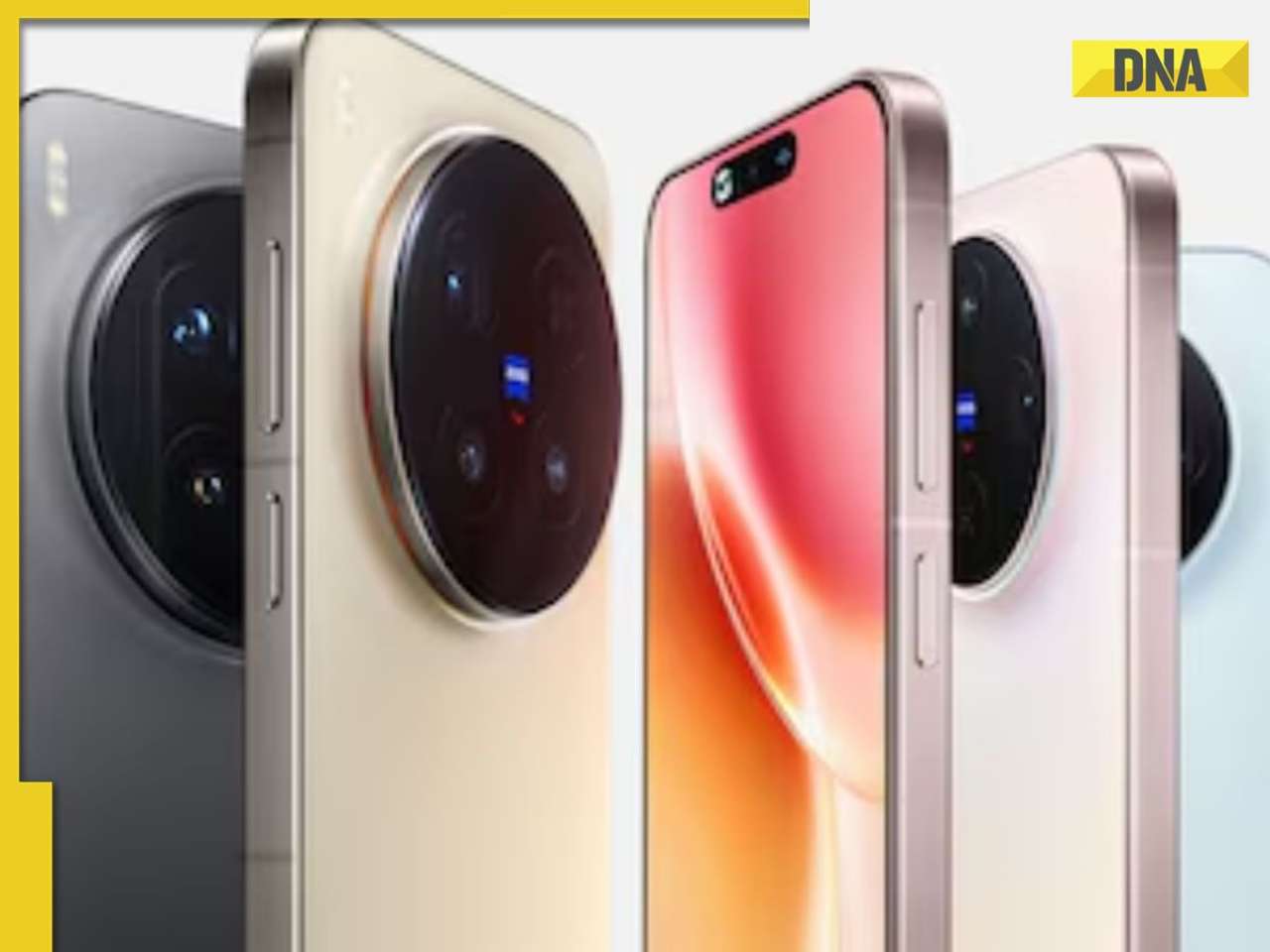
Core Insights - Vivo is preparing to launch its X300 series in India in early December 2025, featuring significant upgrades in display, camera, and performance [1][2][3] Launch Timeline - The Vivo X300 series is expected to debut in the first week of December 2025, with availability through Vivo's official e-store, Flipkart, and other major retail outlets [3] Design and Build - The X300 series will retain the signature circular Zeiss-branded camera module, with the X300 likely available in Halo Pink and Phantom Black, while the X300 Pro may launch in Dune Brown and Phantom Black [4] Display and Performance - The X300 Pro is anticipated to feature a 6.78-inch 1.5K BOE Q10+ LTPO OLED flat display with a 120Hz refresh rate, while the standard X300 is expected to have a slightly smaller 6.31-inch display with similar specifications [5] - Both models will be powered by MediaTek's Dimensity 9500 chipset and LPDDR5X RAM for enhanced performance and power efficiency [5][6] Battery Specifications - The X300 Pro is expected to have a 5,440mAh battery, while the X300 will feature a 5,360mAh battery, both supporting 90W wired and 40W wireless fast charging [6] Camera Specifications - The X300 Pro may include a 50MP Sony LYT-828 main sensor, a 50MP ultra-wide Samsung JN1 lens, and a 200MP periscope telephoto sensor, while the standard X300 might feature a 200MP Samsung HPB primary lens and a 50MP ultra-wide camera [7][8] - Both devices are expected to utilize Zeiss imaging technology, with the Pro model incorporating Vivo's V3+ and Vs1 imaging chips, and a 50MP front camera for selfies [8] Expected Pricing - The Vivo X300 is anticipated to be priced around Rs 69,999, while the X300 Pro may cost approximately Rs 99,999 in India, though these prices are not yet officially confirmed [9]

机构:2年内AI手机全球累计出货量超5亿台
Huan Qiu Wang Zi Xun· 2025-11-01 03:53
Core Insights - The global shipment of generative AI smartphones has surpassed 500 million units by Q3 2025, just under two years since their debut at the end of 2023 [1][3] Group 1: Market Growth - The initial rapid growth of generative AI smartphones is primarily driven by high-end smartphones priced over $600 [3] - The growth focus is shifting from the high-end market to the mid-to-high-end market, with Chinese manufacturers being the main drivers of this transition [3] Group 2: Competitive Strategies - Chinese manufacturers are actively integrating lightweight large language models (LLMs) and multimodal AI assistants into smartphones to differentiate themselves in a competitive market [3]

Should you buy Apple's stock after earnings? These analysts see better options.
MarketWatch· 2025-10-31 13:54
Core Insights - Apple is observing an improvement in iPhone trends, indicating a potential positive shift in consumer demand and sales performance [1] - Analysts have noted that Apple's stock is currently more expensive compared to other hardware and smartphone companies such as Qualcomm and Alphabet, suggesting a valuation concern [1] Summary by Categories Company Performance - The improvement in iPhone trends may lead to better sales figures for Apple in the near future, reflecting a recovery in the smartphone market [1] Market Comparison - Apple's stock valuation is highlighted as being higher than competitors like Qualcomm and Alphabet, raising questions about its investment attractiveness relative to these companies [1]
'Why Are There So Many iPhones?' — Samsung Chairman Lee Jae-Yong Cracks Up Crowd During Seoul Meetup With Nvidia CEO Jensen Huang - Samsung Electronics Co (OTC:SSNLF)
Benzinga· 2025-10-31 09:15
Group 1: Key Events - Samsung Electronics Chairman Lee Jae-Yong humorously pointed out the presence of iPhone users during a dinner with Nvidia CEO Jensen Huang and Hyundai Chairman Chung Eui-sun in Seoul [1][2] - The informal dinner took place at Kkanbu Chicken, a popular restaurant in Gangnam, attracting a crowd eager to see the tech leaders [2] Group 2: Market Context - Samsung holds a dominant 68.19% share of the South Korean smartphone market, while Apple has a 21.44% share [3] - Globally, Apple leads with a 24.45% market share, compared to Samsung's 19% [3] Group 3: Financial Performance - Apple reported strong fourth-quarter results with $102.47 billion in revenue, an 8% increase year-over-year, and iPhone sales reaching $49.02 billion [4]