
保险业

Search documents
金融监管总局召开2026年监管工作会议
Jin Rong Shi Bao· 2026-01-16 01:11
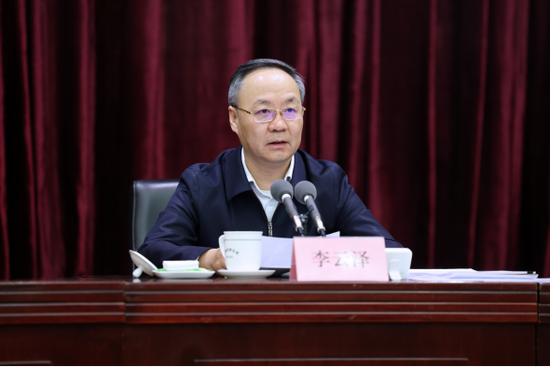
本报讯 记者余嘉欣 孙榕报道 1月15日,国家金融监督管理总局召开2026年监管工作会议,深入贯 彻党中央、国务院决策部署,系统总结2025年工作,统筹安排2026年重点任务。金融监管总局党委书 记、局长李云泽出席会议并讲话,总局党委班子成员出席会议。 会议指出,2025年,金融监管总局系统上下紧紧围绕防风险、强监管、促高质量发展工作主线,迎 难而上、真抓实干,牢牢守住不发生系统性金融风险的底线,各项工作取得积极进展。一是坚定不移推 进全面从严治党。严格落实"第一议题"制度。深入学习宣传贯彻党的二十届四中全会精神。从严从实推 进中央巡视整改。扎实开展深入贯彻中央八项规定精神学习教育。二是有力有序防范化解重点风险。中 小金融机构改革化险取得重大进展。城市房地产融资协调机制扩围增效。积极支持融资平台经营性金融 债务接续置换重组。防非打非工作机制实现省市县三级全覆盖。三是强监管严监管氛围逐步形成。金融 监管法制加快健全。严厉惩治违法违规行为。会同公安等部门坚决打击金融领域"黑灰产"。四是综合施 策引领行业改革转型。持续推进保险业"报行合一"和预定利率调整,加力推动银行业提质增效。支持金 融机构多渠道补充资本。五是精 ...
中信建投:A股预计迎来可观量级的增量资金,有望推动慢牛持续
Xin Lang Cai Jing· 2026-01-16 00:00
Core Viewpoint - The A-share market is expected to welcome a significant amount of incremental funds in 2026, which may sustain a slow bull market. The first quarter is projected to be the peak period for the maturity of fixed deposits, with funds likely flowing from insurance and wealth management channels into the equity market, marking the most abundant time for incremental funds throughout the year [3][4][62]. Group 1: Incremental Funds Sources - Incremental funds are primarily sourced from the migration of household deposits and pressures from asset scarcity, with insurance premium income continuing to grow significantly. By Q3 2025, the equity allocation ratio is expected to rise to 15.5%, nearing historical highs, which could release over 840 billion yuan into the market [4][6][66]. - The total amount of fixed deposits maturing in 2026 is estimated to be around 45 trillion yuan, which will likely lead to increased allocations in wealth management and "fixed income+" products, contributing over 900 billion yuan in medium to long-term funds to the A-share market [4][14][17]. - Public funds are expected to see a net inflow of approximately 230 billion yuan in 2026, driven by the recovery of fund net values and the enhanced motivation of individual investors to enter the market [4][33][34]. Group 2: Market Dynamics - The market's main contradictions in 2026 will shift towards verifying economic prosperity and performance realization, with medium to long-term funds providing a safety net. Active funds from public and private sectors are anticipated to further strengthen the "technology + resource products" dual mainline market, with accelerated sector rotation [4][62][64]. - The "national team" funds are expected to see a significant reduction in inflows, with a projected net inflow of about 200 billion yuan in 2026, as their role shifts in a bull market environment [19][22][23]. - High-risk funds, represented by margin trading and private equity, are expected to remain active, with margin trading net inflows estimated at around 450 billion yuan and private equity assets projected to grow to 8.5 trillion yuan, contributing approximately 700 billion yuan in incremental funds [4][26][31]. Group 3: Global and Domestic Influences - Overseas funds are anticipated to strategically allocate to Chinese assets, with northbound capital expected to net inflow around 100 billion yuan in 2026, although this impact on the overall market is expected to be limited [4][36][39]. - The macro liquidity environment is favorable, with a global interest rate cut cycle entering its later stages, but the marginal improvement in policies is expected to gradually converge. The micro-funding situation is likely to improve significantly, supporting a strong performance in equities over fixed income [4][45][49].



从沙盘推演走向实际赔偿: 董责险穿越费率洼地
Zhong Guo Zheng Quan Bao - Zhong Zheng Wang· 2026-01-15 23:33
Core Viewpoint - The upcoming regulations on the management of company secretaries in listed companies aim to enhance risk awareness and governance quality, which is expected to increase the demand for Directors and Officers Liability Insurance (D&O insurance) in the A-share market [1][3]. Group 1: Regulatory Changes and Market Trends - New regulations for company secretaries are being drafted to improve their performance and risk awareness, which will likely stimulate the demand for D&O insurance [1][3]. - A report indicates that by the end of 2025, over 1,750 A-share listed companies are expected to disclose their D&O insurance purchase plans, reflecting a rapid increase in market penetration [2][3]. Group 2: Industry Insights and Growth - The manufacturing sector leads in the number of companies purchasing D&O insurance, particularly in the computer, communication, and electronic equipment manufacturing industries [3]. - The implementation of new securities and company laws has significantly contributed to the rising penetration of D&O insurance in the A-share market [3][4]. Group 3: Financial Aspects and Pricing - The average premium for D&O insurance remains low, with some policies having coverage limits exceeding 100 million yuan and premiums around 300,000 yuan [6][5]. - The average D&O insurance rate is currently below 0.5%, with expectations of an increase in rates due to rising litigation risks and more claims being reported [6][7]. Group 4: Future Outlook and Recommendations - The D&O insurance market is currently in a "soft cycle," characterized by an oversupply and low prices, but this is expected to change as more claims emerge [7][8]. - To enhance the D&O insurance market, it is recommended to establish mandatory disclosure of insurance details by listed companies and improve the understanding of D&O insurance's role in corporate governance [8][9].
国家金融监督管理总局召开2026年监管工作会议
Xin Lang Cai Jing· 2026-01-15 12:57
Core Viewpoint - The Financial Regulatory Bureau held a meeting to summarize the work of 2025 and arrange key tasks for 2026, emphasizing the importance of risk prevention, strong regulation, and promoting high-quality development in the financial sector [2][10]. Group 1: Achievements in 2025 - The Financial Regulatory Bureau focused on preventing systemic financial risks, achieving significant progress in various areas, including the reform of small and medium-sized financial institutions and the expansion of urban real estate financing coordination mechanisms [3][11]. - A strong regulatory atmosphere has gradually formed, with accelerated improvement of financial regulatory laws and strict punishment of illegal activities [3][11]. - Comprehensive measures have been implemented to lead industry reform and transformation, including the promotion of insurance industry integration and support for financial institutions to supplement capital through multiple channels [3][11]. Group 2: Key Tasks for 2026 - The year 2026 marks the beginning of the "14th Five-Year Plan," and the financial system is urged to adhere to the new development philosophy and promote risk prevention, strong regulation, and high-quality development [4][12]. - The meeting emphasized the need to enhance political awareness and responsibility, effectively manage risks in small financial institutions, and prevent illegal financial activities [5][13]. - There is a focus on improving the quality of industry development, optimizing the layout of financial institutions, and promoting high-level financial openness [5][13]. Group 3: Strengthening Political Construction - The meeting highlighted the importance of placing political construction at the forefront, enhancing the centralized and unified leadership of the Party over financial work, and strengthening the construction of party organizations at all levels [6][14]. - Continuous efforts will be made to combat financial corruption and prevent financial risks, maintaining a high-pressure stance [6][14]. - The establishment of a long-term mechanism for central inspection rectification is emphasized to ensure accountability and enhance the political function of the regulatory team [6][14]. Group 4: Financial Services and Support - The meeting outlined the need to enhance financial services for economic and social quality, focusing on major strategies and key areas [5][13]. - There is a commitment to support small and micro enterprises, optimize financial services for new employment groups, and promote stability in enterprises and employment [5][13]. - The importance of integrating investment in material and human resources to support economic growth is also highlighted [5][13].
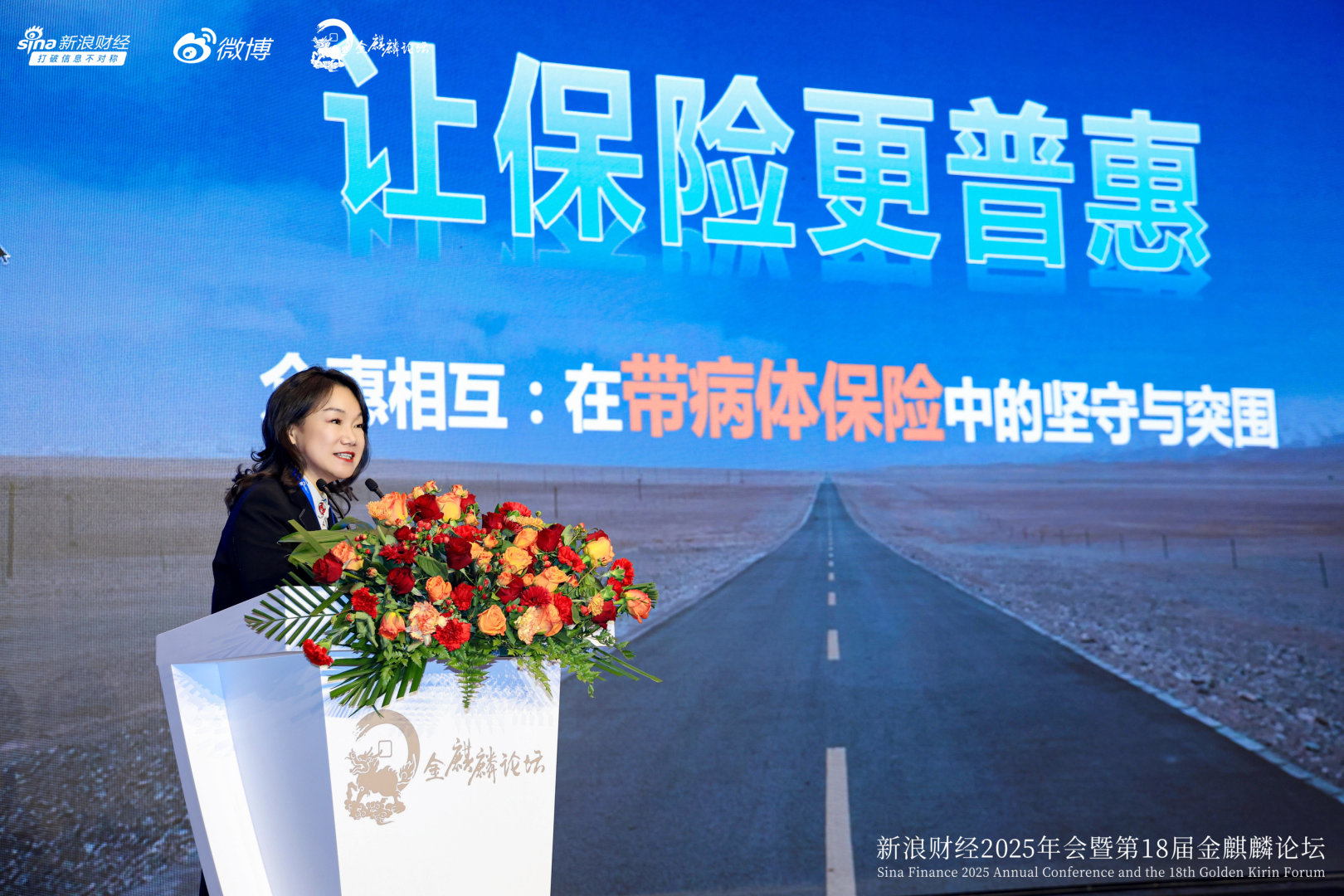
李静:以专病保障与健康管理闭环 推动普惠保险高质量发展
Xin Lang Cai Jing· 2026-01-15 09:27
Core Viewpoint - The essence of insurance is inclusive, and the population with pre-existing conditions is a key focus for inclusive insurance, addressing the protection gap for the 400 million individuals with health issues is essential for the high-quality development of the insurance industry [1][4][12] Policy Support - Various regulatory documents from the China Banking and Insurance Regulatory Commission and the National Financial Regulatory Administration encourage the development of commercial medical insurance targeting individuals with chronic diseases and pre-existing conditions [4][12][13] - The "Healthy China 2030" plan emphasizes the establishment of a multi-tiered medical security system, promoting the development of health commercial insurance and encouraging collaboration between insurance companies and healthcare institutions [4][12][13] Company Initiatives - Since its establishment in 2017, the company has focused on filling gaps in insurance coverage, particularly for underserved populations, and has implemented various mutual insurance plans and specialized disease insurance products [6][14] - The company has launched initiatives such as the "Hepatitis Care" product, which provides comprehensive health management services for chronic liver disease patients, aiming to reduce the incidence of liver cancer and improve patient outcomes [15][16] Project Outcomes - The "Hepatitis Care" product is set to officially launch in May 2025, with preliminary results showing participation from 13,317 patients and the collection of 18.64 million yuan in public welfare funds [16] - The health management program has demonstrated significant adherence, with 82% of insured patients following medical advice and maintaining standardized treatment protocols [16]
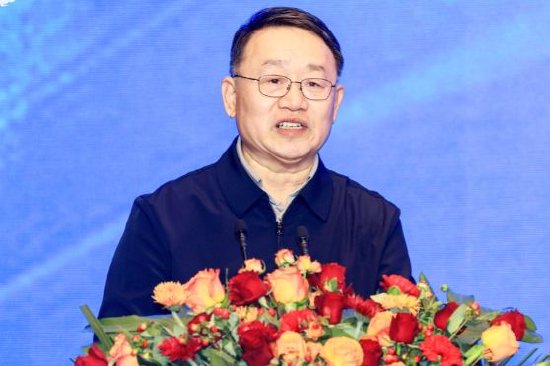
梁涛:现在的机构养老太贵 70%的市场在居家养老、社区养老
Xin Lang Cai Jing· 2026-01-15 09:05
Core Viewpoint - The current elderly care market is facing contradictions, including the exit of major players and a significant gap between market demand and actual operations [2][11]. Group 1: Market Conditions - The demand for elderly care institutions should be increasing due to the aging population, yet many institutions are experiencing high vacancy rates and financial losses [3][11]. - Research indicates that only about 4% of elderly care institutions are profitable, while approximately 35% are operating at a loss [3][12]. - In Beijing, the average retirement pension for employees in 2024 is projected to be 4,658 yuan, while the cost of care facilities for disabled elderly individuals is generally above 5,500 yuan, with prices exceeding 10,000 yuan in central urban areas [3][12]. Group 2: Pricing and Demand Mismatch - The value of the elderly care market is determined not by the number of elderly individuals but by their payment capacity and the availability of corresponding services [4][13]. - As of the end of 2024, there are 406,000 various elderly care institutions and facilities in China, with 7.99 million beds available, which is insufficient compared to the 310 million elderly population [5][14]. - Despite the theoretical demand, actual occupancy rates remain low, highlighting the complexity of the market and insufficient consideration of the real needs of the elderly [5][14]. Group 3: Future Directions - The insurance industry should focus on a balanced approach, primarily emphasizing lighter models of elderly care [6][15]. - Insurance companies are currently involved in the elderly care sector mainly through self-owned or self-built institutions, which can lead to financial pressure and deviation from their core business [6][15]. - There is a need to balance high-end elderly care with inclusive services, promoting affordable, quality, and sustainable care options [7][16].
2025中国企业ESG“金责奖”评选结果揭晓 共筑可持续发展新生态
Xin Lang Cai Jing· 2026-01-15 02:38
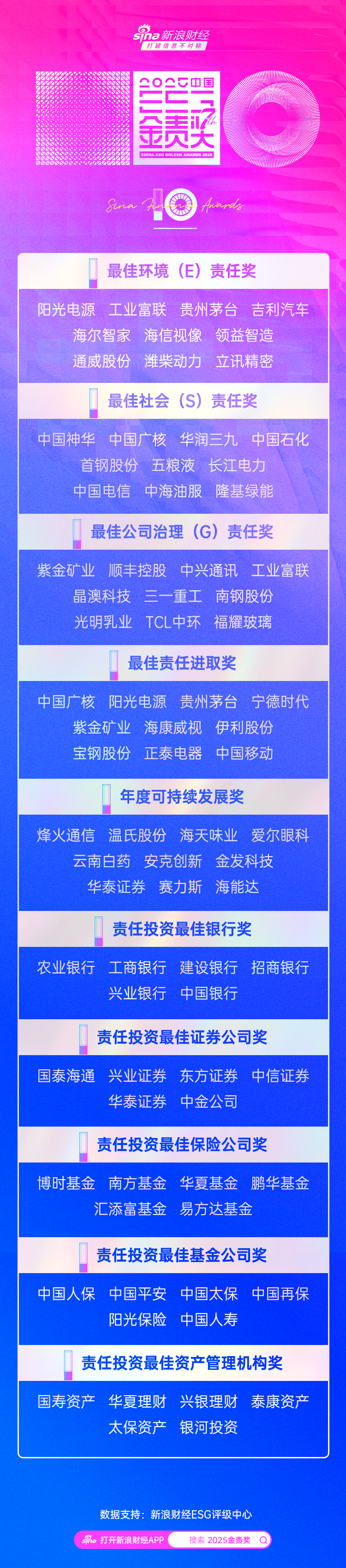
Core Viewpoint - The 2025 China Enterprise ESG "Golden Responsibility Award" aims to recognize companies and institutions that have made significant contributions to ESG initiatives in China, reflecting a shift from voluntary practices to compliance requirements in ESG performance [1][18]. Group 1: Award Categories and Winners - The award includes ten categories: Best Environmental Responsibility Award, Best Social Responsibility Award, Best Corporate Governance Responsibility Award, Best Responsibility Initiative Award, Annual Sustainable Development Award, Best Responsible Investment Bank Award, Best Responsible Investment Securities Company Award, Best Responsible Investment Insurance Company Award, Best Responsible Investment Fund Company Award, and Best Responsible Investment Asset Management Institution Award [1][18]. - The Best Environmental Responsibility Award winners include: Sungrow Power Supply, Industrial Fulian, Kweichow Moutai, Geely Automobile, Haier Smart Home, Hisense Visual Technology, Linyang Electronics, Tongwei Co., Weichai Power, and Luxshare Precision [10][28]. - The Best Social Responsibility Award winners include: China Shenhua, China General Nuclear Power, China Resources Sanjiu, Sinopec, Shougang, Wuliangye, Yangtze Power, China Telecom, China Oilfield Services, and LONGi Green Energy [10][28]. - The Best Corporate Governance Responsibility Award winners include: Zijin Mining, SF Holding, ZTE Corporation, Industrial Fulian, JA Solar, Sany Heavy Industry, Nanjing Steel, Bright Dairy, TCL Zhonghuan, and Fuyao Glass [10][28]. - The Best Responsibility Initiative Award winners include: FiberHome Technologies, Wens Foodstuff Group, Haitian Flavoring and Food, Aier Eye Hospital, Yunnan Baiyao, Anker Innovations, Kingfa Sci. & Tech., Huatai Securities, Silex, and Hainengda [11][28]. - The Annual Sustainable Development Award winners include: China General Nuclear Power, Sungrow Power Supply, Kweichow Moutai, Contemporary Amperex Technology, Zijin Mining, Hikvision, Yili, Baosteel, Chint Electric, and China Mobile [11][28]. Group 2: Responsible Investment Awards - The Best Responsible Investment Bank Award winners include: Agricultural Bank of China, Industrial and Commercial Bank of China, China Construction Bank, China Merchants Bank, Industrial Bank, and Bank of China [11][28]. - The Best Responsible Investment Securities Company Award winners include: Guotai Junan, Everbright Securities, CITIC Securities, Huatai Securities, and CICC [12][28]. - The Best Responsible Investment Insurance Company Award winners include: China Life Insurance, China Ping An, China Pacific Insurance, China Re, Sunshine Insurance, and China Life [13][28]. - The Best Responsible Investment Fund Company Award winners include: Bosera Funds, Southern Fund, China Asset Management, Penghua Fund, Huitianfu Fund, and E Fund [14][28]. - The Best Responsible Investment Asset Management Institution Award winners include: China Life Asset Management, Huaxia Wealth Management, Xingyin Wealth Management, Taikang Asset, Taikang Asset, and Galaxy Investment [15][28]. Group 3: ESG Development Context - By 2025, China's ESG development has transitioned from "setting standards" to "strengthening regulations," with a comprehensive disclosure standard system being established [1][18]. - The ESG performance of enterprises is now a compliance requirement, linking commercial value with social value [1][18]. - The ESG rating center aims to promote sustainable development and responsible investment, enhancing the ESG performance of listed companies [17][34].


大摩闭门会-原材料-金融-交运行业更新-纪要
2026-01-15 01:06
Summary of Key Points from Conference Call Industry Overview - The conference call primarily discusses the financial, insurance, and transportation industries, with a focus on market trends and investment opportunities for 2026 [1][2][19]. Financial Industry Insights - **Loan Rates**: Loan rates are expected to gradually rebound due to regulatory changes, improved pricing awareness, and a balance in supply and demand. The central bank has shifted its focus from lowering financing costs to maintaining them at low levels, which will reduce pressure for rate cuts [3][4]. - **Market Activity**: An active capital market is beneficial for the financial sector, leading to increased household financial asset growth and significant contributions to fee income from new technologies and economic stabilization [6]. - **Investment Opportunities**: Preferred banks include Ningbo Bank and Minsheng Bank, with strong growth potential. In the insurance sector, China Life Insurance and regional insurers are highlighted as having significant growth potential [5][9]. Insurance Sector Projections - **Premium Growth**: The insurance industry is expected to see strong growth in new premiums and business value in 2026, driven by improved product attractiveness and the expansion of major companies in the bancassurance channel [9]. - **Investment Trends**: In 2025, insurance capital is projected to enter the market at approximately 1.8 trillion RMB, with about 1 trillion RMB flowing into the stock market. A shift from high-dividend stocks to growth stocks is anticipated [11]. Brokerage Industry Outlook - **Operating Environment**: The brokerage industry is expected to have a favorable operating environment in 2026, with active trading and a more friendly regulatory environment. Firms like Dongfang Caifu are expected to perform well due to high trading volumes [12]. - **IPO Activity**: The IPO market is anticipated to remain active, with a significant recovery in financing volumes expected in 2026, benefiting brokers with strong underwriting capabilities [13][14]. Transportation Industry Analysis - **Airline Sector**: The airline industry is in an upward cycle, with supply constraints due to delayed aircraft deliveries and increased demand for air travel in China. Policies promoting tourism and infrastructure investment are expected to support growth [19][20]. - **Shipping and Express Delivery**: The oil shipping sector is poised for growth due to increased demand for compliant vessels, while the express delivery market is expected to consolidate, with leading players gaining market share [19][21]. Market Risks and Challenges - **Risk Management**: The financial sector is effectively managing risks, particularly in manufacturing and small enterprises. Real estate risks are being closely monitored by authorities [7][8]. - **Economic Outlook**: The macroeconomic environment is stable, which is favorable for the financial sector's development. However, the shipping industry faces risks related to macroeconomic demand outlooks [20]. Additional Insights - **Commodity Markets**: The export of photovoltaic components and batteries is expected to increase significantly, impacting the electrolytic aluminum market. The lithium carbonate market is experiencing price increases due to environmental inspections and production delays [22][23]. - **Copper and Aluminum Supply**: The copper market is facing supply constraints, while aluminum prices are supported by strong demand from the photovoltaic sector [25][26]. This summary encapsulates the key insights and projections from the conference call, highlighting the financial, insurance, and transportation industries' dynamics and investment opportunities for 2026.
利空也砸不下大A
虎嗅APP· 2026-01-15 00:29
Core Viewpoint - The A-share market is experiencing extreme enthusiasm, prompting regulatory measures to cool down the market, indicating a shift towards a "slow bull" market rather than a "crazy bull" market, emphasizing the need for investors to focus on fundamentals rather than emotions [5][6]. Market Sentiment and Regulatory Response - On January 14, the exchange announced an increase in the minimum margin ratio for financing from 80% to 100%, leading to an immediate market downturn [5]. - The regulatory stance is clear: the market can rise, but it should not be driven solely by emotions, and investors must return to fundamentals [6]. Investment Opportunities and Risks - The focus should be on identifying key sectors that are likely to perform well while avoiding those that may pose risks [7][8]. - The analysis will cover 13 high-interest sectors to provide insights on potential investment opportunities [9]. AI Computing Power - The rise of AI infrastructure is supported by increased investments from cloud vendors, with companies like "易中天" (New Yizhong, Zhongji Xuchuang, Tianfu Communication) showing significant stock price increases [11]. - However, the current high valuations may be unsustainable, and without new positive developments, there is a risk of a bubble burst in this sector [11]. Space Computing Industry - The space computing industry is expected to emerge as a significant market, with technologies deploying data centers in space to address ground-based limitations [13][15]. - China's advancements in space computing are supported by government initiatives, with plans for a comprehensive deployment strategy by 2025 [17][18]. Humanoid Robots - The humanoid robot sector is anticipated to see differentiation by 2026, with industrial applications being the primary focus, while household robots remain underdeveloped [20][22]. - Companies like 优必选 (UBTECH) are ramping up production, with expectations of significant output increases in the coming years [22][23]. Semiconductor Equipment - Domestic wafer fabs are planning expansions to meet AI chip demand and enhance production capacity, which will benefit semiconductor equipment suppliers [25][26]. Controlled Nuclear Fusion - The commercialization of controlled nuclear fusion is accelerating, with multiple technological pathways being explored [28][30]. - China is making significant strides in fusion energy, with projects like EAST and BEST expected to lead to practical applications by 2027 [32][33]. Commercial Aerospace - The commercial aerospace sector is experiencing a surge, driven by fears of missing out on investment opportunities, although there are concerns about the sustainability of this growth [41][42]. - China's satellite deployment is rapidly increasing, positioning the country as a major player in the global space race [44]. Photovoltaics - The photovoltaic sector is expected to reach a turning point in 2026, driven by supply-side adjustments and improved fundamentals [47][51]. - The cancellation of export tax rebates is likely to increase costs for exporters, benefiting larger firms with economies of scale [51][52]. Consumer Sector - The consumer sector is seen as a safe haven during market volatility, with specific focus areas including media, service consumption, and premium goods like liquor [66][70]. - The overall consumer demand is expected to recover gradually, but structural changes may lead to a lack of strong support for broad-based growth [67]. Banking Sector - The banking sector has shown resilience despite fundamental pressures, with attractive dividend yields drawing in long-term investors [72][73]. - However, the sector is unlikely to lead the market due to its lower growth potential compared to technology and growth stocks [74]. Insurance Sector - The insurance sector has outperformed banks, benefiting from stock market recovery and expected growth in both asset and liability sides [76]. - The aging population is likely to increase the importance of insurance companies in key areas like healthcare and retirement [76]. Brokerage Firms - Brokerage firms have seen strong earnings growth but face challenges in maintaining investor interest due to perceived volatility and lack of long-term growth [77].

莆田监管分局同意筹建中国渔业互助保险社福建分社湄洲岛营业部
Jin Tou Wang· 2026-01-14 04:17
三、筹建期间接受莆田金融监管分局的监督指导,不得从事金融业务活动。 一、同意筹建中国渔业互助保险社福建分社湄洲岛营业部。 二、中国渔业互助保险社福建分社应严格按照有关法律法规要求办理筹建事宜,自批复之日起6个月内 完成筹建工作。 2026年1月5日,国家金融监督管理总局莆田监管分局发布批复称,《中国渔业互助保险社福建分社关于 设立湄洲岛营业部的请示》(渔保闽请〔2025〕11号)材料收悉。经审核,现批复如下: 四、筹建工作完成后,应按照有关规定和程序向莆田金融监管分局提交开业验收报告。 ...