Automobiles

Search documents
大空头Michael Burry-股权激励的 “悲剧代数”:拆解股权稀释背后的价值损耗逻辑-The Tragic Algebra of Stock-Based Compensation
2025-12-04 02:21
Summary of Key Points from the Conference Call Industry and Company Involvement - The discussion primarily revolves around the **technology sector**, particularly focusing on **stock-based compensation (SBC)** practices within companies like **Tesla**, **Palantir**, **Amazon**, and **Nvidia** [4][5][19][35]. Core Insights and Arguments - **Valuation Methodology**: The traditional discounted cash flow (DCF) approach is deemed inadequate for companies that frequently issue stock-based compensation, leading to a misrepresentation of their true value [4][7]. - **SBC Practices**: There is a significant increase in stock-based compensation costs over the last decade, which are often not accurately reflected in GAAP or adjusted earnings reported by companies [7][8]. - **Dilution Impact**: The dilution caused by SBC is a critical factor that negatively affects shareholder value. Companies that utilize SBC dilute ownership, which must be accounted for in valuation models [12][26]. - **Warren Buffett's Perspective**: Buffett's critique highlights that SBC should be considered an expense, as it represents a transfer of value from shareholders to employees [10][11]. - **Growth vs. Dilution**: Higher growth rates do not necessarily mitigate the negative effects of dilution. Companies with high growth can still suffer significant value loss due to SBC [30][32]. Additional Important Content - **Examples of Companies**: - **Tesla** dilutes shareholders at approximately 3.6% annually without buybacks, leading to substantial present value destruction [32][33]. - **Palantir** has a dilution rate of about 4.6% annually and has no earnings after adjusting for SBC [34]. - **Amazon** has diluted shareholders at around 1.3% annually, with the dilution value exceeding its net income since 2018 [35][36]. - **Nvidia** has repurchased $91 billion of its stock since 2018, but its cumulative operating cash flow is less than its net income due to working capital changes [43][44]. - **Market Dynamics**: The analysis suggests that many popular companies engage in buybacks that do not effectively reduce share count, leading to a false sense of security regarding shareholder value [38][39]. - **Long-term Viability**: The discussion emphasizes that predicting long-term growth rates, especially at levels like 15%, is overly optimistic and often unrealistic [13][23]. This summary encapsulates the critical insights and arguments presented in the conference call, focusing on the implications of stock-based compensation in the technology sector and its impact on company valuations and shareholder interests.



FERRARI N.V. SIGNS A NEW SYNDICATED REVOLVING CREDIT FACILITY
Globenewswire· 2025-12-03 18:28
Core Insights - Ferrari has signed a Euro 350 million unsecured committed revolving credit facility for general corporate and working capital purposes [1][2] - The new facility has a five-year term with two one-year extension options, replacing the previous Euro 350 million facility due December 2026 [2] - The new credit facility offers a lower cost of capital compared to the prior facility, indicating strong support from a group of twelve international banks [3] Company Overview - Ferrari is a leading luxury brand known for its racing, sports cars, and lifestyle products, symbolizing exclusivity and innovation [4] - The brand is closely associated with its Formula 1 team, Scuderia Ferrari, which has won 16 Constructors' and 15 Drivers' world titles since 1950 [4] - Ferrari designs and produces iconic luxury sports cars sold in over 60 markets worldwide, along with personal luxury goods and experiences [4]



Michelin, Forvia and Stellantis agree on Symbio restructuring plan
Reuters· 2025-12-03 14:13
Core Insights - Michelin, Forvia, and Stellantis have reached an agreement regarding the restructuring and refinancing of Symbio, a hydrogen fuel cell firm jointly owned by the three companies [1] Company Summary - The agreement involves the restructuring and refinancing of Symbio, indicating a strategic move by Michelin, Forvia, and Stellantis to strengthen their position in the hydrogen fuel cell market [1]

Risk sentiment returns to markets, U.S.-Russia talks fall short
Youtube· 2025-12-03 08:02
Market Overview - US stocks closed higher, driven by key AI companies, boosting hopes for a year-end Santa rally [2][19] - Bitcoin surged towards the $94,000 level, recovering from a recent selloff, with notable volatility [20][21] - The VIX, a volatility indicator, has decreased as markets stabilized, with the NASDAQ experiencing a 3% rally over the past two weeks [4][5] AI Industry Dynamics - OpenAI is under pressure as competitors like Google and Anthropic gain ground, with Anthropic preparing for a potential IPO in 2026 [6][7][57] - The competitive landscape in AI is intensifying, leading to concerns about commoditization and reduced profit margins for AI technologies [8][9][10] - OpenAI's CEO issued a "code red" memo, indicating urgency in improving their chatbot product amid rising competition [11][58] Economic Outlook - The macroeconomic environment is perceived as favorable, with equities at all-time highs and credit spreads at 15-year lows, but the probability of sustained perfection is low [28][31] - Inflation is expected to rise due to strong demand and supply chain constraints, with potential implications for central bank policies [32][35] - Japan's inflation is increasing, with corporate profitability rising significantly, indicating a need for higher interest rates [42][44] Geopolitical Factors - Ongoing Russia-Ukraine peace talks have not yielded results, which may have implications for European markets [51][53] - The potential resolution of the Ukraine conflict could positively impact the European economy, but expectations for a quick resolution are low [52][53] Company-Specific Insights - Nissan's CFO highlighted the company's success in China, attributing it to giving local teams maximum autonomy to meet customer demands [66][71] - The company is launching new models in Japan and Europe, aiming to enhance its global relevance [68][72]

Hyundai Motor Group Unveils Production-Ready Autonomous Mobility Robot Platform 'MobED' at iREX 2025
Prnewswire· 2025-12-03 01:00
Core Insights - Hyundai Motor Group has unveiled MobED, its first mass-produced mobility robot platform, at the International Robot Exhibition 2025 in Tokyo, showcasing advancements in robotics technology [1][2]. Group 1: Product Overview - MobED is a fully autonomous mobility robot platform that has evolved from a concept presented at CES 2022 to a production-ready model utilizing artificial intelligence [2]. - The platform is designed for diverse industrial and everyday applications, aiming to set new standards in the global robotics market [3][5]. Group 2: Key Features - MobED is defined by three main pillars: Adaptive Mobility (hardware), Intuitive Autonomy (software), and Infinite Journey (applications), highlighting its innovative approach to robotics functionality [4][5]. - The robot features AI-based autonomous navigation, LiDAR-camera fusion sensors, and an eccentric posture control mechanism, ensuring stable and adaptive movement [5]. Group 3: Market Position and Future Plans - MobED will be available in two models, MobED Pro and MobED Basic, with sales expected to begin in the first half of 2026 [5]. - A technical seminar and capability showcase for MobED will take place at the Group's booth during iREX 2025 from December 3 to 6 [5].

Bitcoin bounces back, Dell founder gifts $6 billion for 'Trump accounts'
Youtube· 2025-12-02 22:17
Market Overview - The stock market is experiencing a rebound, with the Dow up over 200 points, indicating a recovery from previous risk-off sentiment [2][3] - The Nasdaq has increased by 0.75%, while the S&P 500 is up about 0.5%, reflecting a general positive trend in the market [2][3] - The VIX volatility index has decreased, suggesting reduced market volatility compared to recent weeks [3] Sector Performance - Technology stocks are leading the market, with a notable increase of 1.11%, driven by ongoing interest in AI [5] - Energy stocks have seen a decline of 1.4%, marking them as the biggest losers in the current trading session [5] - The semiconductor sector continues to perform well, with the Philly semiconductor index up for seven consecutive days, highlighting strong investor interest [7][8] Cryptocurrency Market - Bitcoin is holding steady just below $92,000, showing a recovery of over 7% from previous lows [11][12] - Ethereum has also seen a significant increase of over 9%, indicating a positive trend in the cryptocurrency market [13] - The SEC is considering an innovation exemption for digital asset companies, which could further bolster the crypto market [12] Automotive Industry - November auto sales are estimated at 15.7 million, showing a slight improvement from October but a decline from the previous year [65] - SUVs and trucks remain the most popular vehicle types among American consumers, while compact and midsize car sales continue to decline [68][70] - The impact of tariffs on vehicle pricing has been relatively muted, with a year-over-year price increase of about 4% attributed mainly to inflation [74][76] Health Insurance Sector - Curative, a health insurance startup, has raised $150 million, achieving a valuation of $1.3 billion, focusing on preventative care [90][92] - The company reports a 30% reduction in inpatient hospital admissions within six months of employers adopting its model [92] - Curative's zero out-of-pocket cost model encourages preventive health visits, resulting in high member engagement [100][102] AI and Technology - Major firms like Bank of America and BlackRock assert that the AI boom is not a speculative bubble, with expectations for sustained growth driven by AI advancements [42][44] - The K-shaped economy is highlighted, where higher-income consumers are driving growth while lower-income consumers struggle [49][51] - OpenAI faces increasing competition from companies like Google and Anthropic, prompting a strategic shift to focus on enhancing capabilities rather than expanding offerings [55][56]



Amazon (NasdaqGS:AMZN) 2025 Conference Transcript
2025-12-02 17:02
Summary of Key Points from the Conference Call Company and Industry Overview - The conference primarily focuses on Amazon Web Services (AWS), a leading cloud computing platform, which has grown to a $132 billion business, with a year-over-year growth rate of 20% [1][2][3] - AWS is recognized for its extensive infrastructure, including the largest private network and a global network of data centers spanning 38 regions and 120 availability zones [3][4] Core Insights and Arguments - AWS's growth is attributed to various services, including S3, which handles over 500 trillion objects and hundreds of exabytes of data, and the increasing adoption of AI technologies [2][3] - The introduction of Bedrock, a platform for deploying generative AI applications, has seen significant uptake, with over 50 customers processing more than 1 trillion tokens each [30][31] - AWS's AI infrastructure is highlighted as the most scalable and powerful, with a focus on NVIDIA GPUs and the launch of new Trainium chips designed for AI workloads [14][20][21] - The company emphasizes the importance of security and compliance, particularly in sectors like healthcare and finance, where AWS has established partnerships with major organizations [5][18] Innovations and Developments - AWS has launched several new AI models and services, including Nova 2, which offers cost-optimized low-latency models, and Nova Forge, allowing customers to blend proprietary data with AWS's training datasets [47][49] - The introduction of AI Factories enables customers to deploy dedicated AI infrastructure in their own data centers, enhancing security and compliance [19] - The Trainium 3 Ultra servers, featuring the first 3-nanometer AI chip, promise significant improvements in compute performance and efficiency for AI workloads [22][23] Customer Success Stories - Companies like Eli Lilly are leveraging AWS's infrastructure to create AI Science Factories, enabling autonomous hypothesis generation and experimentation [27][28] - Sony's partnership with AWS has transformed its operations, enhancing its ability to deliver engaging customer experiences through data insights and AI capabilities [51][56] Additional Important Points - The conference highlighted the shift towards AI agents, which are expected to revolutionize business operations by automating tasks and improving efficiency [11][12][59] - AWS's commitment to supporting startups is evident, with a significant percentage of AI startups being built on its platform [6][41] - The importance of integrating proprietary data into AI models to enhance their effectiveness and relevance to specific business needs was emphasized [42][45] This summary encapsulates the key points discussed during the conference, focusing on AWS's growth, innovations, customer success stories, and the future of AI in business.
字节“造”手机:走华为造车的路,打阿里腾讯的脸?
Xin Lang Cai Jing· 2025-12-02 05:56
Core Viewpoint - ByteDance is set to release an AI-integrated smartphone in collaboration with ZTE, marking a significant move into hardware without directly manufacturing devices, leveraging its AI capabilities instead [1][2][3]. Group 1: ByteDance's Smartphone Strategy - ByteDance is collaborating with ZTE to launch an AI smartphone, where ByteDance leads the integration of its AI model, Doubao, while ZTE focuses on hardware design and manufacturing [1]. - The smartphone will feature a high-permission AI Agent that can execute complex tasks across applications, significantly enhancing user experience compared to traditional AI applications [1][2]. - This strategy allows ByteDance to embed its AI capabilities deeply into hardware without the need to produce its own devices, similar to Huawei's approach in the automotive sector [3][4]. Group 2: Comparison with Competitors - Other tech giants like Tencent and Alibaba are also developing AI Agents, with Tencent's WeChat aiming to create a comprehensive ecosystem that integrates various services within its platform [13][14]. - Alibaba's "Qianwen" project aims to create a personal AI assistant that can seamlessly integrate with its existing services, enhancing user experience through a closed-loop system [15]. - However, both Tencent and Alibaba face limitations in their ecosystems, as their AI Agents are constrained by the need for data sharing and permissions from third-party applications, which may hinder their effectiveness [16]. Group 3: Lessons from Past Experiences - ByteDance previously acquired Smartisan Technology but faced challenges in the smartphone market, leading to a strategic shift towards partnerships rather than direct hardware production [9][10]. - The decision to collaborate with Nubia reflects a learning curve from past experiences, allowing ByteDance to focus on its strengths in AI technology while avoiding the pitfalls of hardware manufacturing [11]. - This approach not only mitigates risks associated with hardware sales but also positions ByteDance as a technology provider, potentially redefining standards in the AI smartphone market [12].
Equity markets decline in early trade dragged by bank stocks, foreign fund outflows
The Hindu· 2025-12-02 04:44
Market Performance - Benchmark indices Sensex and Nifty declined in early trade on December 2, 2025, due to pressure from blue-chip bank stocks and ongoing foreign fund outflows [1][2] - The 30-share BSE Sensex fell by 380.02 points to 85,261.88 during initial trade after reaching a record high in the previous session [1] - The 50-share NSE Nifty decreased by 98.3 points to 26,077.45 [2] Sector Performance - Major laggards from the Sensex firms included HDFC Bank, ICICI Bank, Axis Bank, Adani Ports, Tata Motors Passenger Vehicles, and Eternal [2] - In contrast, gainers included Asian Paints, Bharti Airtel, Infosys, and Bajaj Finance [2] Foreign and Domestic Investment - Foreign Institutional Investors (FIIs) sold equities worth ₹1,171.31 crore on December 1, while Domestic Institutional Investors (DIIs) purchased stocks worth ₹2,558.93 crore [2] Global Market Context - Asian markets showed mixed performance, with Shanghai's SSE Composite index trading lower, while South Korea's Kospi, Japan's Nikkei 225, and Hong Kong's Hang Seng indices were in positive territory [3] - U.S. markets ended lower on December 1, and Brent crude oil prices dipped 0.03% to $63.15 per barrel [3] Recent Trading Activity - On December 1, the Sensex ended 64.77 points or 0.08% lower at 85,641.90 after earlier gains, having reached a record intra-day high of 86,159.02 [3] - The Nifty settled at 26,175.75, down 27.20 points or 0.10%, after climbing to a lifetime high of 26,325.80 during the day [4]

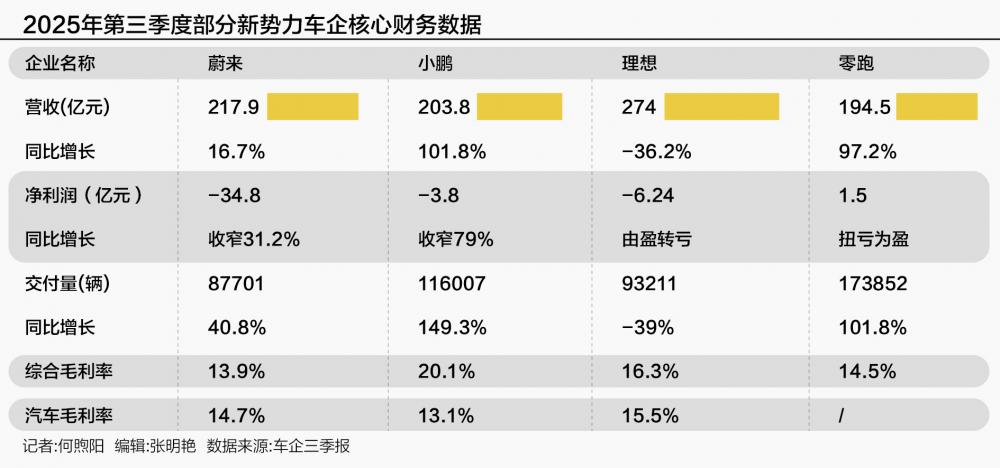
造车新势力Q3财报
2 1 Shi Ji Jing Ji Bao Dao· 2025-12-01 23:13
Core Insights - The competitive landscape of new energy vehicle manufacturers in China is undergoing significant changes as Q3 2025 financial reports are released, with Xpeng Motors showing remarkable growth while NIO and Li Auto face challenges [1][2][3] Company Performance - **Xpeng Motors**: Achieved a revenue of 203.8 billion yuan, with a year-on-year growth of 101.8%. Despite a net loss of 3.8 billion yuan, this represents a 79% reduction in losses compared to the previous year. The company delivered 116,007 vehicles, marking a 149.3% increase year-on-year [4][6][8] - **NIO**: Reported a revenue of 217.9 billion yuan, with a year-on-year growth of 16.7%. The net loss was 34.8 billion yuan, a 31.2% reduction from the previous year. NIO delivered 87,701 vehicles, a 40.8% increase year-on-year [4][12][14] - **Li Auto**: Generated a revenue of 274 billion yuan, but experienced a 36.2% year-on-year decline. The company reported a net loss of 6.24 billion yuan, ending an 11-quarter streak of profitability. Vehicle deliveries fell by 39% to over 93,000 units [4][9][11] - **Leap Motor**: Achieved a revenue of 194.5 billion yuan, with a year-on-year growth of 97.2%. The company reported a net profit of 1.5 billion yuan, marking its second consecutive profitable quarter. Leap Motor delivered nearly 174,000 vehicles, a 101.8% increase year-on-year [4][15][16] Strategic Adjustments - The new energy vehicle market is shifting from growth to competition based on product, technology, and brand strength, as companies adapt their strategies to survive in a more competitive environment [3][16] - **Xpeng Motors**: Focused on improving operational efficiency and profitability, launching new models like the X9 Super Range Extender, which aims to address consumer pain points regarding range and charging speed [7][8] - **Li Auto**: Shifted focus towards AI integration in vehicles, moving away from traditional family-oriented branding to emphasize technological advancements [10][11] - **NIO**: Reduced operational costs and refocused on core automotive sales, moving away from previous explorations in other business areas [12][13] - **Leap Motor**: Adjusted its strategy to enter the range extender market and target the high-end SUV segment, while also attempting to elevate its brand image [15][16]