智能穿戴设备

Search documents
雷鸟创新与蚂蚁集团达成战略合作,全球首发全彩眼镜支付功能
Bei Jing Shang Bao· 2025-08-14 07:23
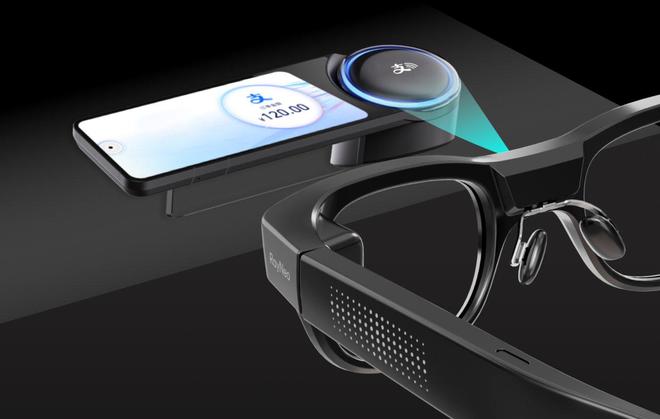
Core Viewpoint - Thunderbird Innovation and Ant Group have announced a strategic partnership to launch the world's first full-color eyewear payment solution, integrating AI and AR technologies into mobile payment scenarios [1] Group 1: Strategic Partnership - The collaboration aims to promote the application of AI and AR technologies in mobile payments [1] - Thunderbird's X3 Pro is the first AI eyewear supporting Alipay's "Look to Pay" feature, allowing users to complete payment processes hands-free by gazing at the Alipay blue ring or QR code [1] Group 2: Market Expansion - The functionality will be expanded through Ant Group's Alipay+ ecosystem to cover cross-border consumption scenarios, including travel and shopping [1] - Future plans include exploring services such as QR code pickup, cycling, and utility bill payments, positioning AI eyewear as a "personal assistant" [1] Group 3: Market Data - According to IDC, China's smart eyewear shipment is expected to reach 2.75 million units by 2025, representing a year-on-year growth of 107% [1] - Thunderbird Innovation has maintained the top position in China's AR/AI eyewear sales for three consecutive years, with a 50% online market share in Q1 2025 [1]
上半年全球智能眼镜出货量同比增长110% Meta市占率超七成
Zheng Quan Shi Bao Wang· 2025-08-14 07:22
Group 1 - The global smart glasses market saw a 110% year-on-year increase in shipments in the first half of 2025, with AI smart glasses accounting for 78% of total shipments [1] - Meta's market share in the global smart glasses market rose to 73% in the first half of 2025, driven by strong demand and production capacity expansion from its main partner Luxottica [1] - The AI smart glasses segment experienced a year-on-year growth of over 250%, significantly outpacing the overall market growth, largely due to the strong demand for Ray-Ban Meta smart glasses [1] Group 2 - The competition in the AI glasses market is intensifying, with companies like Huawei, Amazon, and Xiaomi experiencing declines in the smart audio glasses segment [2] - New products from Chinese companies, such as Xiaomi AI glasses and Alibaba's Quark AI glasses, are exploring payment solutions to reduce reliance on smartphones in outdoor shopping and dining scenarios [2] - Counterpoint has raised its market forecasts for smart glasses in 2025 and 2026, expecting a compound annual growth rate of over 60% from 2024 to 2029, benefiting all ecosystem participants [2]

拒绝卷入AI眼镜“百镜大战”? 这家与谷歌合作的智能眼镜公司想要做什么?
Mei Ri Jing Ji Xin Wen· 2025-08-14 06:53
Core Insights - The emergence of AI-related hardware products, particularly AI glasses, has gained significant attention following the launch of ChatGPT and the domestic large model trend initiated by DeepSeek [1] - Major companies like Xiaomi and Alibaba are entering the AI glasses market, with Xiaomi focusing on photography and voice interaction, while Alibaba explores wearable devices based on AliOS [1] - XREAL, known as one of the "four small dragons" of domestic AR glasses, aims to integrate functionalities of headsets like Apple's Vision Pro into glasses, contrasting with current AI glasses that are seen as limited in their capabilities [1] Market Trends - A report indicates that the international smart glasses market is expected to see a 110% year-on-year increase in shipment volume in the first half of 2025 [1] - AI smart glasses are projected to account for 78% of total shipments in the first half of 2025, up from 46% in the first half of 2024 [1] - The annual growth rate of the artificial intelligence glasses segment is expected to exceed 250%, significantly outpacing the overall market growth [1] Industry Dynamics - The smart glasses sector is expanding, suggesting a potential convergence between AI glasses and AR glasses in the future [1]
佳禾智能:与其他客户合作的AR眼镜将陆续开发完成进入试产验证阶段
Jing Ji Guan Cha Wang· 2025-08-14 04:02
Core Viewpoint - The company Jiahe Intelligent (300793) is actively producing smart audio glasses for clients such as Anker, Tmall, and Harman, and is also developing AR glasses products in collaboration with other clients [1] Group 1 - The company has confirmed its production of smart audio glasses for notable clients [1] - The company is involved in the production of the GO series AR glasses for an AR glasses brand [1] - The company is in the process of developing additional AR glasses in collaboration with other clients, which are entering the trial production verification stage [1]
Rokid Glasses智能眼镜将在中国香港开售
Bei Jing Shang Bao· 2025-08-14 03:45
北京商报讯(记者陶凤实习记者王天逸)8月13日,Rokid举办Rokid Glasses中国香港发布会,正式宣布公 司支持广东话(粤语)的智能眼镜Rokid Glasses(海外版)将在中国香港开售。 Rokid方面向北京商报记者表示,该款智能眼镜侧重亚太地区,海外市场现已成为公司的"重要着力 点"。 ...
佳禾智能:公司与其他客户合作的AR眼镜将陆续开发完成进入试产验证阶段
Zheng Quan Shi Bao Wang· 2025-08-14 03:45
Core Viewpoint - The company, Jiahe Intelligent (300793), is actively engaged in the production of smart audio glasses for clients such as Anker, Tmall, and Harman, and is also developing AR glasses products for the GO series [1] Group 1 - The company has confirmed its involvement in manufacturing smart audio glasses for notable clients [1] - The company is producing GO series AR glasses for a specific AR glasses brand [1] - Other AR glasses collaborations are in the development phase and will soon enter trial production verification [1]
支付宝联手雷鸟,AI眼镜脱离手机也能支付了|独家
Tai Mei Ti A P P· 2025-08-14 02:30
Core Insights - The collaboration between Thunderbird Innovation and Ant Group has led to the launch of the Thunderbird X3 Pro, the world's first AI glasses that support "Alipay Tap to Pay" functionality, allowing users to complete payment processes directly through the glasses [2][3] - The AI glasses industry is at a critical turning point, transitioning from technology validation to large-scale implementation, with payment integration reshaping the value chain of AI and AR glasses [2] Group 1: Product Features - The Thunderbird X3 Pro allows users to complete the entire payment process on the glasses without needing to connect to a smartphone, enabling a "look and pay" experience [3] - Users can initiate payments by pressing a button on the glasses, scanning a blue ring, and confirming payment with a voice command, eliminating the need for voice activation or manual input of payment amounts [3] Group 2: Security Measures - Thunderbird Innovation has implemented a comprehensive risk control system in collaboration with Ant Group to ensure payment security, including voiceprint recognition to respond only to authorized users [3] - Users have the ability to adjust payment limits, disable payment permissions, or unlink devices through Alipay, ensuring full control over their payment accounts [3] Group 3: Market Growth and Future Plans - According to Counterpoint, global smart glasses shipments are expected to grow by 110% year-on-year in the first half of 2025, with a projected compound annual growth rate of over 60% from 2024 to 2029 [4] - In China, smart glasses shipments are anticipated to reach 2.75 million units in 2025, reflecting a 107% year-on-year increase [4] - Thunderbird plans to expand payment capabilities to additional products, including the Thunderbird V3 and V3 Slim, and develop new service capabilities such as QR code pickup, bike sharing, utility payments, and price comparison [4]

报告:2025年上半年全球智能眼镜出货量同比增长110%
Zheng Quan Shi Bao Wang· 2025-08-12 07:27
Core Insights - The global smart glasses market experienced a year-on-year shipment growth of 110% in the first half of 2025, according to Counterpoint's report [1] - Strong demand for Ray-Ban Meta smart glasses, along with the entry of new players like Xiaomi and RayNeo, contributed to this growth [1] - Meta's market share in the global smart glasses sector rose to 73% in the first half of 2025, driven by robust demand and production capacity expansion from its main manufacturing partner, Luxottica [1]
2025年上半年全球智能眼镜市场同比激增 110%
Bei Jing Shang Bao· 2025-08-12 05:33
Core Insights - The global smart glasses market is projected to see a 110% year-on-year increase in shipment volume in the first half of 2025, driven by strong demand for Ray-Ban Meta smart glasses and the entry of new players like Xiaomi and TCL-RayNeo [1] Market Overview - In the first half of 2025, AI smart glasses are expected to account for 78% of total smart glasses shipments, a significant increase from 46% in the first half of 2024 and 66% in the second half of 2024 [1] - The AI glasses segment is experiencing a year-on-year growth exceeding 250%, significantly outpacing the overall market growth, primarily due to the dominance of Ray-Ban Meta AI glasses [1] Brand Performance - Meta's market share in the global smart glasses market reached 73% in the first half of 2025, with Ray-Ban Meta AI glasses seeing a shipment increase of over 200% year-on-year [1] - Xiaomi's AI glasses emerged as a strong competitor, becoming the fourth best-selling model globally and the third best-selling in the AI glasses segment, despite being on sale for only about a week in the first half of 2025 [2]

国泰海通|中小与股权研究:AI眼镜爆发有望推动智能眼镜加速迈向千亿市场
国泰海通证券研究· 2025-08-11 14:15
Core Viewpoint - The AI glasses market is poised for explosive growth, driven by lightweight design, essential use cases, and consumer pricing, with a projected 188% increase in sales in China by 2025, potentially creating a trillion-yuan market space [1][2]. Market Dynamics - The evolution of AI glasses is transitioning from separate functional devices to integrated computing solutions, with three main product categories: audio devices, audio + camera devices, and AR integration devices [2]. - Major brands like Meta and Xiaomi are leading the consumer market, while domestic players are catching up in technology and application expansion [2]. Value Chain and Market Estimation - The cost structure of AI glasses shows that the main chip accounts for approximately 33% of total costs, with optical display and computing units making up 43% and 31% respectively [3]. - The global market for AI glasses is expected to exceed 190 billion RMB by 2030, with the Chinese market projected to surpass 50 billion RMB, reflecting a CAGR of over 80% over five years [3]. Industry Structure - The AI glasses industry value chain includes upstream manufacturers of optical modules, chips, and frames; midstream ODM/OEM manufacturers and software suppliers; and downstream brand manufacturers and distributors [3].