
造船业

Search documents
年均交付27艘 中国造船业纪录持续刷新
Yang Shi Xin Wen· 2025-08-08 04:59
Group 1 - The core point of the news is the delivery of the "GRANDE TIANJIN," a 9000-car capacity automobile transport ship, built by Shanghai Waigaoqiao Shipbuilding Co., a subsidiary of China Shipbuilding Group, which is set to begin its maiden voyage on August 19, primarily transporting Chinese electric vehicles on the China-Europe route [1][2] - The "GRANDE TIANJIN" features new low fuel consumption engines and energy-saving devices, significantly reducing energy consumption and achieving zero carbon emissions during docking, while also receiving "ammonia fuel ready" certification from the Italian classification society [1] - Since the delivery of its first 150,000-ton floating production storage and offloading unit (FPSO) in 2003, Waigaoqiao Shipbuilding has completed and delivered a total of 600 vessels and offshore platforms, totaling 1,020,000 deadweight tons, maintaining an average delivery efficiency of 27 vessels and 4.637 million deadweight tons per year, setting records in China's shipbuilding industry [2] Group 2 - The shipbuilding capabilities of Waigaoqiao cover a complete product spectrum of high-tech and high-value-added vessels, including large cruise ships, medium and large oil tankers, medium and large container ships, automobile transport ships, offshore drilling, and offshore production storage and unloading units [2] - Waigaoqiao Shipbuilding is the only company globally capable of simultaneously constructing civil vessels, offshore equipment, and large cruise ships [2]

全球最大上市船企来了,“两船”完成合并在即,股价双双涨停
2 1 Shi Ji Jing Ji Bao Dao· 2025-08-06 05:28
Core Viewpoint - The merger between China Shipbuilding Industry Corporation (CSIC) and China State Shipbuilding Corporation (CSSC) marks a significant consolidation in the Chinese shipbuilding industry, with the approval from the China Securities Regulatory Commission (CSRC) and the upcoming stock suspension indicating a major shift in the sector [1][2][5]. Group 1: Merger Details - The merger involves a share swap where CSSC will absorb CSIC, leading to CSIC's delisting [1]. - The dissenting shareholders of both companies have the option to cash out at prices of 30.01 CNY per share for CSSC and 4.03 CNY per share for CSIC, totaling approximately 5.56 billion CNY and 13.02 billion CNY respectively [1]. - The merger is expected to enhance resource synergy and operational efficiency within the shipbuilding sector [2][4]. Group 2: Financial and Operational Impact - Post-merger, the combined total assets of CSIC and CSSC are projected to exceed 400 billion CNY, surpassing the 300 billion CNY asset scale of the previous "South-North Train" merger [4]. - For the year 2024, CSIC and CSSC are expected to achieve revenues of 785.84 billion CNY and 554.36 billion CNY respectively, with combined profits exceeding 50 billion CNY [4]. - The order backlog for CSIC stands at 322 vessels with a total weight of 24.61 million tons valued at 216.96 billion CNY, while CSIC holds 216 vessels with a total weight of 30.31 million tons valued at 233.76 billion CNY, together accounting for 15% of the global order backlog [4]. Group 3: Market Context and Future Outlook - The merger is seen as a response to the ongoing consolidation trend in the state-owned enterprise sector, with a rapid approval process of just 71 days highlighting the supportive regulatory environment [5]. - Analysts predict that the successful merger will lead to increased activity in the M&A market, potentially accelerating further consolidation in the industry [6]. - The global shipbuilding industry is entering a new growth cycle, with Chinese shipyards expected to benefit from a robust order book and improved capabilities compared to previous cycles [8].


中船防务再涨超7% 预计上半年纯利同比增超两倍 中船系重组步伐加快
Zhi Tong Cai Jing· 2025-08-06 02:13
Core Viewpoint - China Shipbuilding Defense (中船防务) has seen a significant stock increase of over 7%, attributed to a positive earnings forecast for the first half of the year, with net profit expected to rise substantially compared to the previous year [1] Group 1: Financial Performance - The company anticipates a net profit attributable to shareholders of between RMB 460 million and RMB 540 million for the first half of the year, representing a year-on-year increase of 213.25% to 267.73% [1] - Based on seasonal factors in the shipbuilding industry and improved gross margin assumptions, the profit forecast for China Shipbuilding Defense for 2025 to 2027 has been raised by 24% to 32% [1] Group 2: Order Backlog and Growth Potential - The subsidiary Huangpu Wenchong currently holds approximately RMB 54 billion in new ship orders, which is expected to support an average annual compound growth rate of 70% in profits from 2025 to 2027 [1] Group 3: Corporate Restructuring - On August 4, China Shipbuilding Heavy Industry Co., Ltd. announced plans to merge with China Shipbuilding Industry Co., Ltd. through the issuance of A-shares, a move that has received approval from the China Securities Regulatory Commission [1] - Following the merger, China Heavy Industry will no longer have independent legal status and will be deregistered, marking a significant step in the internal resource integration of China Shipbuilding Group, with potential further consolidation of China Shipbuilding Defense [1]

“两船”完成合并在即,总资产超4000亿元
2 1 Shi Ji Jing Ji Bao Dao· 2025-08-06 00:00
Core Viewpoint - The merger between China Shipbuilding and China State Shipbuilding has received official approval from the China Securities Regulatory Commission, marking a significant step in the restructuring of China's shipbuilding industry [2][5]. Group 1: Merger Details - The merger involves a share swap where China Shipbuilding will absorb China State Shipbuilding, leading to the latter's delisting [2]. - The stock of both companies will be suspended from trading starting August 13, with no specified date for resumption [2][4]. - Dissenting shareholders have the option to cash out at prices of 30.01 yuan per share for China Shipbuilding and 4.03 yuan per share for China State Shipbuilding, with total values of 5.56 billion yuan and 13.02 billion yuan respectively [5]. Group 2: Financial and Operational Impact - The combined total assets of the two companies will exceed 400 billion yuan by the end of 2024, surpassing the 300 billion yuan asset scale of the previous "South-North Train" merger [7]. - In 2024, China Shipbuilding and China State Shipbuilding are projected to achieve revenues of 78.58 billion yuan and 55.44 billion yuan, respectively, with combined annual revenues exceeding 100 billion yuan [7]. - The order backlog includes 322 vessels for China Shipbuilding valued at 216.96 billion yuan and 216 vessels for China State Shipbuilding valued at 233.77 billion yuan, totaling 15% of the global order backlog [8]. Group 3: Market Context and Future Outlook - The merger is seen as a response to the ongoing consolidation trend in the state-owned enterprise sector, with a streamlined approval process taking only 71 days [8]. - The merger is expected to enhance resource synergy, improve bargaining power, and facilitate the integration of green ship technology and military-civilian fusion experiences [7][11]. - Analysts predict that the Chinese shipbuilding industry will remain busy due to a long-term supply-demand imbalance, benefiting from a new cycle of demand in the global shipbuilding market [11].
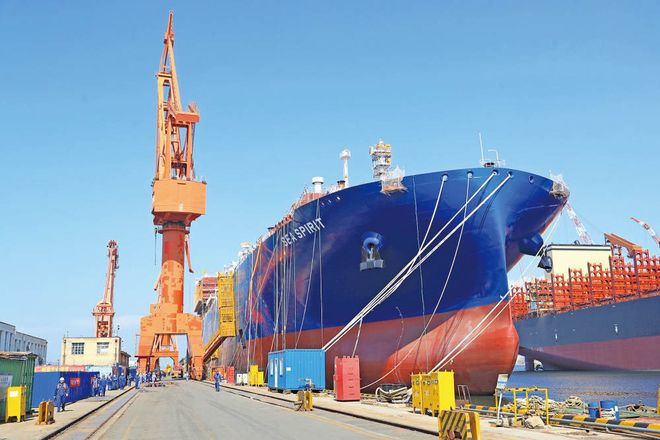
“两船”完成合并在即,总资产超4000亿元
21世纪经济报道· 2025-08-05 23:47
Core Viewpoint - The merger between China Shipbuilding and China State Shipbuilding has received regulatory approval, marking a significant step in the restructuring of China's shipbuilding industry, with the aim of enhancing resource synergy and market competitiveness [1][4][8]. Group 1: Merger Details - The merger involves a share swap where China Shipbuilding will absorb China State Shipbuilding, leading to the latter's delisting [1][4]. - The merger has been in the works for over a year, with the approval process taking only 71 days, indicating strong support for state-owned enterprise consolidation [8]. - Following the merger, both companies will halt trading on August 13, with a resumption date yet to be determined [1][3]. Group 2: Financial and Operational Impact - Combined assets of the two companies will exceed 400 billion yuan, surpassing the asset scale of previous major mergers in the industry [7]. - In 2024, the two companies are projected to achieve combined revenues exceeding 1 trillion yuan and net profits over 50 billion yuan [7]. - The order backlog for China Shipbuilding stands at 322 vessels with a total weight of 24.61 million tons, valued at 216.96 billion yuan, while China State Shipbuilding has 216 vessels valued at 233.77 billion yuan, together accounting for 15% of the global order backlog [7]. Group 3: Strategic Advantages - The merger will facilitate the integration of complementary technologies and enhance bargaining power in the market [7][11]. - The consolidation is expected to reduce internal competition and improve supply chain resilience, positioning the new entity to better capitalize on the upcoming shipbuilding cycle [11]. - The merger aligns with the trend of state-owned enterprises leveraging capital markets for integration, potentially leading to more M&A activities in the future [8][11].
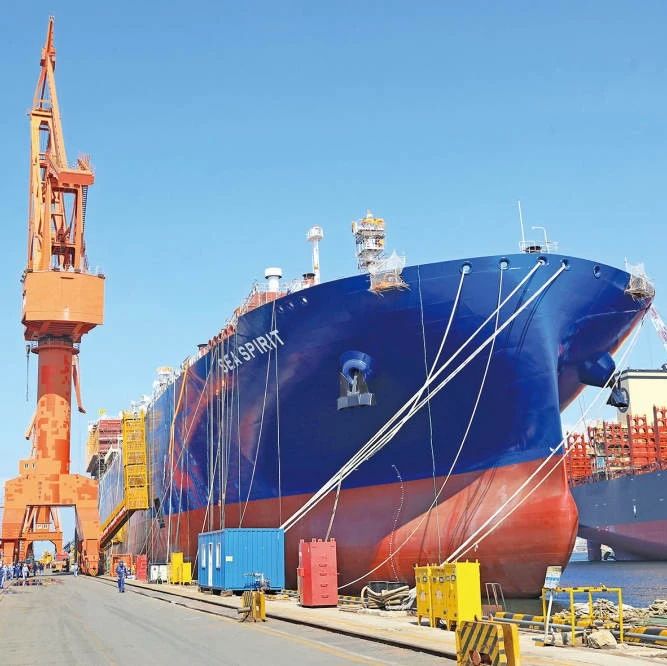
“两船”完成合并在即,全球最大上市船企来了
2 1 Shi Ji Jing Ji Bao Dao· 2025-08-05 13:49
Core Viewpoint - The merger between China Shipbuilding and China State Shipbuilding has received regulatory approval, marking a significant consolidation in the Chinese shipbuilding industry, with implications for resource synergy and market positioning [2][3][4]. Group 1: Merger Details - The merger transaction has been approved by the China Securities Regulatory Commission, with stock suspension starting from August 13 [2]. - China Shipbuilding will absorb China State Shipbuilding through a share swap, leading to the latter's delisting [2]. - Dissenting shareholders have the option for cash compensation, with total values of approximately 5.56 billion yuan and 13.02 billion yuan for China Shipbuilding and China State Shipbuilding respectively [2]. Group 2: Financial and Operational Impact - The combined total assets of the two companies will exceed 400 billion yuan by the end of 2024, surpassing the asset scale of the previous "South-North Car" merger [5]. - Projected revenues for 2024 are 785.84 billion yuan for China Shipbuilding and 554.36 billion yuan for China State Shipbuilding, with combined profits expected to exceed 50 billion yuan [5]. - The order backlog will total 54.92 million deadweight tons, representing 15% of the global order volume, making the merged entity the largest single shipbuilding entity globally [5]. Group 3: Market Context and Future Outlook - The merger aligns with the trend of central enterprise integration in China's shipbuilding industry, with a streamlined approval process taking only 71 days [6]. - The merger is expected to enhance the competitive position of the new entity in the global market, particularly as the shipbuilding industry enters a new growth cycle [8][9]. - Analysts predict that the merger will lead to further consolidation in the industry, benefiting from a long-term demand cycle for ship orders [8].
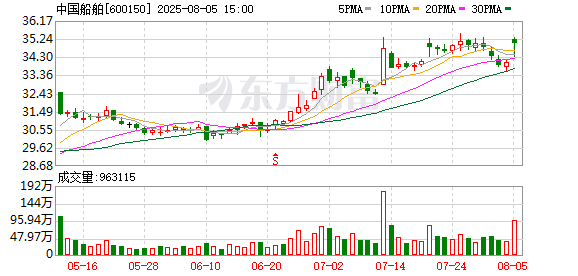
港股异动|中船防务(00317)再涨超6% 中国船舶吸收合并中国重工方案获批 公司未来有望参与整合
Jin Rong Jie· 2025-08-05 03:23
Core Viewpoint - China Shipbuilding Defense (00317) has seen a significant increase in stock price, rising over 6% and currently trading at 16.67 HKD, with a transaction volume of 102 million HKD. This surge is attributed to the announcement of a merger with China Shipbuilding Industry Co., which is seen as a crucial step in internal resource integration within the China Shipbuilding Group [1]. Group 1: Merger Announcement - China Shipbuilding Heavy Industry Co. announced plans to absorb China Shipbuilding Defense through the issuance of A-shares, with the merger approved by the China Securities Regulatory Commission [1]. - Following the merger, China Heavy Industry will no longer have independent legal status and will be deregistered [1]. - The market perceives this merger as a significant move towards further integration of China Shipbuilding Defense, potentially leading to a "three-ship merger" structure [1]. Group 2: Profit Forecast Adjustments - Jianyin International has revised its profit forecasts for China Shipbuilding Defense, increasing the net profit estimates for 2025 to 2027 by 24% to 32% based on seasonal factors in the shipbuilding industry and more optimistic gross margin assumptions [1]. - The subsidiary Huangpu Wenchong currently holds approximately 54 billion RMB in new ship orders, which is expected to support an average annual compound growth rate of 70% in profits from 2025 to 2027 [1].
港股异动 | 中船防务(00317)再涨超6% 中国船舶吸收合并中国重工方案获批 公司未来有望参与整合
智通财经网· 2025-08-05 02:25
Core Viewpoint - China Shipbuilding Defense (00317) has seen a significant increase in stock price, rising over 6% and currently trading at 16.67 HKD, with a transaction volume of 102 million HKD. This surge is linked to the announcement of a merger with China Shipbuilding Industry Co., which has been approved by the China Securities Regulatory Commission [1]. Group 1: Company Developments - China Shipbuilding Industry Co. plans to absorb China Shipbuilding Defense through the issuance of A-shares, leading to the latter's deregistration as an independent entity [1]. - The merger is viewed as a crucial step in the internal resource integration of China Shipbuilding Group, potentially leading to further consolidation within the company [1]. Group 2: Financial Projections - Jianyin International has revised its profit forecasts for China Shipbuilding Defense, increasing the net profit estimates for 2025 to 2027 by 24% to 32% due to seasonal factors in the shipbuilding industry and more optimistic gross margin assumptions [1]. - The subsidiary Huangpu Wenchong is reported to hold approximately 54 billion RMB in new ship orders, which is expected to support an average annual compound growth rate of 70% in profits from 2025 to 2027 [1].
中船防务再涨超6% 中国船舶吸收合并中国重工方案获批 公司未来有望参与整合
Zhi Tong Cai Jing· 2025-08-05 02:24
Core Viewpoint - China Shipbuilding Defense (中船防务) has seen a significant stock price increase, attributed to the announcement of a merger within the China Shipbuilding Group, indicating a strategic move towards resource integration within the industry [1] Group 1: Company Developments - As of the latest report, China Shipbuilding Defense's stock rose over 6%, currently trading at 16.67 HKD with a transaction volume of 102 million HKD [1] - On August 4, China Shipbuilding Industry Co., Ltd. announced plans to absorb China Shipbuilding Heavy Industry Co., Ltd. through the issuance of A-shares, which has received approval from the China Securities Regulatory Commission [1] - Following the merger, China Shipbuilding Heavy Industry will lose its independent status and be deregistered, marking a significant restructuring within the group [1] Group 2: Market Expectations - Market analysts view this merger as a crucial step in the internal resource consolidation of the China Shipbuilding Group, with potential future integration of China Shipbuilding Defense, leading to a "three-ship merger" scenario [1] - Jianyin International has revised its profit forecasts for China Shipbuilding Defense for 2025 to 2027, increasing net profit estimates by 24% to 32% due to seasonal factors in shipbuilding profitability and more optimistic gross margin assumptions [1] - The subsidiary Huangpu Wenchong is reported to hold approximately 54 billion RMB in new ship orders, which is expected to support an average annual compound growth rate of 70% in profits from 2025 to 2027 [1]
合作造船难度“无可比拟”,巨额投资加剧产业空心,韩美关税协议引发韩国新不安
Huan Qiu Shi Bao· 2025-08-04 22:51
Group 1 - The recent trade agreement between South Korea and the United States has not alleviated concerns in South Korea regarding its implementation and potential impacts [1][6] - South Korea's Minister of Trade, Industry and Energy expressed worries about the 15% tariff rate affecting exporters' profitability, despite the agreement avoiding the worst-case scenario [1][3] - The "MASGA" project, aimed at enhancing U.S. shipbuilding capabilities, is seen as a significant overseas expansion for South Korea's manufacturing sector, but it faces numerous challenges [2][3] Group 2 - The shipbuilding cooperation between South Korea and the U.S. involves a $150 billion investment, but the project is complicated by the need to establish or upgrade local shipyards and develop skilled labor [2][3] - Concerns have been raised about the potential transfer of high-end technical talent and production capacity from South Korea to the U.S. as a result of the agreement [3][4] - The automotive industry is also affected, with South Korean cars now subject to a 15% tariff, raising concerns about the competitiveness of South Korean exports compared to Japanese vehicles [3][4] Group 3 - The $3.5 billion investment figure mentioned in the agreement is seen as excessively large, prompting calls for government support to help domestic industries adapt [4] - The upcoming summit between South Korean and U.S. leaders is expected to address unresolved economic issues, including non-tariff barriers that could pressure South Korea for further concessions [5][6] - Experts warn that the trade agreement merely outlines a broad framework, with key issues in agriculture, digital services, and other sectors remaining unresolved [6]