
生物医药产业

Search documents
诺奖得主看好“创新药械最友好城市”
Jie Fang Ri Bao· 2025-10-18 01:06
Core Insights - The 2025 Shanghai International Biopharmaceutical Industry Week, themed "Linking the World, Empowering Industries," is taking place from October 13 to 17, featuring various events aimed at fostering innovation and collaboration in the biopharmaceutical sector [1] Group 1: Innovation Ecosystem - Shanghai is recognized for its world-class innovation ecosystem and policy environment that supports the development of innovative drugs and medical devices, attracting investment and talent [1] - The city has been reducing the comprehensive costs of innovation and entrepreneurship in biopharmaceuticals during the 14th Five-Year Plan, facilitating faster drug screening and clinical research processes [1] Group 2: Investment and Financing - The investment summit highlighted the significance of brain-computer interface technology, with Shanghai Guotou's subsidiary leading a 100 million yuan investment in the company Borui Kang, which is developing a potential first-in-class brain-computer interface product [2] - The support from state-owned capital and the innovative ecosystem in Shanghai are crucial for the development of the brain-computer interface industry, which requires patient capital and a skilled workforce [2] Group 3: Cutting-edge Research - Research on HIF (hypoxia-inducible factor) as a target for cancer treatment is gaining traction, with Nobel laureate Greg Semenza presenting promising preclinical results on dual inhibitors targeting HIF-1α and HIF-2α [3] - Shanghai's strong academic institutions and collaboration between research teams and the industry position the city as a potential leader in groundbreaking drug development [3] Group 4: Innovative Projects - The development of allogeneic CAR-T cells by a team from East China Normal University represents a significant innovation, aiming to reduce the high costs associated with current autologous CAR-T therapies [4][5] - The project has received substantial funding from Shanghai Zhangjiang and is advancing towards commercialization with a focus on gene editing and cell therapy [5] Group 5: Policy Support - The introduction of the "New and Excellent Drugs and Medical Devices" policy in Shanghai has accelerated the process for innovative products to enter hospitals, significantly reducing the time required for new drugs to be adopted [6] - As of August this year, 196 products have been included in the "New and Excellent Drugs and Medical Devices" directory, reflecting the city's commitment to enhancing its biopharmaceutical innovation capabilities [6]
“百万英才汇南粤”N城联动秋季招聘辽宁专场启幕 超220个次50万元以上岗位“含金量”足
Nan Fang Ri Bao Wang Luo Ban· 2025-10-16 08:10
Group 1 - The "Million Talents Gathering in Nanyue" 2025 N City Linked Autumn Recruitment event commenced in Dalian, Liaoning, from October 15 to 18, organized by Zhongshan [1] - The recruitment event will cover four key universities in Liaoning, offering over 22,000 job positions, including more than 1,700 positions with annual salaries exceeding 200,000 yuan and over 220 positions with salaries above 500,000 yuan [1] - The job offerings align well with the academic strengths of Liaoning universities and the needs of Guangdong's modern industrial clusters, particularly in emerging industries such as new energy, artificial intelligence, new materials, and information technology [1] Group 2 - Over 790 enterprises and institutions registered for the recruitment event, providing more than 22,000 job positions, including over 17,000 for undergraduates, more than 1,900 for master's degree holders, and over 1,500 for doctoral candidates [2] - The recruitment features leading companies and innovative enterprises such as Mingyang Smart Energy, Kangfang Biotech, and Dayang Electric, as well as universities and research institutions, ensuring comprehensive coverage of industry and research [2]
金句来了丨2025上海国际生物医药产业周大放送DAY2
Sou Hu Cai Jing· 2025-10-14 09:32
Core Viewpoint - The article discusses the recent financial performance of a leading company in the technology sector, highlighting significant revenue growth and strategic initiatives aimed at expanding market share [1] Group 1: Financial Performance - The company reported a revenue increase of 25% year-over-year, reaching $5 billion in the last quarter [1] - Net income rose to $1.2 billion, reflecting a 30% increase compared to the previous year [1] - The gross margin improved to 45%, up from 40% in the same quarter last year [1] Group 2: Strategic Initiatives - The company plans to invest $500 million in research and development to enhance product offerings and innovation [1] - A new partnership with a leading cloud service provider is expected to drive additional revenue streams [1] - The company aims to expand its presence in emerging markets, targeting a 15% growth in these regions over the next two years [1]
中国馆海派非遗令观众驻足 多场经贸活动引来企业家关注 “上海日”压轴亮相大阪世博
Jie Fang Ri Bao· 2025-10-12 02:18
Group 1 - The Shanghai Day event at the 2025 Osaka Expo showcased Shanghai's unique cultural heritage and creative performances, attracting a large audience [1][2] - The event featured traditional intangible cultural heritage displays, including guqin music and incense-making, which engaged international visitors and highlighted the cultural vitality of Shanghai [2] - Collaborative performances between Shanghai and Japanese artists, such as the Shanghai National Orchestra and local taiko drummers, emphasized cross-cultural dialogue and strengthened ties between the two cities [2] Group 2 - The Shanghai delegation conducted multiple economic exchange activities in Japan, including the "Shanghai-Kansai Economic Exchange Conference" and the "Shanghai-Kyoto Entrepreneurs Seminar," to enhance economic cooperation [3][4] - Japanese companies expressed interest in Shanghai's industrial environment, particularly in sectors like green low-carbon technology, biomedicine, and high-end manufacturing, indicating potential investment opportunities [3] - The establishment of the Japan (Shanghai) Small and Medium Enterprises International Industrial Park aims to facilitate Japanese companies' operations in Shanghai, with over ten companies already settled [3]
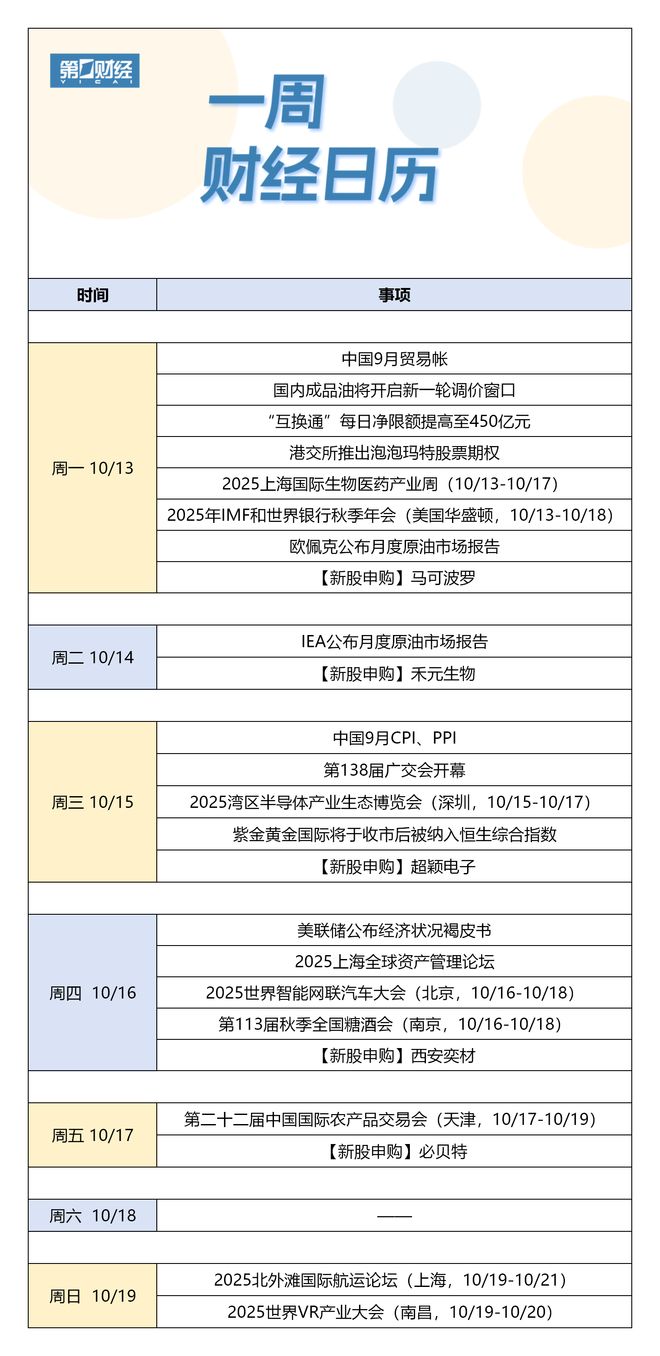
下周财经日历(10月13日-10月19日)
Di Yi Cai Jing Zi Xun· 2025-10-11 12:47
Group 1 - China's trade balance for September will be released on October 13, which is a key indicator for the country's economic health [1] - Domestic refined oil prices will enter a new round of adjustment window, impacting the energy sector [1] - The "Swap Connect" daily net limit will be increased to 45 billion yuan, enhancing cross-border trading capabilities [1] Group 2 - The Hong Kong Stock Exchange will launch stock options for Pop Mart, indicating a growing interest in the collectibles market [1] - The International Energy Agency (IEA) will release its monthly oil market report on October 14, providing insights into global oil supply and demand [2] - The 138th Canton Fair will open on October 14, serving as a significant platform for international trade [2]

这些“顶流”悉数到场 2025上海国际生物医药产业周即将举行
Zheng Quan Ri Bao Wang· 2025-10-10 10:47
Core Insights - The 2025 Shanghai International Biopharmaceutical Industry Week will be held from October 13 to 17 in Shanghai Zhangjiang Science Hall, themed "Linking Global Empowerment for Industry" [1] - The event will feature a structure of "1+1+15+N," including one opening ceremony, one concurrent exhibition, 15 thematic forums, and numerous activities throughout the year [1] Group 1: Event Details - The event will gather prominent figures from the scientific, industrial, and investment sectors, including Nobel laureates and leading academicians [1] - Notable attendees include Greg Semenza, Wang Xiaodong, and several academicians from the Chinese Academy of Sciences [1] Group 2: Industry Growth - During the 14th Five-Year Plan period, Shanghai's biopharmaceutical industry is projected to grow from CNY 761.71 billion in 2021 to CNY 984.70 billion in 2024, with a compound annual growth rate (CAGR) of 8.94% [2] - The manufacturing output is expected to increase from CNY 171.20 billion in 2021 to CNY 201.17 billion in 2024, reflecting a CAGR of 6.9% [2] Group 3: Organizers and Partners - The event is organized by the Shanghai Biopharmaceutical Technology Industry Promotion Center, with support from various strategic partners including Shanghai State-owned Capital Investment Co., Ltd. and Shanghai Pharmaceuticals Holding Co., Ltd. [2]
信长星会见丹纳赫集团全球总裁兼首席执行官毕睿宁
Su Zhou Ri Bao· 2025-09-19 00:59
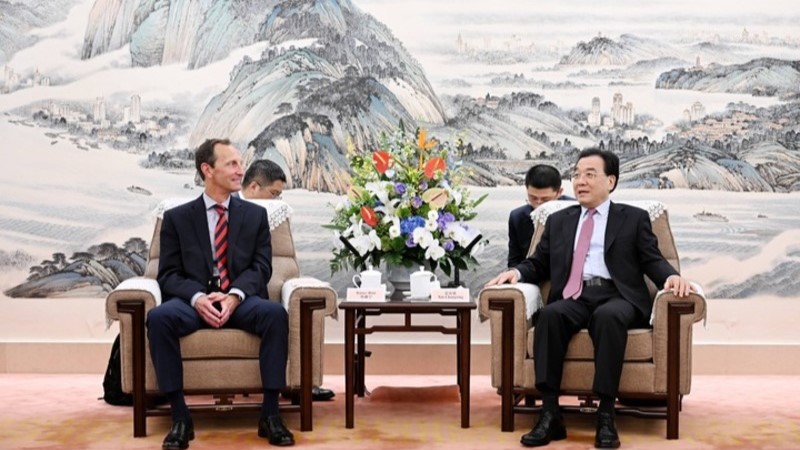
Group 1 - The meeting between the Secretary of the Provincial Party Committee and the CEO of Danaher Corporation highlights the strategic importance of Jiangsu in China's reform and opening-up efforts [1][3] - Jiangsu is positioned as a frontier for China's opening-up, with a solid industrial foundation and vast market potential, particularly in the biopharmaceutical sector [3] - Danaher Corporation, as a Fortune 500 company, aligns well with Jiangsu's key industries, and its increased investment in the region reflects strategic foresight [3] Group 2 - The Secretary expressed hope that Danaher would continue to deepen its investment in Jiangsu, sharing development opportunities and enhancing product offerings to meet public health needs [3] - Danaher’s CEO acknowledged the favorable environment in Jiangsu that has contributed to the company's successful investments and expressed optimism about China's development prospects and Jiangsu's market potential [3] - Danaher plans to engage deeply with Jiangsu's technology companies and research institutions to develop more quality projects and foster mutually beneficial cooperation [3]

无锡海关积极提升跨境贸易便利化水平
Xin Hua Ri Bao· 2025-09-18 21:56
Core Insights - Cross-border trade facilitation is crucial for creating a market-oriented, rule-of-law, and international business environment, supporting high-quality development and high-level openness [1] - Wuxi has been selected as a pilot city for the cross-border trade facilitation initiative for three consecutive years, with significant improvements in foreign trade performance [1] Group 1: Trade Facilitation Initiatives - The cross-border trade facilitation special action launched in April aims to enhance regulatory services and implement various measures to benefit enterprises, resulting in Wuxi's foreign trade import and export reaching 535.34 billion yuan, a year-on-year increase of 7.2% [1] - The "China-Kyrgyzstan-Uzbekistan" international freight train has been operational, saving 30% in logistics costs and providing a stable new channel for the Belt and Road market [2] - Wuxi has expanded its logistics network through various modes, including rail, air, and water transport, enhancing regional logistics capabilities [2] Group 2: Industry Support Measures - The implementation of the "white list" system for importing hazardous chemicals has expedited customs clearance for high-tech enterprises, significantly reducing logistics and material loss costs [3] - The "white list" pilot in the biopharmaceutical sector has been expanded, allowing companies to import research materials more efficiently, thus accelerating innovation in the industry [4] Group 3: E-commerce and New Business Models - Wuxi has established a comprehensive customs supervision center for general goods, express delivery, and cross-border e-commerce, operating 24/7 to attract major e-commerce companies [5] - In the first eight months of the year, Wuxi Customs processed 11.96 million cross-border e-commerce export packages, a year-on-year increase of 118% [5] - The optimization of customs processes has enhanced the confidence of enterprises and stimulated new business vitality, creating a positive cycle of increased trade and business growth [6]
“全程绿灯”加速好药上市步伐
Xin Hua Ri Bao· 2025-09-17 00:18
Core Insights - The "Jiangsu Free Trade Zone Biopharmaceutical Industry Chain Open Innovation Development Plan" was approved by the State Council, aiming to accelerate the entire process from laboratory research to clinical use, facilitating faster access to innovative drugs for patients [1][2] - The plan emphasizes "full-chain reform, institutional openness, and high-level innovation" to address pain points in the biopharmaceutical industry, with 18 specific measures across six key areas [2][5] Full-Chain Reform - The plan aims to enhance research and innovation capabilities, improve approval services, build production and circulation systems, refine procurement policies, increase resource guarantees, and maintain safety standards [2][5] - Jiangsu's biopharmaceutical industry accounts for 1/8 of the national scale, with 1/3 of innovative drugs approved, indicating its leading position in the country [2][6] - Specific reforms include expediting the approval process for generic drugs, reducing fixed asset investment by 30% through segmented production, and eliminating barriers for innovative drugs to reach the market [2][5] Institutional Openness - The plan allows foreign professionals with recognized qualifications to work in Jiangsu without needing to pass domestic exams, facilitating access to international medical expertise for local residents [3][5] - The management of outbound data will see a reduction in evaluation time by 30%-50%, enhancing cross-border data flow for research [3][5] High-Level Innovation - Focus areas include gene and cell therapy, brain science, and the establishment of platforms like the National Biopharmaceutical Technology Innovation Center [3][4] - The plan encourages companies to participate in standard-setting and broadens financing channels through credit bonds [3][4] Addressing Industry Bottlenecks - The plan is problem-oriented, targeting key areas such as process efficiency and resource allocation to ensure tangible benefits for enterprises [5][6] - For instance, reforms in the regulation of experimental animals aim to reduce export clearance times by approximately 50%, addressing specific challenges faced by companies [5][6] Ensuring Effective Reform - Jiangsu will implement measures to ensure that reforms transition from paper to practice, focusing on regional collaboration and detailed management [7] - The plan includes a task list to clarify responsibilities and timelines, ensuring that the 18 measures are effectively executed [7]
江苏自贸区生物医药迎全产业链发展
Jiang Nan Shi Bao· 2025-09-16 14:37
Core Viewpoint - The Jiangsu Free Trade Zone is set to enhance the entire biopharmaceutical industry chain through innovative development, aiming to bridge the gap between laboratory research and clinical application, while also connecting domestic innovation with international markets [1][2]. Group 1: Policy and Implementation - The "Biopharmaceutical Industry Chain Open Innovation Development Plan" has been approved by the State Council, marking Jiangsu as the first province to initiate such a comprehensive reform in the biopharmaceutical sector [1][2]. - The implementation plan includes 18 specific measures across six areas: enhancing R&D capabilities, improving product approval services, constructing a production and distribution system, refining procurement policies, increasing support for resources, and ensuring safety in development [2][3]. Group 2: Industry Strengths - Jiangsu accounts for 1/8 of the national biopharmaceutical industry, leading in both scale and innovation, with approximately 1/3 of innovative drugs approved in the country [3]. - The province's Free Trade Zone is a significant contributor, with half of the industry's output coming from its three designated areas, showcasing strong upstream and downstream capabilities [3]. Group 3: Global Integration and Talent Attraction - The plan facilitates international recognition of professional qualifications for foreign talent, allowing them to work in Jiangsu without the need for domestic certification [4]. - It encourages foreign physicians to provide services within the Free Trade Zone, enabling local residents to access high-quality international medical resources [4]. Group 4: Innovation and Development Focus - The initiative emphasizes cutting-edge fields such as gene and cell therapy and brain science, with plans to implement major national projects in these areas [5]. - Jiangsu aims to establish a national-level platform matrix for biopharmaceutical innovation, including a national biopharmaceutical technology innovation center and the largest gene sequencing matrix in Asia [5].