
连锁商超

Search documents
盒马公布财年规划 持续看好内需消费市场
Zhong Guo Jing Ji Wang· 2025-08-07 04:00
Core Insights - Hema has rapidly entered the top three of China's retail supermarket sector, achieving over 420 stores by March 31, 2025, and ranking third in the 2024 China Chain Top 100 list with a GMV of 75 billion [1] - The growth of Hema and similar retail enterprises has significantly contributed to domestic demand, which accounted for an average of 86.4% of economic growth over the past four years [1] Group 1 - Hema's opening in Jiangsu Taizhou attracted significant attention, with reports of long queues and high sales, such as over 500 king crabs sold in a single day [2] - The company has established a robust supply chain with eight supply chain centers and over 300 direct procurement bases, enhancing its ability to offer unique products and self-branded goods [2][3] - Hema's focus on differentiated global products, including affordable imported salmon and trendy items like durian layer cake, has driven customer traffic and consumption [2] Group 2 - Hema has refined its business model over ten years, focusing on two core formats: Hema Fresh and Hema NB, while strategically closing underperforming stores [4] - The company achieved its first annual profit in the last fiscal year, indicating a successful strategic focus [5] - Hema has integrated its membership system with Alibaba's 88VIP, resulting in a doubling of membership numbers and demonstrating consumer recognition of the brand [6]
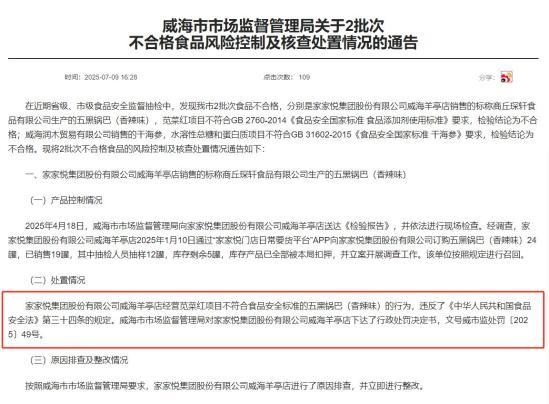
家家悦超市屡曝食品安全问题 供货来源现“幽灵”供应商
Zhong Guo Xin Wen Wang· 2025-07-22 20:27
Core Viewpoint - Jiajiayue Group has faced multiple food safety issues this year, leading to its inclusion on market regulatory blacklists, particularly due to incidents involving "ghost" suppliers [1][6]. Group 1: Food Safety Violations - Jiajiayue's Weihai store sold products that failed to meet national food safety standards, resulting in administrative penalties [4]. - The Lai Zhou store was found to have pesticide residues exceeding legal limits in vegetables sourced from unverified suppliers, leading to a fine of 10,000 yuan [6][8]. - The company has been reported for over a dozen food safety violations in Shandong province alone in 2024, with complaints about agricultural residue being particularly prevalent [8]. Group 2: Regulatory and Compliance Issues - The current supplier admission system at Jiajiayue has significant regulatory loopholes, as stores procured problematic products without verifying supplier qualifications [8]. - There are indications of the company providing false documentation to regulatory authorities, reflecting a disregard for the Food Safety Law [7][8]. - Consumer complaints have surged, highlighting issues such as spoiled fresh produce and expired packaged goods, which align with regulatory findings of safety violations [8][10]. Group 3: Company Background and Industry Context - Jiajiayue Group, established in 1981 and listed in 2016, operates over a thousand stores across several provinces in China [10]. - The rapid expansion of the retail network raises challenges in maintaining consistent quality control across logistics and terminal inspections, a critical issue for the company and the broader retail industry [10].


多家昔日知名上市企业面临退市的启示
Zheng Quan Shi Bao Wang· 2025-05-13 15:07
Group 1 - The core viewpoint of the articles highlights the trend of well-known listed companies facing delisting from the A-share market due to financial difficulties and inability to adapt to market changes [1][2][4] - Renrenle, a regional supermarket chain leader, received a notice of termination of listing due to a negative net asset of -404 million yuan and an audit report that could not express an opinion, leading to a proposed delisting by the Shenzhen Stock Exchange [1] - Renrenle's revenue has significantly declined from over 10 billion yuan in previous years to 1.43 billion yuan in 2024, marking a nearly 90% decrease from its peak [1][3] Group 2 - Peng Bo Shi, another A-share listed company, also received a notice of proposed termination of listing, having seen its market value shrink from over 60 billion yuan to approximately 1 billion yuan, a reduction of over 98% [2][3] - The decline of these companies reflects broader trends in the market where failure to adapt to economic changes and consumer preferences can lead to severe operational challenges and potential extinction [3][4] - Companies must continuously strengthen their core competitiveness and adapt their business models to meet evolving consumer demands and market conditions to avoid being eliminated from the capital market [4]


长江商学院陈歆磊:零售商做自有品牌并非替代品牌商
经济观察报· 2025-05-11 06:34
Core Viewpoint - The increase in self-owned products by leading retailers may not pose a problem, but if the entire industry follows suit in pursuit of maximum profits, it could create an unfavorable ecosystem for brand manufacturers [1][3]. Group 1: Retail Trends - Retailers are increasing the proportion of self-owned products, with Su Ning's 2024 report indicating that self-owned product sales accounted for 22.6% of total sales, boosting gross margin [5]. - The trend of retailers developing private brands is not new, having started in the late 1970s in Europe, where private brands accounted for about 20% of retail sales, rising to over 40% by 2000 [5]. - In contrast, the share of private brands in China's top 100 supermarket companies was only 5% in 2022, indicating a slower adoption compared to Western markets [5]. Group 2: Market Dynamics - The rise of self-owned brands in China is influenced by the lack of strong brand power among retailers, with the top 20 retailers in the U.S. holding 60% market share, while the top 100 in China hold less than 9% [6]. - The shift from a supply-driven market to a consumer-driven market in China means that retailers are now trying to capture differentiated consumer demands, which poses challenges for brand manufacturers [8]. Group 3: Brand Manufacturer Strategies - Brand manufacturers face limited choices: some hesitate to collaborate with retailers for fear of becoming mere OEMs, while others accept the partnership for stable orders [9]. - Key considerations for brand manufacturers when deciding to collaborate with retailers include excess production capacity, brand value protection, and potential competition with retailer's self-owned products [9]. - The actions of retailers in developing self-owned brands are not solely aimed at replacing brand manufacturers but are also driven by the pursuit of higher profits and market validation [10][11].

长江商学院陈歆磊:零售商做自有品牌并非替代品牌商
Jing Ji Guan Cha Wang· 2025-05-10 03:16
Core Insights - The article discusses the evolution and implications of private brands in the retail sector, highlighting the balance between brand loyalty and price sensitivity among consumers [1][2][3] Group 1: Retail Trends - Retailers are increasingly focusing on private brands to enhance profit margins, with examples like Suning and Yonghui aiming for significant increases in private brand sales [3][4] - The share of private brands in the Chinese retail market remains low compared to Western markets, with only 5% of sales from private brands among the top 100 supermarkets in China as of 2022 [3][4] Group 2: Market Dynamics - The competitive landscape in China is fragmented, with the top 100 retailers holding less than 9% market share, which contrasts sharply with the U.S. market where the top 20 retailers command 60% [4] - The rise of private brands may lead to a "dark moment" for brand manufacturers if the entire industry shifts towards maximizing private brand offerings [2][8] Group 3: Brand and Retailer Relationships - Brand manufacturers face critical decisions regarding partnerships with retailers, weighing factors such as production capacity, brand value protection, and competition with retailer private brands [7][8] - Retailers' private brands are often seen as a means to negotiate better terms with brand manufacturers, creating a complex dynamic in the market [7][8] Group 4: Consumer Behavior - The shift towards private brands reflects changing consumer preferences, with price sensitivity becoming more pronounced as low-cost private brands proliferate [8][9] - The decline in slotting fees indicates improved selection capabilities among retailers, suggesting a more competitive environment for brand manufacturers [9]

永辉发力县域市场 新密胖东来调改首店落地
Zheng Quan Shi Bao Wang· 2025-04-30 11:47
Core Insights - Yonghui Supermarket is set to reopen its Xinmi Zhongqiang Guangnian store after adjustments, marking its eighth store in Henan under the "Pang Donglai" assistance program [1] - The store's product structure has been revamped to meet 80% of Pang Donglai standards, with a significant increase in fresh food offerings [1][2] - The adjustment reflects a broader trend of increasing consumer interest in county-level markets, prompting Yonghui to continue expanding in these areas [2][3] Group 1 - The Xinmi Zhongqiang Guangnian store has optimized its product offerings, removing 8,136 items and adding 5,036 new products, resulting in a new product addition rate of over 55.2% [1] - The proportion of imported goods has risen to 16%, and the share of fresh food has increased from 5% to 20%, creating a "fresh + food + daily necessities" product mix [1] - The store features a dedicated area for Pang Donglai brand products, offering over 40 popular items, including affordable quality essentials [1] Group 2 - The store has enhanced customer experience through service upgrades, such as offering various meat preparation services and providing conveniences like magnifying glasses and wet hand tools [2] - Employee engagement has been boosted through salary reforms, with an average salary increase of 64% for frontline staff and additional benefits like paid leave and free meals [2] - The county market's consumption capacity is gaining attention from various retail brands, with Yonghui planning further adjustments in multiple county-level stores [2][3] Group 3 - National retail sales in urban areas reached 42.12 trillion yuan, growing by 3.4%, while rural retail sales hit 6.67 trillion yuan, increasing by 4.3% [3] - The slower pace of life in county markets leads consumers to prefer in-store shopping, focusing on product quality, price, and service, which presents growth opportunities for quality supermarkets [3] - With the opening of the Xinmi store, Yonghui's total number of adjusted stores will rise to 70, with expectations to reach 124 by the end of June [3]
