
AIoT

Search documents
小米集团-SU7 Pro_Max 交付周期缩短,或为潜在改款车型打开窗口;受高基数及旗舰车型提前发布影响,双十一 GMV 同比 - 9%;评级 “买入”
2025-11-12 02:20
Summary of Xiaomi Corp. (1810.HK) Conference Call Company Overview - **Company**: Xiaomi Corp. (1810.HK) - **Market Cap**: HK$1.1 trillion / $143.3 billion - **Enterprise Value**: HK$915.9 billion / $117.8 billion - **Current Price**: HK$42.98 - **Target Price**: HK$56.50 - **Upside Potential**: 31.5% [6][20] Key Points Industry and Market Performance - **Singles' Day GMV**: Xiaomi reported Rmb29.0 billion GMV during the Singles' Day promotion, a 9% decrease from Rmb31.9 billion last year [1][21] - **Smartphone Rankings**: Xiaomi ranked No.2 in sales volume and GMV on JD.com, with three models in the top 10 best-sellers [23][27] - **Market Share**: Xiaomi is gaining volume share in the smartphone segment priced below Rmb3,000 while maintaining leadership in the premium segment with the Xiaomi 17 Pro Max [23][32] Product and Manufacturing Insights - **SU7 Pro/Max Delivery Times**: The waiting time for SU7 Pro and SU7 Max has been reduced to 6-9 weeks from approximately 30 weeks, indicating improved manufacturing capabilities [1][2] - **EV Manufacturing**: In October, Xiaomi delivered 48.6k units, including 15.0k SU7 models, reflecting strong demand and capacity utilization [2][20] - **Upcoming Product Cycle**: A potential new facelift for the SU7 is expected to enhance product offerings into 2026 [19][20] Financial Performance and Projections - **Revenue Growth**: Projected revenue growth for 2024 is Rmb365.9 billion, increasing to Rmb710.8 billion by 2027 [6][17] - **EBITDA Growth**: Expected EBITDA growth from Rmb30.8 billion in 2024 to Rmb79.4 billion in 2027 [6][17] - **EPS Projections**: EPS is projected to grow from Rmb1.07 in 2024 to Rmb2.38 in 2027 [6][17] Strategic Initiatives - **Subsidy for Singles' Day**: Xiaomi announced a Rmb2 billion subsidy for the 2025 Singles' Day, up from Rmb1.3-1.6 billion in previous years, to stimulate sales [24] - **AIoT Sales**: Sales pressure was noted in AIoT categories, but personal care devices showed strong growth [23] Risks and Considerations - **Market Conditions**: The company may face challenges due to a high base from the previous year, impacting year-over-year comparisons [23][32] - **Short-term Volatility**: While the share price may experience short-term fluctuations, the long-term outlook remains positive [20] Future Watchpoints - **Upcoming Results**: Anticipation for 3Q25 results in late November [20] - **Capacity Expansion**: Monitoring progress in EV manufacturing capacity ramp-up [20] - **New Product Launches**: Filing of new EV models and potential technology events towards the end of 2025 [20] Conclusion Xiaomi Corp. is positioned for growth with a strong product lineup and improved manufacturing capabilities. Despite facing challenges in the current market environment, the long-term outlook remains favorable with strategic initiatives aimed at enhancing sales and market share.

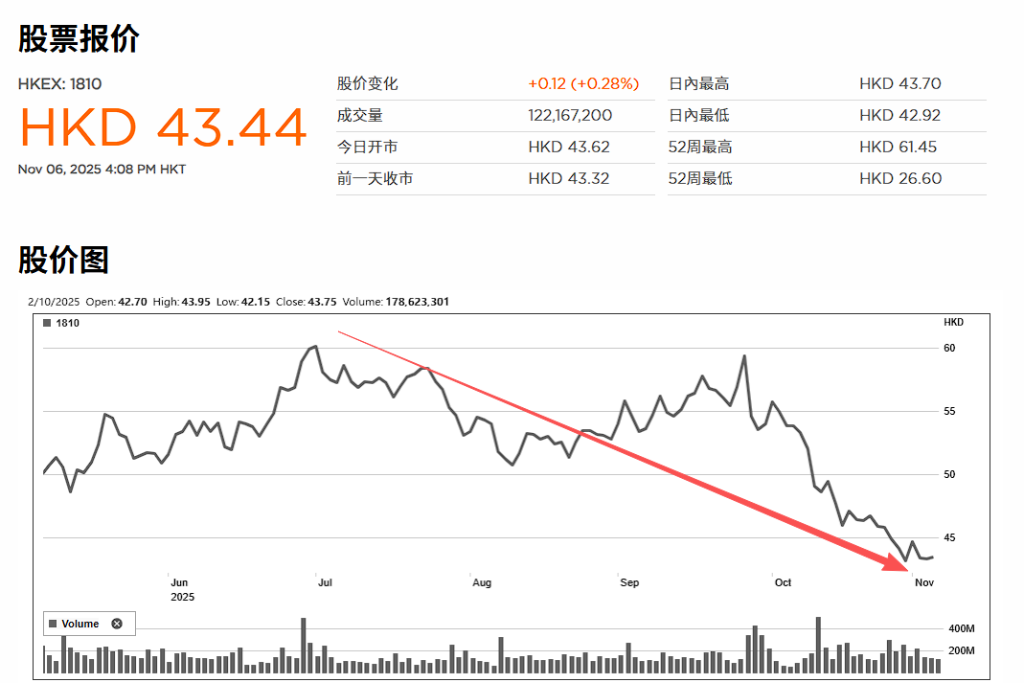
小米集团-W再跌超3% 较6月高点跌超三成 高盛称做空小米成对冲基金共识
Zhi Tong Cai Jing· 2025-11-07 03:55
Core Viewpoint - Xiaomi Group-W (01810) has seen its stock price drop over 30% from its peak in June, with a current price of 42.1 HKD, reflecting a decline of 3.08% as of the latest report [1] Group 1: Stock Performance - The stock price of Xiaomi has decreased by over 30% since its highest point in June [1] - As of the latest report, the stock is trading at 42.1 HKD with a trading volume of 30.76 billion HKD [1] Group 2: Hedge Fund Activity - Recent data from Goldman Sachs indicates a 53% increase in short positions against Xiaomi by hedge funds over the past week [1] - The selling pressure from pension funds and hedge funds has dominated the market in the last two weeks [1] Group 3: Investor Sentiment - Investor sentiment is turning cautious ahead of Xiaomi's third-quarter earnings report scheduled for November 18 [1] - Hedge funds view Xiaomi as a consensus short/sell target in the short term due to a lack of catalysts [1] Group 4: Analyst Downgrades - Goldman Sachs has recently lowered its target price for Xiaomi, citing several factors [1] - Key reasons for the downgrade include rising storage chip prices impacting smartphone gross margins, a slowdown in AIoT business growth to single digits, and delays in the second phase of electric vehicle factory affecting deliveries [1]

港股异动 | 小米集团-W(01810)再跌超3% 较6月高点跌超三成 高盛称做空小米成对冲基金共识
智通财经网· 2025-11-07 03:51
Core Viewpoint - Xiaomi Group's stock has declined over 30% from its peak in June, with a current drop of 3.08% to HKD 42.1, amid increasing short-selling activity by hedge funds [1][1][1] Group 1: Stock Performance - Xiaomi's stock price has fallen to HKD 42.1, representing a decline of over 30% since June's highest point [1] - The trading volume reached HKD 30.76 billion, indicating significant market activity [1] Group 2: Hedge Fund Activity - Hedge fund short positions on Xiaomi surged by 53% in the past week, reflecting growing bearish sentiment [1] - Recent data shows that selling pressure from pension funds and hedge funds has dominated the market in the last two weeks [1] Group 3: Investor Sentiment - Investor sentiment is turning cautious ahead of Xiaomi's third-quarter earnings report scheduled for November 18 [1] - Feedback from hedge funds suggests that Xiaomi is viewed as a consensus short/sell target in the short term due to a lack of catalysts [1] Group 4: Analyst Outlook - Goldman Sachs has lowered its target price for Xiaomi, citing rising storage chip prices that suppress smartphone gross margins [1] - The growth rate of Xiaomi's AIoT business has slowed to single digits, and delays in the electric vehicle phase two factory are impacting deliveries [1]
重磅!彭博:高盛称做空小米已经成为对冲基金共识
美股IPO· 2025-11-06 12:27
Core Viewpoint - Goldman Sachs' market team identifies Xiaomi as a consensus short/sell target in the short term due to a lack of catalysts and various operational challenges [1][5][9] Group 1: Market Sentiment and Short Selling - Hedge funds have increased their short positions on Xiaomi by 53% in the past week, indicating a shift in investor sentiment towards caution ahead of the upcoming Q3 earnings report [3][9] - The overall selling pressure is dominated by pension funds and hedge funds, reflecting a bearish outlook on Xiaomi's stock [3][9] Group 2: Financial Performance and Forecasts - Goldman Sachs has lowered Xiaomi's 12-month target price from HKD 66 to HKD 56.5, a decrease of over 10%, citing rising storage chip prices, slowing AIoT growth, and delays in electric vehicle factory construction as key reasons [5][19] - The report predicts that Xiaomi's smartphone gross margin will decline to approximately 10% by 2026, with a cautious forecast of 1.73 million units shipped, reflecting only a 1% year-on-year growth [13][20] Group 3: AIoT and Electric Vehicle Business - AIoT growth is expected to slow down significantly, with projected revenue growth rates of 6% and 0% in Q3 and Q4 of 2025, respectively, primarily due to high base effects in the Chinese market [14] - Xiaomi's electric vehicle business is seen as a core growth story, with expected deliveries of 390,000 units in 2025 and 800,000 units in 2026, despite the financial impact of vehicle purchase subsidies [16][17] Group 4: Long-term Outlook and Valuation - Despite the challenges, Goldman Sachs maintains a "buy" rating on Xiaomi, highlighting the attractive risk-reward profile at current stock prices [21] - The long-term valuation model has been updated, with a bull case price of HKD 67.4, representing a 56% upside, and a bear case price of HKD 39.0, indicating a 10% downside [22]


过去一周飙升53%,外资对小米的空仓激增,存储价格暴涨是原因之一
Hua Er Jie Jian Wen· 2025-11-06 09:44
Core Viewpoint - Hedge funds have significantly increased their short positions on Xiaomi, with a 53% surge in the past week, indicating a cautious investor sentiment ahead of the company's Q3 earnings report on November 18 [1][5] Group 1: Hedge Fund Activity - Hedge funds view Xiaomi as a consensus short/sell target in the short term due to a lack of catalysts [1][5] - The selling pressure has been dominated by pension funds and hedge funds, reflecting a strong bearish sentiment [5] Group 2: Financial Performance and Forecasts - Goldman Sachs has lowered Xiaomi's 12-month target price from HKD 66 to HKD 56.5, a decline of over 10% [1][11] - The downgrade is attributed to rising storage chip prices affecting gross margins, slowing growth in AIoT business, and delivery risks from delays in the electric vehicle factory [1][11] - Market expectations for Xiaomi's Q3 revenue growth are set at 23% year-on-year [1] Group 3: Smartphone Business and Margins - Rising storage costs are expected to pressure Xiaomi's smartphone gross margins, which are projected to decline to around 10% by 2026 [6] - Despite the margin pressure, Xiaomi's high-end strategy and favorable currency adjustments may mitigate some of the impacts [6] Group 4: AIoT Business Growth - AIoT revenue growth is anticipated to slow down due to high base effects, with expected growth rates of 6% and 0% in Q3 and Q4 of 2025, respectively [8] - However, international market expansion could provide new growth opportunities, with plans to open approximately 2,000 Xiaomi stores by 2026 [8] Group 5: Electric Vehicle Business - The electric vehicle segment is crucial for Xiaomi's future growth, with a projected financial impact of around RMB 3 billion from vehicle purchase subsidies in the first half of 2026 [9] - Production capacity is expected to gradually increase, with delivery forecasts remaining stable at 390,000 vehicles in 2025 and 800,000 in 2026 [10] Group 6: Long-term Outlook - Despite the challenges, Goldman Sachs maintains a "buy" rating, citing attractive risk-reward dynamics at current stock prices [12] - The company is also investing in new areas such as AI language models and robotics, which could serve as potential catalysts for stock price appreciation [12]
里昂:料小米集团-W第三季经调整净利润增60% 电动车续为亮点
Zhi Tong Cai Jing· 2025-11-05 07:09
Core Viewpoint - Citi expects Xiaomi Group-W (01810) to achieve a year-on-year revenue growth of 22% and a 60% increase in adjusted net profit in Q3, reaching RMB 112.9 billion and RMB 10 billion respectively, driven by robust electric vehicle sales [1] Group 1: Financial Performance - Q3 total revenue is projected to be RMB 112.9 billion, with adjusted net profit at RMB 10 billion, reflecting a year-on-year growth of 22% and 60% respectively [1] - For Q4, total revenue and adjusted net profit are expected to grow by 15% and 16% year-on-year, attributed to a recovery in smartphone sales and continued growth in electric vehicle deliveries [1] Group 2: Electric Vehicle Segment - The approval of Xiaomi's second electric vehicle factory is anticipated to act as a catalyst for stock price revaluation [1] - Electric vehicle deliveries are expected to rise to 109,000 units, with an average price of approximately RMB 260,000, and the segment may have already achieved breakeven [1] Group 3: Smartphone and AIoT Business - Xiaomi's smartphone revenue may decline by 3% year-on-year due to decreased shipments in China and India [1] - The AIoT business is projected to slow down to a year-on-year growth of 5% due to reduced subsidies for trade-ins [1]
协创数据:综合竞争力迈上新台阶,第三季度营收、利润创上市以来单季新高
Zheng Quan Shi Bao Wang· 2025-10-30 01:35
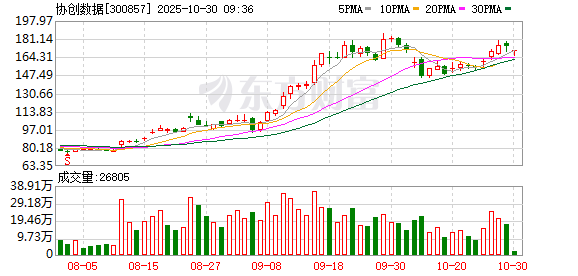
Core Insights - The company reported a significant increase in revenue and net profit for the first three quarters of 2025, with revenue reaching 8.331 billion yuan, a year-on-year growth of 54.43%, and net profit of 0.698 billion yuan, up 25.30% [2] - The third quarter alone saw record highs in both revenue and net profit, with figures of 3.387 billion yuan and 0.266 billion yuan respectively [2] Group 1: Industry Trends - The storage industry has entered a price increase cycle since Q2 2025, with prices for various storage products rising significantly for five consecutive months [3] - Morgan Stanley forecasts a multi-year "super cycle" for the storage industry, predicting the global storage market could reach 300 billion dollars by 2027 [3] - The current storage cycle is believed to be driven by AI, with expectations of continued price increases into Q4 2025 and 2026 due to severe shortages [3] Group 2: Company Developments - The company aims to build an integrated computing power foundation, having deployed multiple large-scale computing clusters globally [3] - A procurement plan for 150 million yuan worth of solid-state drives has been announced to enhance the company's data storage server production capabilities [4] - The company has made breakthroughs in industrial automation and intelligent robotics, launching the FCloud intelligent training platform to serve various sectors including finance and biomedicine [5] Group 3: International Expansion - The company is actively expanding its international presence and has submitted an application for H-share listing on the Hong Kong Stock Exchange to enhance its overseas business layout and financing capabilities [6]

特斯联艾渝在2025世界顶尖科学家论坛发布AIoT异构算力与智能体产品
IPO早知道· 2025-10-29 03:21
Core Insights - The article discusses the 2025 World Top Scientists Forum held in Shanghai, featuring prominent scientists and industry leaders discussing advancements in AI and technology [2] - The focus is on the evolution of AI technology, particularly the transition from isolated nodes to interconnected systems, emphasizing the importance of AIoT as a key technology path for implementing intelligent solutions [3] AIoT Computing Power - The company aims to build a heterogeneous intelligent computing cloud and establish a TaaS (Token as a Service) business model [5] - The self-developed hybrid inference engine HICE is crucial for efficient interconnection of heterogeneous chips, significantly improving mixed inference efficiency by over two times [7] AIoT Intelligent Agents - The company is developing a product matrix driven by intelligent agents, with the HALI intelligent agent system set to launch globally in November 2024 [10] - HALI utilizes end-to-end reinforcement learning to optimize task execution without human intervention, enhancing its ability to understand physical world dynamics [12] - The AIoT intelligent agents have already empowered various products, with plans for future releases including lightweight AR smart glasses and portable intelligent agents [14] Strategic Vision - The company emphasizes that in the AIGC era, computing power is fundamental for AI implementation, while intelligent agents serve as excellent carriers for realizing AI value [14] - The synergy between AIoT and intelligent agents is seen as a potential core driver for the next generation of AI growth [14]

特斯联与新华三达成战略合作,聚焦融合计算
Zheng Quan Shi Bao Wang· 2025-10-16 10:42
Core Viewpoint - Tesla Union and New Ziguang Group's Xinhua San have announced a strategic cooperation to focus on the development of AIoT computing power platforms and heterogeneous computing ecosystems [1] Group 1: Strategic Cooperation - The collaboration will leverage Tesla Union's expertise in heterogeneous computing compilation and AIoT technology, alongside Xinhua San's comprehensive layout across the entire industry chain of "cloud-network-security-computing-storage-end" [1] - The partnership aims to achieve deep integration of computing power technologies, resource sharing, and exploration in the construction of heterogeneous computing supernodes [1] Group 2: Goals and Innovations - The cooperation is expected to drive innovation and application of domestic computing power in the AIoT sector, accelerating the establishment of an efficient, intelligent, and secure heterogeneous computing ecosystem [1] - Both companies will work together to promote the development and application of heterogeneous computing integration [1]
特斯联与新华三达成战略合作 双方将围绕AIoT算力平台打造及异构算力生态建设进行深度合作
Mei Ri Jing Ji Xin Wen· 2025-10-16 03:40
Core Insights - Tesla Union and H3C have announced a strategic partnership focused on AIoT computing power platform development and heterogeneous computing ecosystem construction [1] Group 1: Strategic Collaboration - The collaboration will leverage Tesla Union's expertise in heterogeneous computing compilation and spatial intelligence scenarios alongside H3C's comprehensive layout across the "cloud-network-security-computing-storage-end" industry chain [1] - This partnership aims to enhance innovation and application of domestic computing power in the AIoT sector [1] Group 2: Goals and Objectives - The joint efforts are expected to accelerate the establishment of an efficient, intelligent, and secure heterogeneous computing ecosystem [1] - The collaboration will promote the integration and application of heterogeneous computing [1]