软件服务

Search documents
汉得信息成交额创2025年3月11日以来新高
Zheng Quan Shi Bao Wang· 2026-01-08 03:41
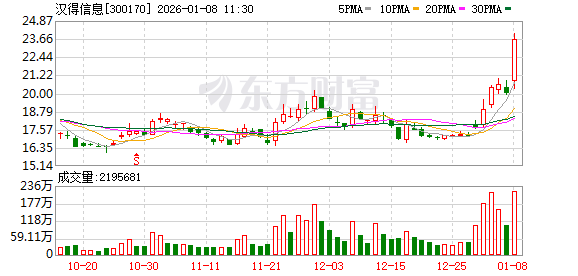
数据宝统计,截至11:08,汉得信息成交额44.51亿元,创2025年3月11日以来新高。最新股价上涨 20.00%,换手率20.84%。上一交易日该股全天成交额为20.70亿元。(数据宝) (文章来源:证券时报网) ...


A500ETF基金(512050)持仓股海光信息涨超11%。2026开年两融余额增长显著,春季行情仍有纵深
Mei Ri Jing Ji Xin Wen· 2026-01-08 02:51
Group 1 - A-shares opened lower on January 8, with the CSI A500 index showing mixed performance among its constituent stocks, while the A500 ETF (512050) fell by 0.24% with a trading volume exceeding 1.2 billion yuan [1] - The margin trading balance reached a historical high of 2.58 trillion yuan as of January 6, marking a year-on-year increase of 40.93%, indicating active market trading at the beginning of the year [1] - Key sectors attracting financing inflows include semiconductors and industrial metals, reflecting investor interest in these areas [1] Group 2 - Shenwan Hongyuan suggests that the Shanghai Composite Index's recent upward trend indicates a potential for continued spring market momentum, with new capital expected to flow into A-shares [2] - The A500 ETF (512050) offers investors a low-cost entry into core A-share assets, with a comprehensive strategy covering all 35 sub-industries and a focus on sectors like AI, pharmaceuticals, and renewable energy [2] - The ETF boasts advantages such as a low fee rate of 0.2%, strong liquidity with an average daily trading volume exceeding 5 billion yuan, and a large scale of over 40 billion yuan [2]

上海自贸区板块盘初走高,彤程新材涨停
Mei Ri Jing Ji Xin Wen· 2026-01-08 02:10
Group 1 - The Shanghai Free Trade Zone sector experienced an initial rise on January 8, with notable stock performances [1] - Tongcheng New Materials reached the daily limit increase, while Baoxin Software rose over 9% [1] - Other companies such as China Merchants Energy and Pudong Construction also saw significant gains, with increases of over 8% and 7% respectively [1]

驶入新赛道,这家“老”企业年收15亿元(奋进“十五五”·一线见闻)
Ren Min Wang· 2026-01-07 22:47
Core Viewpoint - The article emphasizes the transformation of traditional manufacturing into intelligent, green, and service-oriented manufacturing, highlighting the importance of digitalization in the industry [1]. Group 1: Company Overview - Sichuan Jiuzhou Investment Holding Group, established in 1958, has evolved from a traditional manufacturing company to include software services, focusing on digital solutions such as disaster monitoring and management systems [2][3]. - Jiuzhou Software, founded in 2022, aims to meet the digital transformation needs of traditional manufacturing clients by expanding into the information technology service sector, which offers higher value-added opportunities [3]. Group 2: Technological Advancements - The intelligent manufacturing industrial park in Mianyang, Sichuan, features over 50 unmanned devices operating under a centralized control system, leading to reduced operational costs and improved management efficiency [2]. - Jiuzhou Software has developed an intelligent networked cloud control platform tailored for the park's autonomous driving scenarios, enabling seamless integration of various unmanned devices [3][4]. Group 3: Service Model and Client Engagement - The company emphasizes the need for a shift in mindset from traditional manufacturing to a service-oriented approach, focusing on understanding client needs and providing ongoing support and upgrades [3][4]. - Continuous service upgrades are provided post-project delivery, including the development of new functionalities to adapt to the rapid advancements in autonomous driving technology [4]. Group 4: Financial Projections and Future Goals - Jiuzhou Software anticipates achieving a revenue of 1.5 billion yuan (approximately 15 million) by 2025, indicating a strong growth trajectory in the new service-oriented market [5]. - The company aims to leverage its hardware manufacturing strengths while increasing investment in service technologies and tackling key industry challenges [5].

AI芯片狂卷1480亿美元,但这块业务却熄火:英伟达押注制造业四年收益寥寥
Hua Er Jie Jian Wen· 2026-01-07 13:47
Core Insights - Nvidia's AI chip business generated nearly $148 billion in revenue over the past nine months, significantly surpassing the $27.5 billion from the same period in 2023, but the company's transition to an integrated hardware-software platform has faced major setbacks [1] - The Omniverse software, which was intended to be a core tool for creating digital twins in manufacturing and logistics, has seen minimal revenue and a stalled commercialization process, leading to the decision to shut down the Omniverse Cloud service by August 2025 due to lack of demand [1][3] - CEO Jensen Huang expressed frustration over the slow progress of the Omniverse division, criticizing the team for focusing on demonstrations rather than product development, and highlighting the lack of widespread adoption by large enterprises [1][4] Revenue and Market Response - Despite the explosive growth in AI chip revenue, the market has not reacted strongly to the revenue gap from Omniverse, indicating the challenges Nvidia faces in establishing a second growth curve [2] - The inability to address software usability and industry adaptation issues may hinder Nvidia's ambitions in robotics and industrial digitalization for the long term [2] Demand and Service Closure - Omniverse was launched in 2021 as a platform for designers to collaborate on 3D designs, but the reality has fallen short of expectations, with few clients actually signing on for large-scale simulations [3] - Developers have reported that the platform is difficult to use, incomplete, and prone to crashes, leading to the termination of the cloud service project [3] Internal Pressure and Management Concerns - Huang's anxiety over Omniverse's performance is evident, as he has pressured the team to find new revenue sources and has expressed frustration in internal meetings regarding the lack of profitability and the team's focus on demonstrations [4] - The actual outcomes of collaborative projects have also led to dissatisfaction among management, particularly regarding the scale of partnerships with companies like BMW [4] Long-term Challenges and Industry Barriers - Nvidia executives compare Omniverse to CUDA, suggesting that it may take years of investment to fully realize its potential in the "physical AI" market [6] - The company faces intense competition and structural barriers in the robotics simulation field, with many large enterprises preferring to develop their own internal simulation software rather than relying on Nvidia's platform [6] - Industry-specific technical challenges and cost-effectiveness issues also pose significant obstacles to the widespread adoption of Omniverse [6][5] Development and Market Creation - Currently, Omniverse is seen as a horizontal open platform for developers rather than a complete application, indicating that Nvidia's attempt to create a market from scratch will require a lengthy nurturing period [7]

连华尔街都看腻了AI!美股资金正悄悄流向标普500其余493家公司
智通财经网· 2026-01-07 12:57
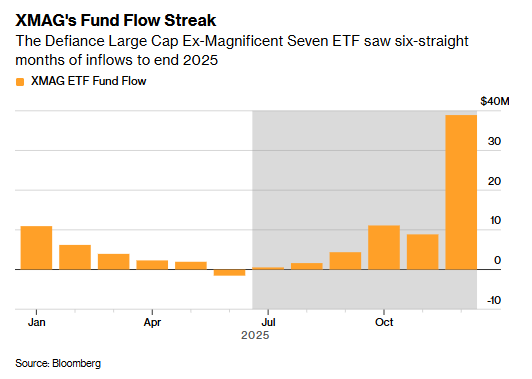
Core Viewpoint - The AI concept stocks have dominated the U.S. stock market over the past three years, leading to a cumulative increase of 78%, but investor enthusiasm is waning as concerns grow about the sustainability of this growth and the potential for a market shift away from the "Magnificent Seven" stocks [1] Group 1: Market Trends - A market style shift has begun, with the "Magnificent Seven" index down 2% since October 29, while the remaining 493 stocks in the S&P 500 have risen by 1.8% [2] - Funds are moving from high-growth stocks to more defensive and reasonably valued sectors, as evidenced by the Defiance Large Cap Ex Magnificent Seven ETF, which saw a threefold increase in net inflows in December compared to November [2] Group 2: Future Outlook - The performance of the remaining 493 S&P 500 stocks is expected to be "remarkable" in 2025, with high profit margins maintained despite economic challenges [5] - If economic conditions improve, cyclical and growth-oriented sectors may also benefit, providing opportunities for investors looking to move away from tech giants [5] - Historical examples suggest that once the dominance of the "Magnificent Seven" ends, the overall market may experience volatility [6] Group 3: Investment Sentiment - There is a growing sentiment of "AI fatigue," with warnings from various analysts about the potential end of the tech giants' dominance [7] - Goldman Sachs predicts that the contribution of the "Magnificent Seven" to S&P 500 earnings growth will decline from 50% in 2025 to 46% in 2026, while the growth rate for the remaining stocks is expected to rise from 7% to 9% [7] - Value investors are finding the remaining 493 stocks attractive due to significant valuation disparities and favorable macroeconomic conditions [7]





明天,有重磅利好!
Xin Lang Cai Jing· 2026-01-07 10:29
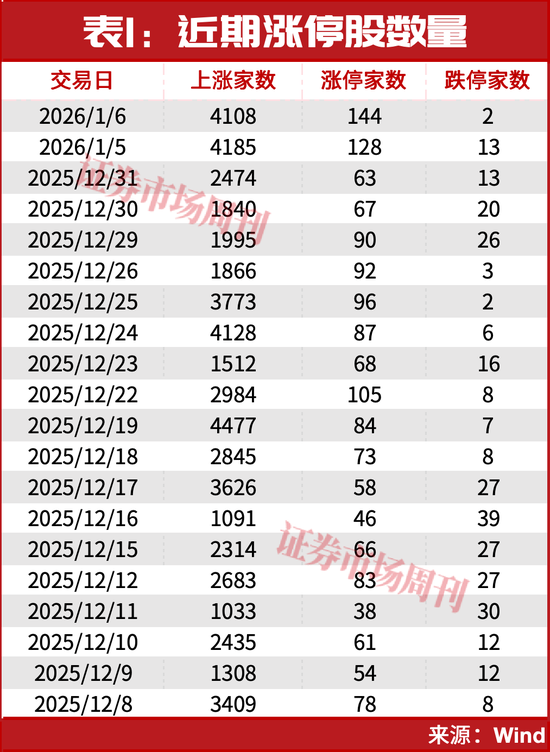
Core Viewpoint - The stock market is experiencing a significant surge with over a hundred stocks hitting the daily limit up, indicating a strong upward trend in various sectors, including technology and defense [1][2]. Group 1: Market Performance - The A-share market has shown a notable recovery, with major indices accelerating upward, such as the Shanghai Composite Index reaching a nearly 10-year high, increasing by 7% since December 17, 2025 [2][13]. - Trading volume has surged, with January 6 recording a transaction amount of 2.83 trillion yuan, the highest in four months [2][13]. - The number of stocks hitting the daily limit has exceeded a hundred multiple times, with 128 stocks on January 5 and 144 on January 6, marking the highest levels since May 6, 2025 [2][14]. Group 2: Characteristics of Limit-Up Stocks - Limit-up stocks are concentrated in various sectors, including commercial aerospace, brain-computer interfaces, autonomous driving, mergers and acquisitions, AI applications, semiconductors, non-ferrous metals, chemicals, and finance [5][17]. - There is a significant emergence of consecutive limit-up stocks, with companies like Shengtong Energy achieving 14 consecutive limit-ups and Fenglong Co. achieving 8 [5][16]. - Stocks of varying market capitalizations are experiencing limit-ups, with those under 10 billion yuan making up the largest share, while some stocks exceeding 100 billion yuan, such as Zhaoyi Innovation and China Satellite Communications, also hit the limit-up [6][17]. - Both low and high-priced stocks are represented, with Galaxy Electronics showing three consecutive limit-ups and Star Ring Technology achieving a 20% limit-up after doubling in price since October 27, 2025 [6][17]. Group 3: Major Events Influencing Stocks - Recent limit-up stocks are closely tied to significant events, such as Shengtong Energy's continuous limit-up related to its acquisition offer from Qiteng Robotics [9][20]. - In the semiconductor sector, stocks like Zhaoyi Innovation and Lian Microelectronics have surged due to multiple favorable factors, including rising prices of overseas leading stocks and the listing of the first GPU stock in Hong Kong [9][20]. - The autonomous driving sector has also seen a wave of limit-up stocks, with over ten stocks hitting the limit on January 6, influenced by major announcements from NVIDIA at CES 2026 [9][20]. - CES 2026, held from January 6 to 9, is expected to catalyze various sectors, including consumer electronics and AI, with significant product launches impacting stock performance [10][21]. Group 4: Upcoming Events - Several upcoming events in January are anticipated to have a catalytic effect on the A-share market and related sectors, including the launch of AI products by Lenovo and NVIDIA, and the Alibaba Cloud event [10][21][22]. - Key dates include the second China eVTOL Innovation Development Conference on January 15-16 and the Beijing Commercial Aerospace Exhibition on January 23-25, which are expected to influence market dynamics [10][22].


AI深度赋能 三维天地重塑制药行业数智化生态
Zheng Quan Shi Bao Wang· 2026-01-07 05:30
Core Insights - The pharmaceutical industry is at a critical juncture for high-quality development and digital transformation, with laboratory management and data governance being essential for enhancing efficiency and compliance [1] Group 1: AI Integration in Laboratory Management - Traditional manual management in laboratories is becoming inadequate due to increasing compliance demands and the need for faster R&D [2] - AI technology integrated with the SW-LIMS system automates data processing, ensuring accuracy and compliance by converting quality standards into structured data [2] - AI can automatically check formats, correct text, and verify logic in experimental records, providing real-time alerts for deviations [2] Group 2: Data Governance and Quality Improvement - High-quality data is crucial for the digital transformation of pharmaceutical companies, with the DAM platform utilizing AI for automated data governance [3] - The platform enhances data quality accuracy to over 98% by cleaning and standardizing both structured and unstructured data [3] - AI monitors compliance with regulations like GDPR and HIPAA, generating compliance reports to reduce audit burdens and costs [3] Group 3: Practical Applications and Future Plans - The AI solutions from the company have been successfully implemented in leading pharmaceutical firms, improving data quality accuracy from 75% to over 98% [4] - Future plans include developing an AI Agent platform for various high-value business scenarios and enhancing marketing automation through AI [4] - The company aims to optimize the ChatBI analysis experience, increasing intent recognition accuracy to over 90% and providing continuous support for the industry's digital transformation [4]
Wind:2025年美股市场股权融资规模总计2018亿美元 增幅14.27%
智通财经网· 2026-01-06 22:53
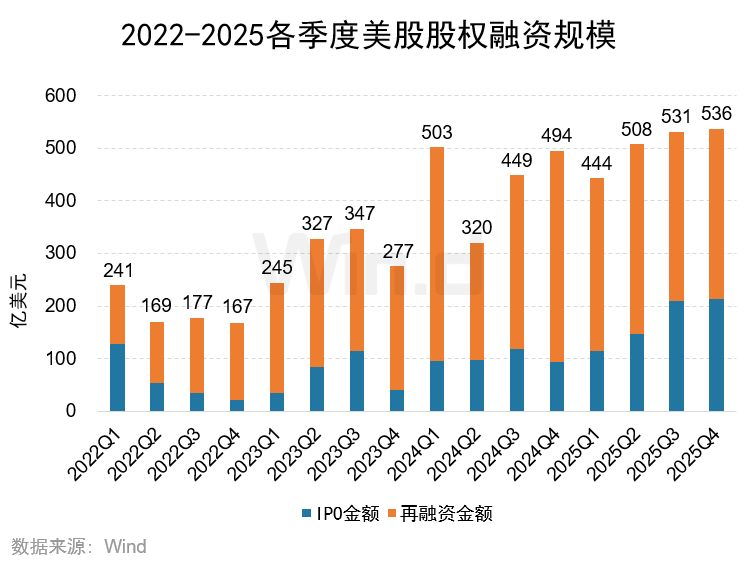
Core Insights - The US equity financing market in 2025 showed a significant recovery, with total financing reaching $201.8 billion, a 14.27% increase from $176.6 billion in 2024 [1][3][39] - Initial Public Offerings (IPOs) saw a notable rise, with 403 companies going public, raising $68.4 billion, marking a 67.95% increase compared to 2024 [1][14][30] - SPAC IPOs also surged, with 123 companies raising $23.4 billion, a dramatic increase of 153.75% from the previous year [1][33] - Chinese companies listed in the US primarily consisted of small to medium-sized enterprises, totaling 68 IPOs but raising only $1.1 billion, a decrease of 62.88% from 2024 [1][36] Equity Financing Overview - Total equity financing in the US market for 2025 was $201.8 billion, with IPOs contributing $68.4 billion (33.90%) and refinancings accounting for $133.4 billion (66.10%) [3][6] - The non-bank financial sector led in financing, raising $61.9 billion, followed by the pharmaceutical and biotechnology sector at $33.9 billion, and software services at $22.6 billion [9] IPO Market Trends - The IPO market in 2025 was dominated by the Nasdaq, with 313 companies raising $46.04 billion, representing 67.30% of the total IPO market [16] - The highest fundraising sector for IPOs was non-bank financials, raising $34.6 billion, followed by pharmaceuticals at $8 billion, and software services at $7.4 billion [18] - A total of 230 companies raised $1 billion or less in their IPOs, making up 57% of the total IPO count [27] Refinancing Trends - The refinancing market in 2025 totaled $133.4 billion, a slight decrease of 1.82% from 2024, with 912 refinancing events, an increase of 2.36% [39] - The Nasdaq led in refinancing events with 734 occurrences, raising $69.65 billion, while the NYSE had 125 events totaling $62.37 billion [43][45] - The non-bank financial sector was the top industry for refinancing, raising $27.3 billion, followed closely by pharmaceuticals at $25.9 billion [46] Underwriting Rankings - In the IPO underwriting space, Cantor Fitzgerald led with $6.484 billion from 34 deals, followed by Goldman Sachs with $6.354 billion from 36 deals, and Morgan Stanley with $5.956 billion from 35 deals [55][56] - For refinancing, J.P. Morgan topped the list with $21.098 billion from 91 deals, followed by Goldman Sachs with $16.393 billion from 73 deals [59][60]
2025年度美股承销排行榜
Wind万得· 2026-01-06 22:38
Core Viewpoint - The US equity financing market in 2025 showed a significant recovery, with both the number and scale of equity financing reaching a four-year high, totaling $201.8 billion, a 14.27% increase from $176.6 billion in 2024 [2]. Group 1: Financing Scale Trends - In 2025, the total equity financing scale in the US market was $201.8 billion, up 14.27% from $176.6 billion in 2024 [5]. - The IPO financing scale reached $68.4 billion, marking a 67.95% increase from the previous year [5]. - The refinancing scale totaled $133.4 billion, which is a slight decrease of 1.82% compared to 2024 [5]. Group 2: Financing Method Distribution - In 2025, IPO financing accounted for $68.4 billion, representing 33.90% of the total equity financing, while refinancing accounted for $133.4 billion, making up 66.10% [8]. Group 3: Industry Distribution of Financing Entities - The non-bank financial sector led in financing scale with $61.9 billion, followed by the pharmaceutical and biotechnology sector at $33.9 billion, and the software services sector at $22.6 billion [12]. - In terms of financing events, the pharmaceutical and biotechnology sector had the highest number with 354 events, followed by the non-bank financial sector with 212 events [15]. Group 4: IPO Trends - A total of 403 companies successfully went public in 2025, an increase of 131 from 2024, with total financing amounting to $68.4 billion [18]. - The Nasdaq remained the leading market for IPOs, with 313 companies listed, raising $46.04 billion, which is 67.30% of the total IPO market [20]. - The highest IPO financing was achieved by Medline, raising $6.265 billion [35]. Group 5: SPAC and Chinese Companies - In 2025, 123 SPACs were listed, a significant increase of 72 from 2024, raising $23.4 billion, up 153.75% [38]. - There were 68 Chinese companies that went public in the US, raising only $1.1 billion, a decrease of 62.88% from the previous year [41]. Group 6: Refinancing Trends - The total refinancing amount in 2025 was $133.4 billion, a decrease of 1.82%, with 912 refinancing events, an increase of 2.36% from 2024 [45]. - The Nasdaq led in refinancing events with 734 occurrences, raising $69.654 billion [49]. - The non-bank financial sector had the highest refinancing amount at $27.3 billion [52]. Group 7: Underwriting Rankings - Cantor Fitzgerald topped the IPO underwriting list with $6.484 billion, followed closely by Goldman Sachs at $6.354 billion and Morgan Stanley at $5.956 billion [61]. - In refinancing, JPMorgan led with $21.098 billion, followed by Goldman Sachs at $16.393 billion and Morgan Stanley at $12.876 billion [65].