
芯片设计

Search documents
“日版支付宝”PayPay计划在美上市
Bei Jing Shang Bao· 2025-10-15 15:54
Group 1 - SoftBank is preparing for an IPO of its payment application operator PayPay in the U.S., potentially valuing it over 3 trillion yen (approximately $20 billion) [1] - PayPay has been meeting with institutional investors since mid-September to discuss its potential valuation, with a baseline estimate of 2 trillion yen [1] - The discussions come as the U.S. IPO market experiences its busiest quarter since Q4 2021, with $24 billion raised through IPOs in Q3 [1] Group 2 - PayPay is a leader in Japan's mobile payment sector and has expanded its services to include banking and credit card offerings [1] - The app encourages users to shift from cash to electronic payments, with Japan's cashless payment ratio exceeding 40% last year [2] - PayPay announced plans for cross-border payments starting with South Korea, indicating a focus on overseas expansion as a growth strategy [2] Group 3 - PayPay has strengthened its cryptocurrency business by acquiring 40% of Binance Japan and plans to launch new cryptocurrency services [2] - The financial business segment, including PayPay, reported a more than doubling of operating profit to 18.1 billion yen for the April to June quarter [2] - The trading value of cryptocurrencies in Japan doubled to 33.7 trillion yen in the first seven months of this year [2] Group 4 - SoftBank is negotiating with global banks for a $5 billion loan using its ARM shares as collateral to fund investments in AI, particularly OpenAI [3] - If successful, the total margin loan from ARM shares will increase from $13.5 billion to $18.5 billion [3] - SoftBank has previously used similar financing strategies, raising about $8 billion from 11 banks before ARM's IPO [3] Group 5 - SoftBank invested $30 billion in OpenAI as part of a $40 billion funding plan, with OpenAI's valuation at $300 billion [4] - The "Stargate" project, announced by former President Trump, involves building AI infrastructure with an initial investment of $100 billion, potentially expanding to $500 billion [5] - The project is currently stalled due to uncertainties from tariffs and recent industry developments [5]


利好!A股芯片龙头发布!
Zheng Quan Shi Bao· 2025-10-15 14:09
Core Viewpoint - A significant number of A-share listed companies have announced performance forecasts for the first three quarters of 2025, with most indicating an increase in net profit, and several companies are expected to see their net profits double year-on-year [1][2]. Group 1: Company Performance Highlights - Haiguang Information reported a revenue of 9.49 billion yuan for the first three quarters of 2025, a year-on-year increase of 54.65%, and a net profit of 1.961 billion yuan, up 28.56% [2]. - Tai Ling Microelectronics expects a revenue of approximately 766 million yuan for the first three quarters of 2025, representing a year-on-year increase of about 30%, with a projected net profit of around 140 million yuan, an increase of approximately 118% [2][3]. - ST Bailing anticipates a net profit of 85 million to 127 million yuan for the first three quarters of 2025, reflecting a growth of 66.23% to 148.37% compared to the previous year [4]. - Asia-Pacific Co. forecasts a net profit of 310 million to 335 million yuan, indicating a growth of 97.38% to 113.30% year-on-year [5]. - Meinian Health expects a net profit of 42 million to 62 million yuan, representing a year-on-year increase of 70.51% to 151.70% [5]. Group 2: Market Reactions - Following the performance forecasts, many companies experienced significant stock price increases, with Suihengyun's stock hitting the upper limit on October 15 after announcing a projected net profit of 345 million to 515 million yuan, a growth of 87.83% to 180.38% [6][7]. - Tongda Co. also saw its stock price surge after revealing a projected net profit of 180 million to 152 million yuan, reflecting a growth of 50.01% to 111.12% [8]. - Jiantou Energy's stock rose by 5.12% after announcing a projected net profit of approximately 1.583 billion yuan, an increase of about 231.75% year-on-year [9].
利好!A股芯片龙头发布!
证券时报· 2025-10-15 14:06
Core Viewpoint - A significant number of A-share listed companies have released performance forecasts for the first three quarters of 2025, with most indicating an increase in net profit, and several companies are expected to see their net profits double year-on-year [1][3][6]. Group 1: Company Performance Highlights - Haiguang Information reported a revenue of 9.49 billion yuan for the first three quarters of 2025, a year-on-year increase of 54.65%, and a net profit of 1.961 billion yuan, up 28.56% [3]. - In Q3 alone, Haiguang Information achieved a revenue of 4.026 billion yuan, growing 69.6% year-on-year, with a net profit of 760 million yuan, marking a 13.04% increase [4]. - Tailin Microelectronics expects a revenue of approximately 766 million yuan for the first three quarters of 2025, representing a growth of about 30%, and a net profit of around 140 million yuan, an increase of approximately 118% [4]. - ST Bailing anticipates a net profit of 85 million to 127 million yuan for the first three quarters, reflecting a growth of 66.23% to 148.37% [7]. - Asia-Pacific Co. forecasts a net profit of 310 million to 335 million yuan, indicating a growth of 97.38% to 113.30% [8]. - Meinian Health expects a net profit of 42 million to 62 million yuan, a year-on-year increase of 70.51% to 151.70% [8]. Group 2: Market Reactions and Trends - Following the performance forecasts, many companies' stock prices surged significantly, with Suihengyun's stock hitting the upper limit after announcing a projected net profit increase of 87.83% to 180.38% [12]. - Tongda Co. also saw its stock price rise sharply after forecasting a net profit increase of 50.01% to 111.12% [13]. - Jiantou Energy's stock rose by 5.12% after announcing a projected net profit increase of approximately 231.75% due to lower coal market prices and increased profitability from its power generation subsidiaries [13][14]. - Citic Securities anticipates a positive outlook for the electronics industry driven by the consumer electronics peak season and the release of new AI products, suggesting a favorable industry cycle [5].



光通信芯片龙头优迅股份IPO过会!福建厦门两级国资参投
Sou Hu Cai Jing· 2025-10-15 10:36
Core Viewpoint - Xiamen Youxun Chip Co., Ltd. successfully passed the IPO review for the Sci-Tech Innovation Board, becoming the second company from Xiamen to achieve this in 2023 [1] Company Overview - Youxun is one of the earliest companies in China to enter the optical communication chip design industry, focusing on the research, design, and sales of optical communication transceiver chips [3][4] - The company was established in 2003 and is located in Xiamen, Fujian Province [3] - Youxun's IPO represents a story of innovation in the optical communication industry, breaking international monopolies and showcasing the growth of a "national manufacturing single champion" [3][9] Industry Context - The optical communication industry is rapidly developing due to the demands of the digital and AI era, which require high-speed data transmission and large capacity [4] - Optical communication technology uses light waves for information transmission, offering advantages such as high-speed data transfer, large data capacity, long-distance transmission, and low signal loss [4] Product Portfolio - Youxun's main products include optical communication transceiver chips, transimpedance amplifier chips, limiting amplifier chips, and laser driver chips [5] - The optical communication transceiver chip contributes the most to revenue, accounting for over 80% in each reporting year [5] Financial Performance - Revenue for Youxun from 2022 to 2024 is projected to be 339 million, 313 million, and 411 million CNY respectively, with net profits of approximately 81.4 million, 72.1 million, and 77.9 million CNY [6] - The company maintains a high gross margin, with rates of 55.26%, 49.14%, and 46.75% over the reporting period, which is above the industry average [7][8] Market Position - Youxun has established a complete core technology system in optical communication chip design, achieving breakthroughs in key areas and becoming one of the few companies in China to provide comprehensive optical communication chip solutions [9][10] - The company has a leading market share in the 10Gbps and below segment in China, ranking second globally [12] Research and Development - Youxun has accumulated a rich pool of technology and core patents, with 114 authorized patents as of June 30, 2025 [15] - The company is actively developing new products to meet the increasing demand for high-speed optical communication chips, including 50G PON transceiver chips and 400Gbps data center transceiver chips [11] Ownership and Investment - The actual controllers of Youxun are Ke Binglan and Ke Tenglong, who collectively hold 27.13% of the voting rights [16] - The company has received investments from state-owned capital at both the provincial and municipal levels in Fujian and Xiamen [19] IPO Plans - Youxun plans to raise approximately 809 million CNY through its IPO, with funds allocated for the development and industrialization of next-generation access network and high-speed data center chips, as well as vehicle-mounted chip projects [19]
东莞新一批上市后备企业名单公布,松山湖入选最多
Nan Fang Du Shi Bao· 2025-10-15 09:23
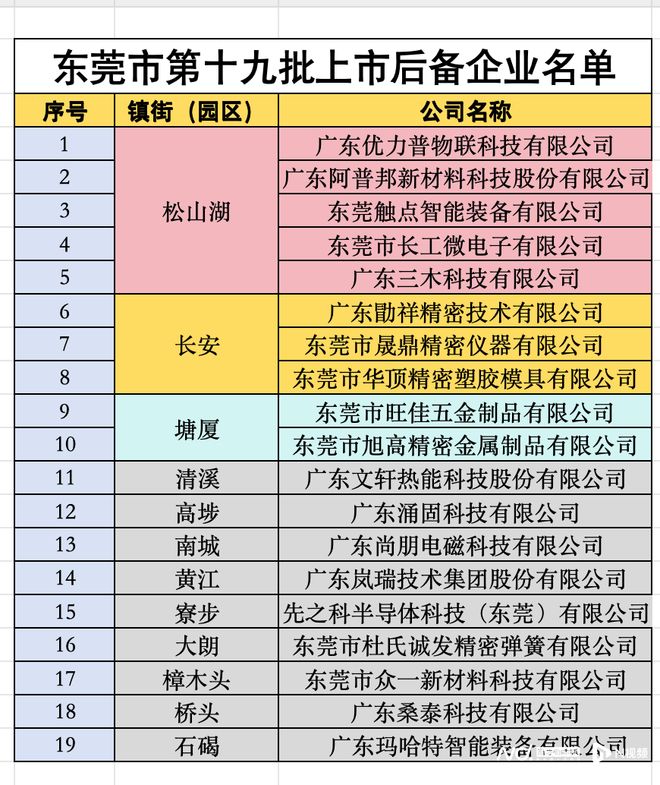
Core Insights - Dongguan has announced the 19th batch of listed reserve enterprises, with 19 companies recognized, including Guangdong Wenxuan Thermal Energy Technology Co., Ltd. [1] - The selected companies are distributed across 12 towns and streets in Dongguan, with the highest number in Songshan Lake (5 companies) [1][2] - The recognized enterprises span various sectors, including high-end equipment manufacturing, new materials, semiconductors, electronic information, and precision manufacturing [2][3] Company Highlights - Xianzhi Semiconductor Technology (Dongguan) Co., Ltd. is a leading global semiconductor manufacturer, focusing on the R&D, manufacturing, and sales of semiconductor discrete devices, and has been awarded the national "specialized and innovative small giant" title in 2023 [3] - Guangdong Youlipu Internet of Things Technology Co., Ltd. is also a national "specialized and innovative small giant" enterprise, providing products for cloud computing, big data, and artificial intelligence [4] - Dongguan Changong Microelectronics Co., Ltd. specializes in high-performance low-voltage high-current power chip design, offering a complete power solution that breaks the foreign chip monopoly [4] - Guangdong Apuban New Materials Technology Co., Ltd. focuses on the R&D, production, and sales of adhesive new materials, serving manufacturing enterprises in the Pearl River Delta and nationwide [4] - Dongguan Dushi Chengfa Precision Spring Co., Ltd. is a national high-tech enterprise with over 70 patents, collaborating with the Shenzhen Institute of Advanced Technology for medical device research [4] Market Context - Dongguan currently has 85 listed companies, including 65 on the A-share market, forming a capital market characterized by "technological innovation + advanced manufacturing" [4] - The city plans to continue implementing the "Listing Kunpeng Plan" to enhance its support policies for enterprise listings and promote rapid development through capital markets [4]
炬芯科技营收预增54.5%扣非涨204% 研发费率27%
Chang Jiang Shang Bao· 2025-10-15 07:01
Core Viewpoint - The company, Juchip Technology, is experiencing rapid growth in its business performance, driven by advancements in AI technology and a focus on product innovation and development [1][3]. Financial Performance - For the first three quarters of 2025, Juchip Technology expects to achieve a revenue of 721 million yuan, representing a year-on-year increase of 54.50% [2][4]. - The net profit attributable to the parent company is projected to be 151 million yuan, reflecting a year-on-year growth of 112.94% [2][4]. - The net profit after deducting non-recurring gains and losses is anticipated to be 146 million yuan, showing a significant increase of 204% compared to the previous year [2][4]. - The company's net profit margin is expected to reach 20.94%, up from 15.20% in the same period last year, an increase of 5.75 percentage points [2]. Research and Development - Juchip Technology has increased its R&D investment to approximately 194 million yuan, a year-on-year growth of 21.55%, resulting in an R&D expense ratio of about 27% for the first three quarters [5][6]. - The company is focusing on the AI transformation of edge products and accelerating the iteration of new products to enhance operational results [4][6]. Market Performance - Since the end of September 2024, Juchip Technology's stock price has entered an "upward channel," increasing by over 270% in approximately one year [8]. - The company has successfully launched several projects with leading brands, with products in the low-latency private wireless audio sector already entering mass production [6][8]. Dividend and Share Buyback - Juchip Technology plans to distribute a cash dividend of 1 yuan per 10 shares, amounting to approximately 17.43 million yuan, which represents 19.07% of the net profit attributable to shareholders for the first half of 2025 [6][7]. - Historically, the company has distributed dividends three times since its listing, totaling 82 million yuan [7].


优迅股份IPO生死局:3000万元软件退税是否“骗税”引争议
Xin Lang Zheng Quan· 2025-10-15 06:32
优迅股份成立于2003年2月,主要从事光通信前端收发电芯片的研发、设计与销售。 优迅股份近一个月的核心争议直指其嵌入式软件增值税退税的合理性与真实性。根据公开数据,2022年 至2025年上半年,优迅股份归母净利润分别为8139.84万元、7208.35万元、7786.64万元、4695.88万元, 而同期获得的嵌入式软件退税金额分别为993.41万元、698.05万元、957.87万元、439.54万元,占当期净 利润的比例分别高达12.20%、9.68%、12.30%、9.36%。2022年至2025年上半年,优迅股份获得的增值 税即征即退金额累计超过3000万元,占各期净利润比例平均超过10%。 争议的种子源于国家对软件产业的税收扶持政策。根据《财政部、国家税务总局关于软件产品增值税政 策的通知》,嵌入式软件产品可享受增值税实际税负超过3%部分即征即退。 有举报信及相关媒体指出,优迅股份的主营产品——光通信电芯片(如TIA、收发合一芯片等)本质上 属于模拟芯片或模数混合芯片。在芯片设计行业,这类芯片通常通过硬件电路实现功能。 举报材料还指出,同行业中以模拟和信号链芯片设计为主的企业,如思瑞浦、圣邦股份等 ...
星瞰IPO|奕斯伟三年亏掉50亿,“RISC-V第一股”能否撑到行业黎明?
Sou Hu Cai Jing· 2025-10-14 06:16
Core Viewpoint - The company, Beijing Yiswei Technology Co., Ltd., is pursuing an IPO in Hong Kong to become the first publicly listed company focused on RISC-V architecture, despite facing significant financial losses and challenges in its business model [2][15]. Financial Performance - Over the years 2022 to 2024, the company reported revenues of 2 billion, 1.752 billion, and 2.025 billion RMB, with net losses of 1.57 billion, 1.873 billion, and 1.547 billion RMB, totaling a cumulative loss of 4.99 billion RMB [4][10]. - The gross margin has significantly declined from 25.9% in 2022 to 15.4% in 2023, with a slight recovery to 17.7% projected for 2024, indicating ongoing financial struggles [6][7]. Business Model and Market Position - The company specializes in RISC-V architecture, providing system-level solutions primarily for smart terminals and embodied intelligence applications, but it faces challenges such as a weak ecosystem and compatibility issues [2][4]. - Yiswei ranks fourth among RISC-V solution providers in China, holding a market share of only 1% [4]. Customer Dependency - The company heavily relies on a single major client, BOE Technology Group, which accounted for over 76% of its revenue from 2022 to 2024, peaking at 82.1% in 2023 [8][9]. - This dependency poses a significant risk to the company's stability and growth potential, as it may limit negotiation power and strategic flexibility [9]. Research and Development - The company has invested heavily in R&D, spending approximately 14 billion RMB annually from 2022 to 2024, which constitutes over two-thirds of its revenue [10]. - Despite the high R&D expenditure, the company has seen a reduction in employee numbers, with a 24% decrease from 2022 to 2024, which is atypical for a growth-oriented company [10]. Market Outlook - RISC-V architecture is still in an exploratory phase, with a projected market penetration of only 1.3% in 2024, expected to rise to 11.8% by 2029 [13]. - The company's ability to survive until the market for RISC-V solutions matures remains uncertain, given its current financial situation [13].
豪威集团半年赚20亿投17亿研发 芯片首富虞仁荣拟套现36亿还债
Chang Jiang Shang Bao· 2025-10-13 23:46
Core Viewpoint - The actual controller of the chip giant, Huowei Group, plans to reduce his shareholding to repay debts and lower the pledge rate, which has raised market concerns about his financial situation [1][4]. Shareholding and Debt Situation - Huowei Group's controlling shareholder, Yu Renrong, intends to sell up to 24 million shares within three months through block trading, which represents a maximum of 1.99% of the company's total shares [4]. - If the maximum reduction is executed at the closing price of 151.17 yuan per share, Yu Renrong could cash out approximately 3.6 billion yuan [5]. - As of September 30, 2025, Yu Renrong directly holds 27.65% of Huowei Group's shares, with a pledge rate of 51.58% [2][6]. - The total number of pledged shares due in the next six months is 2.538 million, corresponding to a financing balance of 1.1 billion yuan [8]. Financial Performance and Stability - Huowei Group reported a robust financial position with an asset-liability ratio of 38.36% as of June 30, 2025 [3][12]. - The company achieved a profit of over 2 billion yuan in the first half of 2025, with more than 1.7 billion yuan invested in research and development [3][12]. - The company has consistently increased its R&D investment, with a total of 17.24 billion yuan in the first half of 2025, representing a year-on-year growth of 9.01% [9]. Market Position and International Expansion - Huowei Group is among the top ten fabless semiconductor companies globally, with a significant portion of its revenue coming from international markets [11]. - In 2023 and 2024, the company's revenue from overseas markets was 183.31 billion yuan and 209.62 billion yuan, accounting for over 80% of total revenue [11]. - The company has successfully entered NVIDIA's supply chain, supporting its next-generation smart driving vehicles [11]. Future Prospects - Huowei Group is advancing its Hong Kong IPO and accelerating its international strategy and overseas business development [12].

联芸科技股价涨5.39%,招商基金旗下1只基金位居十大流通股东,持有32.08万股浮盈赚取99.46万元
Xin Lang Cai Jing· 2025-10-13 02:37
Group 1 - The core viewpoint of the news is that Lianyun Technology has seen a significant increase in its stock price, rising by 5.39% to reach 60.60 CNY per share, with a trading volume of 320 million CNY and a turnover rate of 7.96%, resulting in a total market capitalization of 27.876 billion CNY [1] - Lianyun Technology, established on November 7, 2014, is located in Hangzhou, Zhejiang Province, and specializes in platform-based chip design, focusing on data storage control chips and AIoT signal processing and transmission chips. The revenue composition is 85.68% from data storage control chips, 11.77% from AIoT signal processing and transmission chips, and 2.55% from other products [1] Group 2 - Among the top circulating shareholders of Lianyun Technology, a fund under China Merchants Fund, specifically the China Merchants Fengying Active Allocation Mixed A (009362), has entered the top ten circulating shareholders, holding 320,800 shares, which accounts for 0.46% of the circulating shares. The estimated floating profit today is approximately 994,600 CNY [2] - The China Merchants Fengying Active Allocation Mixed A fund was established on July 29, 2020, with a current scale of 687 million CNY. Year-to-date returns are 26.19%, ranking 3780 out of 8234 in its category, while the one-year return is 27.45%, ranking 3212 out of 8083. Since its inception, the fund has experienced a loss of 25.61% [2]