饮料制造

Search documents
宗庆后家族,海外资产大曝光
首席商业评论· 2025-07-18 04:47
Core Viewpoint - The article discusses the complex offshore capital network and asset management strategies of the Zong family, particularly focusing on Zong Fuli's role in managing the family's wealth and investments, including real estate transactions in Los Angeles and Hong Kong [6][34]. Group 1: Real Estate Transactions - A luxury mansion owned by the Hilton family in Los Angeles was sold for $25 million after being on the market for over two years, down from an initial listing price of $55 million, representing a price drop of over 50% [3][4][6]. - The buyer of the mansion is reportedly connected to the Zong family, specifically during the final phase of Zong Qinghou's life [6][7]. Group 2: Offshore Capital Network - The Zong family's offshore capital network is primarily facilitated through offshore companies, with Zong Fuli controlling Hongsheng Beverage Group Limited, which is linked to an offshore entity registered in the British Virgin Islands [8][9]. - Zong Fuli has held directorships in multiple offshore companies, including Best Max Group Limited and several others registered in the British Virgin Islands, indicating a vast and secretive offshore capital network [10][11]. Group 3: Domestic Business Control - The Zong family controls a significant domestic enterprise matrix through offshore companies, with Bountiful Gold Trading Limited and other entities holding stakes in various food and beverage companies in China [15][16]. - Hongsheng Group, under Zong Fuli's leadership, has invested in 58 companies, primarily in the food and beverage sector, and has taken on a substantial portion of Wahaha Group's product processing business [17][22]. Group 4: Historical Context and Strategy - The formation of the Zong family's offshore network is partly a response to the risk of losing control over joint ventures, particularly following the partnership with Danone in 1996 [23][24]. - This strategy has allowed Zong Fuli to maintain control over Wahaha and expand the family's business interests through various offshore and domestic investments [25]. Group 5: Overseas Property Investments - The Zong family has a history of overseas property investments, including a property in Hong Kong purchased for HKD 11.1 million, which was later sold for HKD 26 million [27][29]. - Zong Fuli also owns a property in Hong Kong valued at approximately HKD 200 million, held under a company name rather than her personal name [31][33].


宗庆后家族,海外资产大曝光
凤凰网财经· 2025-07-17 13:25
Core Viewpoint - The article discusses the significant price drop of a luxury property owned by the Hilton family in Los Angeles, which sold for $25 million after being listed for $55 million two years prior, highlighting a more than 50% decrease in price, indicating a potential investment opportunity in the luxury real estate market [1][2]. Group 1: Family Wealth and Asset Management - The transaction occurred shortly before the passing of Zong Qinghou, a prominent businessman known for his frugal lifestyle, which contrasts with the family's complex wealth management strategies [3]. - Zong Qinghou's family has a vast offshore capital network, with offshore companies playing a crucial role in their asset management [4][6]. - Zong Fuli, Zong Qinghou's daughter, has been involved in multiple offshore companies, indicating a sophisticated approach to wealth preservation and growth [5][6]. Group 2: Offshore Company Structures - The family controls a significant number of domestic enterprises through offshore companies, with BOUNTIFUL GOLD TRADING LIMITED and others being key players in their investment strategy [10][14]. - The offshore companies are primarily registered in tax-friendly jurisdictions like the British Virgin Islands and Seychelles, creating a complex and discreet financial network [7][8]. - The family has established a substantial presence in Hong Kong, further diversifying their asset portfolio [8][9]. Group 3: Real Estate Investments - The family has a history of investing in overseas real estate, including properties in Los Angeles and Hong Kong, which serve as a means of asset diversification [17][18]. - Zong Fuli purchased a property in Hong Kong for approximately $1.11 million, which was later sold for $26 million, showcasing the potential for significant returns in the real estate market [18]. - The family's current property holdings in Hong Kong are valued at around HKD 200 million, indicating a strong investment in high-value real estate [19][21]. Group 4: Family Dynamics and Future Challenges - The family's previously organized asset structure is now facing challenges due to emerging disputes among family members, which could impact their business network [22].

知情人士:宗庆后,不止这四个孩子
创业家· 2025-07-17 10:10
Group 1 - The article discusses the complex family dynamics and inheritance disputes surrounding the late Zong Qinghou, founder of Wahaha Group, revealing that he has six children in addition to his daughter Zong Fuli [5][7][11] - Zong Fuli is currently embroiled in legal battles with her half-siblings over the inheritance of a 29.4% stake in Wahaha Group, which has led to significant public interest and speculation about the company's future [7][24] - The article highlights the historical context of Zong Qinghou's relationships, including his marriages and the implications these have on the inheritance claims of his children [6][18] Group 2 - The article outlines the financial aspects of the inheritance dispute, mentioning a family trust set up with a balance of approximately $1.8 billion, and the ongoing legal actions regarding the distribution of these assets [21][24] - It notes that Zong Fuli's management of the company has faced challenges, including internal disputes and potential changes in ownership dynamics, particularly concerning a 46% stake that may be acquired by her stepmother, Du Jianying [24][25] - The article emphasizes the significance of employee stock ownership within Wahaha Group, which could influence the control of the company depending on the outcomes of ongoing legal disputes [24][25]

香飘飘: 香飘飘关于2023年股票期权激励计划首次授予及预留授予部分股票期权注销完成的公告
Zheng Quan Zhi Xing· 2025-07-17 08:07
Core Points - The company announced the cancellation of a total of 6.1497 million stock options from its 2023 stock option incentive plan due to various reasons including expiration, employee departures, and unmet performance targets [1] - The cancellation includes 550,700 stock options that expired unexercised, 1.427 million options from 10 employees who left the company, and 4.172 million options from 36 employees due to performance criteria not being met [1] - The company confirmed that this cancellation will not affect its capital structure or have a substantial impact on its financial status and operating results [1] Summary by Sections Stock Option Cancellation - A total of 6.1497 million stock options have been canceled from the 2023 stock option incentive plan [1] - 550,700 options expired unexercised before the deadline [1] - 1.427 million options were canceled due to 10 employees leaving the company [1] - 4.172 million options were canceled due to performance criteria not being met by 36 employees [1] Impact on Company - The cancellation of stock options will not affect the company's capital structure [1] - There will be no substantial impact on the company's financial condition and operating results [1] - The company's stock option management policies remain unaffected [1]

宗馥莉的继承之战
投中网· 2025-07-17 03:34
Core Viewpoint - The control of Wahaha by Zong Fuli remains unstable, facing a significant challenge due to a sudden inheritance dispute involving 35 billion RMB, which could shake the financial foundation and family control of the company [3][5][6]. Group 1: Inheritance Dispute - An inheritance dispute has erupted, with three individuals claiming to be the illegitimate children of Zong Qinghou, initiating lawsuits in both Hong Kong and Hangzhou [4][5]. - The plaintiffs are seeking to reclaim $2.1 billion in offshore trust assets and to divide Zong Qinghou's 29.4% stake in Wahaha Group, with the total disputed amount reaching 35 billion RMB [5][6]. - If the plaintiffs succeed, the ownership structure of Wahaha could shift from a balance of state capital, employee shareholding, and Zong Fuli to a more complex arrangement involving multiple heirs, potentially leading to governance turmoil [6][10]. Group 2: Zong Fuli's Challenges - Zong Fuli has faced multiple crises since taking over Wahaha, including factory shutdowns and disputes over shareholding, indicating a strategic shift towards the Hongsheng system [9][12]. - The current shareholding structure consists of 46% state-owned shares, 29.4% held by the Zong family, and 24.6% by employee shareholding, which was maintained under Zong Qinghou's leadership [10][16]. - Zong Fuli's management style contrasts with her father's, focusing on institutional reforms that have led to dissatisfaction among long-time employees, complicating her leadership transition [22][24]. Group 3: The Role of Hongsheng Group - Zong Fuli's control over Wahaha is bolstered by her leadership of Hongsheng Beverage Group, which has become a key player in Wahaha's production and distribution [32][35]. - Hongsheng Group operates independently from Wahaha, allowing Zong Fuli to maintain significant influence over production and profit channels, despite the ongoing disputes [33][34]. - Recent actions to replace Wahaha's core departments with personnel from Hongsheng indicate a strategic pivot towards consolidating power within the Hongsheng framework [38][42]. Group 4: Brand Control and Future Implications - Despite Zong Fuli's control over production, the Wahaha brand remains under the group's ownership, which could limit her operational flexibility if disputes escalate [44][45]. - Attempts to transfer Wahaha trademarks to her controlled entities have been halted by state capital, reflecting a lack of trust in her management of complex interests [48][54]. - The ongoing inheritance dispute and control crisis represent the most significant challenge Zong Fuli has faced since taking the helm, with implications for both her future and the brand's trajectory [56][57].

娃哈哈遗产大战,谁是正“宗”?
和讯· 2025-07-16 09:32
Core Viewpoint - The article discusses the ongoing inheritance dispute within Wahaha Group following the death of its founder, Zong Qinghou, highlighting the complexities of family dynamics, legal battles, and corporate restructuring that may impact the company's future [3][15]. Group 1: Inheritance Dispute - Three individuals claiming to be Zong Qinghou's illegitimate children have filed lawsuits in Hong Kong and Hangzhou courts to claim a share of a $2.1 billion trust and 29.4% equity in Wahaha Group, valued at over 20 billion yuan [3][12]. - The legal proceedings hinge on establishing paternity, as non-marital children have equal inheritance rights under Chinese law, but must prove their relationship through DNA testing [4][12]. - The key figure in the inheritance dispute is Du Jianying, a former high-ranking executive at Wahaha, who is alleged to be the mother of the claimants and has significant control over various subsidiaries [5][10]. Group 2: Corporate Restructuring - Following Zong Qinghou's death, Zong Fuli has taken over as chairman and initiated significant reforms, including the closure of 18 production facilities, which has caused internal unrest among employees [6][7]. - The closures primarily affected factories not under the control of Zong Fuli's enterprise system, while new production lines were established in other regions, indicating a strategic shift in operations [8][10]. - The restructuring efforts have raised concerns among distributors, with reports of three provincial distributors halting orders due to fears over supply stability amid ownership changes [15]. Group 3: Broader Implications for Family Businesses - The inheritance battle at Wahaha reflects a larger trend in China's private sector, where over 80% of private enterprises are family-owned and are facing succession challenges as the first generation of entrepreneurs ages [11][15]. - Family trusts are increasingly favored as a wealth management tool to protect family assets from business risks, but they require careful planning and integration with other financial strategies to be effective [14]. - The outcome of the Wahaha inheritance case may set important precedents for wealth transfer and family business governance in China, particularly regarding the rights of non-marital children and the validity of cross-border trusts [15].
国内首个免费提供的深度研究,反而有市面上最好的体验
歸藏的AI工具箱· 2025-07-16 08:50
Core Viewpoint - The article discusses the launch of Metaso's deep research feature, which is the first free product offering in the market that provides deep research capabilities, aiming to reduce costs while maintaining high accuracy in AI search and reasoning results [2][64]. Group 1: Deep Research Functionality - Metaso has implemented a segmented reinforcement learning approach to break down deep research tasks, significantly reducing resource consumption while ensuring high accuracy [3]. - The platform enhances user confidence by allowing them to verify information through various interactions and displays, effectively reducing model hallucinations [4][14]. - A novel interaction design reveals the dynamic "problem chain" during the execution of deep research tasks, providing users with insights into the model's reasoning process [7][14]. Group 2: User Interaction and Experience - The deep research results are presented in a more understandable format, utilizing various modalities to aid comprehension, such as audio explanations and interactive reports [15][21]. - Users can generate audio podcasts for each result, allowing for verification of information through listening [16]. - The platform highlights references and sources interactively, enhancing the user experience and understanding of the results [17]. Group 3: Case Studies and Applications - The article provides examples of how the deep research feature effectively addresses current social and financial issues, such as the inheritance dispute involving Wahaha's founder, Zong Qinghou, and the implications of stablecoins in the financial sector [27][40]. - A detailed timeline of events related to the inheritance dispute is presented, showcasing the platform's ability to organize and clarify complex information [30][33]. - The platform also offers strategic insights for gaming scenarios, demonstrating its versatility in handling various types of inquiries [50][61]. Group 4: Technological Innovation and Philosophy - Metaso's commitment to providing free access to advanced AI search and deep research services reflects a belief that the best technology should serve the most people [64][65]. - The company emphasizes that technological innovation is driven by the desire to reduce costs and improve service quality, rather than merely providing free services as a charitable act [64].

城市工作会议联合解读电话会议
2025-07-16 00:55
Summary of Conference Call on Urban Development and Industry Insights Industry and Company Involved - **Industry**: Real Estate, Building Materials, Energy Drinks - **Companies Mentioned**: Dongpeng Beverage, Conch Cement, Taipai Group, Huaxin Cement, China Resources, Binjiang, Greentown, Jianfa Zhonghai Key Points and Arguments Urban Development and Real Estate Policy - The Central Urban Work Conference emphasizes a shift from large-scale expansion to improving existing urban stock, indicating a focus on urban renewal rather than large-scale stimulus, which benefits post-cycle industries like building materials and home appliances [1][2][3] - The policy aims to steadily advance the renovation of urban villages and dilapidated housing, avoiding a return to the monetization of shantytown renovations seen in 2015-2016, suggesting limited demand for incremental cyclical products [1][3][5] - The real estate market is transitioning from expansion to quality enhancement, focusing on improving existing housing quality and surrounding environments rather than new construction [1][6][7] Regional Market Performance - The real estate markets in first and second-tier core cities and their metropolitan areas are expected to outperform the national average, with regional developers like China Resources, Binjiang, Greentown, and Jianfa Zhonghai being noteworthy [1][8] Energy Drink Consumption Trends - Population movement significantly impacts energy drink consumption, with higher preferences in first and second-tier cities. As population density increases, energy drink consumption is expected to rise, making Dongpeng Beverage a recommended investment [1][9][10] - The consumption of energy drinks varies across provinces, with Guangdong leading in market share for Red Bull and Dongpeng, which is projected to maintain a 35% revenue growth rate [1][11] Building Materials Industry Insights - Urban renewal and village renovation will have limited demand pull for the building materials industry, with the consumption of building materials being most affected, particularly in segments like waterproofing, piping, and coatings [2][12][15] - The cement sector is expected to benefit from demand growth and supply-side reforms, with recommendations for Conch Cement, Taipai Group, and Huaxin Cement as investment targets due to their strong market positions and profitability [2][15][16] Market Outlook and Investment Strategy - The overall sentiment from the conference indicates a cautious approach to large-scale stimulus, with the market expected to remain within a relatively stable range [3][5] - Investment strategies should focus on a "barbell" approach, balancing technology and military sectors with dividend-paying assets like bank stocks and high-dividend service sector stocks [3] Conclusion - The conference highlights a significant policy shift in urban development and real estate, with implications for various industries. The focus on quality over quantity in housing and urban infrastructure suggests a need for investors to adapt their strategies accordingly, particularly in the building materials and consumer goods sectors.



娃哈哈回应宗馥莉被起诉
新华网财经· 2025-07-15 06:01
Core Viewpoint - The recent lawsuit involving Zong Fuli, the chairwoman of Wahaha Group, due to inheritance disputes has attracted market attention, although the company claims it is an internal family matter unrelated to its operations [1][5]. Group 1: Inheritance Dispute - Zong Fuli is being sued in Hong Kong by her half-siblings, Zong Jichang, Zong Jieli, and Zong Jisheng, who are seeking to freeze approximately $1.8 billion in assets and claim $2.1 billion in trust rights promised by their late father, Zong Qinghou [2][4]. - The plaintiffs allege that Zong Qinghou instructed the establishment of a trust through HSBC in Hong Kong, with an account balance of about $1.8 billion as of early 2024 [4]. - Zong Fuli's legal representatives question the validity of the evidence presented by the plaintiffs, stating they have not been informed of any relevant instructions from Zong Qinghou [5]. Group 2: Company Operations and Management - Wahaha Group has shut down 18 production lines this year, with about 5 of these factories having shareholders who are plaintiffs in the inheritance case [6][9]. - The company stated that the closures are part of a strategy to enhance market responsiveness and optimize production and sales structures [6]. - Following Zong Qinghou's death, Zong Jichang and Zong Jieli were appointed as directors in several Wahaha subsidiaries, indicating their increasing involvement in the company's management [6][7]. Group 3: Company Performance - Despite the ongoing controversies, Wahaha Group's sales performance remains strong, with projected revenues for 2024 expected to reach around 70 billion yuan, an increase of approximately 20 billion yuan from the previous year [11].

扣非净利最高下跌95%!均瑶健康上半年业绩承压!跨界踩雷、信披违规,益生菌龙头的困境何解?
Xin Lang Cai Jing· 2025-07-15 05:46
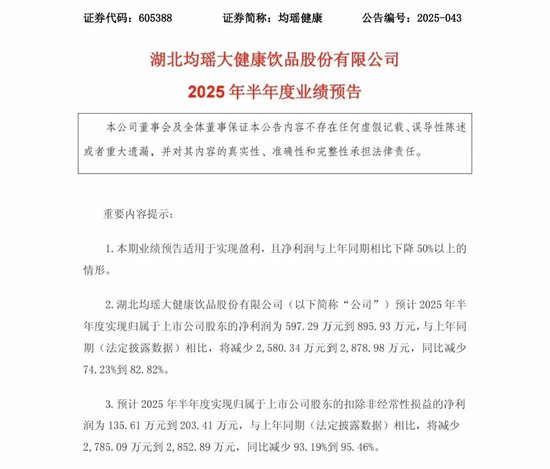
Core Viewpoint - The company, Hubei Junyao Health Beverage Co., Ltd., is experiencing significant declines in its financial performance for the first half of 2025, with net profit expected to drop by 74.23% to 82.82% compared to the same period last year, primarily due to a challenging consumption environment and increased costs associated with business restructuring and R&D efforts [1][3][14]. Financial Performance Summary - The projected net profit for the first half of 2025 is estimated to be between 5.97 million and 8.96 million yuan, a decrease of 2.58 million to 2.88 million yuan from the previous year [1]. - The company's net profit after deducting non-recurring items is expected to fall by 93.19% to 95.46%, with a reduction of 2.78 million to 2.85 million yuan [1]. - In 2024, the company reported a total revenue of 1.458 billion yuan, a year-on-year decrease of 10.77%, and a net profit of -29.12 million yuan, marking its first annual loss since its listing in 2020 [8][9]. Reasons for Performance Decline - The decline in traditional room-temperature yogurt business due to a sluggish consumption environment and shrinking market share has directly impacted profits [3]. - Expansion into e-commerce and new retail channels has led to increased upfront sales and marketing expenses, further squeezing profit margins [3]. - Increased R&D investments have expanded the functional strain resource library from over 6,000 to over 40,000 strains, which, while beneficial for long-term growth, has raised short-term costs [3]. Regulatory Issues - The company faced regulatory scrutiny for failing to timely disclose its expected losses for 2024, resulting in warnings from the Hubei Securities Regulatory Bureau and disciplinary actions from the Shanghai Stock Exchange [5][7]. - Key executives were held responsible for the disclosure violations, emphasizing the need for improved compliance with information disclosure obligations [7]. Business Challenges - The core probiotic beverage segment saw a revenue decline of 2.71% in 2024, with inventory levels significantly increasing, indicating supply-demand imbalances [11]. - The company’s attempts to diversify into the bottled water market and supply chain management have not yielded expected results, with significant challenges in both areas [12][11]. Positive Developments - Despite overall challenges, the company reported a 139.19% increase in revenue from probiotic foods in the first quarter of 2025, driven by strong online sales growth [13]. - The international business segment also showed promising growth, with a 24.54% increase in revenue in 2024 and a further 77.43% increase in the first quarter of 2025 [13]. Conclusion - The company is undergoing a critical transformation phase, facing multiple challenges including declining traditional business performance, regulatory issues, and increased costs from strategic investments. However, there are signs of potential recovery in online and international markets, indicating a complex but evolving business landscape [14].