存量提质增效

Search documents
蜜雪集团:2025年归母净利润同增33%,2026年侧重存量提质增效-20260326
Guoxin Securities· 2026-03-26 02:45
Investment Rating - The investment rating for the company is "Outperform the Market" [6][4]. Core Insights - The company is expected to achieve a 33% year-on-year increase in net profit attributable to shareholders in 2025, with total revenue projected at 33.56 billion yuan, reflecting a growth of 35.2% [1][9]. - The company plans to focus on improving the quality and efficiency of existing stores in 2026, with a slowdown in the pace of new store openings [2][4]. - The gross profit margin is expected to decline due to changes in revenue structure and rising raw material costs, with a long-term target of maintaining around 30% [3][16]. Financial Performance - In 2025, the company reported a gross profit margin of 31.1%, down 1.3 percentage points year-on-year, and a net profit margin of 17.5%, down 0.3 percentage points [3][14]. - The company’s revenue for 2025 is projected to be 335.60 billion yuan, with a breakdown of 314.4 billion yuan from product sales and 13.3 billion yuan from equipment sales [1][9]. - The forecast for net profit attributable to shareholders for 2026 is adjusted to 67.4 billion yuan, reflecting a decrease of 9.6% from previous estimates [4][18]. Store Expansion Strategy - As of the end of 2025, the total number of global stores reached 59,823, with a net increase of 13,344 stores, while the closure rate was approximately 5.4% [2][12]. - The company is focusing on expanding in lower-tier cities, with stores in tier-three and below cities increasing to 32,119, representing a rise from 57.4% to 58.0% of total stores [2][12]. - The overseas market, particularly in Indonesia and Vietnam, is undergoing adjustments, with a net reduction of 428 stores, but is expected to return to net growth in 2026 [2][12].
悉心呵护街边小店
Jing Ji Ri Bao· 2026-02-13 00:05
Core Viewpoint - The recent government report from the Shanghai Municipal People's Congress emphasizes the importance of developing street markets and small shops, highlighting their role in enhancing urban vibrancy and consumer engagement [1][2]. Group 1: Importance of Street Shops - Street shops are essential for urban commercial systems, serving as vital components that cater to diverse consumer needs alongside larger retail formats [1]. - They provide low-barrier entrepreneurship opportunities for ordinary individuals, supporting livelihoods and contributing to community well-being [2]. Group 2: Challenges and Recommendations - Urban management often prioritizes large-scale developments over supporting small shops, leading to their decline due to high rents and regulatory burdens [3]. - A shift in governance perspective is necessary, focusing on genuine community needs rather than superficial achievements [3]. - Improving the business environment for small shops is crucial, requiring proactive support from authorities to reduce operational burdens [3][4]. Group 3: Tailored Governance Strategies - Cities must transition from expansive growth to enhancing existing urban spaces, which includes protecting small shops as part of urban quality improvement [4]. - Strategies should include lowering operational costs for small shops and providing targeted support through tax, finance, and training policies [4].
将权益市场作为规划转型的主线|大家谈城市更新④
Xin Lang Cai Jing· 2026-02-01 03:56
Core Viewpoint - China's urban development is transitioning from large-scale expansion to a focus on improving existing assets, which will lead to significant changes in land and space governance [1]. Group 1: Urban Development Transition - The shift in urban development mode signifies a need to transform existing urban assets into equity, avoiding the burden of debt from construction [1]. - By 2025, the total value of urban real estate in China is estimated to be between 450 trillion to 500 trillion yuan [1]. Group 2: Steps for Asset Improvement - The first step involves conducting an asset survey to identify and categorize every piece of land and building, analyzing inefficiencies and potential for higher value utilization [2]. - The second step focuses on generating cash flow from these assets, which is essential for standardizing their value and enabling market transactions [2]. - The third step is to create a new equity market for existing assets, which is crucial for local governments to escape debt traps and facilitate the transition to a focus on existing asset quality [3]. Group 3: Role of Planning and Management - The transformation requires planning professionals to not only design but also understand financial implications, marking a significant shift in the planning industry [4]. - Future planning institutions may act like investment banks, identifying undervalued assets and facilitating their entry into the equity market, while resource management departments will oversee transactions and ensure market transparency [3].
王凯:让城市更好托举人民幸福
Jing Ji Ri Bao· 2026-01-30 00:09
Group 1 - The core viewpoint of the articles emphasizes the shift in urban development in China from extensive expansion to quality enhancement, focusing on optimizing existing resources rather than merely increasing land and construction [1][2][3] - Urbanization rate in China is projected to reach approximately 67.89% by 2025, with a further increase to around 75% by 2035, indicating significant historical achievements in urban development [1] - The need for institutional innovation in urban construction, operation, and governance is highlighted, transitioning from traditional resource inputs to new factors such as data and technology [1][2] Group 2 - The Central Urban Work Conference in July 2025 outlines the overall requirements for urban work, emphasizing a human-centered approach, efficient development, and coordinated governance [2] - Urban renewal is identified as a critical aspect linking public welfare and urban development, requiring a comprehensive approach rather than simple demolition and reconstruction [2][3] - The importance of addressing specific demographic needs, such as those of children, the elderly, new citizens, and residents in aging communities, is underscored [2] Group 3 - A systematic approach to urban diagnostics is recommended, advocating for a "health check" of cities to identify weaknesses and inform renewal strategies [3] - The articles stress the significance of fine-tuning urban space design to enhance social relationships and cultural identity, moving from macro narratives to micro governance [3][4] - The necessity of integrating operational strategies throughout the urban renewal process is emphasized, ensuring that planning includes long-term operational considerations and community involvement [4]
土地不够用?广州向“存量”要出百亿产值,做对这四件事
Nan Fang Du Shi Bao· 2026-01-07 04:04
Core Insights - Guangzhou is transforming low-efficiency land into high-end intelligent manufacturing bases, with a focus on policy innovation and model exploration to address urban challenges and support high-quality development [2][12][22] Group 1: Project Examples - The transformation of Qishan Village in Huadu District is expected to generate an annual tax revenue exceeding 400 million yuan after the completion of new facilities, compared to a previous total output of less than 100 million yuan from 15 small enterprises [4][6] - The Baiyun District's Luochongwei area is undergoing a complex urban renewal, utilizing a model of "legal expropriation + net land transfer," with a total credit line of 26 billion yuan to address funding challenges [6][8] - Xilang Village in Liwan District is implementing a self-funded, self-renovation model, allowing the village to maintain control over development and ensure long-term benefits [8][10] Group 2: Policy Innovations - Guangzhou has developed a "1+11+N" policy framework for low-efficiency land redevelopment, addressing various challenges through tailored solutions [13][14] - The first key to unlocking funding involves different financial strategies, such as government compensation and national special loans, to alleviate financial pressures on redevelopment projects [14][15] - The second key focuses on ensuring that village collectives do not lose income post-redevelopment, with mechanisms in place to maintain or increase overall revenue [14][15] Group 3: Governance Transformation - The role of the government is shifting from being the sole supplier of land to becoming a facilitator and coordinator of public interests, enhancing community engagement in redevelopment processes [18][19] - The market dynamics are being redefined, with state-owned enterprises taking on comprehensive roles beyond mere developers, including risk management and industry guidance [18][19] - Community involvement is increasing, with residents actively seeking opportunities for self-funded renovations, indicating a shift in local governance and social agency [19][20] Group 4: Future Challenges - The ultimate challenge lies in finding sustainable and high-quality industrial content for the newly created spaces amid economic pressures and competitive landscapes [20][22] - Balancing historical preservation, ecological constraints, and affordable housing needs remains a critical aspect of urban governance in Guangzhou's redevelopment efforts [20][22]

以城市更新助力“稳楼市”
2 1 Shi Ji Jing Ji Bao Dao· 2025-12-10 23:25
Core Viewpoint - The State Council emphasizes the need for urban renewal actions to integrate with safety hazard elimination and stabilize the real estate market, focusing on high-quality development in housing and real estate [1] Group 1: Urban Renewal and City Development - Urban growth is shifting from large-scale expansion to improving existing stock, with urban renewal as a key approach to enhance urban quality [1] - The main tasks of urban renewal include assessing urban conditions to identify urgent issues faced by residents, such as public service gaps [1] - The renovation of old residential areas consists of three levels: basic, improvement, and enhancement, addressing infrastructure upgrades and adding community services [1] Group 2: Complete Community Construction - The goal of complete community construction is to create a sense of belonging for residents within a 5-10 minute walking distance to essential services and facilities [2] - Updating old neighborhoods and facilities can inject new vitality into these areas, promoting new economic activities and enhancing community governance [2] - The housing market's focus has shifted to ensuring that existing properties meet the needs of residents and industries, emphasizing the importance of using properties effectively [2] Group 3: Policy Shifts and Market Dynamics - The focus of housing policies is transitioning from stimulating demand to evaluating the effective use of existing properties, addressing both supply and demand sides [3] - As of this year, 449 cities have initiated urban assessments, with 287 cities starting the renovation of old residential areas, indicating a nationwide effort in urban renewal [3] - The government is prioritizing the improvement of housing quality and property management as part of the urban renewal strategy [4] Group 4: Employment and Economic Recovery - Urban renewal is driving new business models and consumption patterns, contributing to job creation and economic recovery [4] - Recent government initiatives include financial support for families and education, aiming to enhance the overall economic environment and stabilize housing values [4] - The combination of supply-side initiatives and demand-side recovery efforts is crucial for reinforcing the value of housing and stabilizing the market [4]
已批未建需重新申报!地铁建设,真的变天了
3 6 Ke· 2025-12-08 22:46
Core Viewpoint - The recent announcement from Ningbo's authorities regarding the need for re-approval of previously approved but unimplemented subway projects signals a significant shift in subway construction policies across various cities in China, indicating a tightening of regulations and a focus on quality and efficiency over mere expansion [2][4][12]. Summary by Sections Policy Changes - The National Development and Reform Commission has introduced new requirements for cities with previously approved subway projects that have not yet been implemented, necessitating re-approval for new planning submissions [2][4]. - The tightening of subway construction policies has been a gradual process, starting with the 2018 "Document No. 52," which raised the economic and fiscal thresholds for cities seeking to initiate subway projects [2][3]. Construction Criteria - New criteria for urban rail transit project submissions include a minimum public finance budget revenue of 30 billion yuan, a regional GDP of 300 billion yuan, and a resident population of at least 3 million [3]. - The focus has shifted from expanding the scale of subway construction to prioritizing quality and efficiency, with cities now required to demonstrate the ability to implement previously approved projects before applying for new ones [4][12]. Impact on Cities - Many cities are now under pressure to complete previously approved subway lines rather than pursuing new projects, as failure to meet construction standards could result in losing the right to build even approved lines [4][5]. - Cities like Chengdu are urged to accelerate the implementation of their approved subway lines, while others face challenges due to debt or insufficient passenger flow [5][6]. Investment Trends - The investment in urban rail transit construction peaked at 628.6 billion yuan in 2020 but has since declined, with 2023's investment at 521.4 billion yuan, a decrease of 17.05% from the peak [7]. - The new policies are expected to further limit the number of cities eligible for subway construction, as the thresholds for GDP and fiscal revenue are anticipated to increase significantly [11][12]. Urbanization and Future Directions - The ongoing tightening of subway construction policies reflects a broader transition in urbanization from rapid growth to stable development, emphasizing the need for cities to focus on optimizing existing infrastructure rather than expanding it [12][14]. - The future of urban competitiveness will rely more on enhancing existing services and infrastructure quality rather than merely increasing the quantity of subway lines [16][17].
四中全会精神在基层丨财政不花大钱,政府靠什么让“忧居”变“优居”?
Xin Hua Wang· 2025-10-31 23:51
Core Insights - The article discusses the transformation of old housing into modern living spaces in Guangzhou, highlighting a shift in urban governance from large-scale demolition to micro-renovation without significant financial investment from the government [1][2]. Group 1: Urban Transformation - The project "Hongqiao·Xiaoshijiji" in Guangzhou exemplifies a successful micro-renovation, turning 17 old buildings into a single modern structure with various amenities, completed in just six months [1][2]. - The shift in urban development strategy reflects a broader trend in China, moving from large-scale expansion to enhancing existing urban spaces, focusing on quality over quantity [2][8]. Group 2: Community Involvement - A working group was established in July 2023 to facilitate discussions among residents, project designers, and stakeholders to address renovation needs and preferences [2][4]. - The funding model for the renovation involves contributions from residents, enterprises, and government support, promoting a collaborative approach to urban renewal [3][8]. Group 3: Innovative Solutions - The project employs a "unified design, aggregated property rights, and overall approval" model to tackle the complexities of property ownership in old neighborhoods [5]. - Modular construction techniques were utilized to reduce construction time by approximately 60%, addressing concerns about disruption during renovations [7]. Group 4: Governance and Policy - The government's role has evolved from being a direct builder to a facilitator, focusing on creating rules and platforms for diverse stakeholders to collaborate [8]. - New regulations introduced in June 2024 aim to ease restrictions on small-scale renovations, allowing for more community-driven improvements [2].
新华社经济随笔·四中全会精神在基层丨财政不花大钱,政府靠什么让“忧居”变“优居”?
Xin Hua Wang· 2025-10-31 03:42
Core Viewpoint - The transformation of old housing into modern living spaces in Guangzhou reflects a significant shift in urban governance, moving from large-scale demolition and construction to micro-renovation and community involvement [1][2]. Group 1: Urban Renewal Strategy - The project "黉桥·小石集" exemplifies a successful micro-renovation approach, converting 17 old buildings into a single modern structure without forced demolition or significant government funding [1]. - The local government has shifted its role from being a developer to a facilitator, creating platforms for collaboration among various stakeholders, including residents and businesses [2][3]. Group 2: Community Engagement - A dedicated task force was established to engage residents in the renovation process, ensuring their voices were heard and their needs addressed [2][4]. - The project adopted a funding model where residents, businesses, and the government each contributed financially, promoting a collaborative approach to urban renewal [3]. Group 3: Innovative Solutions - The project utilized a "unified design, aggregated property rights, and overall approval" model to address the complexities of property ownership in old neighborhoods [5]. - Advanced construction techniques, such as modular building technology, were employed to minimize disruption and reduce construction time by approximately 60% [7]. Group 4: Policy and Governance - New regulations were introduced to facilitate small-scale renovations, allowing for increased building capacity while focusing on enhancing public service facilities [2]. - The government is now seen as a rule-maker and coordinator rather than a direct builder, emphasizing the importance of flexible policies and community-driven initiatives [7].
中央部署7大重点任务,物业行业迎来3大机遇
3 6 Ke· 2025-08-06 02:18
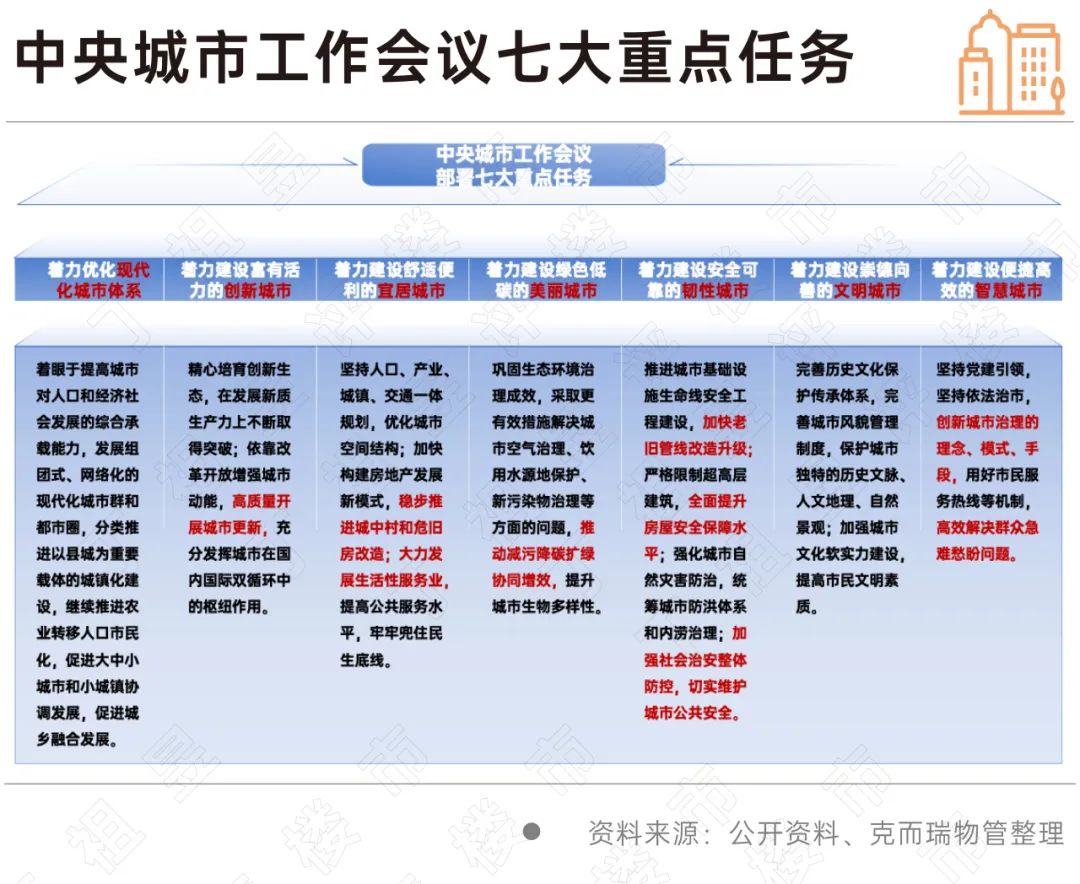
Core Insights - The Central Urban Work Conference held on July 15, 2025, marks a significant event in urban development, indicating a shift from rapid urbanization to stable development, focusing on quality improvement and efficiency in existing urban assets [1][4]. Urban Development Trends - China's urbanization is transitioning from a rapid growth phase to a stable development phase, emphasizing quality enhancement and efficiency in existing urban assets rather than large-scale expansion [1][4]. - The conference outlined seven key tasks for urban development, including optimizing modern urban systems, fostering innovative cities, creating livable environments, promoting green and low-carbon cities, and enhancing smart city infrastructure [4][6]. Property Management Industry Opportunities - The property management industry is experiencing a profound shift in its core positioning due to the new urban development landscape [3][23]. - Three major opportunities for the property management sector have emerged: 1. **Urban Renewal**: The focus on high-quality urban renewal creates opportunities for community hardware upgrades, allowing property companies to engage deeply in community transformation [8][12]. 2. **Quality Improvement and Efficiency**: The shift towards enhancing existing assets allows property firms to leverage their operational capabilities to improve community experiences and activate local economies [10][11]. 3. **Upgraded Public Service Demand**: The emphasis on developing life services provides a pathway for property companies to extend their services in areas like elder care and community mediation, addressing residents' urgent needs [11][12]. Community and Space Management - Property management can evolve from community maintenance to city-level operations, focusing on urban renewal, space management, and extending public services [12][23]. - The market for community hardware upgrades, such as elevator installations and exterior renovations, is projected to be substantial, supported by government policies and funding [14][15]. - The operational model for community spaces includes both public service enhancements and commercial activities, fostering community engagement and generating sustainable revenue streams [20][21][22]. Strategic Positioning - Property companies possess a unique advantage due to their close ties with residents, enabling them to effectively address community needs and contribute to urban governance [23]. - By participating in urban renewal and enhancing service offerings, property management firms can elevate their value and play a crucial role in building "People's Cities" [23].