脑机接口

Search documents
强脑科技获约20亿元融资 新资方疯抢老股
Jing Ji Guan Cha Wang· 2026-01-10 03:05
Group 1 - The core point of the article is that Zhejiang Qiangnao Technology Co., Ltd. has completed a new round of financing amounting to approximately 2 billion RMB, setting a record for non-invasive BCI financing and becoming the second-largest brain-computer interface company globally after Neuralink [2] - The funds raised will be used to accelerate the research and development of core BCI technologies, achieve breakthroughs in extreme engineering, and scale up product production [2] - Unlike previous rounds that primarily involved financial investment institutions, this round of financing includes partnerships with upstream and downstream companies in the industry chain, with investors such as IDG Capital and major manufacturing giants like Lens Technology and Lianyi Intelligent Manufacturing [2] Group 2 - The Ministry of Industry and Information Technology, along with seven other ministries, has issued implementation opinions to accelerate the industrialization and commercialization of new terminals such as AR/VR wearable devices and brain-computer interfaces [3] - The favorable policy environment and financing news have attracted new investors who are closely monitoring the old shares held by early investors in Qiangnao Technology [3]

36氪精选:脑机接口虚火?但再不下手就晚了
日经中文网· 2026-01-10 00:34
Core Viewpoint - The brain-computer interface (BCI) sector is expected to experience a significant wave of financing in 2026, driven by advancements in technology and supportive government policies [5][6][9]. Group 1: Market Dynamics - Non-invasive BCI company "Qiangnao Technology" recently completed a financing round of 2 billion yuan, igniting interest in BCI concept stocks [6]. - The BCI sector has seen a strong market response, with companies like Innovation Medical, Nanjing Panda, and Yanshan Technology experiencing stock price surges [7]. - Elon Musk's announcement regarding Neuralink's plans for large-scale production of BCI devices by 2026 has been a major catalyst for the current market enthusiasm [7]. Group 2: Investment Landscape - Major venture capital firms such as Sequoia China, IDG, and Baidu Ventures have invested in various BCI companies, indicating a broadening interest beyond just medical applications to technology and consumer sectors [9]. - The BCI market is transitioning from primarily medical investments to include technology and consumer-focused investments, particularly in consumer healthcare applications [9]. Group 3: Non-Invasive BCI Insights - Non-invasive BCI technology has a wide range of applications, including sleep monitoring, attention tracking, and treatment for mental health disorders, but has faced challenges due to high user education costs and product homogeneity [10][12]. - The technology has limitations in signal quality, as non-invasive methods like EEG struggle with signal clarity and resolution [10]. - Companies are shifting focus from pure brain control to developing smart prosthetics and other applications that utilize muscle signals and AI algorithms for better intent recognition [11]. Group 4: Invasive BCI Developments - Invasive BCI companies are navigating significant challenges, including safety, signal stability, and regulatory compliance, but have still managed to secure funding during market downturns [13]. - The evaluation of BCI companies has shifted from focusing solely on technical capabilities to assessing their overall operational capabilities and clinical trial progress [13]. - Notable invasive BCI companies include Borui Kang, which is pursuing a listing on the Science and Technology Innovation Board, and has reported successful clinical trials with significant patient improvements [14]. Group 5: Key Players and Innovations - Borui Kang has developed a semi-invasive BCI system that has shown promising results in clinical trials, achieving significant improvements in patient functionality [14]. - Ladder Medical focuses on ultra-flexible neural electrode technology and has successfully conducted clinical trials for spinal cord injury patients [15][16]. - Brain Tiger Technology, which aims to compete with Neuralink, utilizes silk protein for its electrodes, enhancing biocompatibility and reducing long-term damage [17]. Group 6: Future Outlook - The year 2026 is anticipated to be a pivotal moment for the BCI industry, with advancements in technology and regulatory support paving the way for broader adoption [22]. - The introduction of independent billing for BCI services by the National Healthcare Security Administration in 2025 reflects a commitment to supporting the industry's growth [22]. - Companies that establish a strong foothold in the BCI sector are likely to gain significant influence over future technologies, products, and standards [23].

九成调研股本周上涨 三大热门领域被“踏破门槛”
Zheng Quan Shi Bao· 2026-01-09 17:41
Group 1: Institutional Research and Market Trends - A total of 116 listed companies conducted institutional research from January 5 to 9, with nearly 90% achieving positive returns as the market rose [1] - Notable stock performances included Pulite with a 42.59% increase, and Chengdu XianDao and Borui Chuanbo both exceeding 30% [1] - Key areas of interest for institutions included brain-computer interfaces, commercial aerospace, and AI applications, spurred by the central bank's new action plan on digital currency [1] Group 2: Brain-Computer Interface Developments - The brain-computer interface (BCI) concept is currently a major market hotspot, with the Wind BCI index rising approximately 20% [2] - Companies like Dineike are advancing BCI technology, with prototypes expected by 2026, focusing on brainwave interaction technology for human-device communication [2] - Entropy Technology held three institutional research sessions, attracting 132 institutions, and plans to launch a BCI prototype by March 2026, although initial revenue impact is uncertain [3] Group 3: Commercial Aerospace Opportunities - The commercial aerospace sector remains hot, with the Wind commercial aerospace index also increasing about 20% [4] - Chaojie Co. reported new customer collaborations expected to begin in Q1, focusing on manufacturing components for commercial rockets [4] - Guanglian Aviation is involved in developing core components for launch vehicles and has made progress in securing orders from leading aerospace companies [4] Group 4: Digital Currency Policy Changes - The central bank's new action plan for digital currency management will officially start on January 1, 2026, expanding the scope of digital currency from cash-like to deposit-like [6] - Tianyang Technology highlighted that banks will need to upgrade IT systems to accommodate the new digital currency features, which could lead to significant investment opportunities [6] - Future policy signals to watch include the need for supporting regulations in the settlement area and pilot programs for practical applications of digital currency [7]
帮主郑重盘前策略:15连阳之后的机会与风险
Sou Hu Cai Jing· 2026-01-09 10:47
Group 1 - The market is at a critical juncture after a significant 15-day rally, with expectations of a potential adjustment but limited downside due to external capital interest [1] - Current market dynamics resemble a game of "passing the parcel," where funds are focused on brokerage stocks while rotating through previous hot sectors like commercial aerospace and brain-computer interfaces, leading to a hot market but stagnant indices [3] - The reliance on old hot sectors has reached a bottleneck, necessitating a new sector to invigorate the market, with the Beijing Stock Exchange (BSE) identified as a potential key player due to its smaller market cap and strong investor interest [4] Group 2 - The strategy for the main board is to exercise caution as the number of bullish days increases, advising against chasing old hot sectors and waiting for a significant correction [5] - Attention should be directed towards "breakthrough" stocks on the BSE that align with emerging industry trends and have solid performance backing, with recommendations for small position trials [5] - The cyclical nature of market fluctuations suggests that seeking the next opportunity during periods of exuberance is essential for generating excess returns [6]

港股异动|助推脑机接口落地 蓝思科技H股涨超9%
Shang Hai Zheng Quan Bao· 2026-01-09 09:20
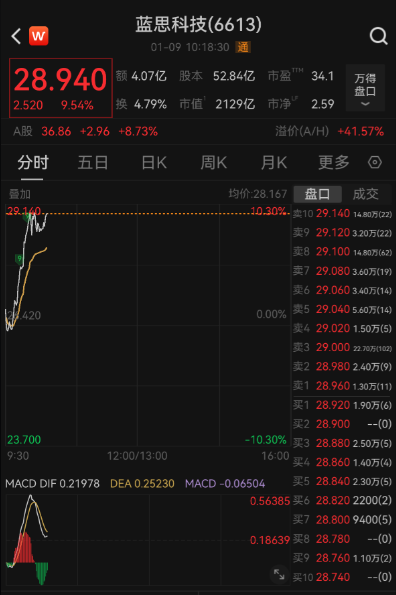
Group 1 - On January 9, 2023, Lens Technology's H-shares surged by 9.54%, reaching HKD 28.94 per share by 10:18 AM [1] - The company's market capitalization is approximately HKD 212.9 billion, with a price-to-earnings ratio of 34.1 and a price-to-book ratio of 2.59 [2] - The premium of Lens Technology's A-shares over H-shares is 41.57% [2] Group 2 - Lens Technology is a strategic investor in Qiangnao Technology, which recently completed a financing round of approximately RMB 2 billion [3] - The funds raised by Qiangnao Technology will be used to accelerate the research and development of brain-machine interface core technologies and to scale up production [3] - Lens Technology has a long-term partnership with a major North American client, serving as a primary core supplier for over 10 years [3]

沪指涨破4100点豪取16连阳 两市成交额突破3万亿大关
Yang Zi Wan Bao Wang· 2026-01-09 08:45
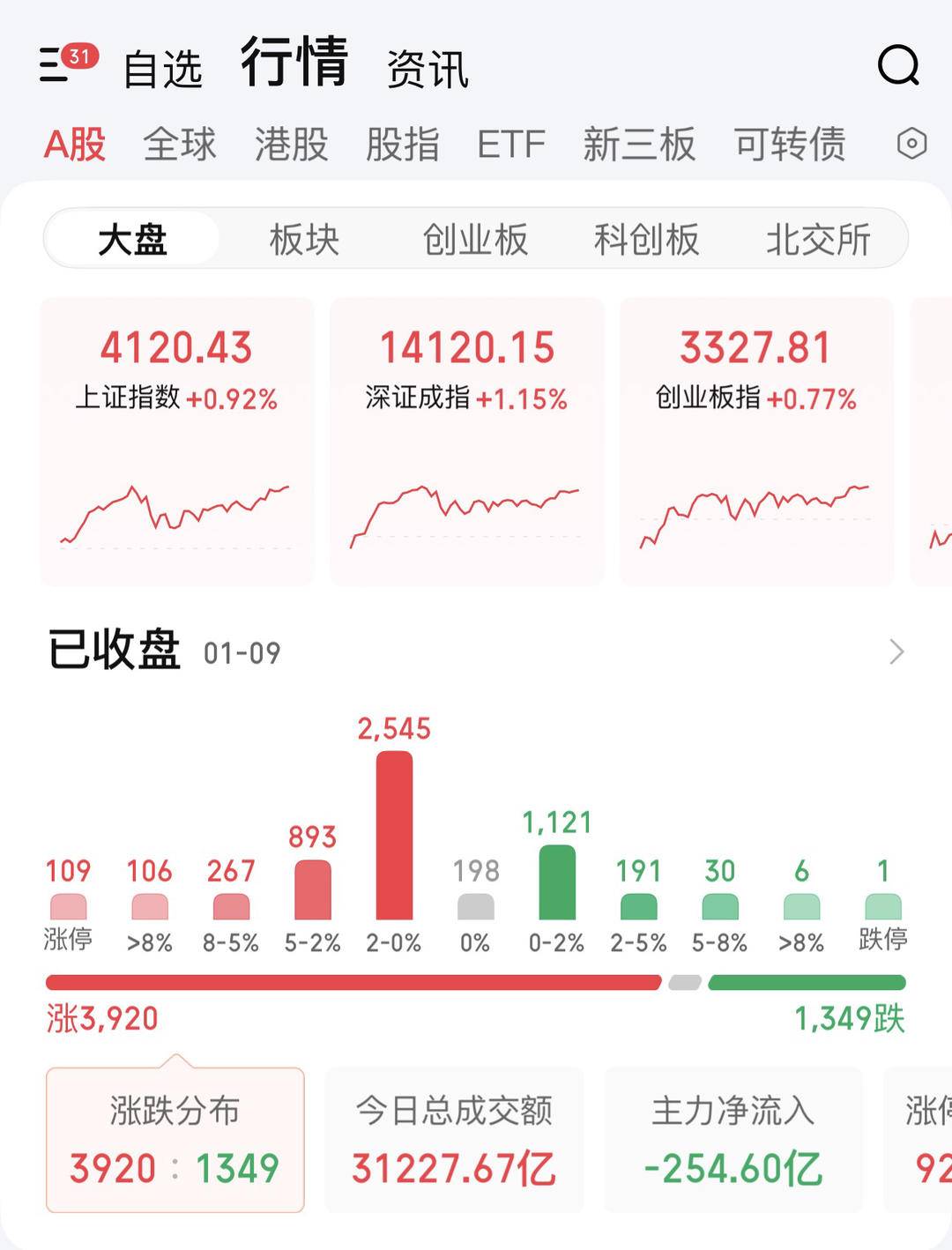
Market Performance - The Shanghai Composite Index opened high and broke through 4100 points, achieving a 16-day consecutive rise, while the Shenzhen Component Index increased by over 1% [1] - The total trading volume of the Shanghai and Shenzhen markets reached 3.12 trillion, an increase of 322.4 billion compared to the previous trading day, marking the fifth time in history that it surpassed 3 trillion [1] Stock Trends - Over 3900 stocks in the market rose, with more than 100 stocks hitting the daily limit for two consecutive days; there were 19 stocks with consecutive limit-ups on Friday, and 46 stocks failed to hit the limit, resulting in a limit-up rate of 67% (excluding ST and delisted stocks) [3] - The AI application concept saw a collective surge, with over twenty constituent stocks hitting the daily limit, including companies like Yingli Media and Shenguang Group [4] Sector Analysis - The commercial aerospace concept remained active, with stocks like Luxin Venture Capital and China Satellite Communications showing significant gains [4] - The controllable nuclear fusion concept continued its strong performance, with companies like Hongxun Technology and China First Heavy Industries achieving consecutive limit-ups [4] Weekly Performance - The Shanghai Composite Index rose by 3.82% this week, marking the largest weekly increase in over a year, while the ChiNext Index increased by 3.89% [6] - According to China Merchants Securities, the A-share market is expected to continue its upward trend in January, with a focus on sectors like commercial aerospace, AI applications, and semiconductor equipment [6] Market Sentiment - Huatai Securities noted that while the continuous rise of the Shanghai Composite Index is eye-catching, it should not be overly emphasized as it does not indicate significant trends in longer time frames [6] - The trading volume has remained above 2.5 trillion since the New Year, indicating strong market support and a willingness among some investors to pay premiums [6]
利好传来,A股大涨!4100点+3万亿同日突破!发生了什么?
天天基金网· 2026-01-09 08:04
Market Performance - On January 9, the market experienced a significant rally, with the Shanghai Composite Index breaking through 4100 points, closing up 0.92%, while the Shenzhen Component Index rose by 1.15% and the ChiNext Index increased by 0.77% [2] - The overall market saw over 3900 stocks rise, with more than a hundred stocks hitting the daily limit for two consecutive days. The trading volume reached 3.12 trillion yuan, marking the fifth time in history that it surpassed 3 trillion yuan [2] Weekly Overview - In the first week of 2026, the Shanghai Composite Index gained 3.82%, moving from 3983 points to 4121 points. The trading volume for the first four days exceeded 2.5 trillion yuan, with Friday's volume soaring to 3.15 trillion yuan, marking a return to the 3 trillion yuan level after 73 trading days [3] Economic Indicators - The rise in market confidence was likely bolstered by the release of CPI and PPI data from the National Bureau of Statistics. In December, the CPI increased by 0.2% month-on-month and 0.8% year-on-year, while the core CPI rose by 1.2% year-on-year. The PPI saw a month-on-month increase of 0.1% and a narrowing year-on-year decline [10] - Analysts believe that the recovery in CPI and PPI data supports the trend of economic stabilization, providing a fundamental backing for the capital market [11] Investment Outlook - Looking ahead to 2026, the A-share market is expected to continue its upward trend, with an anticipated influx of 2 trillion yuan in new capital driven by increased retail participation [11][12] - The report from Guosen Securities indicates that retail investors are likely to become more active, while institutional and foreign capital flows may improve [12] Sector Performance - Key sectors such as AI applications, commercial aerospace, and controllable nuclear fusion have led the market rally, while the brain-computer interface sector saw a decline [2][14] - The brain-computer interface concept recorded a year-to-date increase of 21.82%, while commercial aerospace gained 11.41% this week [15][16] AI Application Growth - The AI application sector is expected to experience significant growth in 2026, driven by technological advancements, supportive policies, and increasing market demand [18] - According to Huaxin Securities, 2026 is projected to be a "golden year" for AI applications, with major models like GPT-5 and Gemini 3 expected to enhance capabilities [18]

蓝思科技联手强脑科技 一场“穿越颅骨”的工业突围
Xin Lang Cai Jing· 2026-01-09 06:43
Core Insights - The brain-computer interface (BCI) sector in China's A-share market has experienced a significant surge, driven by a major funding round of approximately 2 billion RMB for BrainCo, a leading player in the field, marking it as the second-largest single financing in the global BCI sector after Neuralink [2][23][25] - The partnership between BrainCo and Lens Technology signifies a transformative shift in the BCI industry from experimental research to large-scale industrial production, indicating a convergence of soft neural signals and hard manufacturing capabilities [4][26] Company Developments - Lens Technology has positioned itself as a strategic investor and the exclusive manufacturer of core hardware modules for BrainCo, highlighting its ambition to transition from a consumer electronics supplier to a key player in the BCI market [5][27] - The collaboration between Lens Technology and BrainCo is seen as a critical move for Lens, as it seeks new growth avenues amid declining returns from traditional consumer electronics [5][27][30] Market Dynamics - The BCI market in China is projected to reach 3.83 billion RMB by 2025, with non-invasive products accounting for approximately 82% of the market share, indicating a strategic focus on safer, less invasive technologies [9][30] - BrainCo's proprietary dry electrode sensor technology has eliminated the need for conductive gels, facilitating high-precision brain signal acquisition and enabling a wide range of applications from medical to consumer products [9][30][31] Technological Advancements - BrainCo has developed a diverse product matrix, including a brain-machine interface for social communication aimed at children with autism and a sleep aid device that has received FDA certification, showcasing its commercial viability [10][31] - The collaboration between BrainCo and Lens Technology is expected to accelerate the commercialization of BCI technologies, moving beyond research to practical applications that address real-world issues [10][31] Industry Landscape - The BCI industry in China is characterized by a dual-core structure, with significant contributions from institutions in Beijing and Shanghai, fostering a competitive environment for technological advancements [11][32] - Beijing's Brain Science and Brain-like Research Institute is leading in high-throughput semi-invasive wireless brain-machine systems, while Shanghai focuses on brain mapping and clinical applications, creating a robust ecosystem for BCI development [13][35] Future Outlook - The Chinese government aims to establish a reliable BCI industry system by 2030, with plans to cultivate leading global enterprises, indicating strong institutional support for the sector [19][41] - The next three to five years are anticipated to be a period of significant industry reshuffling, with potential volatility in stock prices and technological pathways, as the market matures [20][41]

脑机接口技术已进入“临床价值验证与早期产业化”的关键期
Zhong Guo Jing Ji Wang· 2026-01-09 06:15
Core Viewpoint - Brain-computer interface (BCI) technology is a critical area at the intersection of life sciences and information technology, with significant global competition and potential applications in medical fields, particularly in disease prevention, diagnosis, treatment, and management [1] Group 1: Current Applications and Progress - BCI technology is primarily applied in clinical settings for the rehabilitation of motor and speech functions, with motor function recovery being the most advanced area [2] - Notable examples include Neuralink's successful implantation in over ten patients and the clinical validation of products like Synchron's Stentrode and Onward Medical's ARC-BCI [2] - In speech function, the "Beijing Brain No. 1" system has made significant progress in decoding speech for patients with severe speech disorders due to conditions like ALS [2] Group 2: Technology Maturity and Challenges - The current stage of BCI technology is characterized as a critical period for clinical value verification and early industrialization, facing both unprecedented policy support and intense international competition [3] - Key evaluation metrics include safety and reliability, effectiveness and stability, and usability, with ongoing challenges in long-term safety, performance stability in real-life scenarios, and maintenance issues [4] Group 3: Technical Challenges and Breakthrough Directions - Major technical challenges include balancing high-resolution signal acquisition with low invasiveness, and developing systems that ensure low power consumption while maintaining real-time performance [5][6] - The need for "plug-and-play" capabilities in decoding algorithms and addressing individual variability and time drift are also critical areas for future breakthroughs [6] Group 4: Barriers to Large-Scale Clinical Application - Key barriers to large-scale clinical application include the need for rigorous clinical trials to establish safety and efficacy, the development of reliable manufacturing processes, and the establishment of ethical and legal frameworks [7] - Predictions suggest that semi-invasive BCIs may take 1-2 years for approval in rehabilitation applications, while invasive BCIs may require around 5 years [7] Group 5: Future Development Possibilities - Future applications of BCI technology are expected to extend beyond motor rehabilitation to include speech function restoration and treatment for severe neurological disorders, with aspirations for merging biological intelligence with artificial intelligence to enhance human capabilities [8]
卫星翻倍、有色称王、脑机顶流,三大赛道起爆!谁是真王者?
Jin Rong Jie· 2026-01-09 05:32
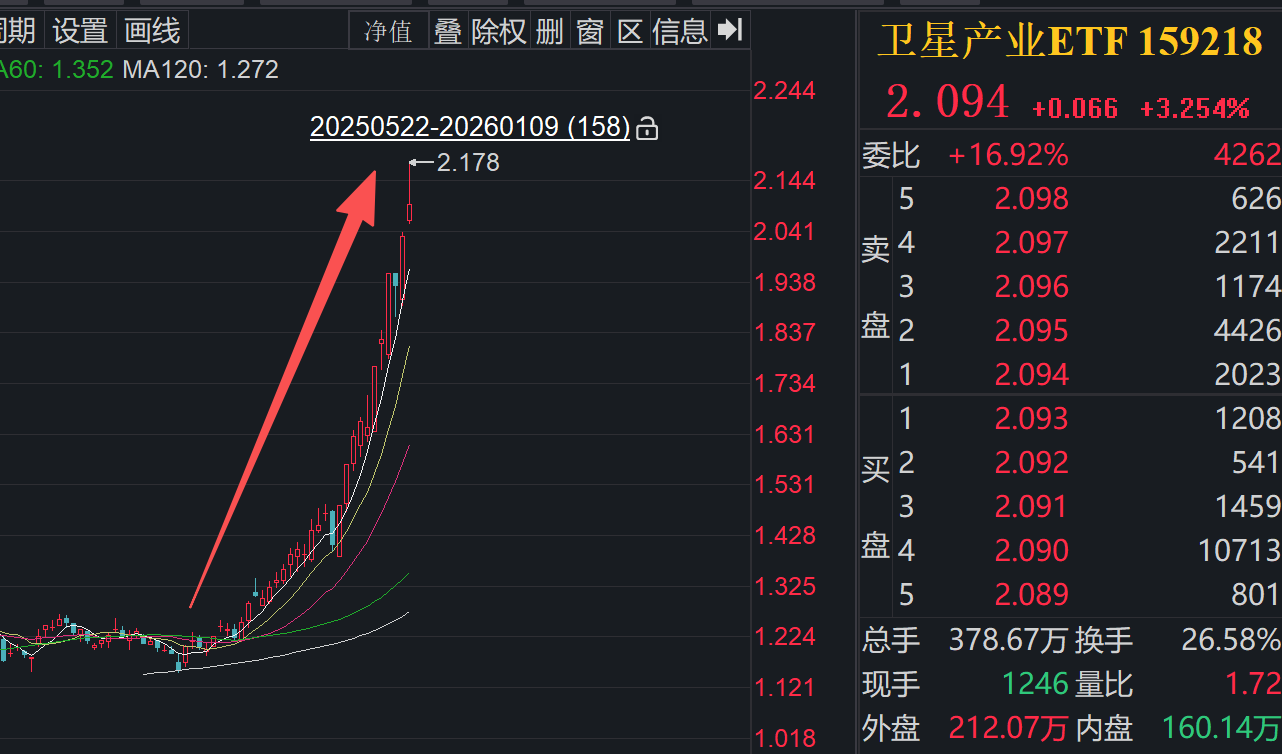
Core Viewpoint - The years 2025 and 2026 are expected to witness significant historical milestones in the Chinese stock market, particularly with the Shanghai Composite Index breaking records and sectors like aerospace, non-ferrous metals, and brain-computer interfaces experiencing rapid growth [1]. Group 1: Satellite Industry - The satellite industry is currently in an unprecedented acceleration phase, with the satellite industry ETF (159218) being the first in the commercial aerospace sector to double in value this year [1]. - The International Telecommunication Union (ITU) has submitted an application for an additional 203,000 satellites, covering 14 satellite constellations, which indicates a potential doubling of satellite launches in 2026 compared to 2025 [4]. Group 2: Non-Ferrous Metals - The non-ferrous metals sector is poised for a new bull market in 2026, driven by the weakening of the US dollar and the increasing demand for materials like copper and rare earths, which are essential for electric vehicles, AI data centers, and high-end manufacturing [5]. Group 3: Brain-Computer Interfaces - The brain-computer interface sector is gaining attention due to its inclusion in the "14th Five-Year Plan" and significant advancements such as Neuralink's announcement of mass production in 2026 and successful clinical trials of domestic products [6]. - The most immediate application of brain-computer interfaces is in medical rehabilitation for patients with spinal injuries and strokes, highlighting the importance of practical applications over speculative concepts [8]. - The focus on brain-computer interfaces should be on high-end medical devices, as the sector is currently experiencing a policy and innovation cycle that supports its growth [8].