粮食储备

Search documents
新华社权威速览·非凡“十四五” | 保障“舌尖上的安全” 粮食储备部门做了这些工作
Xin Hua She· 2025-10-14 14:16
Group 1 - The core objective is to ensure food safety, health, and security for the population, which is crucial for national food security, covering the entire chain of grain acquisition and storage [1] - During the "14th Five-Year Plan" period, significant efforts have been made by grain reserve departments to safeguard food safety for the public [1] Group 2 - The standard system in the grain sector has been continuously improved, with over 100 national standards and more than 50 industry standards revised or established, including standards for wheat flour and rapeseed oil [4] - The initiative aims to guide moderate processing of grains and oils, promoting scientific and healthy consumption of these products [4] Group 3 - The quality inspection system for grain has been advanced, enhancing the capacity for grain quality safety inspection and monitoring [6] - A nationwide inspection of policy-related grain and oil reserves has been conducted to ensure compliance and safety [6]

新华社权威速览·非凡“十四五”丨保障“舌尖上的安全”,粮食储备部门做了这些工作
Xin Hua She· 2025-10-14 13:01
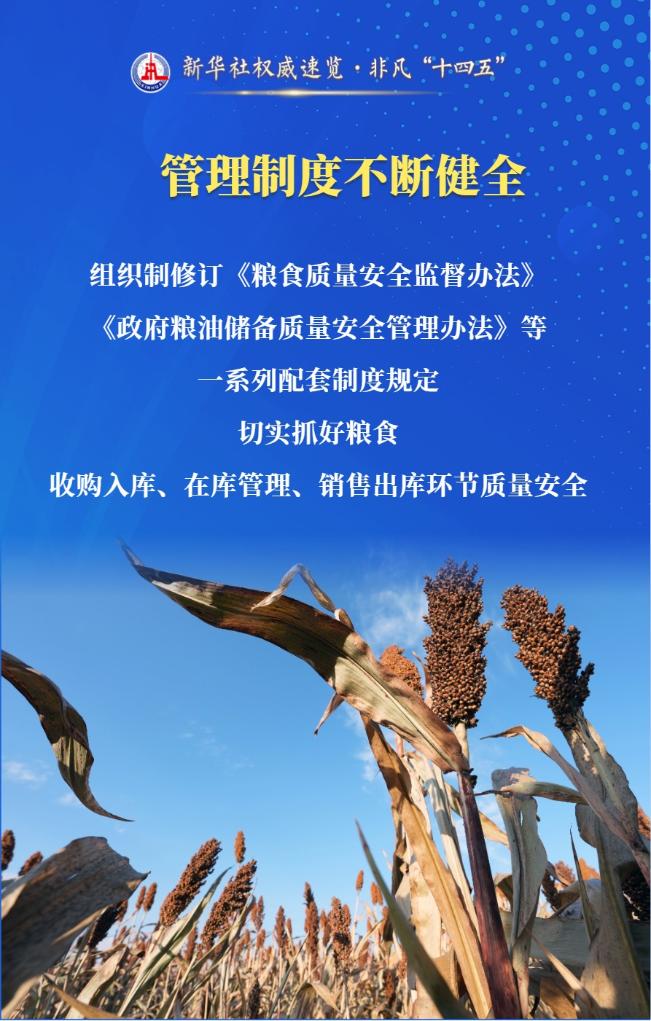
让群众吃得更安全、更放心、更健康,是保障国家粮食安全的重要内容,涉及粮食收购和储存的全 链条、各环节。"十四五"时期以来,为保障人民群众"舌尖上的安全",粮食储备部门做了这些工作。跟 随这组海报,一起了解下。 新华社权威速览 · 非凡"十四 管理制度不断健全 组织制修订《粮食质量安全监督办法》 《政府粮油储备质量安全管理办法》等 系列配套制度规定 切实抓好粮食 收购入库、在库管理、销售出库环节质量安全 新华社权威速览 · 非凡"十 标准体系持续完善 推动制修订粮食领域国家标准100多项 行业标准50多项 制修订《小麦粉》《菜籽油》等国家标准 以及全谷物相关标准 引导粮油适度加工 促进粮油科学健康消费 策划:令伟家 统筹:曹建礼 何险峰 制作:陶叶 ...
中国建设7个区域粮食应急保障中心
Zhong Guo Xin Wen Wang· 2025-10-14 05:29
Core Viewpoint - China is enhancing its grain emergency guarantee system by establishing seven regional grain emergency guarantee centers to improve food security in response to extreme weather and natural disasters [1][2]. Summary by Relevant Sections Emergency Response System - China has developed a four-level grain emergency response system at the national, provincial, municipal, and county levels to strengthen its emergency preparedness [1]. Regional Centers - The establishment of seven regional grain emergency guarantee centers in areas such as Beijing-Tianjin-Hebei, Yangtze River Delta, Guangdong-Hong Kong-Macao, Chengdu-Chongqing, Central China, Northwest, and Northeast is aimed at creating a more robust emergency response mechanism [1]. Enterprise Support - A selection of large grain and oil processing and logistics companies has been designated as national-level grain emergency guarantee enterprises, with provincial-level counterparts also identified to enhance resource coordination and support [1]. Supply Capacity - During the 14th Five-Year Plan period, the grain emergency guarantee capacity in China has been steadily improving, with 36 major cities maintaining a supply of finished grain and oil reserves for over 15 days [2].
国家粮食和物资储备局答21:加快建立食品贮存监管机制
2 1 Shi Ji Jing Ji Bao Dao· 2025-10-14 05:26
Core Viewpoint - The article discusses the achievements in grain circulation reform and development during the "14th Five-Year Plan" period, emphasizing the importance of ensuring grain quality safety throughout the entire supply chain [1][2][3] Group 1: Management System - The management system for grain quality safety has been continuously improved, with the implementation of laws and regulations such as the "Grain Security Law" and the "Grain Circulation Management Regulations" [1] - The National Grain and Material Reserve Bureau has organized the revision of various regulations, including the "Grain Quality Safety Supervision Measures" and the "Government Grain and Oil Reserve Quality Safety Management Measures," to strengthen corporate responsibility and departmental oversight [1] Group 2: Standard System - Since 2021, over 100 national standards and 50 industry standards in the grain sector have been revised or established, focusing on green, high-quality, nutritious, and healthy grain [2] - The revision of mandatory national standards for wheat and other varieties has been carried out to improve quality indicators, while standards for grain storage and processing have been developed to enhance storage quality and promote healthy consumption [2] Group 3: Quality Inspection System - A grain quality safety inspection and monitoring system has been established, with a focus on provincial, municipal, and county-level collaboration to ensure timely responses and information flow [2] - The capacity for grain inspection and testing has been enhanced, contributing to the monitoring of grain quality safety and the overall good quality of stored grain and oil [2] Group 4: Future Directions - The National Grain and Material Reserve Bureau plans to deepen the responsibilities in grain acquisition and storage, aiming to establish a food storage supervision mechanism and enhance monitoring capabilities [3]
国家发改委公布《政府粮食储备安全风险事项报告管理办法(试行)》
Sou Hu Cai Jing· 2025-10-09 03:52
国家发改委公告,《政府粮食储备安全风险事项报告管理办法(试行)》已经2025年9月26日第23次委 务会议审议通过,现予公布,自2025年12月1日起施行。 政府粮食储备安全风险事项报告管理办法(试行) 第一章 总 则 第一条为规范承储政府粮食储备的企业或者其他组织政府粮食储备安全风险事项报告行为,推进健全内 控管理制度,确保政府粮食储备安全,根据《中华人民共和国粮食安全保障法》、《粮食流通管理条 例》等法律法规,制定本办法。 第二条本办法所称政府粮食储备安全风险事项,是指在政府粮食储备运行管理中,与承储政府粮食储备 的企业或者其他组织履行粮食储备管理法定职责密切相关的,可能对政府粮食储备数量、质量和储存安 全具有实质性影响,不采取应对处置措施会对政府粮食储备安全产生危害的事项。 第三条承担政府粮食储备风险事项报告义务的企业或者其他组织包括: (一)中国储备粮管理集团有限公司分(子)公司、直属企业,其他具体承担中央政府粮食储备承储任 务的企业; (二)省级政府储备粮管理公司或者其他组织,以及具体承担省级政府粮食储备承储任务的企业; (三)承担市县级政府粮食储备管理职能的企业或者其他组织,以及具体承担市县级政府 ...
粮食安全看山东”之聊城:“智慧粮库”保“粮安
Zhong Guo Fa Zhan Wang· 2025-09-26 07:38
Core Viewpoint - Food security is a strategic cornerstone of national security and a core element related to the economy and people's livelihoods, with Shandong Liaoguan Grain and Material Reserve Co., Ltd. focusing on "technology storage, intelligent management, and efficient operation" to systematically promote smart granary construction [1] Group 1: Smart Granary Construction - The company has established a modern grain reserve management system through the integration of cutting-edge technology, innovative management models, and strengthened government-enterprise collaboration [1][4] - A phased goal of "one year to establish, two years to enhance, and three years to demonstrate" has been set for the smart granary construction, with significant capital investment and collaboration with leading industry enterprises [1][5] - A three-level collaborative promotion mechanism has been established to ensure efficient implementation of construction tasks [1] Group 2: Technological Empowerment - The company has deployed micro-weather stations, multi-parameter grain condition detection sensors, and HD monitoring equipment to create a three-dimensional monitoring network [2] - Digital twin technology is utilized for real-time tracking and precise problem identification throughout the grain storage process, improving operational efficiency by over 30% [2] Group 3: Business Process Reengineering - The company has achieved full online business processes, reducing average processing time by 40% through an integrated management platform [3] - An intelligent early warning and emergency response mechanism has been established to enhance risk management efficiency [3] - Data-driven decision support is reinforced through big data analysis, providing scientific basis for grain rotation plans and energy management strategies [3] Group 4: Achievements and Impact - The smart granary system has significantly reduced the grain rotation loss rate and improved storage operation efficiency, with a notable decrease in response time for abnormal grain conditions [4] - The average management capacity per person has increased from 5,000 tons to between 7,000 and 10,000 tons [4] - The company has organized digital construction observation and exchange activities across eight counties, promoting technological standard upgrades in the regional grain industry [4] Group 5: Future Directions - The company aims to continue deepening smart granary construction and explore applications of cutting-edge technologies such as "blockchain + grain traceability" and "artificial intelligence + quality detection" [5] - The goal is to promote digital upgrades across the entire industry chain and provide a replicable model for ensuring national food security and supporting state-owned enterprise reform [5]
粮食安全看山东”之临清:“轴流风机压入式通风”助“粮安
Zhong Guo Fa Zhan Wang· 2025-09-25 09:35
Core Viewpoint - The introduction of the "axial flow fan pressurized ventilation" technology in Linqing City significantly enhances grain storage safety and quality while reducing energy consumption and storage losses [1][2] Group 1: Technology Overview - The traditional method of using large fans (7.5 kW) for ventilation in grain storage is inefficient due to high electricity consumption and significant moisture loss [1] - The new technology employs a 1.5 kW axial flow fan to pressurize cool air into the grain pile, effectively lowering temperature and balancing humidity [1] Group 2: Benefits of the New Technology - Energy savings are substantial, with the axial flow fan consuming only 1.5 kW, leading to a significant reduction in electricity usage [1] - The gentle airflow minimizes moisture loss and reduces storage damage, thereby preserving grain quality [1] - The operational process is simplified, saving labor and time costs, which provides an efficient solution for local grain storage [1]
粮食安全看山东”之莘县:巩固粮食安全“压舱石
Zhong Guo Fa Zhan Wang· 2025-09-25 09:32
Core Insights - Food security is a crucial foundation for national security, and grain storage facilities play a vital role in ensuring food safety [1][2][3] Group 1: Grain Storage Management - The Shandong Xincheng National Grain Reserve has implemented a standardized management system covering all aspects of grain storage, including entry and exit, storage management, safety protection, and personnel assessment [1] - The storage capacity of the reserve has increased from 15,000 tons to 60,000 tons through upgrades and the replacement of old facilities, significantly improving grain quality retention rates [1] - Investment in smart storage technologies has been made, including a seamless data connection with the provincial grain supervision cloud platform [1] Group 2: County-Level Grain Reserves - County-level grain reserves are essential for regional emergency supply, with a total reserve of 10,000 tons achieved by increasing reserves by 5,000 tons in 2018 [2] - A dynamic rotation mechanism for stored grain has been established to ensure freshness and quality, enhancing resilience against market fluctuations and natural disasters [2] Group 3: Quality Control and Agricultural Support - A specialized team conducts regular quality inspections of stored grain, maintaining loss rates below 1%, significantly lower than the industry average [3] - The reserve provides post-harvest services to farmers, helping them reduce losses by approximately 15% through quality testing and storage guidance [3] - Future efforts will focus on stringent food safety measures and enhancing the reserve's contributions to national food security [3]
湖北升级粮食流通基础设施 “十四五”投入财政资金近15亿
Chang Jiang Shang Bao· 2025-09-16 23:14
Core Insights - Food security is emphasized as a national priority, with Hubei province maintaining a stable grain circulation market through market-oriented reforms and central-local collaboration [1] Group 1: Grain Circulation and Market Stability - Hubei's grain circulation market has operated smoothly since the 14th Five-Year Plan, with an average annual grain purchase volume of approximately 26 billion jin over the past five years, with deviations not exceeding 1 billion jin [1] - During the 14th Five-Year period, grain prices remained stable within a reasonable range, without triggering substantial minimum purchase price interventions [1] - Hubei has exceeded national targets for local grain and oil reserves, ensuring quality and safety in storage and management [1] Group 2: Emergency Grain Supply System - Hubei has established 79 emergency grain reserve centers at provincial, municipal, and county levels, with over 3,300 emergency supply entities, an increase of more than 700 since 2020 [2] - The province is focusing on cross-provincial grain supply, with a strategic center in Wuhan and key cities like Xiangyang and Yichang, forming a comprehensive emergency supply network [2] - Nearly 1.5 billion yuan has been invested in grain circulation infrastructure, with the construction of high-standard storage facilities and a robust logistics network [2] Group 3: Technological Development in Grain Industry - Hubei has pioneered a grain technology innovation system, enhancing the integration of production, education, research, and application [3] - The province has seen a significant increase in agricultural industrialization, with 40 new leading enterprises and a strong growth in grain machinery manufacturing [3] - By 2024, Hubei aims to have 13 grain and oil processing enterprises with an industrial output value exceeding 2 billion yuan, doubling the number of public brands in the sector since 2020 [3]
伊春市国资局局长林福祥:以国企改革新成效赋能生态强市高质量发展
Sou Hu Cai Jing· 2025-09-05 01:25
Core Viewpoint - The article highlights the progress and achievements of state-owned enterprises (SOEs) in Heilongjiang Province, particularly in Yichun City, emphasizing their role in ecological development and economic growth as part of the ongoing reforms in China's state-owned sector [1][3]. Group 1: Economic Performance - Yichun's state-owned enterprises achieved a 35.3% year-on-year increase in operating income and a 4.0% reduction in total profit loss, indicating a positive overall trend [3]. - The local SOEs are aligned with the development goals of "ecological city and tourism strong city," showcasing a synergy between economic and ecological benefits [3]. Group 2: Governance and Institutional Innovation - The focus on modern enterprise governance is central to SOE reform, with a comprehensive assessment system and a 60% share of personalized indicators to enhance corporate responsibility [4]. - The establishment of a board of directors with a 100% compliance rate in decision-making processes is a significant step towards effective governance [4]. Group 3: Technological Innovation - Yichun Forest Industry Group has made breakthroughs in the birch sap industry through innovative methods that balance production and ecological sustainability [4]. - The implementation of a "smart fire prevention" project has resulted in zero forest fire incidents since the group's establishment, showcasing effective risk management [5]. Group 4: Asset Management - A "full lifecycle management mechanism" has been established to address the issues of idle assets, with 106 idle facilities identified and 22 assets successfully revitalized, generating an additional annual income of approximately 200,000 yuan [7]. - The city’s construction engineering company has also successfully rented out office space, demonstrating effective asset utilization [7]. Group 5: Party Building and Leadership - The integration of party building with production operations has been emphasized, with initiatives like the "Party Building Navigation Project" leading to enhanced project execution and operational efficiency [8]. - Future plans include revitalizing 20 idle assets and achieving over 10% revenue growth, reinforcing the commitment to ecological and economic development [8].