
脑机接口

Search documents
心玮医疗20260108
2026-01-08 16:02
Summary of New Wei Medical Conference Call Company Overview - New Wei Medical focuses on interventional brain-machine interface technology, utilizing a minimally invasive approach through the jugular vein to access brain vessels for signal collection, differentiating itself from invasive technologies like those developed by Musk's company [2][5] Key Points and Arguments - **Product Development Timeline**: New Wei Medical plans to complete type testing and animal experiments by mid-2026, initiate clinical enrollment in the second half of 2026, and expects to finish all patient enrollment and submit for regulatory approval by 2028 [2][3][4] - **Independent Subsidiary**: The company has established an independent subsidiary named "Wei Brain Technology" to focus on the development of interventional brain-machine interfaces and related investment collaborations, with plans to expand the team to 20 members [2][9] - **Technical Specifications**: The interventional brain-machine interface device uses a nickel-titanium alloy stent with electrode configurations of 4 or 16 channels, with signal processing chips placed subcutaneously beneath the clavicle [2][8] - **Animal Testing Results**: Animal experiments have shown stable signal strength, with a small-tailed sheep experiment maintaining 97%-98% signal strength after 18 months, validating the feasibility of the technology [2][11] Competitive Landscape - **Comparison with Musk's Technology**: New Wei Medical's approach avoids the need for craniotomy, which is required by Musk's invasive technology. This results in lower surgical risks and higher patient acceptance. The company claims its method ensures stable signal transmission due to the encapsulation of the electrode stent by the vessel wall, preventing displacement issues [5][10] Clinical Trial Plans - **First Patient Enrollment**: The company plans to conduct its first clinical trial in 2026, targeting 30-50 patients primarily for limb rehabilitation indications, with a follow-up period of approximately six months [4][10] - **Regulatory Recognition**: New Wei Medical is the only approved project for interventional technology routes in a national initiative co-hosted by the Ministry of Industry and Information Technology and the National Medical Products Administration, indicating recognition of its innovative technology [4][6] Challenges and Future Directions - **Technical Limitations**: The interventional approach may face challenges in accessing smaller, more distal blood vessels, necessitating the design of smaller electrode stents for broader brain area applications [11][12] - **Future Applications**: The company aims to extend its technology from motor function areas to visual and auditory functions, as well as explore emotional management and other research directions [11][12] Additional Insights - **Market Potential**: With 2,500 hospitals in China capable of performing the minimally invasive procedure, New Wei Medical is positioned to leverage a broad market for its technology [5] - **Investment and Collaboration**: The subsidiary aims to attract external partnerships and capital to enhance its operational capabilities and cover more consumer-level application scenarios [9]
20亿!强脑科技完成全球第二大单笔融资,锚定机器人的终极交互
机器人大讲堂· 2026-01-08 14:53
Core Viewpoint - The article highlights the advancements in brain-computer interface technology through the example of Qiangnao Technology, which has developed a smart bionic hand that enables users to perform complex tasks, showcasing the potential for human-robot coexistence in the future [1][3]. Group 1: Company Overview - Qiangnao Technology, founded in 2015, is the first unicorn in the brain-computer interface sector in China, focusing on non-invasive brain-computer interface technology for nearly a decade [5]. - The company recently completed a financing round of approximately 2 billion yuan, making it the second-largest in the global brain-computer interface field after Neuralink [3]. Group 2: Product Development - Qiangnao Technology has launched several products, including smart bionic hands and legs, as well as brain-machine intelligent sleep devices, creating a product matrix that spans medical rehabilitation, consumer health, and advanced robotics [8]. - The smart bionic hand has been successfully used in major events such as the Beijing Winter Paralympics and the Hangzhou Asian Para Games, indicating its practical application and recognition [10]. Group 3: Technological Advancements - The company has developed a solid gel electrode that allows for convenient brain signal acquisition without the need for conductive paste, overcoming a significant barrier in non-invasive technology [7]. - Qiangnao's Revo 2 bionic hand, weighing only 383 grams, can exert a grip force of 50N and carry weights of up to 20kg, showcasing its advanced multi-modal tactile sensing capabilities [12]. Group 4: Competitive Advantage - Qiangnao Technology has established a unique technological and commercial moat through large-scale production and cost control, managing to reduce the cost of its smart bionic hand to one-fifth to one-seventh of similar products in Europe and the U.S. [15]. - The company has achieved mass production of 100,000 units of high-precision brain-computer interface products, demonstrating its capability for industrial-scale production [15]. Group 5: Future Vision - With the recent funding, Qiangnao Technology aims to accelerate technological iterations, expand into global markets, and deepen its product offerings in rehabilitation, health, and human-machine interaction [16]. - The company's strategic direction is evolving from addressing rigid medical needs to broader applications in health, targeting to assist 1 million individuals with physical disabilities and 10 million patients with Alzheimer's, autism, and sleep disorders within the next 5 to 10 years [18].

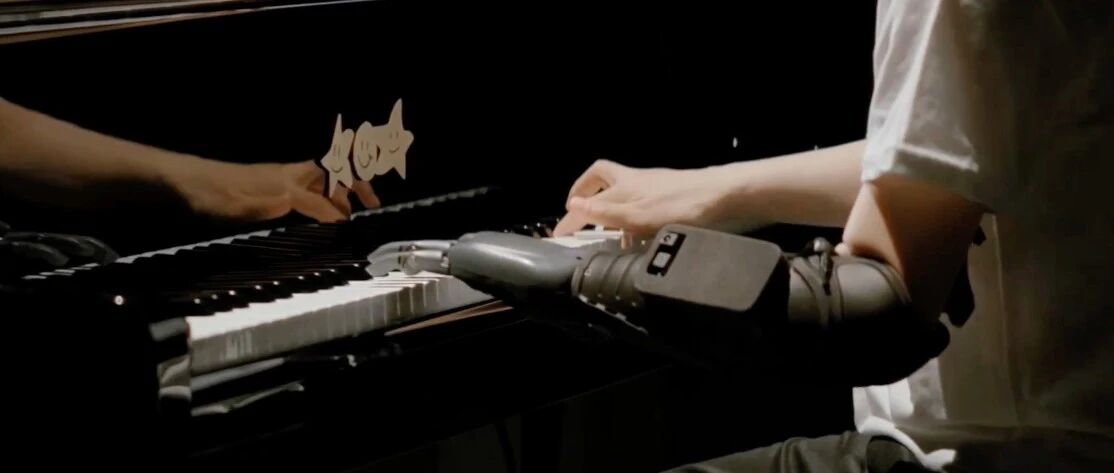
美股异动 | 脑再生科技(RGC.US)盘前续涨近20% 三个交易日累涨157%
智通财经网· 2026-01-08 14:14
Core Insights - Brain-computer interface (BCI) technology is rapidly moving towards commercialization and industrialization due to technological breakthroughs, policy support, and global industry resonance [1] Company Developments - Neuralink, a brain-machine interface company founded by Elon Musk, plans to begin large-scale production of its brain interface devices in 2026 [1] - The company is focusing on streamlining and automating surgical procedures, with a significant breakthrough allowing electrode wires to penetrate the dura mater without needing to remove it [1] Industry Trends - The Chinese Ministry of Industry and Information Technology, along with eight other departments, issued a directive on January 7 to accelerate the industrialization and commercialization of new terminals like brain-computer interfaces [1] - The convergence of technological advancements and supportive policies is propelling the BCI sector from a cutting-edge scientific concept to a critical leap towards commercial viability [1]
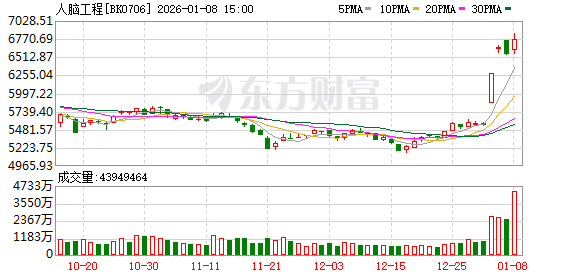
20亿元融资 脑机接口赛道沸腾!强脑科技最新回应
Shang Hai Zheng Quan Bao· 2026-01-08 13:57
Core Viewpoint - The brain-computer interface (BCI) sector is experiencing a resurgence, with significant stock performance and high trading volumes, indicating strong market interest and investment potential [2][3]. Group 1: Market Performance - On January 8, the Wind BCI concept index rose by 3.97%, with a total trading volume of 39.717 billion yuan, reflecting high market activity [3]. - From January 5 to 8, the index recorded a cumulative increase of 18.28%, with total trading volume reaching 142.477 billion yuan, showcasing heightened investor engagement [3]. Group 2: Company Developments - Qiang Brain Technology, one of the "Six Little Dragons of Hangzhou," confirmed the completion of approximately 2 billion yuan in financing, aimed at accelerating core technology research and product scaling [4][5]. - The company aims to assist 1 million physically disabled individuals with neural-controlled prosthetics and improve the lives of 10 million patients suffering from brain-related disorders over the next five to ten years [4]. Group 3: Investment Landscape - The recent financing round was led by prominent institutions such as IDG and Huaden International, along with strategic investors from the industry, indicating growing confidence in the BCI technology's transition from laboratory to large-scale application [5].
20亿元融资,脑机接口赛道沸腾!强脑科技,最新回应
Shang Hai Zheng Quan Bao· 2026-01-08 13:53
Group 1 - The brain-computer interface (BCI) sector has seen a resurgence, with multiple related stocks experiencing strong performance and high trading volumes, as evidenced by a 3.97% increase in the Wind BCI concept index on January 8, 2023, and an 18.28% cumulative increase from January 5 to 8 [1][2] - Strong Brain Technology, one of the "Six Little Dragons" of Hangzhou, confirmed a financing round of approximately 2 billion yuan, which will be used to accelerate core technology research and product scaling in the BCI field [1][3] - The BCI sector is expected to undergo significant advancements, with industry experts predicting that 2026 could be a pivotal year for the commercialization of BCI technology, driven by technological progress, capital influx, and market expectations [2] Group 2 - Several stocks in the BCI sector have achieved consecutive gains, with Nanjing Panda and Innovation Medical both reaching four consecutive trading days of increases, and Innovation Medical's closing price hitting a historical high of 31.49 yuan [2] - The BCI concept has transitioned from a science fiction idea to a tangible reality, with the market showing increased enthusiasm and investment activity, as indicated by a total trading volume of 1,424.77 billion yuan over the four days from January 5 to 8 [2] - Strong Brain Technology aims to assist 1 million physically disabled individuals with neural-controlled prosthetics and improve the conditions of 10 million patients suffering from brain-related disorders through BCI technology within the next five to ten years [3]
跨界脑机接口遭监管警示 亚辉龙信披问题业绩暗藏持续隐忧
Di Yi Cai Jing· 2026-01-08 13:52
Core Viewpoint - The in vitro diagnostic company, YHLO (688575.SH), has announced its entry into the brain-computer interface (BCI) sector, but faced immediate regulatory scrutiny due to inconsistent disclosures regarding its partnership with Shenzhen Brain Machine Starlink Technology Co., Ltd. [1][2] Group 1: Regulatory Scrutiny - The Shanghai Stock Exchange issued an inquiry and warning to YHLO for inaccurate and incomplete information disclosure regarding its collaboration with Brain Machine Starlink, particularly concerning the technical pathways and risks associated with the partnership [2][3] - YHLO's initial announcement described Brain Machine Starlink as a company utilizing both non-invasive and invasive technologies, but later retracted this statement under regulatory pressure, clarifying that the partner only focuses on non-invasive technology [2][3] Group 2: Company Performance - YHLO's financial performance has been under pressure, with a net profit decline of 72.36% year-on-year for the first three quarters of 2025, continuing a downward trend that began in 2023 [1][5] - The company reported a revenue of 1.287 billion yuan, a decrease of 7.69% year-on-year, and has experienced a continuous decline in revenue and net profit over the past three years [5][6] Group 3: Strategic Move into BCI - The partnership with Brain Machine Starlink appears to be a strategic attempt to revitalize market confidence amid declining performance, with the BCI sector being a trending technology area [4][6] - YHLO plans to invest no more than 15 million yuan in Brain Machine Starlink, with total estimated project costs around 30 million yuan, indicating a low financial commitment relative to its cash reserves [5][6] - The company has stated that the collaboration will not yield significant performance improvements in the short term, with potential revenue generation not expected before November 2026 [6]

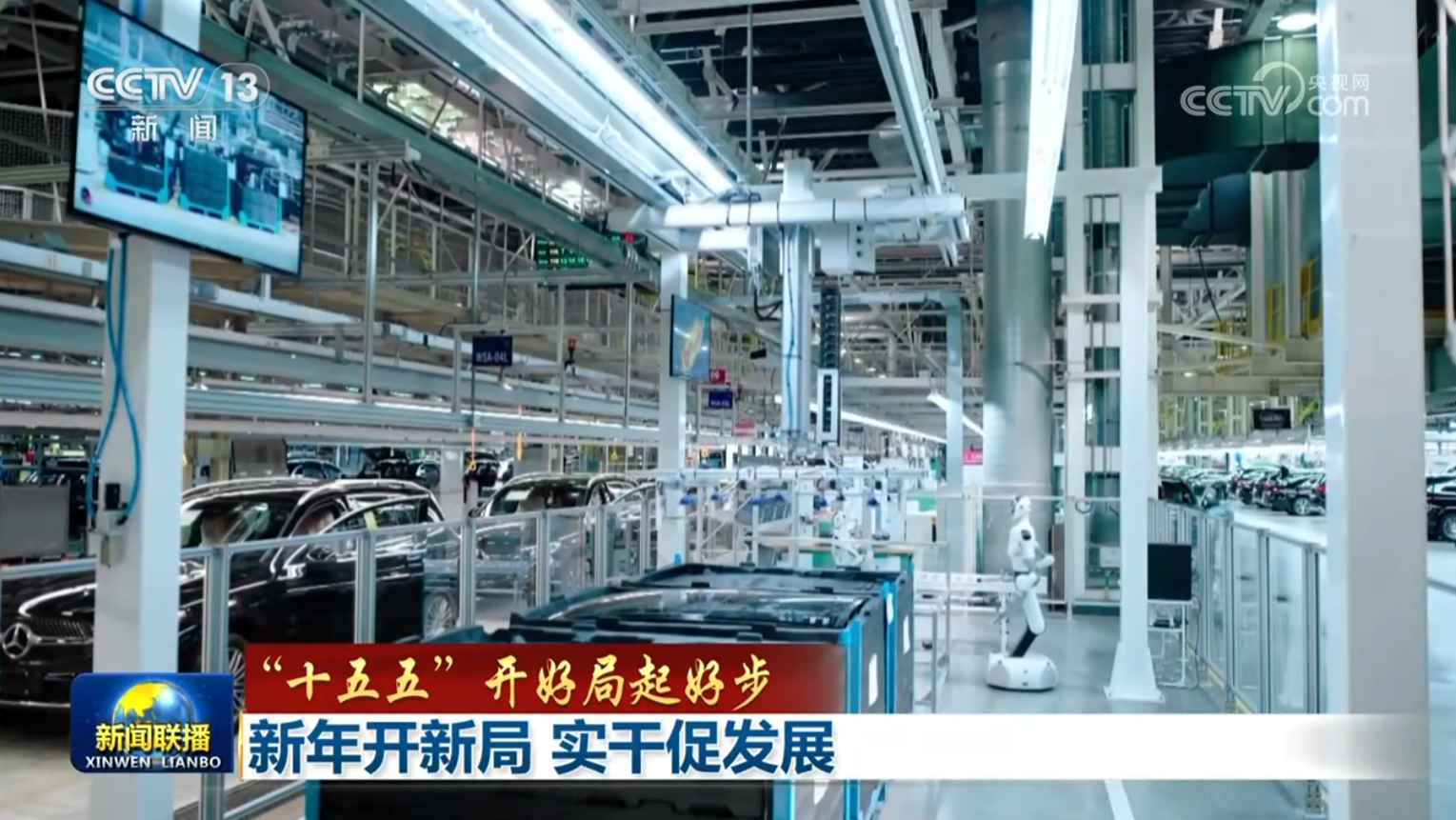
【“十五五”开好局起好步】新年开新局 实干促发展
Yang Shi Wang· 2026-01-08 12:38
Group 1 - The core viewpoint of the articles emphasizes the implementation of practical measures across various regions to achieve a strong start for the "14th Five-Year Plan" and promote high-quality economic development [1] Group 2 - Beijing has launched a significant initiative for the new year with the release of an action plan for building an artificial intelligence innovation hub, which includes nine aspects such as technological innovation and full-domain application empowerment, aiming to establish a 100,000-card-level domestic intelligent computing cluster within two years and achieve a core AI industry scale exceeding 1 trillion yuan [3] Group 3 - Jiangsu is focusing on creating a globally influential industrial technology innovation center, concentrating on key areas like biomanufacturing and future energy, with plans for 40 provincial-level major technological breakthroughs and 80 frontier technology research projects in quantum technology and brain-computer interfaces [5] Group 4 - Liaoning aims to enhance its business environment by proposing 123 specific measures to create a favorable business ecosystem, while Shanghai has released its action plan for the ninth consecutive year to accelerate the development of a world-class business environment, focusing on government services, market competition, industrial ecology, and social governance with 26 practical measures [7] Group 5 - Anhui is prioritizing high-quality development in the new energy vehicle industry through technological innovation, ecological improvement, and consumption stimulation, while Fujian is accelerating the creation of several 100 billion yuan-level marine industry clusters, and Yunnan is focusing on major projects to improve investment efficiency through nine key initiatives [9]
独家 | 强脑科技:已完成20亿元融资 将在五年到十年内帮助百万残障者重返社会
Shang Hai Zheng Quan Bao· 2026-01-08 11:50
Core Viewpoint - Qiangnao Technology, one of the "Six Little Dragons" in Hangzhou, has completed approximately 2 billion yuan in financing, marking the second-largest funding record in the brain-computer interface (BCI) sector globally, after Elon Musk's Neuralink [1] Company Summary - The funds raised will be used to accelerate core technology research and development, extreme engineering breakthroughs, and the scaling and mass production of brain-computer interface products [1] - The company aims to assist 1 million physically disabled individuals in regaining daily life through neural-controlled prosthetics within the next five to ten years [1] - Additionally, the company seeks to improve the conditions of 10 million patients suffering from brain disorders such as autism, ADHD, Alzheimer's, and insomnia [1] Industry Summary - The financing round was led by well-known institutions IDG and Huaden International, with strategic investors from the industry chain such as Lens Technology and Weir Shares joining in [1] - This significant investment comes at a time when the global brain-computer interface sector is gaining momentum, indicating a growing confidence in the transition of this technology from laboratory settings to large-scale applications [1]
今晚9点30,美国重要数据公布;3nm制程供不应求,台积电股价上涨;特朗普:禁止囤房;商务部回应审查Meta收购Manus【美股盘前】
Mei Ri Jing Ji Xin Wen· 2026-01-08 11:23
Group 1 - Major U.S. stock index futures are experiencing declines, with Dow futures down 0.23%, S&P 500 futures down 0.15%, and Nasdaq futures down 0.23% [1] - Brain-computer interface company Neuralink saw a pre-market surge of 27%, following a 157% increase over the past three days, driven by Elon Musk's announcement regarding mass production [1] - Defense and aerospace stocks are rising in pre-market trading, with Lockheed Martin up over 7% and Northrop Grumman also increasing by over 7%, following Trump's call for a significant increase in the U.S. defense budget to $1.5 trillion by 2027 [1] Group 2 - JPMorgan will replace Goldman Sachs as the new issuer of Apple credit cards, with the transition expected to take 24 months [1] - The Chinese Ministry of Commerce is reviewing Meta's acquisition of AI platform Manus, emphasizing compliance with Chinese laws and regulations for cross-border mergers and investments [2] - S&P Global forecasts a 50% increase in global copper demand by 2040, driven by growth in AI and defense sectors, with a potential annual supply gap exceeding 10 million tons if recycling and mining efforts are not intensified [2] Group 3 - Revolution Medicines, a cancer drug developer, saw a pre-market decline of over 9% after AbbVie announced it was not in talks to acquire the company [3] - TSMC's 3nm process technology remains in high demand, with a 1.4% increase in stock price, as the company maintains high capacity utilization and has temporarily halted new projects due to overwhelming orders [3]

涨停复盘:今日全市场共112只股涨停,连板股总数26只,商业航天概念股再掀涨停潮!神剑股份14天10板!
Jin Rong Jie· 2026-01-08 10:58
从板块来看,商业航天概念集体爆发,二十余只成分股涨停,鲁信创投10天8板,金风科技3连板。脑机接口概念延续强势,创新医疗、普利特、南京熊猫4 连板。可控核聚变概念表现活跃,中国一重、国机重装、中国核建2连板。AI应用概念走高,久其软件、宝信软件涨停。下跌方面,大金融、稀土永磁、有 色金属等板块跌幅居前。其中证券方向集体下挫,华林证券跌停。截至收盘,沪指跌0.07%,深成指跌0.51%,创业板指跌0.82%。 1月8日电,沪指窄幅震荡,创业板指盘中跌超1%。截止收盘,沪指跌0.07%,收报4082.98点;深证成指跌0.51%,收报13959.48点;创业板指跌0.82%,收 报3302.31点。沪深两市成交额2.8万亿,较上一个交易日缩量538亿,成交额连续4个交易日超2.5万亿。盘面上,市场热点快速轮动,全市场超3700只个股上 涨,其中112只个股涨停。 三、涨跌家数 今日全市场(不含ST股、退市股)共92股涨停,连板股总数26只,29股封板未遂,封板率为76%。焦点股方面,锋龙股份继续一字涨停晋级10连板。商业航 天概念神剑股份14天10板、鲁信创投10天8板、金风科技9天5板。 一、板块异动 四、涨停 ...



